

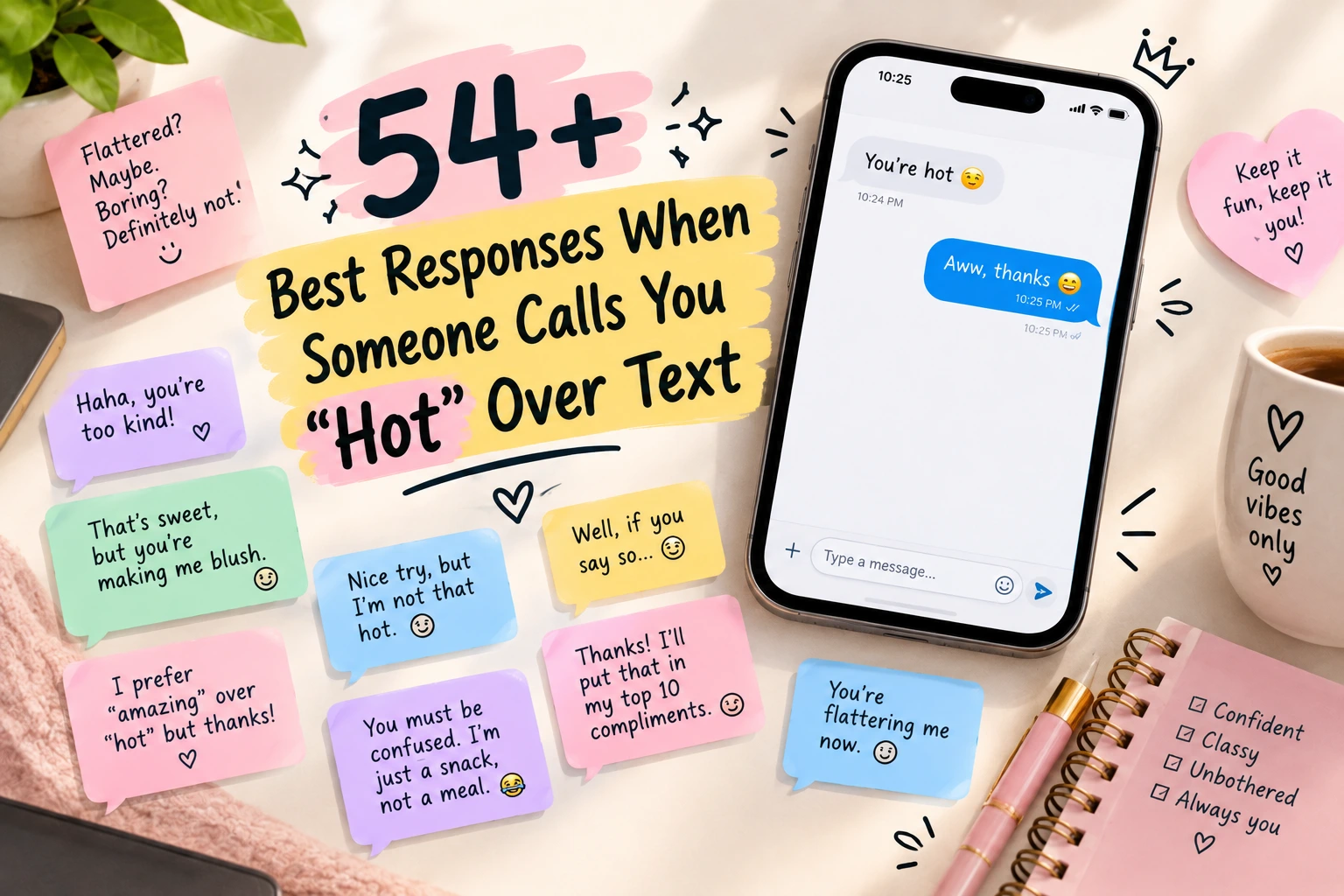
Getting a “you’re hot” text can leave you wondering what to say next. Maybe you appreciate the compliment and want to respond confidently. Maybe you want to keep things light and funny. Or perhaps the message caught you off guard and you would rather set a clear boundary.
There is no single perfect response. Your reply should depend on how comfortable you feel, who sent the message, and what kind of conversation you want to have. A simple “thank you” can work just as well as a witty response, while a direct boundary is appropriate when the compliment feels uncomfortable.
Finding different ways to respond can make texting feel more natural and personal. Instead of automatically replying with “thanks,” you can choose words that reflect your personality while still keeping the conversation respectful.
Section 1: What Does “You’re Hot” Mean?
When someone calls you “hot” over text, they are usually giving you a compliment about your appearance or saying that they find you attractive.
The emotional tone can vary considerably. It may be a casual compliment from a friend, a playful message from someone you know, or an unexpected comment from someone you are not interested in.
Because the phrase can feel personal, your response should reflect your own comfort level.
You do not have to return the compliment, flirt back, or continue the conversation if you do not want to.
A simple “Thanks” is enough. If you feel uncomfortable, you can also say, “I’d rather keep the conversation respectful.”
Section 2: When to Use These Responses
Different responses work for different situations.
When You Appreciate the Compliment
You can keep things simple:
“Thank you, that’s kind of you to say.”
When You Want to Sound Confident
Try:
“I’ll take that as a compliment.”
When You Want to Be Funny
You might say:
“Well, that was unexpected.”
When You Feel Awkward
A neutral response can help:
“Thanks. I wasn’t expecting that.”
When You Are Not Comfortable
Be direct:
“I’d prefer if we kept things respectful.”
The most important rule is that you never need to respond in a way that makes you uncomfortable just because someone complimented you.
Section 3: Is Calling Someone “Hot” Polite or Professional?
Calling someone “hot” is generally casual and personal, not professional.
It may be acceptable between people who are comfortable with casual compliments, but it does not belong in most workplace emails, academic communication, formal messages, or professional settings.
For example, a colleague saying:
“You look great today.”
is generally more appropriate in a professional environment than:
“You’re hot.”
If someone sends you an appearance-based compliment that you do not welcome, you are allowed to establish a boundary.
You can say:
“I’d rather keep our conversations respectful and professional.”
A confident boundary does not require a long explanation.
Polite and Appreciative Responses
1. “Thank you.”
Meaning: You acknowledge the compliment simply.
Tone: Polite, neutral
“Thank you, that’s kind of you to say.”
Short Explanation: This is the safest all-purpose response when you appreciate the compliment but do not want to make the conversation complicated.
2. “That’s kind of you.”
Meaning: You appreciate the person’s words.
Tone: Warm, polite
“That’s kind of you to say. Thank you.”
Short Explanation: A gracious response that does not imply that you feel the same way.
3. “I appreciate that.”
Meaning: You value the compliment.
Tone: Mature, confident
“I appreciate that. Thanks for saying it.”
Short Explanation: Good when you want to sound calm and self-assured.
4. “That’s a nice compliment.”
Meaning: You recognize their comment positively.
Tone: Friendly, neutral
“That’s a nice compliment. Thank you.”
Short Explanation: It acknowledges what they said without encouraging the conversation to become more personal.
5. “I wasn’t expecting that.”
Meaning: Their message surprised you.
Tone: Honest, casual
“I wasn’t expecting that message, but thank you.”
Short Explanation: Useful when the compliment catches you completely off guard.
6. “That made me smile.”
Meaning: Their kind words improved your mood.
Tone: Warm, appreciative
“That actually made me smile. Thanks.”
Short Explanation: A positive response when you genuinely enjoyed receiving the compliment.
7. “That’s sweet of you.”
Meaning: You appreciate their kindness.
Tone: Friendly
“That’s sweet of you to say.”
Short Explanation: A gentle response that keeps the interaction pleasant.
8. “Thanks for the compliment.”
Meaning: You directly acknowledge what they said.
Tone: Polite, straightforward
“Thanks for the compliment. I appreciate it.”
Short Explanation: Works well when you want to acknowledge the message without adding anything flirtatious.
9. “I’ll take that as a compliment.”
Meaning: You are accepting their words positively.
Tone: Confident, light
“I’ll take that as a compliment.”
Short Explanation: A confident response that keeps the conversation relaxed.
10. “That’s nice to hear.”
Meaning: You appreciate their positive opinion.
Tone: Calm, friendly
“That’s nice to hear. Thank you.”
Short Explanation: Particularly useful when you want to keep the conversation simple.
Funny and Playful Responses
11. “Well, that was unexpected.”
Meaning: You are surprised by the compliment.
Tone: Funny, casual
“Well, that was unexpected.”
Short Explanation: A light response when you want to acknowledge the message without taking it too seriously.
12. “Straight to the point, huh?”
Meaning: You are joking about how direct they were.
Tone: Playful
“Straight to the point, huh?”
Short Explanation: Good when someone gives you a very direct compliment.
13. “Someone woke up confident today.”
Meaning: You are teasing the person for being bold.
Tone: Humorous
“Someone woke up confident today.”
Short Explanation: Works best with someone you already know well.
14. “That’s certainly one way to start a conversation.”
Meaning: Their opening message was unusually direct.
Tone: Witty, playful
“That’s certainly one way to start a conversation.”
Short Explanation: A clever response when the compliment arrives unexpectedly.
15. “Well, hello to you too.”
Meaning: You humorously acknowledge their bold opening.
Tone: Casual, witty
“Well, hello to you too.”
Short Explanation: Keeps things light without needing a complicated response.
16. “You really just said that?”
Meaning: You are playfully surprised by their honesty.
Tone: Teasing
“You really just said that?”
Short Explanation: Useful when the message catches you by surprise.
17. “That’s quite an introduction.”
Meaning: Their first message was memorable.
Tone: Witty, casual
“That’s quite an introduction.”
Short Explanation: Great when someone opens a conversation with a bold compliment.
18. “Well, this conversation took an interesting turn.”
Meaning: The conversation suddenly became more personal.
Tone: Humorous
“Well, this conversation took an interesting turn.”
Short Explanation: A playful way to acknowledge the shift in tone.
19. “I’m going to pretend I didn’t blush at that.”
Meaning: You are jokingly acknowledging that the compliment affected you.
Tone: Playful, light
“I’m going to pretend I didn’t blush at that.”
Short Explanation: Best used when you are genuinely comfortable with the compliment.
20. “That was bold.”
Meaning: You recognize that the person was being direct.
Tone: Playful, confident
“That was bold. I’ll give you that.”
Short Explanation: A concise response that acknowledges their confidence.
Confident and Self-Respecting Responses
21. “Thank you. I know my worth.”
Meaning: You appreciate the compliment while showing self-confidence.
Tone: Confident
“Thank you. I know my worth, and I appreciate the compliment.”
Short Explanation: This focuses on self-respect rather than seeking validation.
22. “I appreciate the compliment, but let’s keep it respectful.”
Meaning: You accept the compliment while setting a boundary.
Tone: Assertive, mature
“I appreciate the compliment, but let’s keep the conversation respectful.”
Short Explanation: Useful when the compliment feels a little too personal.
23. “Thanks. Let’s keep the conversation appropriate.”
Meaning: You are clearly establishing a limit.
Tone: Direct, respectful
“Thanks, but let’s keep the conversation appropriate.”
Short Explanation: A strong choice when you want to make your expectations clear.
24. “I’m more interested in getting to know each other.”
Meaning: You want the conversation to focus on personality rather than appearance.
Tone: Mature, thoughtful
“I appreciate that, but I’m more interested in getting to know each other.”
Short Explanation: Helpful when you want to redirect the conversation.
25. “Thanks, but compliments aren’t necessary.”
Meaning: You do not need appearance-based validation.
Tone: Calm, confident
“Thanks, but compliments aren’t necessary.”
Short Explanation: Appropriate when you want to remain polite while reducing that kind of conversation.
26. “I’d rather be appreciated for who I am.”
Meaning: You value personality and character.
Tone: Thoughtful, self-respecting
“I’d rather be appreciated for who I am than just how I look.”
Short Explanation: A meaningful response when you want to shift the conversation toward character.
27. “Thanks. Personality matters more to me.”
Meaning: You prefer deeper qualities over appearance.
Tone: Mature
“Thanks. Personality matters more to me.”
Short Explanation: A simple way to communicate your priorities.
28. “I appreciate that, but let’s not make assumptions.”
Meaning: You want to keep the interaction respectful and measured.
Tone: Assertive
“I appreciate the compliment, but let’s not make assumptions about each other.”
Short Explanation: Useful when someone becomes overly familiar too quickly.
29. “That’s flattering, but I prefer keeping things respectful.”
Meaning: You acknowledge the compliment while establishing a boundary.
Tone: Polite, firm
“That’s flattering, but I prefer keeping things respectful.”
Short Explanation: A balanced response when you want to remain courteous.
30. “Thanks. Let’s talk about something else.”
Meaning: You want to change the subject.
Tone: Direct, calm
“Thanks. Let’s talk about something else.”
Short Explanation: This is ideal when you do not want appearance-based comments to become the focus.
Curious and Thoughtful Responses
31. “What made you say that?”
Meaning: You want to understand their comment.
Tone: Curious, neutral
“What made you say that?”
Short Explanation: Useful when you genuinely want to understand the context behind the compliment.
32. “Was that your way of saying hello?”
Meaning: You are questioning their unusual opening.
Tone: Playful, curious
“Was that your way of saying hello?”
Short Explanation: Works well when the comment arrives at the beginning of a conversation.
33. “What are you trying to say?”
Meaning: You want clarification.
Tone: Curious, direct
“Okay, what are you trying to say?”
Short Explanation: Good when their message seems to have a deeper intention.
34. “That’s an interesting choice of words.”
Meaning: You noticed their particular wording.
Tone: Thoughtful, slightly formal
“That’s an interesting choice of words.”
Short Explanation: Useful when you want to acknowledge the comment without immediately encouraging it.
35. “What do you mean by that?”
Meaning: You want them to clarify their message.
Tone: Neutral, direct
“What do you mean by that?”
Short Explanation: A practical response when you are unsure how seriously to take the compliment.
36. “That’s quite a statement.”
Meaning: Their compliment was noticeable or bold.
Tone: Calm, thoughtful
“That’s quite a statement.”
Short Explanation: A subtle response that leaves room for the other person to explain themselves.
37. “I’m curious what prompted that.”
Meaning: You want to know what led them to say it.
Tone: Thoughtful, mature
“I’m curious what prompted that comment.”
Short Explanation: Works well when you want clarification without sounding confrontational.
38. “You seem very confident about that.”
Meaning: You are commenting on their certainty.
Tone: Playful, observant
“You seem very confident about that.”
Short Explanation: A light way to acknowledge a bold compliment.
Warm and Friendly Responses
39. “That’s really nice of you.”
Meaning: You appreciate their kindness.
Tone: Warm, friendly
“That’s really nice of you to say.”
Short Explanation: A comfortable choice when you want to remain friendly.
40. “You’re making me smile.”
Meaning: Their message made you happy.
Tone: Warm
“You’re making me smile with that compliment.”
Short Explanation: Use this when you genuinely appreciate their positive words.
41. “I appreciate the kind words.”
Meaning: You are grateful for their compliment.
Tone: Mature, polite
“I appreciate the kind words. Thank you.”
Short Explanation: This works especially well when you want to stay gracious and composed.
42. “That’s nice to hear from you.”
Meaning: You value the person’s positive comment.
Tone: Friendly
“That’s nice to hear from you. Thanks.”
Short Explanation: A warm response without making the conversation overly personal.
43. “You’re very kind.”
Meaning: You recognize their kindness.
Tone: Polite, appreciative
“You’re very kind. Thank you.”
Short Explanation: A classic response that works in many situations.
44. “I’ll accept the compliment.”
Meaning: You are confidently acknowledging what they said.
Tone: Confident, light
“I’ll accept the compliment. Thank you.”
Short Explanation: A slightly more playful version of simply saying “thanks.”
When You Do Not Welcome the Comment
45. “I’d rather you not comment on my appearance like that.”
Meaning: You are clearly asking them to stop.
Tone: Firm, respectful
“I’d rather you not comment on my appearance like that.”
Short Explanation: Use this when the message crosses a personal boundary.
46. “I’m not comfortable with comments like that.”
Meaning: You are expressing discomfort.
Tone: Direct, calm
“I’m not comfortable with comments like that, so please keep that in mind.”
Short Explanation: Clear communication is appropriate when someone’s message makes you uncomfortable.
47. “Please keep things respectful.”
Meaning: You are setting a straightforward boundary.
Tone: Firm, mature
“Please keep things respectful. I’d appreciate that.”
Short Explanation: Short, clear, and effective when you do not want to debate the issue.
48. “I’d prefer we keep this conversation appropriate.”
Meaning: You want to change the tone.
Tone: Professional, assertive
“I’d prefer we keep this conversation appropriate.”
Short Explanation: Particularly useful when you need a clear but composed response.
49. “That kind of comment makes me uncomfortable.”
Meaning: You are directly communicating how the comment affects you.
Tone: Honest, firm
“That kind of comment makes me uncomfortable, so please don’t continue.”
Short Explanation: It clearly communicates a boundary without unnecessary hostility.
50. “Let’s keep the conversation respectful.”
Meaning: You want the interaction to remain appropriate.
Tone: Mature, direct
“Let’s keep the conversation respectful.”
Short Explanation: A concise response when you want to redirect the interaction.
Short and Neutral Responses
51. “Thanks.”
Meaning: You acknowledge the compliment without adding anything else.
Tone: Neutral
“Thanks.”
Short Explanation: Sometimes the simplest response is the best one.
52. “Noted.”
Meaning: You have acknowledged what they said.
Tone: Dry, confident
“Noted.”
Short Explanation: Useful when you want to keep your response extremely brief.
53. “I hear you.”
Meaning: You acknowledge their statement.
Tone: Calm, neutral
“I hear you. Thanks for saying that.”
Short Explanation: This can work when you want to acknowledge the message without reciprocating.
54. “Well, thank you.”
Meaning: You accept the compliment politely.
Tone: Friendly, composed
“Well, thank you. That’s kind of you.”
Short Explanation: A slightly warmer version of “thanks.”
55. “I appreciate the honesty.”
Meaning: You acknowledge their directness.
Tone: Confident, thoughtful
“I appreciate the honesty.”
Short Explanation: Good when someone has been unusually straightforward and you want to acknowledge that without making promises about how you feel.
56. “That’s certainly direct.”
Meaning: You recognize how straightforward their message was.
Tone: Calm, slightly humorous
“That’s certainly direct.”
Short Explanation: Useful when the compliment arrives unexpectedly and you want to keep your response measured.
Real-Life Situations: What Should You Say?
When You Appreciate the Compliment
You do not need an elaborate response.
Best reply: “Thank you, that’s kind of you to say.”
This is warm, polite, and does not create unnecessary pressure.
When a Friend Says It as a Joke
If the friendship is comfortable and the comment is clearly harmless, you can keep your response light.
Best reply: “Straight to the point, huh?”
It acknowledges the joke without making the conversation overly serious.
When Someone Says It Too Early
If you barely know the person, you do not have to match their level of familiarity.
Best reply: “That’s quite a statement.”
This acknowledges what they said while leaving the conversation open for a more appropriate direction.
When You Are Not Interested
You can be polite without giving the impression that you want the conversation to continue in that direction.
Best reply: “Thanks, but I’d rather keep the conversation respectful.”
A clear response is often better than sending mixed signals.
When the Comment Makes You Uncomfortable
Your comfort matters more than finding a clever comeback.
Best reply: “I’m not comfortable with comments like that. Please keep things respectful.”
You do not need to justify your boundary further.
What to Avoid When Responding
1. Do Not Feel Obligated to Flirt Back
A compliment does not create an obligation to return it.
You can simply say “thank you” or change the subject.
2. Avoid Saying More Than You Mean
If you appreciate a compliment but do not want to encourage anything further, keep your response neutral.
3. Do Not Ignore Your Boundaries
If a message makes you uncomfortable, you are allowed to say so clearly.
4. Avoid Overthinking a Simple Compliment
Sometimes “thanks” is genuinely enough.
You do not need to create a clever response every time.
5. Do Not Let Pressure Decide Your Reply
You can take your time before responding. You are not required to answer immediately.
6. Do Not Confuse Confidence With Being Rude
You can set a boundary without insulting the other person.
A calm response is often more effective than a harsh one.
Pro Tips for Responding Confidently
1. Match the Situation, Not Just the Words
Think about who sent the message and what the conversation has been like.
A close friend’s joke and an unexpected message from a stranger require very different responses.
2. Keep Your Reply Proportional
If someone sends a two-word compliment, you do not need to write a paragraph.
A short response can communicate confidence just as effectively.
3. Remember That “No” Is a Complete Answer
If a conversation becomes uncomfortable, you do not have to keep explaining yourself.
A clear boundary is enough.
Conclusion
Knowing the best responses when someone calls you “hot” over text is less about finding the cleverest comeback and more about choosing a response that feels right for you.
You can accept the compliment with a simple “thank you,” keep things light with humor, ask what they mean, or set a clear boundary when necessary.
The most confident response is one that reflects your comfort level rather than someone else’s expectations.
You do not have to perform a perfect response. Just communicate honestly, respectfully, and on your own terms.
Discover more
other ways to say let me know if otherwise