
“Are you sure?” is one of those tiny questions that can instantly change the mood of a conversation. Sometimes it is genuine concern. Sometimes it is skepticism. And sometimes, it is practically an invitation to respond with something clever.
Whether a friend doubts your decision, a classmate questions your answer, or someone playfully challenges what you just said, a funny response can keep the conversation light. The trick is choosing a reply that matches the situation instead of forcing a joke where one does not belong.
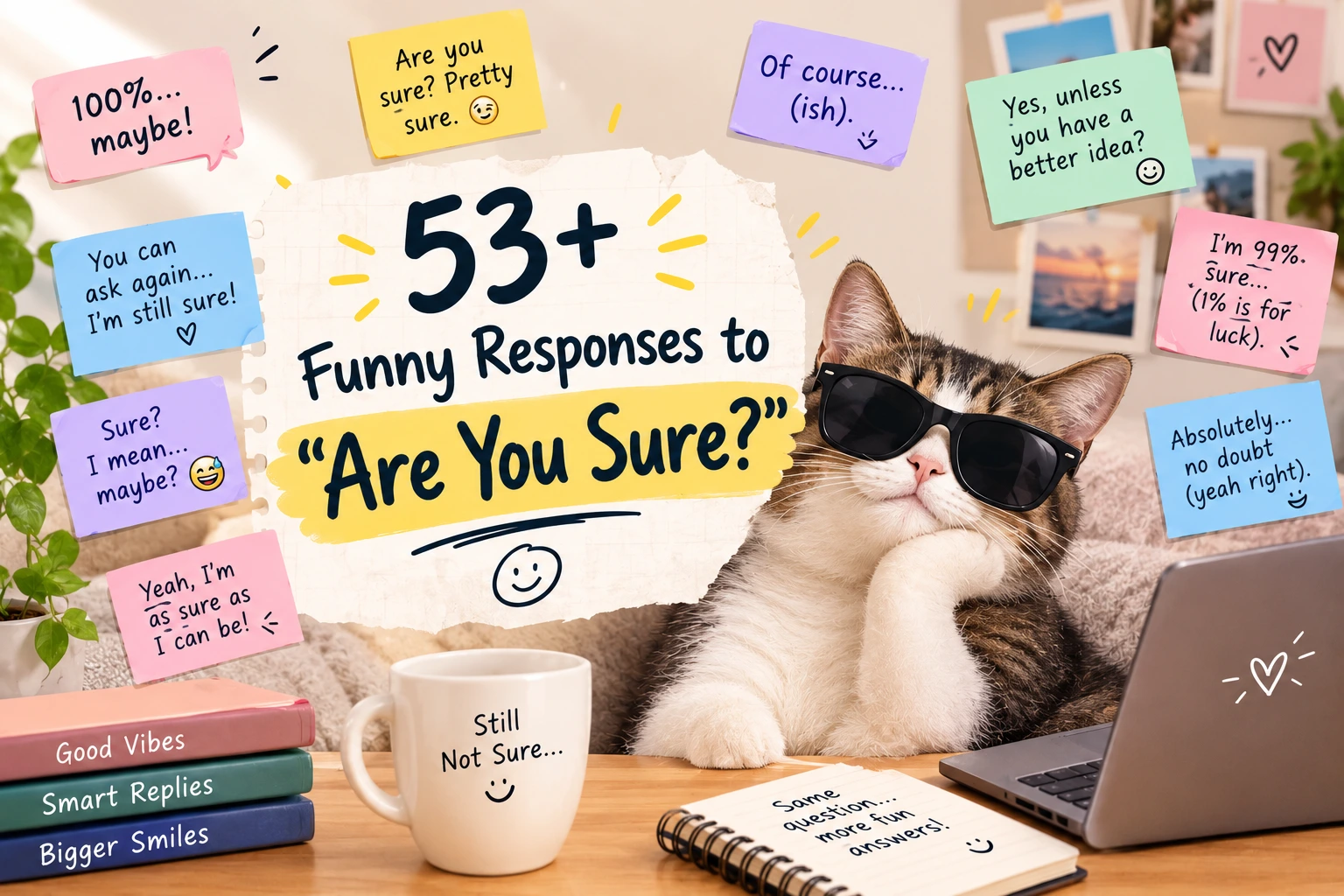
This guide brings together 53+ funny responses to “Are you sure?”, ranging from witty one-liners and playful comebacks to sarcastic responses and clever replies. Each one includes a realistic example so you can see how it actually works in conversation.
What Does “Are You Sure?” Mean?
“Are you sure?” is usually a request for confirmation. Someone may be checking whether you are confident about what you said, decided, or plan to do.
For example, if you say, “I’m going to order the spiciest thing on the menu,” your friend might respond, “Are you sure?”
The phrase can sound concerned, doubtful, curious, teasing, or skeptical depending on the situation and tone.
A funny response works best when the conversation is casual and the other person is clearly not asking about something serious. In those moments, humor can turn a simple question into a memorable exchange.
When to Use Funny Responses to “Are You Sure?”
Funny replies are best for casual conversations with friends, classmates, siblings, or people who understand your sense of humor.
You might use them when:
- A friend questions your unusual choice.
- Someone doubts your confidence.
- A classmate asks whether you are certain about an answer.
- Someone playfully challenges your decision.
- You want to make a normal conversation more entertaining.
- A friend keeps asking for confirmation.
For example:
Friend: “Are you sure you want to watch that movie again?”
You: “Absolutely. My questionable decisions are very consistent.”
However, avoid overly sarcastic replies when someone is genuinely worried or when the topic is serious.
Is “Are You Sure?” Polite or Professional?
Yes, “Are you sure?” can be perfectly polite, but its tone depends heavily on context.
In professional situations, it can sometimes sound doubtful or challenging. A softer version such as “Would you like to double-check?” or “Would you like to confirm that?” may sound more appropriate.
Funny responses are generally better suited to informal conversations. In a workplace email, for example, a sarcastic comeback could easily be misunderstood.
The safest rule is simple: match your humor to the relationship and situation.
Witty and Playful Responses
1. “As sure as I can possibly be.”
Meaning: You are confidently confirming your decision.
Tone: Witty and confident.
Example Sentence:
“Are you sure you want to go?” “As sure as I can possibly be.”
Why to use it: It is funny without being rude and works in many casual conversations.
2. “Pretty sure. I only questioned it twelve times.”
Meaning: You jokingly admit that you have already overthought the decision.
Tone: Self-deprecating and playful.
Example Sentence:
“Are you sure this is the right choice?” “Pretty sure. I only questioned it twelve times.”
Why to use it: Great when you want to joke about overthinking.
3. “Absolutely. Next question.”
Meaning: You are completely confident.
Tone: Confident and humorous.
Example Sentence:
“Are you sure you want pizza?” “Absolutely. Next question.”
Why to use it: Short, bold, and easy to use in texting.
4. “I’m sure enough to proceed.”
Meaning: You have enough confidence to continue.
Tone: Dry and clever.
Example Sentence:
“Are you sure this will work?” “I’m sure enough to proceed.”
Why to use it: Perfect for someone who enjoys understated humor.
5. “Sure? No. Certain? Also no. But we’re going.”
Meaning: You are jokingly admitting uncertainty while staying committed.
Tone: Funny and adventurous.
Example Sentence:
“Are you sure we should do this?” “Sure? No. Certain? Also no. But we’re going.”
Why to use it: Great for harmless spontaneous plans.
6. “My confidence says yes.”
Meaning: You are playfully trusting your confidence.
Tone: Light and witty.
Example Sentence:
“Are you sure about that?” “My confidence says yes.”
Why to use it: Simple enough for everyday texting.
7. “I have never been more unnecessarily confident.”
Meaning: You are humorously exaggerating your confidence.
Tone: Self-aware and funny.
Example Sentence:
“Are you sure you can finish this today?” “I have never been more unnecessarily confident.”
Why to use it: Works especially well when the situation is slightly ridiculous.
8. “That sounds like a problem for future me.”
Meaning: You are choosing not to worry about possible consequences.
Tone: Playful and carefree.
Example Sentence:
“Are you sure you want to leave it until tomorrow?” “That sounds like a problem for future me.”
Why to use it: A classic humorous response to harmless procrastination.
9. “I’m confidently confused, if that helps.”
Meaning: You are admitting uncertainty in a humorous way.
Tone: Self-deprecating.
Example Sentence:
“Are you sure this is correct?” “I’m confidently confused, if that helps.”
Why to use it: Ideal when you are not actually certain but want to keep things light.
10. “I’ve decided to trust the process.”
Meaning: You are choosing to continue without worrying too much.
Tone: Playful and trendy.
Example Sentence:
“Are you sure this plan will work?” “I’ve decided to trust the process.”
Why to use it: Funny when the situation clearly does not require a dramatic amount of confidence.
11. “My answer has already left the building.”
Meaning: You are joking that your decision is final.
Tone: Quirky and playful.
Example Sentence:
“Are you sure you want that one?” “My answer has already left the building.”
Why to use it: Adds personality to a simple confirmation.
Sarcastic and Savage Responses
12. “No, I just enjoy making confident statements.”
Meaning: You sarcastically imply that you are obviously sure.
Tone: Sarcastic.
Example Sentence:
“Are you sure that’s what you want?” “No, I just enjoy making confident statements.”
Why to use it: Good for friends who appreciate dry humor.
13. “No, I’m guessing professionally.”
Meaning: You jokingly claim that you are only making an educated guess.
Tone: Sarcastic and witty.
Example Sentence:
“Are you sure about the answer?” “No, I’m guessing professionally.”
Why to use it: Especially funny in casual academic conversations.
14. “I was, until you asked.”
Meaning: Their question has made you suddenly doubt yourself.
Tone: Teasing.
Example Sentence:
“Are you sure this is the right way?” “I was, until you asked.”
Why to use it: One of the easiest responses when someone makes you second-guess yourself.
15. “Thanks for introducing doubt into the equation.”
Meaning: You jokingly blame them for making you uncertain.
Tone: Dry and sarcastic.
Example Sentence:
“Are you sure you sent the email?” “Thanks for introducing doubt into the equation.”
Why to use it: Great for playful conversations.
16. “You’re really committed to making me doubt myself, huh?”
Meaning: You are teasing someone for repeatedly questioning you.
Tone: Sarcastic and playful.
Example Sentence:
“Are you sure? Are you really sure?” “You’re really committed to making me doubt myself, huh?”
Why to use it: Perfect when someone keeps asking the same question.
17. “I was hoping nobody would ask that.”
Meaning: You jokingly suggest that you might not actually be certain.
Tone: Dry humor.
Example Sentence:
“Are you sure this is the correct answer?” “I was hoping nobody would ask that.”
Why to use it: Great when you want to admit uncertainty without making the conversation serious.
18. “No refunds on confidence.”
Meaning: Your confidence is already committed.
Tone: Clever and sarcastic.
Example Sentence:
“Are you sure you want to do that?” “No refunds on confidence.”
Why to use it: Works well as a short, punchy comeback.
19. “Questioning me will only make this more entertaining.”
Meaning: You are jokingly welcoming the challenge.
Tone: Playful and confident.
Example Sentence:
“Are you sure you can pull this off?” “Questioning me will only make this more entertaining.”
Why to use it: Good when you want to sound confident without becoming aggressive.
20. “That question feels suspiciously judgmental.”
Meaning: You are teasing someone for sounding doubtful.
Tone: Sarcastic.
Example Sentence:
“Are you sure you want to wear that?” “That question feels suspiciously judgmental.”
Why to use it: Useful when someone is clearly teasing you.
21. “I admire your dedication to doubting me.”
Meaning: You are joking about someone’s persistent skepticism.
Tone: Dry and sarcastic.
Example Sentence:
“Are you sure? Really sure?” “I admire your dedication to doubting me.”
Why to use it: Best for someone who keeps challenging your decisions.
22. “Believe me, I’m just as surprised.”
Meaning: You jokingly admit that even you are surprised by your decision.
Tone: Sarcastic and light.
Example Sentence:
“Are you sure you actually finished the project?” “Believe me, I’m just as surprised.”
Why to use it: Excellent for self-aware humor.
Short and Clever Responses
23. “One hundred percent.”
Meaning: You are completely certain.
Tone: Confident.
Example Sentence:
“Are you sure?” “One hundred percent.”
Why to use it: Simple, direct, and easy to send in a text.
24. “Would I lie to you?”
Meaning: You jokingly imply that the person should trust you.
Tone: Playful.
Example Sentence:
“Are you sure this is the right address?” “Would I lie to you?”
Why to use it: Works best with someone who already knows your humor.
25. “Sure enough.”
Meaning: A concise confirmation.
Tone: Casual and witty.
Example Sentence:
“Are you sure?” “Sure enough.”
Why to use it: Short without sounding overly serious.
26. “Cross my Wi-Fi.”
Meaning: A humorous variation of a promise.
Tone: Silly and playful.
Example Sentence:
“Are you sure you’ll remember?” “Cross my Wi-Fi.”
Why to use it: Great for casual texting and internet-style humor.
27. “Ask me tomorrow.”
Meaning: You are jokingly suggesting that your certainty might change.
Tone: Dry and playful.
Example Sentence:
“Are you sure you want to do it?” “Ask me tomorrow.”
Why to use it: Works well when you are deliberately being indecisive.
28. “As sure as Monday is coming.”
Meaning: You are jokingly describing something as inevitable.
Tone: Witty.
Example Sentence:
“Are you sure you’ll be there?” “As sure as Monday is coming.”
Why to use it: A creative alternative when you want something more memorable than “yes.”
29. “Suspiciously sure.”
Meaning: You are very confident, almost too confident.
Tone: Quirky.
Example Sentence:
“Are you sure this will work?” “Suspiciously sure.”
Why to use it: Perfect for a quick text.
30. “Sure-ish.”
Meaning: You are somewhat confident but not completely certain.
Tone: Casual and humorous.
Example Sentence:
“Are you sure this is correct?” “Sure-ish.”
Why to use it: Great when you actually have some doubts.
31. “Emotionally, yes.”
Meaning: You jokingly distinguish emotional confidence from actual certainty.
Tone: Clever and sarcastic.
Example Sentence:
“Are you sure this is a good idea?” “Emotionally, yes.”
Why to use it: Works especially well for ridiculous or spontaneous decisions.
32. “In this economy? Absolutely.”
Meaning: You humorously emphasize your confidence.
Tone: Trendy and playful.
Example Sentence:
“Are you sure you want to order dessert?” “In this economy? Absolutely.”
Why to use it: Best for casual conversations and social media-style humor.
Dramatic and Over-the-Top Responses
33. “I have consulted the ancient scrolls.”
Meaning: You jokingly claim that you have done extensive research.
Tone: Dramatic and silly.
Example Sentence:
“Are you sure this is the best option?” “I have consulted the ancient scrolls.”
Why to use it: Great when you want an exaggerated response.
34. “The council has spoken.”
Meaning: You jokingly present your decision as final.
Tone: Dramatic and playful.
Example Sentence:
“Are you sure we should go?” “The council has spoken.”
Why to use it: Works especially well among friends.
35. “I have never been more dramatically certain.”
Meaning: You are exaggerating your confidence.
Tone: Dramatic and humorous.
Example Sentence:
“Are you sure?” “I have never been more dramatically certain.”
Why to use it: Adds theatrical humor to an ordinary exchange.
36. “The universe gave me a thumbs-up.”
Meaning: You jokingly claim that everything supports your decision.
Tone: Whimsical.
Example Sentence:
“Are you sure this is what we should do?” “The universe gave me a thumbs-up.”
Why to use it: Perfect for silly, low-stakes situations.
37. “I consulted my highly qualified imaginary advisor.”
Meaning: You jokingly pretend to have expert guidance.
Tone: Absurd and playful.
Example Sentence:
“Are you sure about this?” “I consulted my highly qualified imaginary advisor.”
Why to use it: Good when you want a deliberately ridiculous answer.
38. “The committee of one has approved it.”
Meaning: You humorously reveal that you alone made the decision.
Tone: Dry and witty.
Example Sentence:
“Are you sure we should order this?” “The committee of one has approved it.”
Why to use it: A clever response when nobody else needs to approve your choice.
39. “I have made my peace with the consequences.”
Meaning: You jokingly accept whatever happens next.
Tone: Dramatic.
Example Sentence:
“Are you sure you want to eat that much dessert?” “I have made my peace with the consequences.”
Why to use it: Great for harmless decisions that feel unnecessarily dramatic.
40. “The stars have aligned.”
Meaning: You jokingly claim that everything is pointing toward your decision.
Tone: Dramatic and playful.
Example Sentence:
“Are you sure we should go tonight?” “The stars have aligned.”
Why to use it: Adds a little theatrical flair.
41. “I have received a sign.”
Meaning: You humorously suggest that something has confirmed your choice.
Tone: Playful and dramatic.
Example Sentence:
“Are you sure you want the chocolate cake?” “I have received a sign.”
Why to use it: Works well when the decision is completely harmless.
Self-Deprecating and Relatable Responses
42. “Sure, but my track record is not encouraging.”
Meaning: You are confident while joking about your past decisions.
Tone: Self-deprecating.
Example Sentence:
“Are you sure this plan will work?” “Sure, but my track record is not encouraging.”
Why to use it: Funny when you can laugh at your own mistakes.
43. “Absolutely. This is how I usually make questionable choices.”
Meaning: You jokingly admit that the decision might not be wise.
Tone: Self-aware.
Example Sentence:
“Are you sure you want to do that?” “Absolutely. This is how I usually make questionable choices.”
Why to use it: Great for friends who know you well.
44. “My confidence is doing all the work right now.”
Meaning: You may not have much evidence, but you sound confident anyway.
Tone: Funny and honest.
Example Sentence:
“Are you sure you can finish it?” “My confidence is doing all the work right now.”
Why to use it: Works well when you are taking a humorous risk.
45. “I’m sure enough to regret it later.”
Meaning: You are confident but jokingly expect future regret.
Tone: Dry and self-deprecating.
Example Sentence:
“Are you sure you want to buy that?” “I’m sure enough to regret it later.”
Why to use it: Perfect for harmless questionable purchases or decisions.
46. “I’ve made worse decisions with less confidence.”
Meaning: You are joking that your current decision is relatively reasonable.
Tone: Self-deprecating and witty.
Example Sentence:
“Are you sure this is a good idea?” “I’ve made worse decisions with less confidence.”
Why to use it: A strong choice when you want to laugh at your own history.
47. “My brain voted yes.”
Meaning: You jokingly say your mind has approved the decision.
Tone: Cute and playful.
Example Sentence:
“Are you sure you want to go?” “My brain voted yes.”
Why to use it: Short, friendly, and easy to use.
48. “I’m operating on confidence and very little evidence.”
Meaning: You admit that your confidence may exceed the available proof.
Tone: Clever and self-aware.
Example Sentence:
“Are you sure this is going to work?” “I’m operating on confidence and very little evidence.”
Why to use it: Particularly funny when everyone knows the situation is uncertain.
Extra Clever Responses
49. “If I say no, will you stop asking?”
Meaning: You are teasing someone for repeatedly questioning you.
Tone: Playful and sarcastic.
Example Sentence:
“Are you sure? Are you really sure?” “If I say no, will you stop asking?”
Why to use it: Best when someone keeps asking for confirmation.
50. “Let’s call it aggressively optimistic.”
Meaning: You are confident, but you recognize that the decision might be ambitious.
Tone: Witty and self-aware.
Example Sentence:
“Are you sure we can finish this tonight?” “Let’s call it aggressively optimistic.”
Why to use it: Perfect for ambitious plans.
51. “My answer has been peer-reviewed by absolutely nobody.”
Meaning: You jokingly admit that your conclusion has not been independently verified.
Tone: Clever and sarcastic.
Example Sentence:
“Are you sure this is correct?” “My answer has been peer-reviewed by absolutely nobody.”
Why to use it: Great for academic or intellectual humor.
52. “I’m choosing confidence over evidence today.”
Meaning: You are humorously admitting that confidence is carrying the decision.
Tone: Sarcastic and playful.
Example Sentence:
“Are you sure this plan will work?” “I’m choosing confidence over evidence today.”
Why to use it: Works when everyone knows the situation is uncertain but harmless.
53. “Absolutely. Ask me again and I’ll become less sure.”
Meaning: Repeated questioning may make you doubt yourself.
Tone: Funny and teasing.
Example Sentence:
“Are you sure you want to go?” “Absolutely. Ask me again and I’ll become less sure.”
Why to use it: One of the best responses when someone keeps asking.
54. “Sure enough to say yes, not enough to write a report about it.”
Meaning: You are confident enough for the situation but not excessively certain.
Tone: Dry and clever.
Example Sentence:
“Are you sure this is the right choice?” “Sure enough to say yes, not enough to write a report about it.”
Why to use it: Great for people who enjoy understated humor.
55. “I’m 73% sure, and I’m rounding up.”
Meaning: You humorously admit that you are not completely certain.
Tone: Playful and sarcastic.
Example Sentence:
“Are you sure this is going to work?” “I’m 73% sure, and I’m rounding up.”
Why to use it: Perfect when you want to be honest while keeping the mood light.
Real-Life Situations: The Best Funny Response
When a Friend Keeps Questioning You
If your friend asks “Are you sure?” three times in a row, try:
Best response:
“I was, until you asked.”
It is short, funny, and directly addresses their repeated doubt.
When Someone Doubts Your Decision
If you are confident about a harmless choice, use:
Best response:
“Absolutely. Next question.”
It communicates confidence without turning the conversation into an argument.
When You Are Actually Unsure
Do not pretend to be completely confident just to sound clever.
Best response:
“I’m 73% sure, and I’m rounding up.”
It lets you admit uncertainty while keeping things humorous.
When You Want a Dramatic Comeback
For a ridiculous or low-stakes situation, try:
Best response:
“The council has spoken.”
It gives an ordinary decision an unnecessarily dramatic twist.
When Someone Is Genuinely Concerned
If someone is asking because they care about your safety or wellbeing, skip the sarcasm.
Best response:
“Yes, I’m sure. Thanks for checking.”
A little sincerity is better than a joke when the situation is serious.
What to Avoid
1. Do Not Use Sarcasm With the Wrong Person
Not everyone understands dry humor. A joke that works with your best friend may sound rude to someone you barely know.
2. Avoid Being Mean
A funny response should make the conversation more enjoyable, not embarrass the other person.
3. Do Not Overdo It
If someone asks “Are you sure?” once, you probably do not need a five-line comedy routine.
4. Read the Situation
If someone is genuinely worried, respond seriously. Humor is best saved for situations where the mood allows it.
5. Avoid Personal Insults
You can tease the situation without attacking someone’s intelligence, appearance, or personality.
Pro Tips
1. Keep It Short
The funniest comebacks are often quick. A simple “I was, until you asked” can land better than an elaborate explanation.
2. Match Their Energy
If the other person is joking, joke back. If they are being serious, answer sincerely.
3. Use Self-Deprecating Humor
Joking about your own uncertainty is usually safer than making the other person the target of the joke.
Bonus: 10 Quick One-Liners
- “Suspiciously sure.”
- “Absolutely. Moving on.”
- “I was, until you asked.”
- “Sure-ish.”
- “Emotionally, yes.”
- “The council has spoken.”
- “Ask me tomorrow.”
- “My confidence says yes.”
- “I’m sure enough.”
- “One hundred percent, give or take.”
Conclusion
A good response to “Are you sure?” can turn an ordinary exchange into a genuinely funny moment. The best comeback depends on the person, the situation, and how confident or playful you want to sound.
Whether you choose a quick “Absolutely. Next question,” a sarcastic “No, I’m guessing professionally,” or a dramatic “The council has spoken,” keep your response natural. Humor works best when it feels effortless rather than forced.
The goal is not simply to have the funniest comeback. It is to make the conversation more enjoyable while staying respectful.
When in doubt, be clever, not cruel.
Discover more
other ways to say let me know if otherwise