
Good communication is not always about choosing complicated words. Sometimes, a small change in wording can make a message sound clearer, warmer, and more professional. “Let me know if otherwise” is one of those phrases that people often use when they want someone to tell them if a situation is different from what was expected.
The problem is that the phrase can sound slightly awkward or incomplete in everyday English. Depending on the situation, you may want something more natural, direct, polite, or conversational. That is where having several alternatives becomes useful. Whether you are writing an email, sending a work message, making plans with friends, or confirming an arrangement, the right expression can make your meaning much easier to understand.
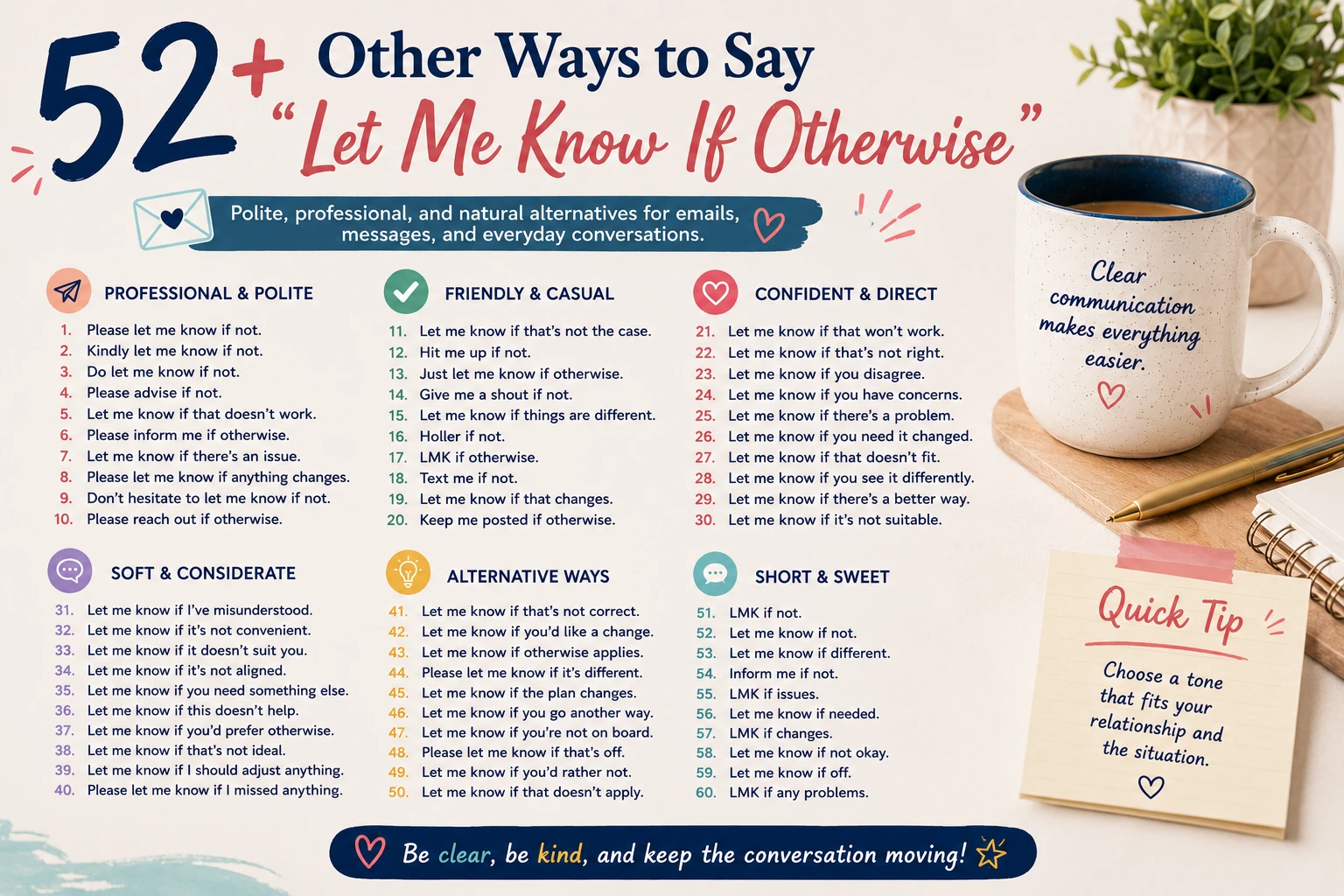
Below are 52+ natural alternatives, with examples and explanations to help you choose the best wording.
“Let me know if otherwise” generally means “tell me if the situation is different from what I have assumed, suggested, or expected.”
For example, if you write, “I’ll assume the meeting is still scheduled for Friday. Let me know if otherwise,” you are asking the recipient to tell you if the meeting has changed.
The phrase is usually intended to be polite and flexible. However, native speakers often use clearer alternatives such as “Please let me know if anything has changed” or “Let me know if that’s not the case.”
The emotional tone is usually neutral and professional. It does not express a strong emotion; instead, it leaves room for correction or clarification.
You might use this type of expression when confirming plans, discussing deadlines, checking information, arranging appointments, or communicating expectations.
For example:
“I’ll submit the report by Friday. Please let me know if the deadline has changed.”
Or:
“I’ll assume everything is still on schedule. Let me know if anything is different.”
The phrase is particularly useful in emails and workplace messages, but it can also be adapted for casual conversations.
In professional communication, clarity is more important than sounding overly formal. “Let me know if otherwise” is understandable, but it can feel somewhat unnatural because “otherwise” needs a clear reference point.
Instead, phrases such as “Please let me know if anything has changed,” “Let me know if that’s not the case,” or “Please tell me if I’ve misunderstood” often sound smoother.
In casual conversations, you have even more freedom. You can say, “Let me know if that’s not right,” “Tell me if I’ve got it wrong,” or simply, “Let me know if anything changes.”
The best choice depends on your relationship with the person and the situation.
1. “Please let me know if anything has changed.”
Meaning: Ask someone to tell you about any changes.
Tone: Polite and professional.
“I’ll proceed with the original schedule, so please let me know if anything has changed.”
This is one of the most natural alternatives for emails and workplace communication.
2. “Let me know if that’s not the case.”
Meaning: Ask someone to correct you if your understanding is wrong.
Tone: Neutral and professional.
“I believe the meeting is at 10 a.m. Let me know if that’s not the case.”
Use it when you have already stated an assumption.
3. “Please tell me if I’m mistaken.”
Meaning: Invite the other person to correct your understanding.
Tone: Respectful and formal.
“I understand that the final draft is due Monday. Please tell me if I’m mistaken.”
This works especially well when accuracy matters.
4. “Let me know if I’ve misunderstood.”
Meaning: Ask someone to clarify if you interpreted something incorrectly.
Tone: Professional and thoughtful.
“My understanding is that we only need to submit the first section. Let me know if I’ve misunderstood.”
It shows that you are open to correction rather than assuming you are automatically right.
5. “Please let me know if that has changed.”
Meaning: Ask whether previously given information is still accurate.
Tone: Formal and clear.
“I’ll use the address provided earlier. Please let me know if that has changed.”
This is particularly useful in emails.
6. “Let me know if anything is different.”
Meaning: Ask someone to mention any difference from what you expect.
Tone: Friendly and neutral.
“I’ll meet you outside at six. Let me know if anything is different.”
This works naturally in both texts and casual conversations.
7. “Please let me know if I have that wrong.”
Meaning: Ask for correction if your information is inaccurate.
Tone: Polite and conversational.
“I believe we agreed on Thursday. Please let me know if I have that wrong.”
It sounds less stiff than some formal alternatives.
8. “Let me know if my understanding is incorrect.”
Meaning: Ask someone to confirm whether your interpretation is accurate.
Tone: Formal and professional.
“My understanding is that the project begins next week. Let me know if my understanding is incorrect.”
This is suitable for business emails and formal discussions.
9. “Please correct me if I’m wrong.”
Meaning: Invite someone to correct inaccurate information.
Tone: Polite and direct.
“Please correct me if I’m wrong, but I believe the application closes tomorrow.”
It is a familiar phrase that works in many professional situations.
10. “Let me know if that isn’t right.”
Meaning: Ask the person to tell you if your information is incorrect.
Tone: Friendly and conversational.
“I’ll bring the documents tomorrow. Let me know if that isn’t right.”
This is a simple option for everyday communication.
11. “Please let me know if there are any changes.”
Meaning: Ask to be informed about modifications.
Tone: Professional.
“I’ll continue preparing the presentation. Please let me know if there are any changes.”
It is useful when plans may change before completion.
12. “Let me know if I’m missing anything.”
Meaning: Ask whether there is additional information you should know.
Tone: Helpful and collaborative.
“I’ve included the budget and timeline. Let me know if I’m missing anything.”
This makes you sound open to feedback.
13. “Please let me know if that’s incorrect.”
Meaning: Ask for confirmation or correction.
Tone: Formal.
“I’ve recorded the delivery date as September 12. Please let me know if that’s incorrect.”
It works well when confirming factual details.
14. “Let me know if I need to make any adjustments.”
Meaning: Ask whether changes are necessary.
Tone: Professional and cooperative.
“I’ve completed the draft. Let me know if I need to make any adjustments.”
This is especially useful when submitting work for review.
15. “Please tell me if anything needs to be changed.”
Meaning: Invite feedback about necessary modifications.
Tone: Polite and professional.
“I’ve attached the revised document. Please tell me if anything needs to be changed.”
It communicates flexibility without sounding uncertain.
16. “Let me know if the situation is different.”
Meaning: Ask someone to tell you if circumstances differ from what you believe.
Tone: Neutral.
“I’ll plan around the current schedule. Let me know if the situation is different.”
This is useful when circumstances may change.
17. “Please let me know if that assumption is incorrect.”
Meaning: Ask whether an assumption is accurate.
Tone: Formal and precise.
“I’m assuming the event will remain indoors. Please let me know if that assumption is incorrect.”
This is ideal for formal communication.
18. “Let me know if I’ve got that wrong.”
Meaning: Ask someone to correct you if necessary.
Tone: Casual and friendly.
“I thought we were meeting at noon. Let me know if I’ve got that wrong.”
It sounds natural in texts and everyday conversations.
19. “Tell me if that’s not what you meant.”
Meaning: Ask someone to clarify their intended meaning.
Tone: Conversational.
“I understood your message as a confirmation. Tell me if that’s not what you meant.”
This works well when interpreting someone’s words.
20. “Please keep me posted if anything changes.”
Meaning: Ask someone to continue updating you.
Tone: Professional and friendly.
“We’ll move forward with the current plan. Please keep me posted if anything changes.”
It is excellent for ongoing projects.
21. “Let me know if plans change.”
Meaning: Ask someone to inform you about changes to an arrangement.
Tone: Casual and practical.
“I’ll see you Friday evening. Let me know if plans change.”
It is short and natural for texting.
22. “Please update me if anything is different.”
Meaning: Ask for updated information if circumstances change.
Tone: Professional.
“I’ll work with the current figures. Please update me if anything is different.”
This is useful in workplace communication.
23. “Let me know if that doesn’t work for you.”
Meaning: Give someone permission to suggest a different arrangement.
Tone: Friendly and considerate.
“I can meet at four. Let me know if that doesn’t work for you.”
It is excellent for scheduling conversations.
24. “Please let me know if you see it differently.”
Meaning: Invite someone to share a different perspective.
Tone: Respectful and collaborative.
“That’s how I understand the situation. Please let me know if you see it differently.”
It works well during discussions where opinions may differ.
25. “Let me know if I’ve missed something.”
Meaning: Ask whether you have overlooked important information.
Tone: Humble and professional.
“I’ve covered the main points. Let me know if I’ve missed something.”
This is useful when reviewing plans or documents.
26. “Please let me know if there’s anything I should reconsider.”
Meaning: Invite someone to identify something that may need another look.
Tone: Thoughtful and professional.
“I’m comfortable with the current approach, but please let me know if there’s anything I should reconsider.”
It shows openness without appearing indecisive.
27. “Let me know if I’m working with outdated information.”
Meaning: Ask whether the information you have is no longer current.
Tone: Professional.
“I’m using last month’s figures. Let me know if I’m working with outdated information.”
This is particularly useful when information changes frequently.
28. “Please advise if this is no longer accurate.”
Meaning: Ask someone to tell you if the information has become incorrect.
Tone: Formal.
“I’ve noted the deadline as Friday. Please advise if this is no longer accurate.”
This fits formal business correspondence.
29. “Let me know if that needs to be revised.”
Meaning: Ask whether something needs changing.
Tone: Professional and concise.
“I’ve prepared the schedule as discussed. Let me know if that needs to be revised.”
It works well after submitting work.
30. “Please let me know if your plans have changed.”
Meaning: Ask whether someone’s previously stated plans are still the same.
Tone: Polite and considerate.
“I’ll arrange transportation for Saturday. Please let me know if your plans have changed.”
This is useful for personal and professional arrangements.
31. “Tell me if I’m off track.”
Meaning: Ask whether your current approach is incorrect.
Tone: Casual and collaborative.
“I’m planning to focus on these three points. Tell me if I’m off track.”
It encourages honest feedback.
32. “Let me know if you had something else in mind.”
Meaning: Ask whether someone expected a different approach.
Tone: Friendly and flexible.
“I was planning to send the report this afternoon. Let me know if you had something else in mind.”
It works well when collaborating with others.
33. “Please let me know if I should approach this differently.”
Meaning: Ask whether another method would be better.
Tone: Professional and receptive.
“I’ve started organizing the data this way. Please let me know if I should approach this differently.”
This is a strong choice when requesting feedback.
34. “Let me know if that no longer applies.”
Meaning: Ask whether previously relevant information is still valid.
Tone: Formal and concise.
“I’ll follow the existing guidelines. Let me know if that no longer applies.”
This works particularly well in professional writing.
35. “Please let me know if circumstances have changed.”
Meaning: Ask whether the situation is now different.
Tone: Formal and polished.
“I’ll proceed according to the current plan. Please let me know if circumstances have changed.”
It is suitable for formal emails.
36. “Let me know if you need anything different.”
Meaning: Offer flexibility if the other person needs another arrangement.
Tone: Warm and helpful.
“I can prepare the documents today. Let me know if you need anything different.”
This creates a cooperative tone.
37. “Please tell me if I’ve misunderstood the situation.”
Meaning: Ask someone to correct your interpretation.
Tone: Respectful and formal.
“I understood that the meeting had been postponed. Please tell me if I’ve misunderstood the situation.”
It is useful when avoiding confusion is important.
38. “Let me know if that doesn’t sound right.”
Meaning: Ask whether your suggestion or interpretation seems incorrect.
Tone: Friendly and conversational.
“I’m thinking we should start with the introduction. Let me know if that doesn’t sound right.”
It works well during collaborative conversations.
39. “Please let me know if you would prefer something else.”
Meaning: Give the other person an opportunity to choose another option.
Tone: Polite and considerate.
“I can send the report this afternoon. Please let me know if you would prefer something else.”
This is excellent when offering choices.
40. “Let me know if there’s another arrangement.”
Meaning: Ask whether a different arrangement exists.
Tone: Neutral and professional.
“I’ll plan around the current schedule. Let me know if there’s another arrangement.”
Use it when coordinating plans.
41. “Please flag anything that has changed.”
Meaning: Ask someone to specifically point out changes.
Tone: Professional and concise.
“I’ve reviewed the latest version. Please flag anything that has changed.”
This works especially well in workplace settings.
42. “Let me know if you have any corrections.”
Meaning: Invite someone to point out mistakes or inaccuracies.
Tone: Professional.
“I’ve attached my notes. Let me know if you have any corrections.”
It is a straightforward way to request feedback.
43. “Please let me know if my information is outdated.”
Meaning: Ask whether your information is no longer current.
Tone: Formal and practical.
“I have the previous contact details on file. Please let me know if my information is outdated.”
This is useful when confirming records.
44. “Let me know if I should account for anything else.”
Meaning: Ask whether another factor needs to be considered.
Tone: Professional and thoughtful.
“I’ve considered the budget and timeline. Let me know if I should account for anything else.”
It shows attention to detail.
45. “Please let me know if there’s a better way to handle this.”
Meaning: Invite suggestions for a more effective approach.
Tone: Collaborative and professional.
“This is how I planned to handle the issue. Please let me know if there’s a better way to handle this.”
It encourages constructive input.
46. “Tell me if anything comes up.”
Meaning: Ask someone to inform you if a problem or change occurs.
Tone: Casual and friendly.
“I’ll take care of the booking. Tell me if anything comes up.”
This is natural in everyday conversations.
47. “Keep me informed if anything changes.”
Meaning: Ask someone to provide updates.
Tone: Professional.
“We’ll continue with the current timeline. Keep me informed if anything changes.”
It is a strong choice for ongoing work.
48. “Let me know if we need to rethink the plan.”
Meaning: Ask whether the current plan needs reconsideration.
Tone: Collaborative and thoughtful.
“I’m comfortable moving forward, but let me know if we need to rethink the plan.”
It works well during projects and group decisions.
49. “Please let me know if I’m missing any context.”
Meaning: Ask whether there is information you do not yet understand.
Tone: Thoughtful and professional.
“I’ve reviewed the proposal, but please let me know if I’m missing any context.”
This is useful when dealing with complicated situations.
50. “Let me know if you’d like me to do anything differently.”
Meaning: Offer to adjust your approach based on the other person’s preference.
Tone: Warm and cooperative.
“I’ve formatted the document as requested. Let me know if you’d like me to do anything differently.”
It shows flexibility and willingness to help.
51. “Please let me know if this doesn’t align with your expectations.”
Meaning: Ask whether your work or proposal differs from what someone expected.
Tone: Polished and professional.
“I’ve prepared the proposal based on our discussion. Please let me know if this doesn’t align with your expectations.”
This is particularly useful when presenting work for review.
52. “Let me know if I should be aware of anything else.”
Meaning: Ask whether there is additional information you need.
Tone: Professional and considerate.
“I’ll prepare everything according to the current instructions. Let me know if I should be aware of anything else.”
It is a flexible alternative for workplace conversations.
53. “Please keep me updated if the situation changes.”
Meaning: Ask for updates if circumstances develop differently.
Tone: Formal and professional.
“I’ll proceed with the current arrangement. Please keep me updated if the situation changes.”
It is a polished option for emails and formal communication.
54. “Let me know if I’ve misunderstood anything.”
Meaning: Invite corrections about your understanding.
Tone: Humble and respectful.
“I believe we agreed to meet on Tuesday. Let me know if I’ve misunderstood anything.”
This is useful when confirming details without sounding overly confident.
55. “If anything changes, just let me know.”
Meaning: Ask the person to inform you about future changes.
Tone: Friendly and natural.
“I’ll reserve the table for seven. If anything changes, just let me know.”
This is one of the easiest choices for everyday communication.
Choosing the Best Alternative
The best replacement for “let me know if otherwise” depends on what you are actually trying to communicate.
If you are confirming information, “Let me know if that’s not the case” is natural and direct.
If you are asking for corrections, “Please correct me if I’m wrong” works well.
If plans might change, “Let me know if anything changes” is simple and effective.
If you are writing professionally, “Please let me know if there are any changes” or “Please advise if this is no longer accurate” can sound polished without becoming unnecessarily complicated.
For casual conversations, keep things simple. “Tell me if I’ve got that wrong” or “Let me know if anything is different” will usually feel more natural.
The goal is not to use the fanciest phrase. It is to make your meaning immediately clear.
Conclusion
There are many better ways to express the idea behind “let me know if otherwise.” The right alternative can make your message sound clearer, more natural, more considerate, or more professional.
Whether you are confirming a deadline, arranging plans, requesting feedback, or checking your understanding, small wording changes can make communication much smoother. Instead of relying on one phrase repeatedly, choose an expression that matches your purpose and relationship with the reader.
Good communication is not about sounding complicated. It is about making your meaning clear while leaving the other person comfortable enough to respond honestly.
Discover more