
Imagine someone offers you something that sounds almost too good to be true. Free food, an amazing deal, an unexpected favor, or a suspiciously generous offer. Your first reaction might be, “Okay, but what’s the catch?”
It is a perfectly normal question, but it also creates an opportunity for humor. A clever response can turn a serious question into a funny conversation, especially when you already know the other person is joking or being overly suspicious.
Finding funny responses to “What’s the catch?” can help you sound quick-witted without being rude. Whether you are texting a friend, teasing a sibling, responding to a classmate, or joking with someone at work, the right line can make the conversation much more memorable.
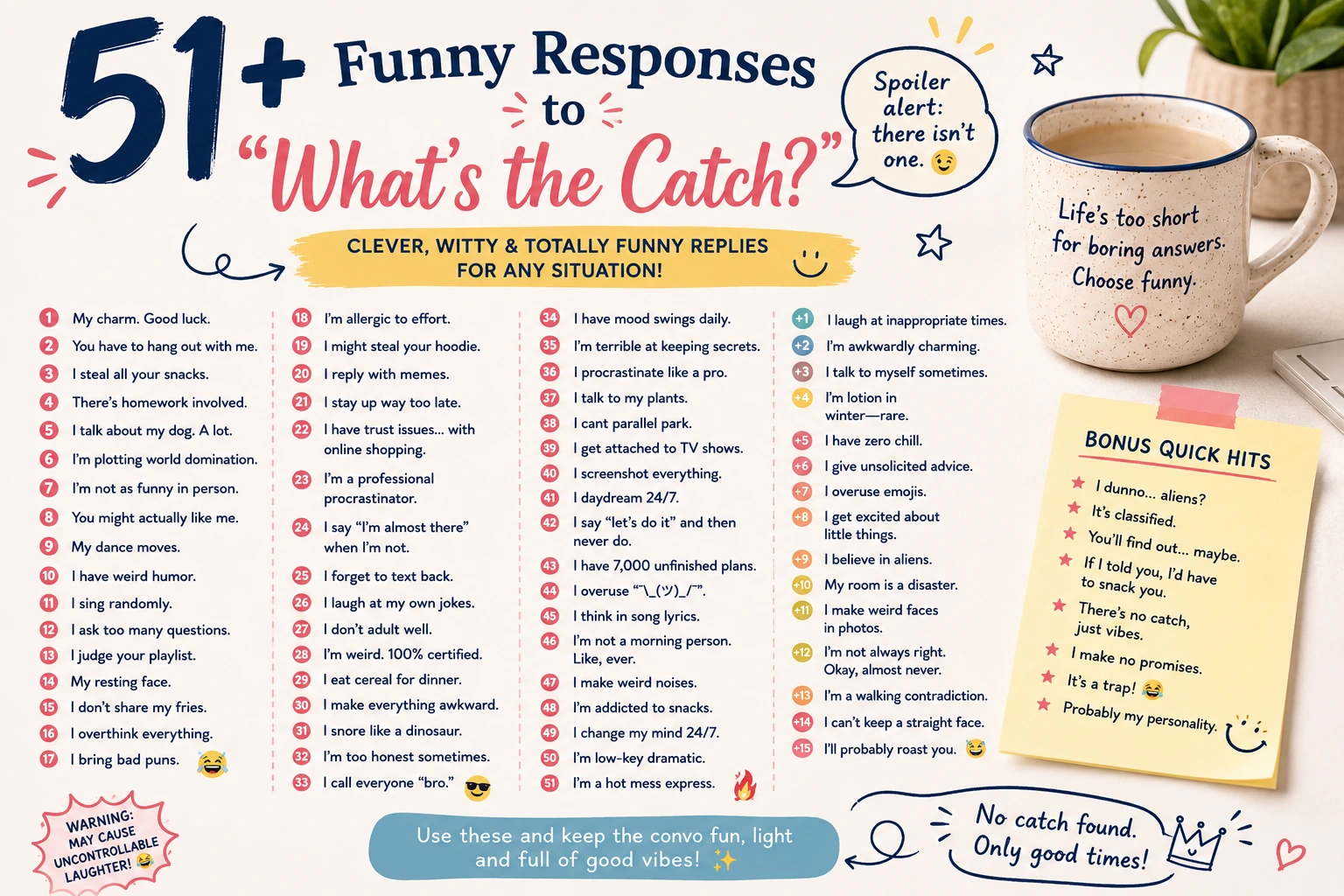
Here are 55 creative responses, along with their meanings, tones, examples, and the situations where they work best.
What Does “What’s the Catch?” Mean?
“What’s the catch?” means, “What is the hidden disadvantage, condition, or problem?”
People usually say it when an offer sounds unusually good or when they suspect there may be something they have not been told.
For example, if your friend says, “I’ll buy you lunch today,” you might jokingly ask, “What’s the catch?”
The expression can sound suspicious, curious, playful, or skeptical depending on the situation. With friends, it is often humorous. In professional situations, however, it may sound too informal or distrustful unless used carefully.
When to Use “What’s the Catch?”
The phrase is most natural in casual conversations, texts, social media chats, and friendly situations.
You might use it when:
- A friend suddenly offers you a huge favor.
- Someone gives you an unusually generous deal.
- A person makes a surprising promise.
- A colleague suggests an unexpected benefit.
- Someone invites you somewhere without explaining why.
- A family member suddenly becomes extremely generous.
For example:
“You’re giving me your extra ticket for free? What’s the catch?”
Or:
“You’re saying I don’t have to do anything today? What’s the catch?”
In a formal email or business meeting, a softer phrase such as “Are there any conditions?” or “Is there anything I should be aware of?” is usually more appropriate.
Is “What’s the Catch?” Polite or Professional?
“What’s the catch?” is generally casual rather than formal. It is not necessarily rude, but the phrase can imply that you do not completely trust the offer.
With friends, that can be funny.
At work, it depends heavily on your relationship with the person. Saying it jokingly to a close colleague may be fine, while using it with a client or senior manager could sound unnecessarily skeptical.
For professional communication, try:
- “Are there any conditions?”
- “Is there anything I should know?”
- “Are there any limitations?”
- “What should I be aware of?”
- “Are there any terms attached?”
For casual conversations, you have much more freedom to be creative.
1. “There’s always a catch. I just haven’t found it yet.”
Meaning: You are joking that every good offer must have a hidden condition.
Tone: Playful and sarcastic.
“I’ll cover your shift tomorrow. There’s always a catch. I just haven’t found it yet.”
This works well when you want to tease someone without revealing anything serious.
2. “The catch is that you have to trust me.”
Meaning: The supposed disadvantage is simply trusting the person.
Tone: Playful.
“I’ll pick up your favorite snacks. The catch is that you have to trust me.”
Use this with friends when the offer is completely harmless.
3. “You have to listen to my entire story first.”
Meaning: The hidden condition is having to listen to you talk.
Tone: Funny and casual.
“I’ll help you with your presentation. You have to listen to my entire story first.”
It is a good choice for a light conversation with someone you know well.
4. “The catch is that I expect a thank-you.”
Meaning: You jokingly pretend gratitude is the price.
Tone: Friendly and teasing.
“I brought you coffee. The catch is that I expect a thank-you.”
This keeps the interaction warm rather than overly sarcastic.
5. “You’ll have to survive my terrible jokes.”
Meaning: The only downside is having to tolerate your humor.
Tone: Self-deprecating and playful.
“You can come with us for free. You’ll just have to survive my terrible jokes.”
Perfect when you want to make yourself the joke.
6. “The catch is hidden somewhere in the fine print.”
Meaning: You jokingly suggest there are secret conditions.
Tone: Sarcastic.
“I said you could have the last slice. The catch is hidden somewhere in the fine print.”
Use it when the situation is obviously harmless.
7. “You have to pretend this was your idea.”
Meaning: The other person must jokingly take credit for the plan.
Tone: Clever and playful.
“I’ll organize everything. You just have to pretend this was your idea.”
It works especially well between friends.
8. “The catch is that I get bragging rights.”
Meaning: You want credit for doing something helpful.
Tone: Confident and humorous.
“I fixed the problem. The catch is that I get bragging rights.”
This is a fun response after successfully helping someone.
9. “There’s no catch. I’m just feeling suspiciously generous.”
Meaning: You are joking about your unusual generosity.
Tone: Playful.
“I’m paying for lunch today. There’s no catch. I’m just feeling suspiciously generous.”
It is especially funny when generosity is unusual for you.
10. “The catch is that you owe me one.”
Meaning: You expect a future favor in return.
Tone: Friendly and teasing.
“I’ll help you move this weekend. The catch is that you owe me one.”
Use it when the favor is genuinely mutual.
11. “You have to sign away your right to complain.”
Meaning: The humorous condition is that the person cannot complain afterward.
Tone: Sarcastic.
“I’ll choose the movie tonight. You have to sign away your right to complain.”
This is great for friendly arguments about small decisions.
12. “The catch is that you might actually enjoy yourself.”
Meaning: You jokingly suggest enjoyment is the unexpected consequence.
Tone: Lighthearted.
“Come with us tonight. The catch is that you might actually enjoy yourself.”
Use it to persuade someone who is reluctant to join.
13. “You’ll have to find the catch yourself.”
Meaning: You pretend there is a mystery to solve.
Tone: Mysterious and playful.
“I got you the ticket. You’ll have to find the catch yourself.”
This works best when you are deliberately being dramatic.
14. “The catch is that I expect you to be happy about it.”
Meaning: You jokingly make happiness a requirement.
Tone: Funny and warm.
“I made your favorite dessert. The catch is that I expect you to be happy about it.”
It adds humor to a thoughtful gesture.
15. “There’s a small processing fee called friendship.”
Meaning: You jokingly describe friendship as the price.
Tone: Clever and sarcastic.
“I’ll give you a ride. There’s a small processing fee called friendship.”
A great choice for close friends.
16. “The catch is that you owe me pizza.”
Meaning: The favor comes with a humorous food-related condition.
Tone: Casual and playful.
“I’ll help you finish the project. The catch is that you owe me pizza.”
Use this when you want to keep the conversation relaxed.
17. “You have to promise not to tell anyone.”
Meaning: You pretend the offer is a secret.
Tone: Playful and mysterious.
“I’ll give you the last cookie. You have to promise not to tell anyone.”
This works well for silly situations.
18. “The catch is that I’m probably going to remind you about this forever.”
Meaning: You expect to bring up your favor later.
Tone: Teasing.
“I helped you fix your laptop. The catch is that I’m probably going to remind you about this forever.”
It works well when friends enjoy playful teasing.
19. “You have to admit I’m the favorite now.”
Meaning: You jokingly expect to gain special status.
Tone: Confident and funny.
“I saved you the last piece of cake. You have to admit I’m the favorite now.”
Use this with family or close friends.
20. “The catch is that I expect applause.”
Meaning: You jokingly demand recognition.
Tone: Dramatic and humorous.
“I finally cleaned my room. The catch is that I expect applause.”
This is perfect for exaggerating a small achievement.
21. “You have to compliment me first.”
Meaning: The other person must say something nice before receiving the offer.
Tone: Playful.
“I’ll give you the answer. You have to compliment me first.”
It works when both people understand the joke.
22. “The catch is that I get to say ‘I told you so’ later.”
Meaning: You want the right to remind them that you were correct.
Tone: Teasing.
“Take my advice. The catch is that I get to say ‘I told you so’ later.”
Use it when giving advice to a friend.
23. “There’s no catch. This is my character development.”
Meaning: You jokingly suggest your generosity is part of becoming a better person.
Tone: Witty and modern.
“I’m letting you choose the restaurant. There’s no catch. This is my character development.”
It is ideal for casual texting.
24. “The catch is that you have to stop being suspicious.”
Meaning: The only condition is that the person trusts you.
Tone: Playful.
“I brought you your favorite snack. The catch is that you have to stop being suspicious.”
This works particularly well when someone always expects a hidden motive.
25. “The catch is hiding behind the curtain.”
Meaning: You pretend there is a dramatic secret.
Tone: Absurd and funny.
“Free dessert? The catch is hiding behind the curtain.”
Use it when you want an exaggerated response.
26. “You have to accept that I’m being unusually nice today.”
Meaning: You jokingly admit that your generosity is unusual.
Tone: Light and self-aware.
“I’ll help you with your assignment. You just have to accept that I’m being unusually nice today.”
It works well with people who know your personality.
27. “The catch is that you have to return the favor someday.”
Meaning: You expect a similar favor in the future.
Tone: Friendly.
“I’ll cover for you today. The catch is that you have to return the favor someday.”
This is useful when you genuinely expect mutual support.
28. “The catch is that I get to choose the music.”
Meaning: You are adding a silly condition to the offer.
Tone: Casual and playful.
“I’ll drive us there. The catch is that I get to choose the music.”
It is an easy way to make an ordinary conversation more fun.
29. “You have to pretend this never happened.”
Meaning: You jokingly make the generous act a secret.
Tone: Dramatic and humorous.
“I actually shared my dessert with you. You have to pretend this never happened.”
This works best with close friends.
30. “The catch is that you’ll owe me one embarrassing story.”
Meaning: You jokingly ask for a personal story in return.
Tone: Playful.
“I’ll tell you what happened. The catch is that you’ll owe me one embarrassing story.”
Use this when chatting with someone you trust.
31. “You have to agree that I’m a genius afterward.”
Meaning: You want exaggerated praise in return.
Tone: Confident and silly.
“Try my solution. You have to agree that I’m a genius afterward.”
This is a fun way to tease someone before helping them.
32. “The catch is that you have to survive my instructions.”
Meaning: Your instructions may be complicated or chaotic.
Tone: Self-deprecating.
“I’ll teach you how to use it. The catch is that you have to survive my instructions.”
It works especially well when you know your explanations can get confusing.
33. “There’s a catch, but I forgot what it was.”
Meaning: You pretend you have forgotten the hidden condition.
Tone: Absurd and playful.
“I’ll give you the ticket. There’s a catch, but I forgot what it was.”
Use this when you want a deliberately ridiculous answer.
34. “The catch is that you have to enjoy the experience.”
Meaning: You jokingly make enjoyment mandatory.
Tone: Positive and playful.
“Come to the event with us. The catch is that you have to enjoy the experience.”
This is a good response when encouraging someone to join you.
35. “The catch is that I get full credit.”
Meaning: You jokingly want recognition for your contribution.
Tone: Confident and funny.
“I found the solution. The catch is that I get full credit.”
It works well among classmates or friends.
36. “You have to listen to me say how right I was.”
Meaning: You want permission to celebrate being correct.
Tone: Teasing.
“Try my suggestion. You have to listen to me say how right I was afterward.”
Use it when your friend already expects you to tease them.
37. “The catch is that I’m expecting a five-star review.”
Meaning: You jokingly treat your favor like a service.
Tone: Witty.
“I made you breakfast. The catch is that I’m expecting a five-star review.”
This is especially funny after doing something ordinary but pretending it is professional service.
38. “There’s no catch. I just woke up feeling generous.”
Meaning: You have no hidden motive.
Tone: Friendly and casual.
“I’ll share my notes with you. There’s no catch. I just woke up feeling generous.”
It is a natural response when someone genuinely seems suspicious.
39. “The catch is that you have to stop asking questions.”
Meaning: You jokingly want them to accept the offer without investigating.
Tone: Playful.
“I bought you a snack. The catch is that you have to stop asking questions.”
Use it when someone is dramatically suspicious.
40. “The catch is that I’m keeping the receipt.”
Meaning: You pretend there is a return policy.
Tone: Clever and sarcastic.
“I’m giving you my old headphones. The catch is that I’m keeping the receipt.”
It turns an ordinary offer into a mock business transaction.
41. “You have to admit this is suspiciously wholesome.”
Meaning: You joke that the kindness itself is suspicious.
Tone: Witty and modern.
“I brought everyone snacks. You have to admit this is suspiciously wholesome.”
This is a good choice when someone is surprised by your kindness.
42. “The catch is that you’re now officially my favorite.”
Meaning: The person receives special status as part of the joke.
Tone: Warm and playful.
“I saved you a seat. The catch is that you’re now officially my favorite.”
Use it with friends or family.
43. “You have to sign a legally binding agreement to say thank you.”
Meaning: You jokingly exaggerate the importance of gratitude.
Tone: Absurd and humorous.
“I brought you coffee. You have to sign a legally binding agreement to say thank you.”
The exaggerated wording makes an ordinary favor sound ridiculous.
44. “The catch is that I’m going to tell everyone about this.”
Meaning: You jokingly threaten to announce your generosity.
Tone: Teasing.
“I actually helped you with your homework. The catch is that I’m going to tell everyone about this.”
Use it when you want to make the favor sound dramatically important.
45. “The catch is that you have to pretend I’m responsible.”
Meaning: You joke about your own reputation or habits.
Tone: Self-deprecating.
“I remembered the meeting on time. The catch is that you have to pretend I’m responsible.”
It is a good way to laugh at yourself.
46. “You have to accept that this is probably a trap.”
Meaning: You pretend the harmless offer is suspicious.
Tone: Sarcastic.
“I’ll give you the last cookie. You have to accept that this is probably a trap.”
Use it when you want to exaggerate the situation.
47. “The catch is that I get to choose dessert.”
Meaning: You add a simple preference as the supposed condition.
Tone: Casual.
“I’ll drive tonight. The catch is that I get to choose dessert.”
This works well for everyday conversations.
48. “The catch is that you owe me unlimited friendship points.”
Meaning: You jokingly treat friendship like a reward system.
Tone: Playful and quirky.
“I saved you a seat. The catch is that you owe me unlimited friendship points.”
This works especially well in casual texts.
49. “The catch is that you have to admit I’m not completely useless.”
Meaning: You jokingly put yourself down while asking for recognition.
Tone: Self-deprecating.
“I fixed the Wi-Fi. The catch is that you have to admit I’m not completely useless.”
It adds humor without putting the other person down.
50. “There’s a catch, but it comes with free snacks.”
Meaning: You deliberately refuse to reveal the supposed condition.
Tone: Playful and mysterious.
“Come with us. There’s a catch, but it comes with free snacks.”
Use it when you want to create harmless suspense.
51. “The catch is that you’ll have to thank me dramatically.”
Meaning: You jokingly demand an exaggerated thank-you.
Tone: Funny and theatrical.
“I’ll save you a seat. The catch is that you’ll have to thank me dramatically.”
It is perfect for playful friendships.
52. “The catch is that I get to say I called it.”
Meaning: You want credit for predicting the outcome.
Tone: Confident and teasing.
“Take my advice. The catch is that I get to say I called it.”
Use this when you are confident your prediction will be correct.
53. “There’s no catch. I’m simply choosing chaos today.”
Meaning: You jokingly suggest your unexpected kindness is random.
Tone: Quirky and humorous.
“I’m paying for everyone’s coffee today. There’s no catch. I’m simply choosing chaos today.”
This is a fun response when your generosity surprises everyone.
54. “The catch is that you can never use this against me.”
Meaning: You jokingly ask the person not to use your kindness as future leverage.
Tone: Playful.
“Fine, I’ll help you this time. The catch is that you can never use this against me.”
It works well between friends who constantly tease each other.
55. “The catch is that you owe me one good story.”
Meaning: You ask for an entertaining story in return.
Tone: Friendly and conversational.
“I’ll tell you what happened. The catch is that you owe me one good story too.”
This keeps the conversation going instead of ending it with a simple answer.
Choosing the Right Response
Not every funny response works in every situation.
If you are talking to a close friend, you can be more sarcastic. Lines such as “Please hold your applause” or “I expect bragging rights” can work because the relationship already has room for teasing.
If you are talking to someone you do not know well, choose something softer. “There’s no catch, I’m just feeling generous” is safer than a heavily sarcastic response.
For texting, short lines usually work best. A quick “The catch is friendship points” can feel more natural than a long explanation.
The secret is simple: match the humor to the relationship.
Conclusion
A question like “What’s the catch?” does not have to lead to a serious explanation. With the right response, it can become a funny moment that keeps the conversation relaxed and memorable.
From playful teasing to dramatic sarcasm and clever one-liners, these alternatives give you plenty of ways to respond without repeating the same joke. The best response is always the one that fits your relationship and the mood of the conversation.
Use humor naturally, know when to keep it light, and do not force a joke when the situation calls for sincerity. Sometimes the funniest answer is simply the one that sounds like you.
Discover more