

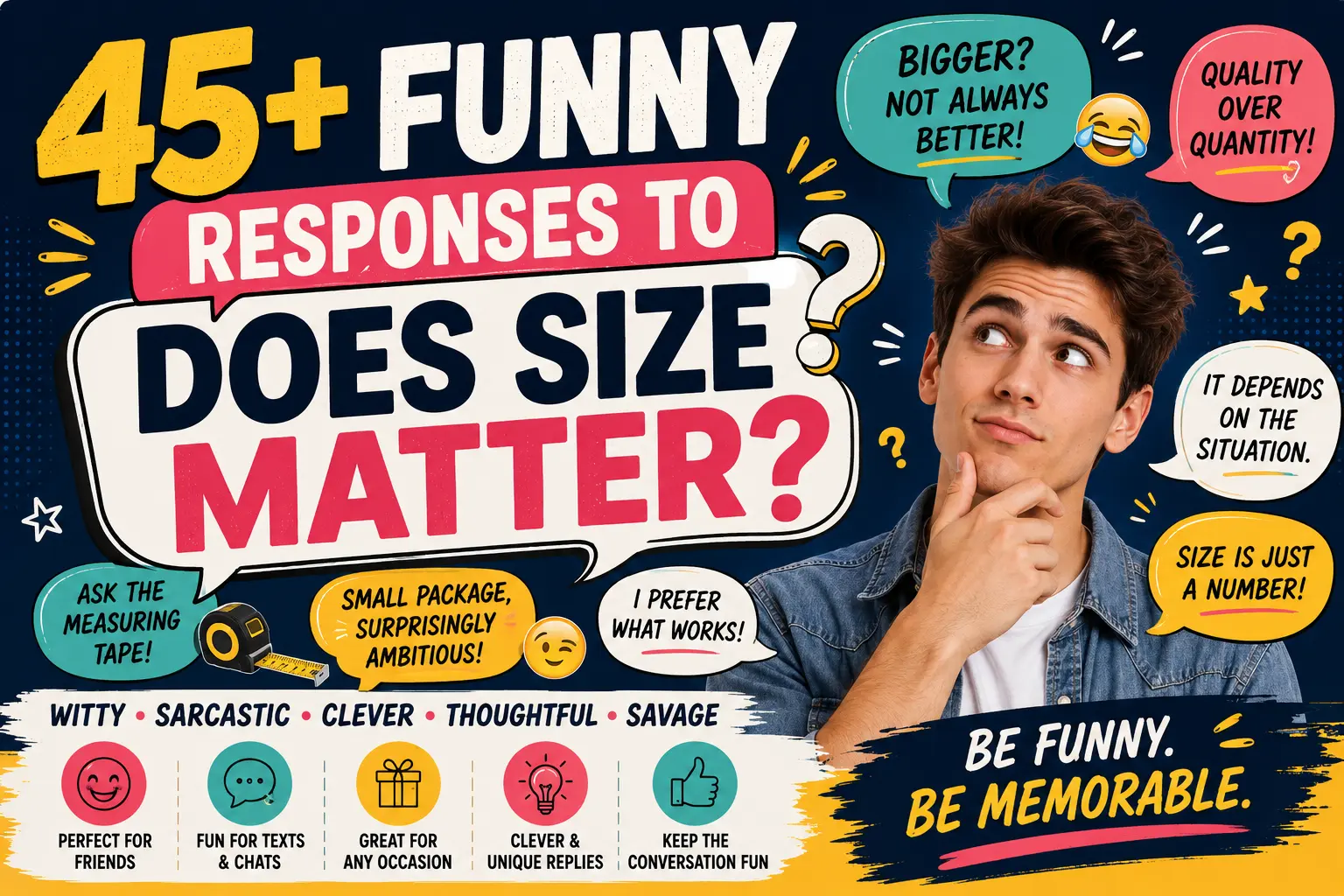
“Does size matter?” is one of those questions that can instantly make a conversation more interesting. Depending on the situation, it can refer to anything from pizza and clothing to bedrooms, projects, screens, portions, or even how much luggage someone thinks they need for a weekend trip. Instead of giving the same predictable answer every time, a clever response can turn the question into a genuinely funny moment.
Humor works especially well when you know the person and understand the context. A quick witty reply can make a casual conversation more memorable without making it awkward. Whether you want something sarcastic, playful, confident, or surprisingly thoughtful, the right response depends on what “size” actually refers to. In this guide, you will find creative responses that keep the conversation light while giving you plenty of ways to show personality.
What Does “Does Size Matter?” Mean?
The phrase “does size matter?” generally asks whether the physical dimensions, amount, capacity, or scale of something makes a meaningful difference.
For example, someone might ask whether the size of a pizza matters, whether a larger room is better, or whether the size of a project affects its quality. The meaning depends entirely on the surrounding conversation.
The question can be serious, curious, teasing, or completely ridiculous. That is why funny responses work so well. Instead of answering with a simple “yes” or “no,” you can use humor to acknowledge the question while keeping the conversation moving.
A good response should match the situation. A playful answer might work perfectly between friends, while a more thoughtful response may be better in a serious discussion.
When to Use Funny Responses to “Does Size Matter?”
Funny responses are best suited to relaxed conversations where humor is welcome. They can work particularly well in texting, group chats, social media comments, conversations with friends, and casual discussions.
For example:
Friend: “Does size matter when ordering pizza?”
Funny response: “Only if everyone suddenly becomes extremely hungry.”
Or:
Friend: “Does size matter for the new TV?”
Funny response: “Only if you want the neighbors watching with you.”
The key is context. A clever response should make the conversation more enjoyable rather than confusing the other person.
You can also adapt the same idea to different situations. A sarcastic reply may work with a close friend, while a lighthearted but respectful answer may be better with someone you do not know very well.
Is “Does Size Matter?” Polite or Professional?
The phrase itself is not automatically rude or inappropriate. Its meaning depends heavily on context.
In everyday conversations about clothing, food, furniture, technology, rooms, or projects, it is completely ordinary. For example, asking whether screen size matters when buying a monitor is a normal practical question.
However, because the phrase can sometimes have an ambiguous meaning, it is worth considering the setting before responding with humor. A joke that works in a group chat may not be appropriate during a workplace meeting.
In professional situations, keep your response relevant to the actual subject. For example:
“It depends on the purpose. Bigger is not always better.”
That answer is simple, confident, and appropriate without turning the conversation into a joke.
In casual situations, however, you can be much more creative.
Absolutely. Here is Part 2, continuing with the funny, nonsexual interpretations of “Does size matter?” and keeping every response distinct.
Polite and Appreciative Responses
1. “It depends on what we are measuring.”
Meaning: Size is only important when the situation actually requires it.
Tone: Calm and witty
Example Sentence: “Does size matter?” “It depends on what we are measuring.”
Short Explanation: This is a clever answer when you want to stay humorous without making the conversation too complicated.
2. “Quality usually has the final say.”
Meaning: Something being bigger does not automatically make it better.
Tone: Confident and thoughtful
Example Sentence: “Does size matter?” “Quality usually has the final say.”
Short Explanation: Use this when you want your answer to sound clever while making a genuine point.
3. “Bigger is not always better.”
Meaning: The largest option is not necessarily the best choice.
Tone: Mature and practical
Example Sentence: “Does size matter?” “Bigger is not always better.”
Short Explanation: This classic response works for everything from food portions to rooms and technology.
4. “The right size matters more.”
Meaning: Choosing something appropriate is more important than choosing something large.
Tone: Thoughtful and friendly
Example Sentence: “Does size matter?” “The right size matters more.”
Short Explanation: This is useful when you want to sound sensible while still keeping the conversation light.
5. “Only when you order the wrong one.”
Meaning: Size becomes important when your choice does not fit your needs.
Tone: Funny and practical
Example Sentence: “Does size matter?” “Only when you order the wrong one.”
Short Explanation: A great response for conversations about clothing, food, furniture, or online shopping.
6. “It matters approximately as much as you think it does.”
Meaning: The importance of size depends entirely on the situation.
Tone: Dry and sarcastic
Example Sentence: “Does size matter?” “It matters approximately as much as you think it does.”
Short Explanation: Use this when you want a deliberately mysterious answer.
7. “Let’s not underestimate the little ones.”
Meaning: Smaller things can still perform surprisingly well.
Tone: Playful
Example Sentence: “Does size matter?” “Let’s not underestimate the little ones.”
Short Explanation: This works particularly well when comparing small and large objects.
8. “The measuring tape has spoken.”
Meaning: The actual measurements should decide whether size matters.
Tone: Silly and humorous
Example Sentence: “Does size matter?” “The measuring tape has spoken.”
Short Explanation: A deliberately dramatic response for casual conversations.
9. “Only if we are keeping score.”
Meaning: Size does not matter unless someone is unnecessarily comparing things.
Tone: Clever and sarcastic
Example Sentence: “Does size matter?” “Only if we are keeping score.”
Short Explanation: This is perfect when someone is taking a harmless comparison far too seriously.
10. “Ask the person who has to carry it.”
Meaning: Size becomes important when practicality is involved.
Tone: Funny and realistic
Example Sentence: “Does size matter?” “Ask the person who has to carry it.”
Short Explanation: Great for luggage, furniture, boxes, shopping bags, and anything else that has to be moved.
Flirty and Playful Responses
These responses keep the conversation light and teasing while staying suitable for ordinary, nonsexual situations.
11. “That sounds like a question for the measuring department.”
Meaning: You are jokingly avoiding a straightforward answer.
Tone: Playful
Example Sentence: “Does size matter?” “That sounds like a question for the measuring department.”
Short Explanation: Use this when you want to give a deliberately ridiculous response.
12. “I prefer things that know how to make an entrance.”
Meaning: A dramatic way of saying appearance can sometimes matter.
Tone: Playful and dramatic
Example Sentence: “Does size matter?” “I prefer things that know how to make an entrance.”
Short Explanation: Works especially well when talking about decorations, gifts, events, or oversized objects.
13. “Depends. Are we talking impressive or practical?”
Meaning: Something can be visually impressive without necessarily being useful.
Tone: Witty and conversational
Example Sentence: “Does size matter?” “Depends. Are we talking impressive or practical?”
Short Explanation: This response keeps the conversation open while adding a clever contrast.
14. “I am more interested in what it can do.”
Meaning: Function is more important than appearance or size.
Tone: Confident
Example Sentence: “Does size matter?” “I am more interested in what it can do.”
Short Explanation: A strong answer for conversations about technology, equipment, or projects.
15. “Small package, surprisingly ambitious.”
Meaning: Something small can still be impressive.
Tone: Playful
Example Sentence: “Does size matter?” “Small package, surprisingly ambitious.”
Short Explanation: Use this for a small gadget, compact project, tiny restaurant, or anything that performs above expectations.
16. “I like my options with a little variety.”
Meaning: Different sizes can have different advantages.
Tone: Lighthearted
Example Sentence: “Does size matter?” “I like my options with a little variety.”
Short Explanation: This is useful when comparing several choices rather than declaring one size superior.
17. “I have learned never to judge by measurements alone.”
Meaning: Numbers do not always tell the whole story.
Tone: Thoughtful and playful
Example Sentence: “Does size matter?” “I have learned never to judge by measurements alone.”
Short Explanation: It sounds philosophical while still keeping the conversation casual.
18. “Big enough to get the job done.”
Meaning: Something only needs to be large enough to perform its purpose.
Tone: Confident and practical
Example Sentence: “Does size matter?” “Big enough to get the job done.”
Short Explanation: This works naturally when discussing tools, equipment, rooms, or projects.
19. “I am team ‘whatever works.’”
Meaning: Function matters more than size.
Tone: Casual and playful
Example Sentence: “Does size matter?” “I am team ‘whatever works.’”
Short Explanation: A relaxed answer when you do not want to overthink the question.
20. “Let’s consult the experts before making bold claims.”
Meaning: You are jokingly suggesting that the question deserves more investigation.
Tone: Witty and humorous
Example Sentence: “Does size matter?” “Let’s consult the experts before making bold claims.”
Short Explanation: This works particularly well when friends are having an exaggerated debate.
Confident and Self Respecting Responses
21. “I care more about value than measurements.”
Meaning: What something offers matters more than its physical size.
Tone: Confident
Example Sentence: “Does size matter?” “I care more about value than measurements.”
Short Explanation: This is a mature response that can apply to products, projects, and experiences.
22. “I do not compete with rulers.”
Meaning: You are not interested in unnecessary comparisons.
Tone: Funny and confident
Example Sentence: “Does size matter?” “I do not compete with rulers.”
Short Explanation: Use this when someone turns an ordinary comparison into a competition.
23. “I know what works for me.”
Meaning: Personal preference matters more than outside opinions.
Tone: Self assured
Example Sentence: “Does size matter?” “I know what works for me.”
Short Explanation: A simple response when you want to shut down unnecessary debate.
24. “Numbers do not impress me by themselves.”
Meaning: A larger measurement does not automatically mean better quality.
Tone: Confident and mature
Example Sentence: “Does size matter?” “Numbers do not impress me by themselves.”
Short Explanation: This works well in discussions about products, achievements, or statistics.
25. “I prefer practical over dramatic.”
Meaning: Usefulness matters more than something being unnecessarily large.
Tone: Confident and witty
Example Sentence: “Does size matter?” “I prefer practical over dramatic.”
Short Explanation: Great for choosing furniture, gadgets, cars, rooms, or anything else where practicality matters.
26. “If it works, it works.”
Meaning: Function matters more than appearance or size.
Tone: Casual and confident
Example Sentence: “Does size matter?” “If it works, it works.”
Short Explanation: This short response is useful when you want to end the debate quickly.
27. “I am not easily impressed by numbers.”
Meaning: Measurements alone do not determine quality.
Tone: Confident
Example Sentence: “Does size matter?” “I am not easily impressed by numbers.”
Short Explanation: Use it when someone is focusing too much on statistics.
28. “The results speak louder than the ruler.”
Meaning: Performance is more important than measurements.
Tone: Clever and confident
Example Sentence: “Does size matter?” “The results speak louder than the ruler.”
Short Explanation: A memorable response when comparing products, projects, or performance.
29. “I choose what fits the purpose.”
Meaning: The appropriate option is more important than the largest option.
Tone: Mature and practical
Example Sentence: “Does size matter?” “I choose what fits the purpose.”
Short Explanation: This is especially useful in practical conversations.
30. “I am here for quality control, not size competitions.”
Meaning: You care about quality rather than pointless comparison.
Tone: Funny and assertive
Example Sentence: “Does size matter?” “I am here for quality control, not size competitions.”
Short Explanation: A playful way to make your preference clear without sounding overly serious.
Here is Part 3, finishing the remaining responses, real life situations, mistakes, pro tips, conclusion, and SEO details.
Funny and Savage Responses
31. “Apparently, we are measuring personalities now.”
Meaning: You are joking about how unnecessary the comparison is.
Tone: Sarcastic
Example Sentence: “Does size matter?” “Apparently, we are measuring personalities now.”
Short Explanation: Use this when someone is making a harmless question unnecessarily competitive.
32. “My ruler is currently on vacation.”
Meaning: You are playfully refusing to provide a measurement.
Tone: Silly and sarcastic
Example Sentence: “Does size matter?” “My ruler is currently on vacation.”
Short Explanation: A deliberately ridiculous answer that works well with friends.
33. “Only if we are building a skyscraper.”
Meaning: Size matters for certain practical purposes but not everything.
Tone: Funny
Example Sentence: “Does size matter?” “Only if we are building a skyscraper.”
Short Explanation: Perfect when someone is overthinking the importance of size.
34. “Let me check the official size department.”
Meaning: You are pretending there is an authority responsible for answering the question.
Tone: Playful and sarcastic
Example Sentence: “Does size matter?” “Let me check the official size department.”
Short Explanation: This makes an ordinary question sound unnecessarily bureaucratic.
35. “I would need a spreadsheet for that.”
Meaning: The question is being treated as far more complicated than it really is.
Tone: Dry humor
Example Sentence: “Does size matter?” “I would need a spreadsheet for that.”
Short Explanation: Great for conversations where everyone is overanalyzing a simple decision.
36. “That depends on the budget.”
Meaning: Practical limitations can matter more than size.
Tone: Witty and realistic
Example Sentence: “Does size matter?” “That depends on the budget.”
Short Explanation: Works especially well when discussing houses, rooms, technology, food, or purchases.
37. “Bigger means more cleaning, so think carefully.”
Meaning: A larger option can come with additional responsibilities.
Tone: Funny and practical
Example Sentence: “Does size matter?” “Bigger means more cleaning, so think carefully.”
Short Explanation: A relatable response for furniture, houses, rooms, and other things that require maintenance.
38. “Congratulations, you have discovered the measuring tape.”
Meaning: You are teasing someone for focusing too much on measurements.
Tone: Savage and playful
Example Sentence: “Does size matter?” “Congratulations, you have discovered the measuring tape.”
Short Explanation: Best used with friends who appreciate sarcastic humor.
39. “This conversation has become suspiciously mathematical.”
Meaning: The discussion has become unnecessarily focused on numbers.
Tone: Clever and sarcastic
Example Sentence: “Does size matter?” “This conversation has become suspiciously mathematical.”
Short Explanation: A fun response when a simple question suddenly turns into a technical debate.
40. “I refuse to let a number define the experience.”
Meaning: A measurement does not determine the overall quality of something.
Tone: Dramatic and humorous
Example Sentence: “Does size matter?” “I refuse to let a number define the experience.”
Short Explanation: The exaggerated seriousness makes this response funny.
Curious, Thoughtful, and Mature Responses
41. “What matters more is whether it suits the situation.”
Meaning: The appropriate size depends on what you actually need.
Tone: Thoughtful
Example Sentence: “Does size matter?” “What matters more is whether it suits the situation.”
Short Explanation: This is a useful answer when you want to move from jokes to a sensible discussion.
42. “Sometimes it matters, sometimes it really does not.”
Meaning: There is no universal answer because circumstances differ.
Tone: Mature and balanced
Example Sentence: “Does size matter?” “Sometimes it matters, sometimes it really does not.”
Short Explanation: This works when you want to avoid an exaggerated yes or no.
43. “Context is doing most of the heavy lifting here.”
Meaning: The importance of size depends entirely on the situation.
Tone: Intelligent and witty
Example Sentence: “Does size matter?” “Context is doing most of the heavy lifting here.”
Short Explanation: A polished response for conversations where the question could have multiple meanings.
44. “Function should come before appearance.”
Meaning: Practical usefulness is more important than how large something looks.
Tone: Mature and practical
Example Sentence: “Does size matter?” “Function should come before appearance.”
Short Explanation: This is ideal for conversations about products, furniture, technology, and design.
45. “The best size is the one that actually works.”
Meaning: The right choice depends on what fulfills the purpose.
Tone: Thoughtful
Example Sentence: “Does size matter?” “The best size is the one that actually works.”
Short Explanation: A simple but meaningful response that works in almost any practical situation.
Real Life Situations
When a Friend Asks About the Size of Something
If your friend is talking about a pizza, room, television, suitcase, or another ordinary object, you can keep the answer playful.
Best response:
“Only if we are building a skyscraper.”
It is short, funny, and keeps the conversation moving.
When Someone Is Comparing Two Products
A practical answer can be fun without turning the discussion into a competition.
Best response:
“The best size is the one that actually works.”
This keeps the focus on usefulness rather than appearance.
When Someone Is Taking the Question Too Seriously
If everyone suddenly starts comparing measurements, add some sarcasm.
Best response:
“This conversation has become suspiciously mathematical.”
It breaks the tension and gives everyone something to laugh about.
When You Want a Mature Answer
Sometimes the best response is straightforward rather than overly clever.
Best response:
“It depends on what you are trying to accomplish.”
This works particularly well in conversations about purchases, projects, technology, or design.
When You Want to Avoid Comparing Things
If you do not want to participate in a pointless comparison, keep your answer confident.
Best response:
“I do not compete with rulers.”
It makes your position clear while keeping the mood light.
What to Avoid
1. Taking the Question Out of Context
“Does size matter?” can mean completely different things depending on the conversation. Understand the subject before choosing your joke.
2. Making the Response Too Complicated
A funny response works best when people understand it immediately. If the joke needs a five minute explanation, it probably is not the right joke.
3. Turning Everything Into a Competition
Not every comparison needs a winner. Sometimes the practical answer is simply that different sizes suit different needs.
4. Using Sarcasm With the Wrong Person
A close friend may understand your humor immediately, while someone you barely know might interpret it differently.
5. Ignoring the Actual Question
If someone genuinely needs advice, do not hide behind humor. Give them a useful answer first and add a joke afterward.
6. Repeating the Same Joke
Once you have made the measuring tape joke, you probably do not need to bring it up five more times.
Pro Tips
Match the Humor to the Situation
A ridiculous response works best when the conversation is already casual. For a serious discussion, use something clever but practical.
Keep Your Delivery Confident
Funny responses often depend more on delivery than wording. Say the line naturally instead of explaining why it is supposed to be funny.
Use Context to Personalize the Joke
The funniest response is usually connected to what you are actually discussing. If you are talking about pizza, mention pizza. If you are discussing a room, mention the room.
Conclusion
“Does size matter?” does not have to lead to a predictable yes or no. With the right response, you can turn an ordinary question into a funny, memorable conversation. From sarcastic lines like “I do not compete with rulers” to thoughtful answers such as “The best size is the one that actually works,” there is an option for almost every situation.
The trick is to understand the context, know your audience, and choose humor that feels natural. A good witty response should make the conversation better, not simply make you sound clever.
Discover more