
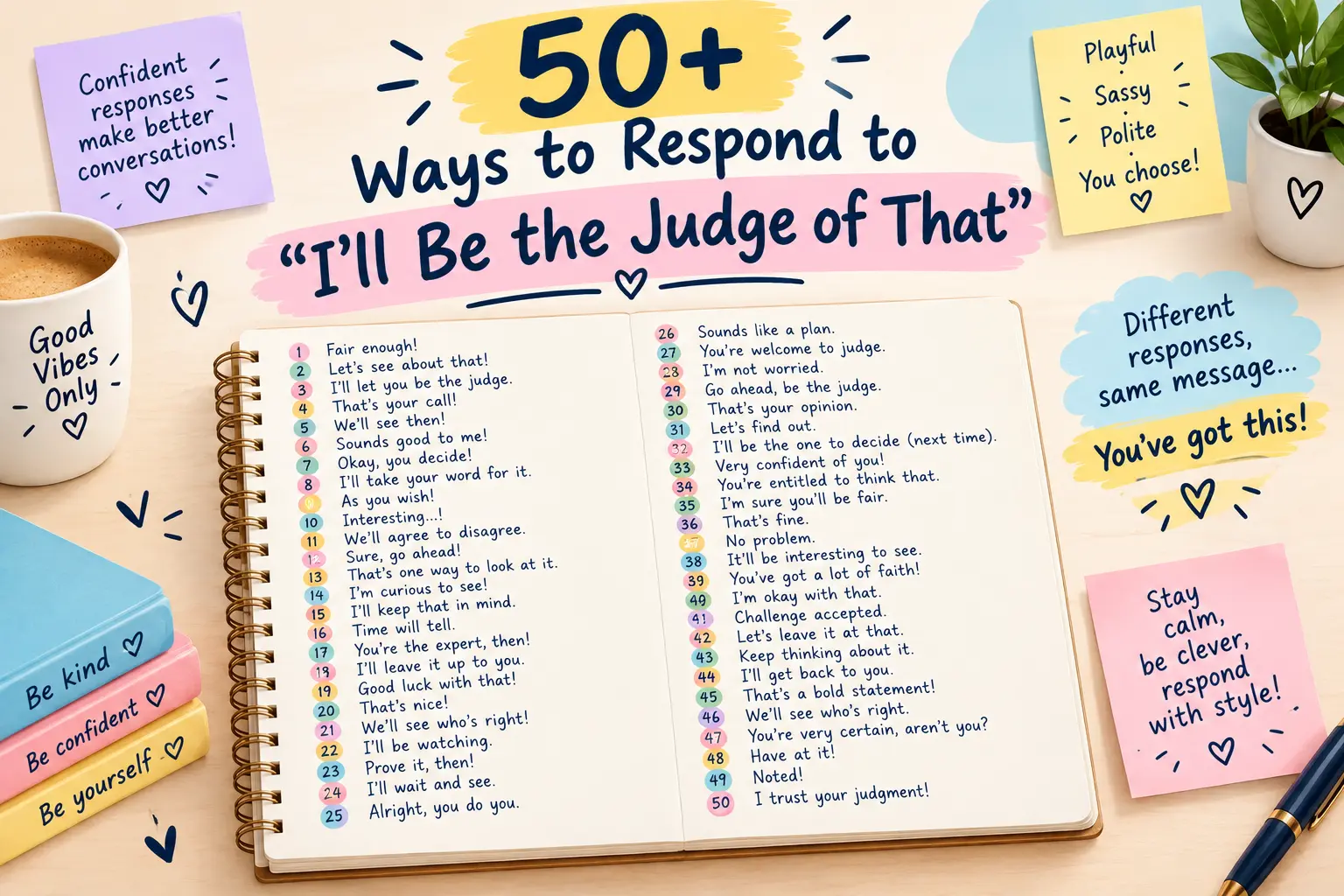
Someone saying “I’ll be the judge of that” can instantly change the mood of a conversation. Depending on their tone, it might be playful teasing, friendly skepticism, a challenge, or even a slightly sarcastic remark. The good news is that you do not have to take it too seriously.
A clever response can keep the conversation moving and show that you are confident enough to play along. You can answer with humor, confidence, curiosity, or a little friendly competition. The best response depends on who said it and what happened before the comment.
Whether you heard “I’ll be the judge of that” from a friend, coworker, classmate, or someone you are getting to know, having a few responses ready can make the conversation much easier. Here are more than 50 natural replies for different situations and personalities.
What Does “I’ll Be the Judge of That” Mean?
“I’ll be the judge of that” usually means “I will decide whether that is true, good, impressive, or acceptable.”
For example, if you tell a friend:
“I make the best pasta in town.”
They might respond:
“I’ll be the judge of that.”
They are probably saying that they want to try your pasta before accepting your claim.
The phrase can be serious, but it is often used playfully. It may suggest skepticism, curiosity, or friendly competition.
The meaning depends heavily on tone. A smile can make it teasing, while a serious voice may make it sound challenging.
When to Use “I’ll Be the Judge of That”
The phrase is most common in casual conversations. Friends may use it when teasing each other or challenging a claim.
For example:
“You said you can beat me at chess? I’ll be the judge of that.”
It can also appear in workplace conversations, although the tone should remain appropriate.
For example:
“You think the new presentation is much better? I’ll be the judge of that when I see it.”
In texting, the phrase is often playful:
“You claim your cooking has improved? I’ll be the judge of that.”
In a formal speech, however, the expression may sound too casual unless it is being used intentionally for humor.
Is “I’ll Be the Judge of That” Polite or Professional?
“I’ll be the judge of that” is generally casual rather than formal.
It is perfectly acceptable among friends, classmates, teammates, and people who have a relaxed relationship. It can create playful tension and make a conversation more interesting.
In professional situations, context matters. A manager joking with a familiar colleague may use it without a problem, but saying it to a client or senior professional could sound dismissive.
If you need a more professional version, try:
- “Let’s see how it turns out.”
- “I’ll take a look and let you know.”
- “I’ll reserve judgment until I’ve seen it.”
- “Let’s evaluate the results first.”
- “I’ll be interested to see the outcome.”
Playful and Lighthearted Responses
1. “Then I hope I get a fair trial.”
Meaning: You jokingly compare their judgment to a courtroom.
Tone: Playful and witty.
Example Sentence: “You think my cooking is good? Then I hope I get a fair trial.”
Short Explanation: This is a fun choice when the other person is clearly teasing you.
Purpose and Personalization: It turns their challenge into a light joke without taking the comment too seriously.
2. “Your honor, I rest my case.”
Meaning: You pretend the conversation is a courtroom.
Tone: Funny and dramatic.
Example Sentence: “You want to judge my playlist? Your honor, I rest my case.”
Short Explanation: Use this when you want to exaggerate the situation for humor.
3. “I’m confident you’ll be impressed.”
Meaning: You believe your claim will hold up.
Tone: Confident and friendly.
Example Sentence: “You’ll be the judge? I’m confident you’ll be impressed.”
Short Explanation: This keeps the challenge alive while showing confidence.
4. “Go ahead. I’m ready.”
Meaning: You accept their challenge.
Tone: Confident and direct.
Example Sentence: “You think my presentation needs work? Go ahead. I’m ready.”
Short Explanation: A short response works well when you do not want to over-explain.
5. “I’ll let the results speak for themselves.”
Meaning: You prefer to prove yourself through actions.
Tone: Calm and confident.
Example Sentence: “You doubt I can finish it today? I’ll let the results speak for themselves.”
Short Explanation: Great when you want to sound self-assured rather than defensive.
6. “I suppose we’ll find out soon.”
Meaning: The truth will become clear later.
Tone: Relaxed and thoughtful.
Example Sentence: “You think this plan will work? I suppose we’ll find out soon.”
Short Explanation: This response avoids arguing and keeps things easygoing.
7. “Challenge accepted.”
Meaning: You accept the person’s challenge.
Tone: Energetic and playful.
Example Sentence: “You think I cannot beat your score? Challenge accepted.”
Short Explanation: Use it when the conversation has a competitive but friendly mood.
8. “I hope you’re prepared to be surprised.”
Meaning: You expect to exceed their expectations.
Tone: Confident and playful.
Example Sentence: “You’ll judge my cooking? I hope you’re prepared to be surprised.”
Short Explanation: This adds a little suspense to the conversation.
9. “Take your time, Judge.”
Meaning: You humorously accept their role as the judge.
Tone: Teasing.
Example Sentence: “You need another minute to decide? Take your time, Judge.”
Short Explanation: It works especially well in text conversations.
10. “The courtroom is officially open.”
Meaning: You continue the courtroom joke.
Tone: Dramatic and humorous.
Example Sentence: “You want proof that I can dance? The courtroom is officially open.”
Short Explanation: Best for friends who enjoy exaggerated humor.
Confident Responses
11. “I’m not worried about your verdict.”
Meaning: You are confident regardless of their opinion.
Tone: Bold and self-assured.
Example Sentence: “You can judge my decision, but I’m not worried about your verdict.”
Short Explanation: This works when you want to show strong self-confidence.
12. “I’m happy to prove it.”
Meaning: You are willing to demonstrate your claim.
Tone: Confident and positive.
Example Sentence: “You think I cannot do it? I’m happy to prove it.”
Short Explanation: It shifts the conversation from arguing to demonstrating.
13. “You’ll see soon enough.”
Meaning: The truth will become obvious shortly.
Tone: Confident and mysterious.
Example Sentence: “You doubt my plan? You’ll see soon enough.”
Short Explanation: Good when you want to keep your response short.
14. “I’ll let you decide after you see it.”
Meaning: You are comfortable letting them make their own judgment.
Tone: Mature and calm.
Example Sentence: “You can judge the project after you see it.”
Short Explanation: This is useful when you want to avoid unnecessary debate.
15. “I have nothing to prove, but I’ll show you anyway.”
Meaning: You are confident but willing to demonstrate your ability.
Tone: Strong and composed.
Example Sentence: “You doubt my skills? I have nothing to prove, but I’ll show you anyway.”
Short Explanation: This gives the response a confident edge.
16. “Let’s put that confidence to the test.”
Meaning: You challenge the other person’s judgment.
Tone: Competitive and playful.
Example Sentence: “You think you can beat my score? Let’s put that confidence to the test.”
Short Explanation: Great for friendly competitions.
17. “I’m comfortable with whatever verdict you reach.”
Meaning: You are not overly concerned about their opinion.
Tone: Mature and confident.
Example Sentence: “Review the proposal carefully. I’m comfortable with whatever verdict you reach.”
Short Explanation: This can also work in professional discussions.
18. “I’ll take my chances.”
Meaning: You are willing to accept their judgment.
Tone: Calm and confident.
Example Sentence: “You think everyone will disagree? I’ll take my chances.”
Short Explanation: Short, natural, and useful in many situations.
19. “I think the evidence is on my side.”
Meaning: You believe you have good reasons supporting your claim.
Tone: Clever and confident.
Example Sentence: “You doubt that I studied enough? I think the evidence is on my side.”
Short Explanation: This continues the judgment theme while sounding witty.
20. “You can judge it when you’re ready.”
Meaning: You are comfortable letting them evaluate the situation.
Tone: Relaxed and self-assured.
Example Sentence: “Take a look at my design. You can judge it when you’re ready.”
Short Explanation: This sounds confident without becoming confrontational.
Funny and Sarcastic Responses
21. “Should I get a lawyer?”
Meaning: You jokingly act as if you are facing a serious trial.
Tone: Sarcastic and humorous.
Example Sentence: “You’re judging my outfit? Should I get a lawyer?”
Short Explanation: Use this with friends who understand sarcastic humor.
22. “Do I at least get an appeal?”
Meaning: You continue the courtroom joke.
Tone: Funny and dramatic.
Example Sentence: “You already decided my cooking is terrible? Do I at least get an appeal?”
Short Explanation: A good comeback when the judgment seems too quick.
23. “Please be gentle with the verdict.”
Meaning: You jokingly ask them not to judge too harshly.
Tone: Light and humorous.
Example Sentence: “You’re reviewing my first painting? Please be gentle with the verdict.”
Short Explanation: This makes a potentially awkward moment more relaxed.
24. “I hope the jury is on my side.”
Meaning: You pretend there is a whole jury judging you.
Tone: Playful.
Example Sentence: “You’re judging my playlist? I hope the jury is on my side.”
Short Explanation: Perfect for a group chat or friendly conversation.
25. “This sounds suspiciously serious.”
Meaning: You joke that their statement sounds too dramatic.
Tone: Sarcastic.
Example Sentence: “You’ll be the judge of my cooking? This sounds suspiciously serious.”
Short Explanation: Good when someone is exaggerating a simple situation.
26. “I didn’t realize I was being graded.”
Meaning: You jokingly act surprised that someone is evaluating you.
Tone: Funny and casual.
Example Sentence: “You’re judging my presentation already? I didn’t realize I was being graded.”
Short Explanation: Works well with classmates and friends.
27. “Well, this got official quickly.”
Meaning: You joke about the seriousness of their comment.
Tone: Dry and witty.
Example Sentence: “You’ll be the judge of my coffee? Well, this got official quickly.”
Short Explanation: Great for understated humor.
28. “I’d like to speak to the manager.”
Meaning: You jokingly pretend to protest their judgment.
Tone: Sarcastic.
Example Sentence: “You gave my cooking a four out of ten? I’d like to speak to the manager.”
Short Explanation: Best used with someone who enjoys exaggerated jokes.
29. “That sounds like a biased court.”
Meaning: You jokingly accuse them of unfair judgment.
Tone: Sarcastic and playful.
Example Sentence: “You already hate my favorite movie? That sounds like a biased court.”
Short Explanation: Keeps the conversation competitive without becoming serious.
30. “I demand a second opinion.”
Meaning: You jokingly reject their judgment.
Tone: Funny and dramatic.
Example Sentence: “You think my idea is terrible? I demand a second opinion.”
Short Explanation: A fun response when someone gives you a teasing verdict.
Flirty and Playful Responses
31. “Then I guess I’ll have to impress you.”
Meaning: You accept their challenge and want to make a good impression.
Tone: Playful and confident.
Example Sentence: “You’ll be the judge of my cooking? Then I guess I’ll have to impress you.”
Short Explanation: Works well when there is already a friendly connection.
32. “I hope I make the cut.”
Meaning: You jokingly suggest that you want their approval.
Tone: Light and playful.
Example Sentence: “You’re deciding whether I’m a good travel partner? I hope I make the cut.”
Short Explanation: It adds a little playful tension without becoming too serious.
33. “I’ll make it worth the verdict.”
Meaning: You promise that the experience will be memorable.
Tone: Playful and confident.
Example Sentence: “You want to judge my cooking? I’ll make it worth the verdict.”
Short Explanation: Best when the conversation already has a teasing tone.
34. “Then I better make a good impression.”
Meaning: You want to impress the other person.
Tone: Warm and playful.
Example Sentence: “You’re judging my first attempt? Then I better make a good impression.”
Short Explanation: A natural response when you care about their opinion.
35. “I’m curious what your verdict will be.”
Meaning: You genuinely want to know what they think.
Tone: Curious and friendly.
Example Sentence: “Try the new recipe and tell me what you think. I’m curious what your verdict will be.”
Short Explanation: This keeps the conversation open and inviting.
36. “I’ll try to earn a favorable verdict.”
Meaning: You jokingly say that you want their approval.
Tone: Playful and clever.
Example Sentence: “You’re judging my date-planning skills? I’ll try to earn a favorable verdict.”
Short Explanation: It adds humor without being overly dramatic.
37. “I hope your standards are reasonable.”
Meaning: You jokingly question how demanding they are.
Tone: Teasing.
Example Sentence: “You’ll judge my cooking? I hope your standards are reasonable.”
Short Explanation: Good for someone who likes playful banter.
38. “I’ll give you something to judge.”
Meaning: You confidently accept the challenge.
Tone: Bold and playful.
Example Sentence: “You think my photography is ordinary? I’ll give you something to judge.”
Short Explanation: Use it when you want to sound energetic and confident.
39. “Just remember, I’m judging your judgment too.”
Meaning: You humorously turn the evaluation back on them.
Tone: Witty and teasing.
Example Sentence: “You’re judging my movie choice? Just remember, I’m judging your judgment too.”
Short Explanation: This creates a playful back-and-forth.
40. “Let’s see if you have good taste.”
Meaning: You jokingly make their judgment part of the challenge.
Tone: Flirty, playful, and confident.
Example Sentence: “You want to judge my playlist? Let’s see if you have good taste.”
Short Explanation: Great for playful conversations about music, food, movies, or style.
Mature and Thoughtful Responses
41. “That’s fair. See what you think after you’ve experienced it.”
Meaning: You accept that someone should form their own opinion.
Tone: Mature and respectful.
Example Sentence: “You are unsure about the idea? That’s fair. See what you think after you’ve experienced it.”
Short Explanation: Useful when the conversation is more serious.
42. “I respect your right to make your own judgment.”
Meaning: You acknowledge that the other person can have their own opinion.
Tone: Respectful and mature.
Example Sentence: “You have reservations about the plan. I respect your right to make your own judgment.”
Short Explanation: Appropriate when you want to avoid turning disagreement into an argument.
43. “Let’s see where the facts take us.”
Meaning: You prefer evidence over assumptions.
Tone: Thoughtful and professional.
Example Sentence: “You think the new strategy will fail? Let’s see where the facts take us.”
Short Explanation: Particularly useful in academic or workplace discussions.
44. “I’d rather let the outcome speak for itself.”
Meaning: You believe results will provide the answer.
Tone: Mature and confident.
Example Sentence: “You are unsure whether I can manage the project? I’d rather let the outcome speak for itself.”
Short Explanation: This response sounds calm instead of defensive.
45. “You can make your decision after seeing the full picture.”
Meaning: You encourage a complete evaluation before reaching a conclusion.
Tone: Thoughtful and professional.
Example Sentence: “Take a look at the entire proposal. You can make your decision after seeing the full picture.”
Short Explanation: Good when someone seems to be judging too quickly.
46. “I understand. Everyone sees things differently.”
Meaning: You accept that people can have different opinions.
Tone: Calm and respectful.
Example Sentence: “You do not like the design? I understand. Everyone sees things differently.”
Short Explanation: A useful response when you want to prevent an argument.
47. “That’s your call.”
Meaning: The final decision belongs to them.
Tone: Casual and composed.
Example Sentence: “You want to decide after reviewing everything? That’s your call.”
Short Explanation: Short and effective when you want to give someone space.
48. “I’m interested to hear your reasoning.”
Meaning: You want to understand why they reached their conclusion.
Tone: Curious and mature.
Example Sentence: “You think the proposal needs work? I’m interested to hear your reasoning.”
Short Explanation: This turns a challenge into a meaningful conversation.
49. “I’m happy to hear your perspective.”
Meaning: You welcome their point of view.
Tone: Open-minded and respectful.
Example Sentence: “You have a different opinion about the plan? I’m happy to hear your perspective.”
Short Explanation: This works especially well when disagreement is involved.
50. “Let’s keep an open mind and see what happens.”
Meaning: Neither person needs to decide immediately.
Tone: Thoughtful and relaxed.
Example Sentence: “We are not sure whether the new approach will work. Let’s keep an open mind and see what happens.”
Short Explanation: A good choice when the outcome is still uncertain.
Short and Clever Comebacks
51. “Fair enough.”
Meaning: You accept their comment without arguing.
Tone: Casual and calm.
Example Sentence: “You’ll decide after you try it? Fair enough.”
Short Explanation: Use this when you want to keep the conversation simple.
52. “We’ll see.”
Meaning: The future will reveal whether the claim is true.
Tone: Relaxed and confident.
Example Sentence: “You think I’ll change my mind? We’ll see.”
Short Explanation: A classic response that works in almost any casual situation.
53. “Deal.”
Meaning: You accept the challenge.
Tone: Casual and confident.
Example Sentence: “You want to judge my cooking after dinner? Deal.”
Short Explanation: Ideal for short text replies.
54. “I’ll take that bet.”
Meaning: You are confident enough to accept the challenge.
Tone: Competitive and playful.
Example Sentence: “You think I cannot finish first? I’ll take that bet.”
Short Explanation: Use it when the situation involves friendly competition.
55. “Then judge away.”
Meaning: You give them permission to make their assessment.
Tone: Bold and playful.
Example Sentence: “You want to review my work? Then judge away.”
Short Explanation: Short, confident, and slightly cheeky.
56. “Your move.”
Meaning: You are putting the next action or decision in their hands.
Tone: Confident and playful.
Example Sentence: “You want proof? Your move.”
Short Explanation: Best when the conversation feels like a friendly challenge.
How to Choose the Right Response
The best response depends less on the exact words and more on the relationship you have with the person.
If a close friend says “I’ll be the judge of that,” humor is usually a safe choice. Try:
“Your honor, I rest my case.”
If someone is challenging you in a friendly way, confidence works well:
“Challenge accepted.”
If the comment is part of a serious discussion, avoid sarcasm and choose something mature:
“I’d rather let the outcome speak for itself.”
And if someone seems genuinely skeptical, you can keep things calm:
“That’s fair. See what you think after you’ve experienced it.”
Real-Life Situations
When a Friend Says It
Your friend doubts your claim that you can cook a great meal.
Best response:
“Then I hope I get a fair trial.”
This keeps the interaction funny without making the challenge serious.
When Someone You Like Says It
Someone you like says they will decide whether your movie recommendation is actually good.
Best response:
“Let’s see if you have good taste.”
It keeps the conversation playful and gives them something to respond to.
When Someone Is Being Too Serious
Someone dismisses your idea before giving it a proper chance.
Best response:
“You can make your decision after seeing the full picture.”
This calmly points out that a fair judgment requires enough information.
When You Want to Sound Confident
Someone doubts whether you can complete a difficult task.
Best response:
“I’ll let the results speak for themselves.”
This puts the focus on your actions rather than an argument.
When You Do Not Want to Argue
Someone disagrees with your opinion and wants to debate it.
Best response:
“Fair enough. Everyone sees things differently.”
It acknowledges their view without turning the conversation into a conflict.
What to Avoid
1. Taking Every Comment Personally
“I’ll be the judge of that” is often playful. Do not automatically assume the person is criticizing you.
2. Becoming Defensive
You do not need to prove yourself through a long explanation. Sometimes a short, confident response is stronger.
3. Using Sarcasm With the Wrong Person
A funny comeback can work brilliantly with a friend but sound rude in a professional setting.
4. Overexplaining Yourself
If someone is simply teasing you, a paragraph-long defense can make the situation more awkward.
5. Turning Friendly Competition Into an Argument
A little competition can be fun. Once the conversation becomes genuinely hostile, it is better to step away from the banter.
6. Ignoring Their Tone
Pay attention to whether the person is joking, challenging you, or seriously questioning your claim. Your response should match the mood.
Pro Tips for a Better Comeback
1. Match Their Energy
If they are joking, joke back. If they are serious, respond calmly. Matching the tone makes your reply feel natural.
2. Confidence Beats Defensiveness
You do not have to convince someone immediately. Sometimes “We’ll see” says more than a long explanation.
3. Know When to Stop
A good comeback should keep the conversation moving, not create unnecessary tension. If the other person is no longer joking, change your approach.
Conclusion
Knowing how to respond to “I’ll be the judge of that” gives you plenty of ways to handle teasing, skepticism, challenges, and playful conversations. You can answer with humor, confidence, curiosity, or maturity depending on the situation.
The strongest response is not always the funniest one. It is the one that fits the person, the setting, and the mood of the conversation. A short “Challenge accepted” can work just as well as a clever courtroom joke.
Stay confident, read the room, and let your response add something to the conversation rather than simply trying to win it.
Discover more