
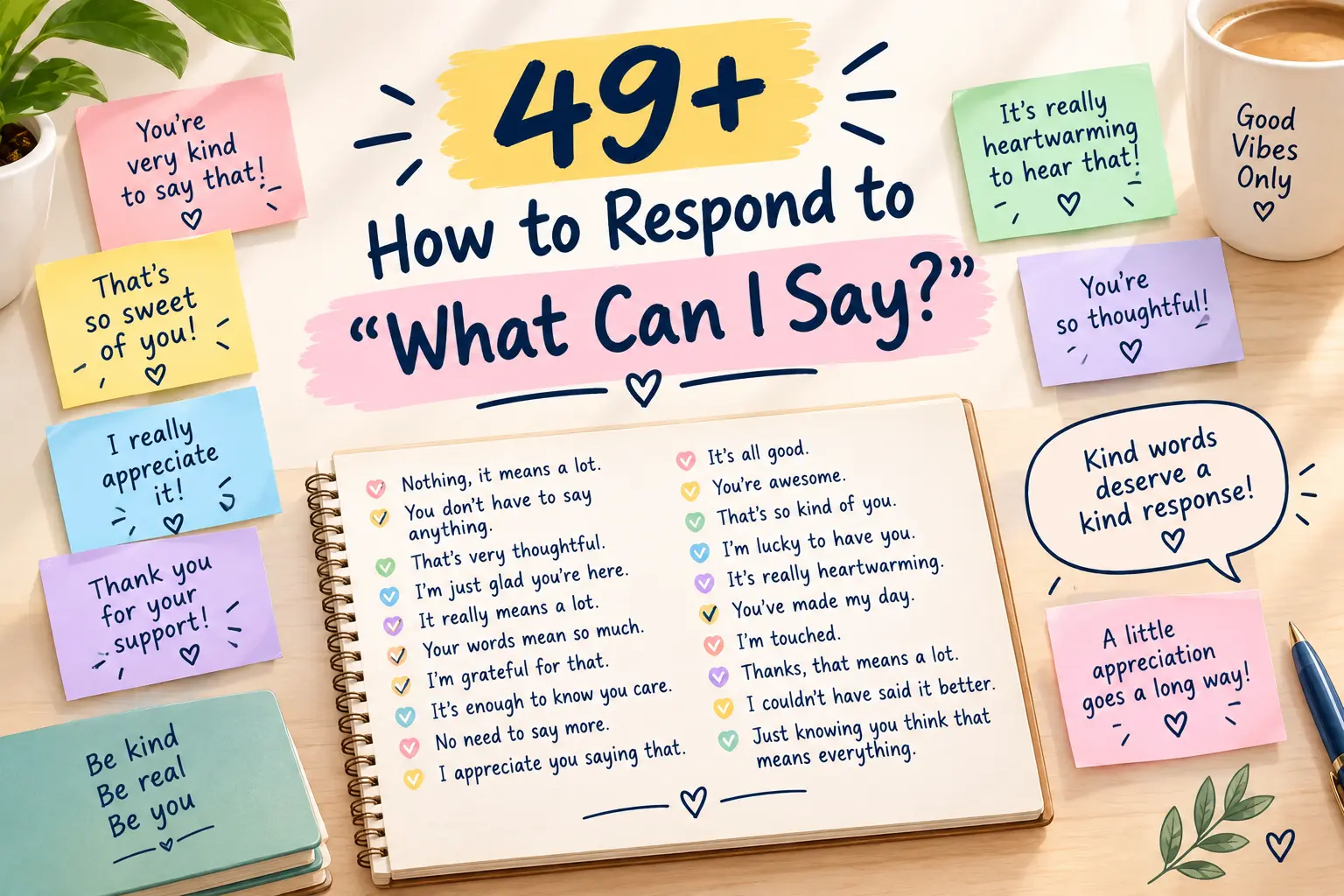
Sometimes a person says, “What can I say?” because they genuinely do not know how to respond. Other times, it can express surprise, embarrassment, gratitude, uncertainty, or even playful sarcasm. The meaning depends heavily on the situation and the tone behind the words. Knowing how to respond can help you keep a conversation natural instead of leaving it at an awkward pause.
Whether you are texting a friend, responding to a coworker, comforting someone, or having a lighthearted conversation, the right reply can make a big difference. Instead of always giving the same predictable response, you can choose an expression that matches the mood. From warm and supportive answers to clever and playful comebacks, these alternatives give you more ways to communicate naturally and confidently.
What Does “What Can I Say?” Mean?
“What can I say?” is a common expression used when someone feels they do not have the right words for a situation.
It can have several meanings depending on context. Someone might say it after receiving a compliment, admitting something, explaining a difficult situation, or joking with another person.
For example:
“You really helped me today.”
“What can I say? I’m always here for you.”
Here, the phrase is confident and friendly.
However, if someone says, “What can I say? Things did not go as planned,” they may be expressing disappointment or resignation.
The emotional tone can therefore range from sincere and thoughtful to humorous, sarcastic, surprised, or uncertain.
When to Use “What Can I Say?”
“What can I say?” works in many everyday situations, but the meaning changes with the conversation.
In casual conversations, you might use it after receiving a compliment:
“You always know how to make people laugh.”
“What can I say? It’s a talent.”
In a workplace conversation, it can be used more carefully:
“The presentation went really well.”
“What can I say? The team put in a lot of effort.”
It can also appear in emails, speeches, interviews, and personal conversations when someone wants to emphasize that words are not enough to express their feelings.
For example, during a speech, someone might say, “What can I say about a person who has supported me throughout my career?”
The phrase is flexible, but your response should always match the relationship and situation.
Is “What Can I Say?” Polite or Professional?
“What can I say?” is generally polite, but it is not always the best choice for formal communication.
In casual conversations, it sounds natural and conversational. Among friends, family members, or familiar coworkers, it can add personality to a conversation.
In professional settings, the phrase can work when used sincerely, but alternatives such as “I appreciate that,” “I’m glad you think so,” or “I’m happy to help” may sound clearer and more polished.
The key is context. If someone says “What can I say?” in a playful way, a humorous response may work well. If they are struggling to find words after an emotional moment, a thoughtful response is more appropriate.
1. “You don’t have to say anything.”
Meaning: Your actions or feelings already communicate enough.
Tone: Supportive, warm.
“You don’t have to say anything. I already understand.”
Why use it: Use this when someone seems unsure about how to explain themselves.
Purpose and Personalization: It works particularly well during sincere or emotional conversations.
2. “Just be yourself.”
Meaning: There is no need to search for a perfect response.
Tone: Encouraging, friendly.
“You don’t need a perfect answer. Just be yourself.”
Why use it: This is useful when someone is nervous about what to say.
Purpose and Personalization: It creates a relaxed atmosphere and removes pressure.
3. “Say what you really think.”
Meaning: Encourage the person to speak honestly.
Tone: Direct, thoughtful.
“You can be honest with me. Say what you really think.”
Why use it: Use this when you want an honest answer.
Purpose and Personalization: It encourages open communication without forcing a particular answer.
4. “I think you’ve said enough.”
Meaning: The person’s message is already clear.
Tone: Calm, slightly firm.
“I think you’ve said enough. I understand your point.”
Why use it: This works when further explanation is unnecessary.
Purpose and Personalization: It can also politely bring a long conversation to an end.
5. “Let your actions speak.”
Meaning: Actions can communicate more effectively than words.
Tone: Motivational, thoughtful.
“You don’t need another explanation. Let your actions speak.”
Why use it: Use this when someone’s behavior matters more than their promises.
Purpose and Personalization: It sounds especially powerful in serious conversations.
6. “Whatever feels right to you.”
Meaning: The person can choose what they genuinely want to say.
Tone: Relaxed, supportive.
“Whatever feels right to you, just be honest about it.”
Why use it: This gives someone freedom without pressuring them.
Purpose and Personalization: It is ideal for personal conversations.
7. “You can simply be honest.”
Meaning: There is no need to make the answer complicated.
Tone: Sincere, mature.
“You can simply be honest. That’s all I’m asking for.”
Why use it: Use this when clarity and honesty matter.
Purpose and Personalization: It works well when discussing misunderstandings.
8. “Tell me what’s on your mind.”
Meaning: Invite the person to explain their thoughts.
Tone: Caring, conversational.
“You seem distracted. Tell me what’s on your mind.”
Why use it: This is useful when someone appears hesitant.
Purpose and Personalization: It opens the door to a deeper conversation.
9. “Whatever you need to say, I’m listening.”
Meaning: You are giving the person your full attention.
Tone: Caring, supportive.
“Take your time. Whatever you need to say, I’m listening.”
Why use it: Use this when someone is struggling to express themselves.
Purpose and Personalization: It shows patience and emotional awareness.
10. “There’s no perfect thing to say.”
Meaning: People do not need perfect words in every situation.
Tone: Reassuring.
“There’s no perfect thing to say. Just tell me how you feel.”
Why use it: This can help someone who is overthinking their response.
Purpose and Personalization: It makes difficult conversations feel less intimidating.
11. “You already know what you want to say.”
Meaning: The person may simply be hesitating.
Tone: Encouraging.
“You already know what you want to say. Just say it.”
Why use it: Use this with someone who needs a little confidence.
Purpose and Personalization: It works particularly well with close friends.
12. “Go ahead, I’m listening.”
Meaning: You are ready for them to continue.
Tone: Friendly, attentive.
“Go ahead, I’m listening. Tell me everything.”
Why use it: This is a simple way to keep a conversation moving.
Purpose and Personalization: It works in both personal and informal workplace conversations.
13. “Just tell me the truth.”
Meaning: You want an honest answer rather than a polished one.
Tone: Direct, serious.
“You don’t need to make excuses. Just tell me the truth.”
Why use it: Use this when honesty is especially important.
Purpose and Personalization: It should be used carefully because it can sound intense.
14. “I’m sure you’ll find the right words.”
Meaning: You trust the person to express themselves.
Tone: Encouraging, gentle.
“Take your time. I’m sure you’ll find the right words.”
Why use it: This is helpful when someone is nervous about speaking.
Purpose and Personalization: It offers reassurance without answering for them.
15. “Sometimes no words are needed.”
Meaning: Silence or actions can communicate enough.
Tone: Reflective, emotional.
“Sometimes no words are needed. I know what you mean.”
Why use it: Use this during meaningful or emotional moments.
Purpose and Personalization: It gives the conversation a calm, sincere feeling.
16. “You can start wherever you want.”
Meaning: The person does not need to organize their thoughts perfectly.
Tone: Patient, supportive.
“You can start wherever you want. We’ll figure it out together.”
Why use it: This is helpful when someone does not know how to begin.
Purpose and Personalization: It encourages natural communication.
17. “Take your time.”
Meaning: There is no need to rush.
Tone: Calm, reassuring.
“Take your time. I’m not expecting an immediate answer.”
Why use it: Use it when someone needs a moment to think.
Purpose and Personalization: It is short but effective in stressful conversations.
18. “Say whatever comes naturally.”
Meaning: Speak without overthinking.
Tone: Casual, encouraging.
“Don’t overthink it. Say whatever comes naturally.”
Why use it: This works well with nervous friends or classmates.
Purpose and Personalization: It encourages authentic communication.
19. “I’d rather hear what you genuinely feel.”
Meaning: You value sincerity over a perfect response.
Tone: Mature, thoughtful.
“Forget the perfect answer. I’d rather hear what you genuinely feel.”
Why use it: This is ideal for meaningful personal conversations.
Purpose and Personalization: It makes the conversation feel more honest.
20. “You can tell me everything.”
Meaning: You are open to hearing the full story.
Tone: Warm, supportive.
“You can tell me everything. I’m not here to judge you.”
Why use it: Use this when someone seems afraid to open up.
Purpose and Personalization: It creates a sense of trust.
21. “I understand. No explanation needed.”
Meaning: You already understand their situation.
Tone: Calm, compassionate.
“I understand. No explanation needed.”
Why use it: This works when someone’s actions or circumstances are already clear.
Purpose and Personalization: It can prevent unnecessary explanations.
22. “I appreciate your honesty.”
Meaning: You value the person’s willingness to be truthful.
Tone: Polite, professional.
“I appreciate your honesty. It helps us move forward.”
Why use it: This is particularly useful in workplace discussions.
Purpose and Personalization: It acknowledges honesty without judging the answer.
23. “That’s all I needed to hear.”
Meaning: The person’s answer has given you enough information.
Tone: Confident, direct.
“That’s all I needed to hear. Thanks for being straightforward.”
Why use it: Use this when you have received a clear answer.
Purpose and Personalization: It brings closure to a conversation naturally.
24. “I think we both know the answer.”
Meaning: The answer may already be obvious.
Tone: Confident, slightly teasing.
“I think we both know the answer here.”
Why use it: This can work during playful or familiar conversations.
Purpose and Personalization: Use it only when the context is clear enough to avoid confusion.
25. “You said it perfectly.”
Meaning: The person’s words expressed exactly what needed to be said.
Tone: Appreciative.
“Honestly, you said it perfectly.”
Why use it: Use this after someone gives a thoughtful explanation.
Purpose and Personalization: It reinforces their confidence.
26. “That actually says a lot.”
Meaning: Their words or behavior communicate more than they realize.
Tone: Thoughtful, observant.
“You may not realize it, but that actually says a lot.”
Why use it: This works when a short comment carries deeper meaning.
Purpose and Personalization: It can encourage someone to reflect on their words.
27. “You’ve made your point.”
Meaning: Their message is already clear.
Tone: Direct, professional.
“I understand your concerns. You’ve made your point.”
Why use it: Useful during discussions or disagreements.
Purpose and Personalization: It acknowledges the other person’s position without necessarily agreeing with it.
28. “That’s one way to put it.”
Meaning: Acknowledge someone’s unusual or interesting wording.
Tone: Playful, mildly sarcastic.
“You call it being spontaneous? That’s one way to put it.”
Why use it: This is best for casual conversations.
Purpose and Personalization: It can add humor without being overly harsh.
29. “Well, you’re not wrong.”
Meaning: The person has made a reasonable point.
Tone: Casual, humorous.
“You’re not wrong. That was definitely an unexpected decision.”
Why use it: Use this when you partly agree with someone.
Purpose and Personalization: It is a natural phrase for friendly debates.
30. “What can I say? You have a point.”
Meaning: Admit that the other person’s argument makes sense.
Tone: Friendly, conversational.
“What can I say? You have a point about the timing.”
Why use it: This keeps a disagreement respectful.
Purpose and Personalization: It shows that you can acknowledge another perspective.
31. “Fair enough.”
Meaning: You accept what the person has said, even if you do not completely agree.
Tone: Casual, mature.
“Fair enough. I can understand why you made that choice.”
Why use it: This is one of the easiest responses for everyday conversations.
Purpose and Personalization: It works particularly well when you want to avoid unnecessary arguments.
32. “I’ll give you that.”
Meaning: You admit that the person has made a valid point.
Tone: Confident, conversational.
“I’ll give you that. Your argument is actually pretty convincing.”
Why use it: Use this during friendly debates or discussions.
Purpose and Personalization: It sounds confident without being overly formal.
33. “You got me there.”
Meaning: You admit that someone has made a good point or caught you off guard.
Tone: Playful, friendly.
“You got me there. I honestly didn’t think of that.”
Why use it: This is perfect for lighthearted conversations.
Purpose and Personalization: It keeps disagreements fun rather than confrontational.
34. “I suppose that speaks for itself.”
Meaning: The situation is clear without further explanation.
Tone: Reflective, polished.
“The results were impressive, so I suppose that speaks for itself.”
Why use it: This works particularly well in professional or formal discussions.
Purpose and Personalization: It allows you to make a point without overexplaining.
35. “Sometimes the simplest answer is best.”
Meaning: A straightforward response can be enough.
Tone: Thoughtful, calm.
“Don’t complicate it. Sometimes the simplest answer is best.”
Why use it: Use this when someone is overthinking their response.
Purpose and Personalization: It encourages clarity.
36. “You don’t need to explain yourself to me.”
Meaning: You are not demanding an explanation.
Tone: Understanding, supportive.
“It’s okay. You don’t need to explain yourself to me.”
Why use it: This can reassure someone who feels pressured.
Purpose and Personalization: It works best when there is already trust between both people.
37. “I know exactly what you mean.”
Meaning: You understand their feelings or message.
Tone: Friendly, empathetic.
“I know exactly what you mean. I’ve been in the same situation.”
Why use it: This is useful when you can relate to someone’s experience.
Purpose and Personalization: It creates a stronger sense of connection.
38. “I’m with you on that.”
Meaning: You agree with their perspective.
Tone: Casual, supportive.
“I’m with you on that. We should probably wait until tomorrow.”
Why use it: Use this when you want to show agreement.
Purpose and Personalization: It sounds more conversational than simply saying “I agree.”
39. “I hear you.”
Meaning: You acknowledge that you understand what someone is saying.
Tone: Empathetic, mature.
“I hear you. It has been a frustrating week.”
Why use it: This is especially useful during emotional conversations.
Purpose and Personalization: It validates the conversation without automatically agreeing with every point.
40. “That makes sense.”
Meaning: You understand their reasoning.
Tone: Friendly, neutral.
“That makes sense. I can see why you chose that option.”
Why use it: This is a simple response for both personal and professional settings.
Purpose and Personalization: It keeps communication clear and respectful.
41. “I can see where you’re coming from.”
Meaning: You understand their perspective.
Tone: Mature, diplomatic.
“I can see where you’re coming from, even though I see it differently.”
Why use it: This is excellent for respectful disagreements.
Purpose and Personalization: It helps prevent conversations from becoming unnecessarily argumentative.
42. “Let’s keep it simple.”
Meaning: Focus on the main point instead of overcomplicating things.
Tone: Confident, practical.
“Let’s keep it simple. We just need to decide what works best.”
Why use it: Use this when a conversation is becoming unnecessarily complicated.
Purpose and Personalization: It brings attention back to the main issue.
43. “Just say what you mean.”
Meaning: Be direct rather than vague.
Tone: Direct, confident.
“You can stop hinting and just say what you mean.”
Why use it: This works with people who are avoiding a straightforward answer.
Purpose and Personalization: It is best used when you have a comfortable relationship with the person.
44. “I’m curious to hear your thoughts.”
Meaning: You genuinely want to know what they think.
Tone: Thoughtful, professional.
“I’ve shared my opinion, and now I’m curious to hear your thoughts.”
Why use it: This is excellent for meetings, discussions, and meaningful conversations.
Purpose and Personalization: It encourages participation without putting someone on the spot.
45. “Tell me more.”
Meaning: Invite the person to continue explaining.
Tone: Friendly, interested.
“That sounds interesting. Tell me more.”
Why use it: This is a simple way to show genuine interest.
Purpose and Personalization: It works especially well when someone has shared an intriguing story.
46. “I’m interested in your perspective.”
Meaning: You want to understand how they see the situation.
Tone: Professional, thoughtful.
“Before we make a decision, I’m interested in your perspective.”
Why use it: This fits workplace discussions and serious conversations.
Purpose and Personalization: It encourages constructive communication.
47. “What would you like to say?”
Meaning: Give the person an open opportunity to speak.
Tone: Calm, neutral.
“You seem like you have something on your mind. What would you like to say?”
Why use it: Use this when you sense that someone is holding something back.
Purpose and Personalization: It creates space for an honest response.
48. “I’m open to hearing it.”
Meaning: You are willing to listen without immediately judging.
Tone: Receptive, mature.
“Whatever your opinion is, I’m open to hearing it.”
Why use it: This is useful when discussing different viewpoints.
Purpose and Personalization: It encourages honest communication.
49. “Say what needs to be said.”
Meaning: Encourage direct and necessary communication.
Tone: Serious, confident.
“If there’s something we need to address, say what needs to be said.”
Why use it: This works when avoiding a difficult topic would not be helpful.
Purpose and Personalization: It communicates confidence and openness.
50. “I think honesty is the best answer here.”
Meaning: Encourage truthful communication rather than excuses.
Tone: Mature, sincere.
“We can avoid all the guessing. I think honesty is the best answer here.”
Why use it: This is useful when the conversation involves uncertainty or misunderstanding.
Purpose and Personalization: It shifts attention toward clarity and trust.
51. “Sometimes you just have to say it as it is.”
Meaning: Speak plainly instead of trying to make the situation sound better than it is.
Tone: Honest, confident.
“It wasn’t an easy decision, but sometimes you just have to say it as it is.”
Why use it: This works when direct communication is more valuable than carefully polished language.
Purpose and Personalization: It gives your response a realistic and straightforward tone.
52. “I think your answer is already clear.”
Meaning: Their words or behavior have already communicated enough.
Tone: Calm, confident.
“You keep avoiding the question, but I think your answer is already clear.”
Why use it: Use this when someone is hesitant to state something directly.
Purpose and Personalization: It can be useful when you want to acknowledge an obvious message without pushing for more explanation.
Conclusion
Knowing how to respond to “What can I say?” gives you more control over the tone of a conversation. Instead of relying on the same predictable response, you can choose words that sound supportive, professional, confident, thoughtful, or playful.
The best response depends on the situation and the relationship you have with the other person. A simple “Tell me more” may be perfect for a friend, while “I appreciate your honesty” may fit a workplace conversation better.
Do not force complicated expressions into everyday conversations. Choose alternatives that feel natural and let your personality come through. Good communication is not about having the fanciest words; it is about using the right words at the right moment.
Discover more