
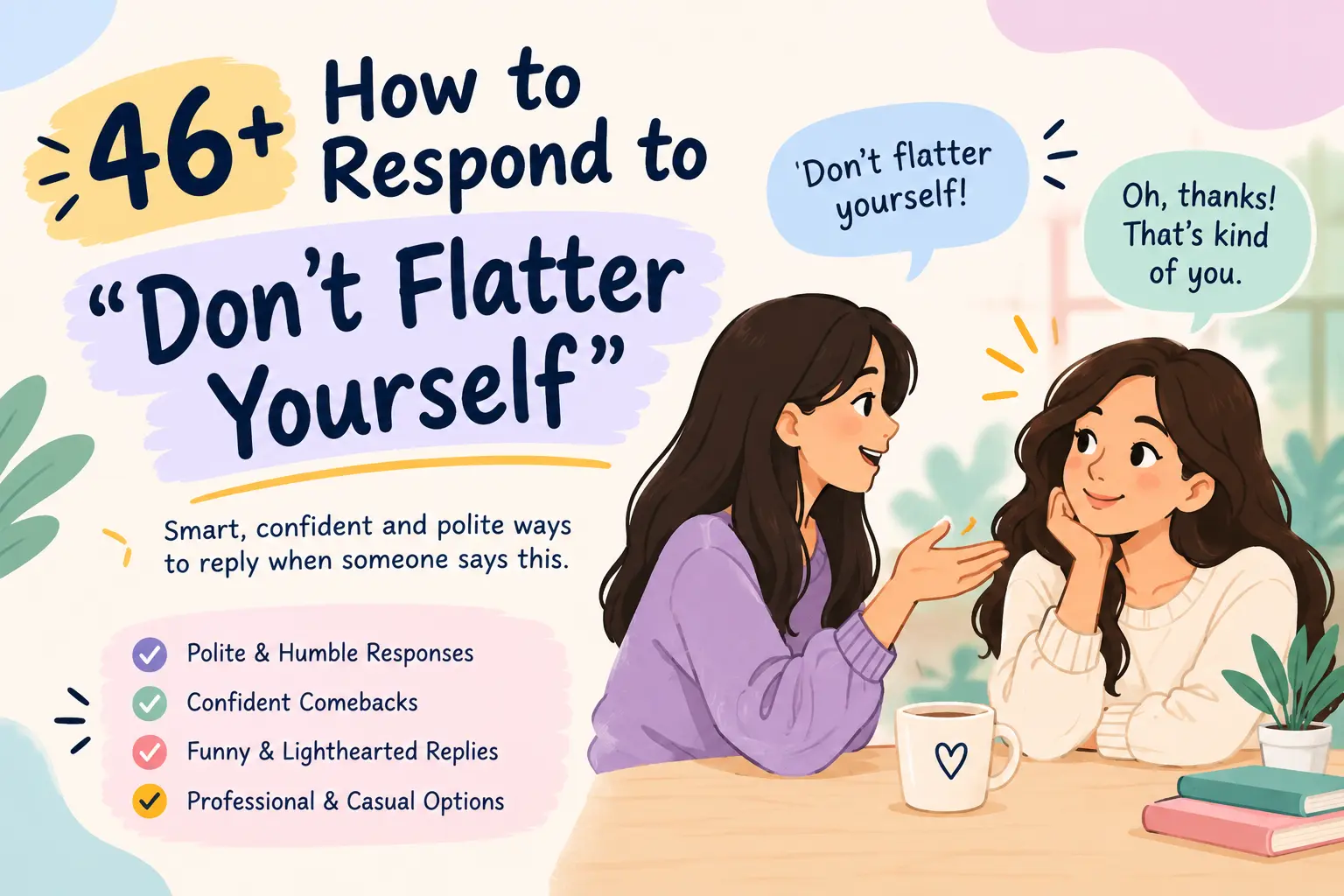
“Don’t flatter yourself” can land in very different ways depending on who says it and how they say it. Sometimes it is playful teasing between friends. Other times, it can sound dismissive, sarcastic, or even a little rude. That is why knowing how to respond to “don’t flatter yourself” can help you handle the moment without becoming defensive. A clever response can turn an awkward exchange into a funny conversation, while a confident response can make it clear that you are not bothered by the comment. The best reply depends on the relationship, context, and tone. Whether you want something witty, sarcastic, confident, classy, or lighthearted, having a few responses ready can make communication much easier. Here are more than 46 creative ways to respond naturally while keeping your personality intact.
What Does “Don’t Flatter Yourself” Mean?
“Don’t flatter yourself” usually means “don’t think too highly of yourself” or “don’t assume you are as important, attractive, impressive, or influential as you think you are.”
The phrase can be playful or insulting depending on the situation.
For example, if a friend says, “You came all this way just to see me, didn’t you?” you might jokingly reply, “Don’t flatter yourself.”
On the other hand, someone might use the phrase seriously to shut down another person’s assumption or confidence.
The emotional tone is therefore important. A playful “Don’t flatter yourself” can invite more teasing, while a harsh version may require a calm and self-assured response.
When to Use It
Responses to “don’t flatter yourself” are mostly useful in casual conversations, texting, friendships, dating, social media, and playful banter.
For example:
- With a friend: “Relax, your ego is safe.”
- During playful teasing: “Too late. I already impressed myself.”
- With someone being dismissive: “Confidence isn’t the same thing as arrogance.”
- In a lighthearted conversation: “I wasn’t flattering myself. I was stating the obvious.”
In professional settings, however, it is usually better to avoid sarcastic comebacks unless you know the person extremely well. A calm and neutral response is often more appropriate at work.
Is It Polite or Professional?
“Don’t flatter yourself” is generally casual and somewhat sarcastic. It can be perfectly harmless between friends, but it can also sound dismissive when used seriously.
Because of that, witty or savage responses are usually better suited to casual conversations. In professional settings, a composed response is safer.
If a colleague says something similar during a workplace discussion, you could respond with:
“I understand your perspective. I was simply explaining my point.”
This keeps the conversation professional instead of turning it into an argument.
1. “Too late. I already did.”
Meaning: You are jokingly admitting that you have already complimented yourself.
Tone: Playful and confident.
Example Sentence: “Too late. I already did, and honestly, I stand by it.”
Why to use it: This is a simple response when someone is teasing you. It keeps the exchange light instead of defensive.
2. “I wasn’t flattering myself. I was stating the obvious.”
Meaning: You are humorously suggesting that your confidence is justified.
Tone: Confident and witty.
Example Sentence: “Don’t flatter yourself.” “I wasn’t flattering myself. I was stating the obvious.”
Why to use it: Perfect when you want to return the sarcasm without becoming aggressive.
3. “Don’t worry, your ego is safe.”
Meaning: You are assuring them that you were not trying to compliment yourself because of them.
Tone: Playful and sarcastic.
Example Sentence: “Relax, your ego is safe. This wasn’t about you.”
Why to use it: This works especially well when someone assumes you are impressed by them.
4. “I wasn’t talking about you.”
Meaning: You are directly correcting their assumption.
Tone: Calm and slightly sharp.
Example Sentence: “Don’t flatter yourself. I wasn’t talking about you.”
Why to use it: Use this when someone has misunderstood your comment and you want to make that clear.
5. “You seem unusually concerned with my confidence.”
Meaning: You are pointing out that their reaction says more about them than you.
Tone: Clever and composed.
Example Sentence: “You seem unusually concerned with my confidence today.”
Why to use it: This is a sophisticated response when you want to stay calm while turning the observation back on them.
6. “I’ll try to survive the compliment.”
Meaning: You are jokingly treating their remark as if it were actually flattering.
Tone: Humorous and playful.
Example Sentence: “Don’t flatter yourself.” “I’ll try to survive the compliment.”
Why to use it: Great for friendly banter when you want to keep the conversation amusing.
7. “Confidence looks good on me, though.”
Meaning: You are refusing to be embarrassed about being confident.
Tone: Confident and cheeky.
Example Sentence: “Maybe I am confident. Confidence looks good on me, though.”
Why to use it: This works when someone is trying to make you feel bad about being self-assured.
8. “I wasn’t flattering myself. You just misunderstood me.”
Meaning: You are calmly clarifying your intention.
Tone: Mature and composed.
Example Sentence: “I wasn’t flattering myself. You just misunderstood what I meant.”
Why to use it: A good choice when you want to avoid unnecessary conflict.
9. “Interesting assumption.”
Meaning: You are acknowledging their comment without accepting their interpretation.
Tone: Calm and subtly sarcastic.
Example Sentence: “Interesting assumption, but that’s not what I meant.”
Why to use it: Short, controlled, and useful when you do not want to over-explain yourself.
10. “I think you give yourself too much credit.”
Meaning: You are turning their own remark back toward them.
Tone: Sarcastic and confident.
Example Sentence: “Don’t flatter yourself.” “I think you give yourself too much credit.”
Why to use it: Best used with someone who enjoys playful verbal sparring.
11. “Don’t worry, I have standards.”
Meaning: You are jokingly implying that you are not easily impressed.
Tone: Savage and playful.
Example Sentence: “You think I’m impressed? Don’t worry, I have standards.”
Why to use it: A strong comeback when the conversation is clearly teasing.
12. “I promise your ego wasn’t the topic.”
Meaning: You are making it clear that the conversation was not centered on them.
Tone: Witty and direct.
Example Sentence: “I promise your ego wasn’t the topic of discussion.”
Why to use it: Useful when someone assumes everything you say is about them.
13. “You really do love being the main character.”
Meaning: You are teasing them for assuming everything revolves around them.
Tone: Funny and sarcastic.
Example Sentence: “You really do love being the main character, don’t you?”
Why to use it: Best for friends or people you already joke with.
14. “I appreciate the confidence you have in yourself.”
Meaning: You are politely teasing someone for being overly self-important.
Tone: Polite but sarcastic.
Example Sentence: “I appreciate the confidence you have in yourself, honestly.”
Why to use it: This has a polished sarcastic edge without sounding openly hostile.
15. “That confidence is almost impressive.”
Meaning: You are joking about how self-assured they are.
Tone: Dry and witty.
Example Sentence: “That confidence is almost impressive. Almost.”
Why to use it: The final word adds a subtle punch.
16. “I wasn’t flattering myself. I was entertaining myself.”
Meaning: You are suggesting that you were simply having fun.
Tone: Funny and relaxed.
Example Sentence: “Don’t flatter yourself.” “I’m not. I was entertaining myself.”
Why to use it: Great when the conversation is playful rather than serious.
17. “You took that personally?”
Meaning: You are questioning why they reacted so strongly.
Tone: Casual and teasing.
Example Sentence: “You took that personally? That wasn’t even directed at you.”
Why to use it: Useful when someone seems unnecessarily defensive.
18. “I think you’re flattering yourself more than I am.”
Meaning: You are cleverly reversing their accusation.
Tone: Sharp and humorous.
Example Sentence: “Honestly, I think you’re flattering yourself more than I ever could.”
Why to use it: One of the better choices when you want a witty comeback.
19. “That’s a very generous interpretation of what I said.”
Meaning: You are pointing out that they have exaggerated your comment.
Tone: Sophisticated and sarcastic.
Example Sentence: “That’s a very generous interpretation of what I said.”
Why to use it: Works well when you want to sound intelligent rather than confrontational.
20. “I think I’ll keep my confidence, thanks.”
Meaning: You are politely refusing to let their comment affect you.
Tone: Confident and mature.
Example Sentence: “I think I’ll keep my confidence, thanks. It suits me.”
Why to use it: A good response when someone is genuinely trying to undermine you.
21. “Noted. I’ll continue anyway.”
Meaning: You acknowledge their remark without allowing it to change your behavior.
Tone: Calm and self-assured.
Example Sentence: “Don’t flatter yourself.” “Noted. I’ll continue anyway.”
Why to use it: This is especially effective when you want to avoid an argument.
22. “I’ll take that as your way of saying I’m memorable.”
Meaning: You are humorously reframing their comment as a compliment.
Tone: Playful and clever.
Example Sentence: “Don’t flatter yourself.” “I’ll take that as your way of saying I’m memorable.”
Why to use it: Great for lighthearted conversations where you want to keep the energy fun.
23. “Your imagination is working overtime.”
Meaning: You are suggesting that they have imagined an intention that was never there.
Tone: Sarcastic and playful.
Example Sentence: “Your imagination is working overtime today.”
Why to use it: A good response when someone makes an exaggerated assumption.
24. “You wish I were flattering myself about you.”
Meaning: You are teasing them by suggesting they actually want your attention.
Tone: Flirty and cheeky.
Example Sentence: “You wish I were flattering myself about you.”
Why to use it: This works best when there is already playful chemistry.
25. “Don’t worry, I wasn’t that impressed.”
Meaning: You are jokingly suggesting that they are not as impressive as they think.
Tone: Savage and humorous.
Example Sentence: “Relax, I wasn’t that impressed in the first place.”
Why to use it: Use this with someone who can handle sarcasm.
26. “I think you misunderstood the assignment.”
Meaning: You are humorously saying that they completely misread the situation.
Tone: Modern and playful.
Example Sentence: “I think you misunderstood the assignment. This wasn’t about you.”
Why to use it: A fun choice for casual texting.
27. “That’s cute. Anyway…”
Meaning: You are dismissing their comment in a deliberately playful way.
Tone: Sarcastic and confident.
Example Sentence: “That’s cute. Anyway, back to what I was saying…”
Why to use it: Works when the conversation is light and you want to move on quickly.
28. “I’ll try not to let your opinion ruin my day.”
Meaning: You are making it clear that their comment does not affect you.
Tone: Confident and sarcastic.
Example Sentence: “I’ll try not to let your opinion ruin my day.”
Why to use it: Useful when someone is being unnecessarily dismissive.
29. “You seem more bothered by my confidence than I am.”
Meaning: You are pointing out that their reaction appears stronger than your original statement.
Tone: Mature and assertive.
Example Sentence: “You seem more bothered by my confidence than I am.”
Why to use it: This is a strong option when the conversation starts becoming unnecessarily personal.
30. “I don’t remember asking for an ego check.”
Meaning: You are telling them that their judgment was unnecessary.
Tone: Direct and slightly savage.
Example Sentence: “Thanks, but I don’t remember asking for an ego check.”
Why to use it: Good when someone is crossing the line from teasing into criticism.
31. “I’ll let you believe that.”
Meaning: You are deliberately refusing to argue about their opinion.
Tone: Dry and confident.
Example Sentence: “Don’t flatter yourself.” “I’ll let you believe that.”
Why to use it: Sometimes the strongest comeback is simply refusing to engage.
32. “Whatever helps you sleep at night.”
Meaning: You are dismissing their statement as something they need to believe.
Tone: Savage and sarcastic.
Example Sentence: “If that’s what you think, whatever helps you sleep at night.”
Why to use it: Use carefully because this can sound harsh outside a joking relationship.
33. “Your confidence is doing a lot of heavy lifting here.”
Meaning: You are suggesting their self-importance is doing more work than reality.
Tone: Clever and sarcastic.
Example Sentence: “Your confidence is doing a lot of heavy lifting in this conversation.”
Why to use it: A more sophisticated alternative to a basic insult.
34. “I wasn’t complimenting myself. I was making a point.”
Meaning: You are clarifying that your statement was not intended as self-praise.
Tone: Professional and composed.
Example Sentence: “I wasn’t complimenting myself. I was making a point about the situation.”
Why to use it: This is one of the safest choices when the conversation is becoming serious.
35. “You can relax. I’m not competing with you.”
Meaning: You are telling the other person that there is no competition between you.
Tone: Calm and confident.
Example Sentence: “You can relax. I’m not competing with you.”
Why to use it: Useful when someone interprets your confidence as a challenge.
36. “Confidence isn’t arrogance.”
Meaning: You are distinguishing healthy self-belief from thinking you are better than everyone else.
Tone: Mature and assertive.
Example Sentence: “Confidence isn’t arrogance, and I don’t think there’s anything wrong with knowing my worth.”
Why to use it: This works particularly well when the comment is genuinely disrespectful.
37. “I’ll take your opinion under advisement.”
Meaning: You are politely acknowledging their opinion without promising to follow it.
Tone: Formal and subtly humorous.
Example Sentence: “I’ll take your opinion under advisement, but I think I’ll trust my judgment.”
Why to use it: A polished response when you want to stay composed.
38. “Thanks for your concern.”
Meaning: You are politely dismissing an unwanted opinion.
Tone: Dry and controlled.
Example Sentence: “Thanks for your concern, but I’m quite comfortable with what I said.”
Why to use it: Short, mature, and effective when you do not want an argument.
39. “I think we’re giving this comment more importance than it deserves.”
Meaning: You are suggesting that the conversation is becoming unnecessarily serious.
Tone: Mature and diplomatic.
Example Sentence: “I think we’re giving this comment more importance than it deserves. Let’s move on.”
Why to use it: Excellent when you want to de-escalate tension.
40. “You don’t have to agree with me.”
Meaning: You are showing that you are comfortable having a different opinion.
Tone: Calm and self-assured.
Example Sentence: “You don’t have to agree with me. I’m still comfortable with my opinion.”
Why to use it: This is particularly useful when a disagreement is becoming personal.
41. “I know what I bring to the table.”
Meaning: You are confidently expressing awareness of your own value.
Tone: Strong and self-assured.
Example Sentence: “I know what I bring to the table, so I’m not worried about that.”
Why to use it: Best when someone is genuinely attempting to undermine your confidence.
42. “I don’t need your permission to feel good about myself.”
Meaning: Your self-confidence does not depend on someone else’s approval.
Tone: Empowered and assertive.
Example Sentence: “I don’t need your permission to feel good about myself.”
Why to use it: A strong response when the other person’s comment is intentionally disrespectful.
43. “Maybe I am giving myself credit. Someone has to.”
Meaning: You are humorously defending your own achievements.
Tone: Witty and confident.
Example Sentence: “Maybe I am giving myself credit. Someone has to.”
Why to use it: This turns a potentially negative comment into a confident joke.
44. “I’d rather be confident than constantly seeking approval.”
Meaning: You are explaining that self-confidence is preferable to relying on other people’s opinions.
Tone: Mature and reflective.
Example Sentence: “I’d rather be confident than constantly seeking approval from everyone around me.”
Why to use it: Best for a serious conversation about confidence and self-worth.
45. “You can keep your opinion; I’ll keep my confidence.”
Meaning: You respectfully separate their opinion from your self-belief.
Tone: Strong and polished.
Example Sentence: “You can keep your opinion, and I’ll keep my confidence. Everyone wins.”
Why to use it: It is assertive without requiring an argument.
46. “I wasn’t looking for validation in the first place.”
Meaning: You are making it clear that their approval was never necessary.
Tone: Confident and mature.
Example Sentence: “I wasn’t looking for validation in the first place, but thanks for the input.”
Why to use it: Useful when someone assumes you need their approval.
47. “If confidence bothers you, that’s something for you to unpack.”
Meaning: You are suggesting that their discomfort with your confidence belongs to them.
Tone: Sophisticated and assertive.
Example Sentence: “If my confidence bothers you, that’s probably something for you to unpack.”
Why to use it: This is a sharper response and should be reserved for situations where someone is deliberately putting you down.
48. “I think I’ll continue believing in myself.”
Meaning: You are calmly refusing to let criticism weaken your self-belief.
Tone: Positive and mature.
Example Sentence: “You don’t have to agree with me. I think I’ll continue believing in myself.”
Why to use it: A strong alternative when you want confidence without hostility.
49. “That’s one opinion. It doesn’t have to become my reality.”
Meaning: You recognize their perspective without allowing it to define you.
Tone: Thoughtful and empowered.
Example Sentence: “That’s one opinion, and it doesn’t have to become my reality.”
Why to use it: Particularly useful when the conversation is more serious than playful.
50. “I’ll leave you with that thought.”
Meaning: You are ending the debate rather than continuing to argue.
Tone: Calm and composed.
Example Sentence: “You may see it differently, and that’s fine. I’ll leave you with that thought.”
Why to use it: A useful response when you want to end an unproductive exchange gracefully.
Conclusion
Knowing how to respond to “don’t flatter yourself” is less about having the harshest comeback and more about understanding the situation. With a friend, a playful response can keep the banter entertaining. With someone being genuinely dismissive, a calm and confident answer can protect your self-respect without escalating the situation. The best response is the one that matches your personality, relationship, and tone of the conversation. You do not always need to prove yourself or win the exchange. Sometimes confidence means knowing when to joke, when to speak up, and when simply to move on.
Discover more
how to respond to merry christmas texts