
Sometimes, a simple phrase can make a conversation feel warmer, more professional, and more welcoming. “I am happy to assist you” is one of those expressions. It communicates willingness, courtesy, and a genuine readiness to help, making it especially useful in customer service, workplace communication, emails, and professional conversations.
However, repeating the same phrase can make your communication sound predictable. Using thoughtful alternatives allows you to match your wording to the situation, relationship, and tone you want to create. Whether you need a polished business expression, a friendly response, or a more confident way to offer support, there are plenty of options to choose from.
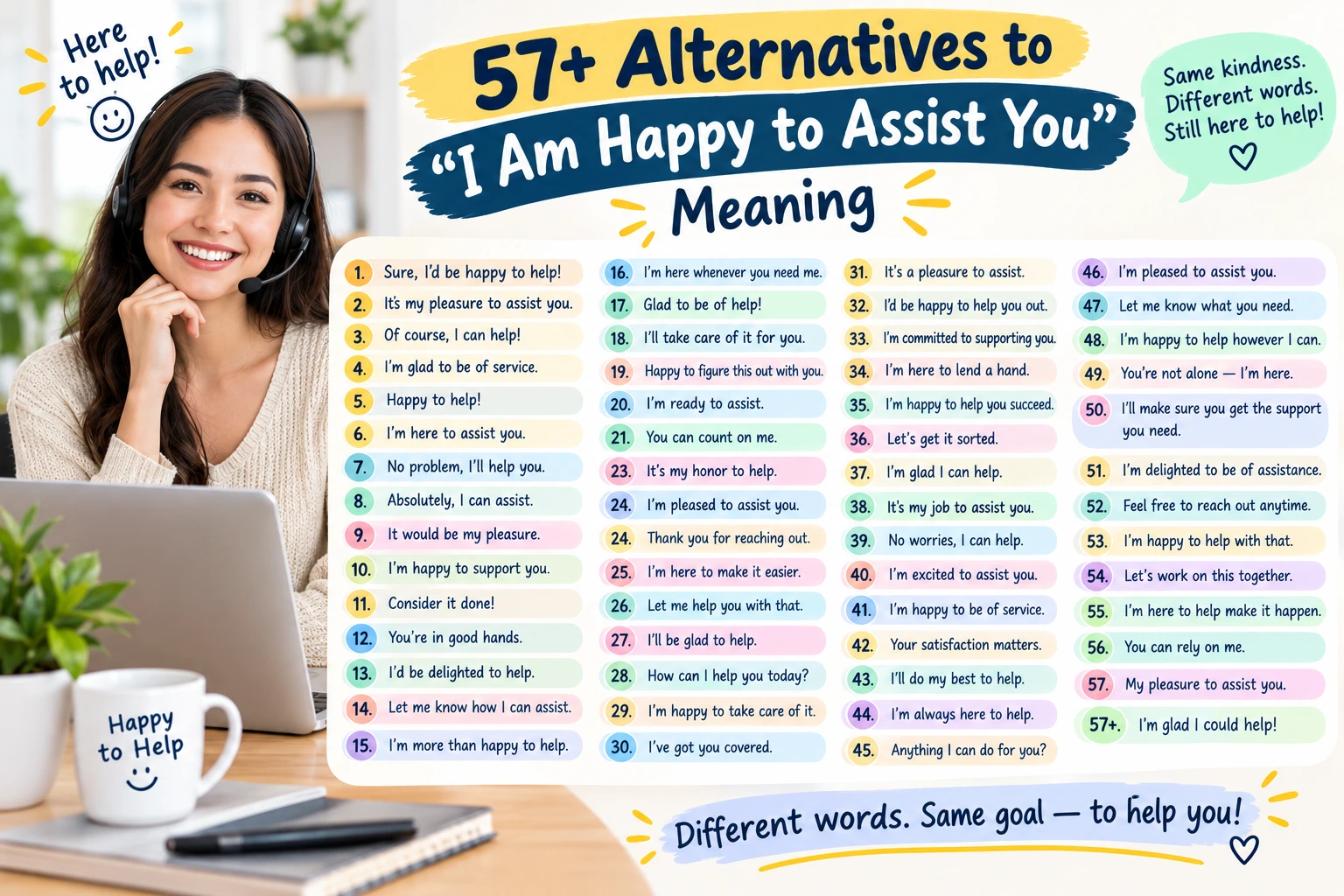
In this guide, you’ll discover 57+ “I am happy to assist you” meaning alternatives, along with meanings, tones, examples, and practical explanations to help you choose the right expression naturally.
Section 1: What Does “I Am Happy to Assist You” Mean?
“I am happy to assist you” means “I am pleased and willing to help you with something.”
The phrase combines two ideas: willingness to help and a positive attitude toward providing that help. It does more than simply say “I can help.” It suggests that the speaker is approachable and genuinely willing to offer support.
For example:
“If you have any questions about the application, I am happy to assist you.”
The tone is generally polite, professional, warm, and service-oriented. It is especially common in customer service, business emails, administrative communication, and workplace conversations.
Depending on the situation, you can replace it with something more formal, friendly, enthusiastic, confident, or conversational.
Section 2: When to Use “I Am Happy to Assist You”
“I am happy to assist you” works in many different situations, particularly when you want to show that you are available and willing to help.
1. Professional Emails
It is excellent for workplace emails and business correspondence.
Example:
“I am happy to assist you with any questions regarding the proposal.”
2. Customer Service
Customer-support professionals often use the phrase to create a helpful and reassuring tone.
Example:
“We are happy to assist you with your account inquiry.”
3. Workplace Conversations
You can use it when offering help to a colleague.
Example:
“If you need help preparing the presentation, I am happy to assist you.”
4. Formal Correspondence
The phrase works well in letters, official responses, and administrative communication.
Example:
“I am happy to assist you with the required documentation.”
5. Speeches or Presentations
It can also be used when offering support to an audience or group.
Example:
“I am happy to assist you throughout this process.”
6. Casual Conversations
Although slightly formal, it can be used casually when you want to sound especially polite.
Example:
“If you need anything while you’re here, I am happy to assist you.”
Section 3: Is “I Am Happy to Assist You” Polite or Professional?
Yes. “I am happy to assist you” is both polite and professional.
It communicates respect without sounding overly complicated. The word “happy” adds warmth, while “assist” gives the expression a professional quality.
It is particularly suitable for:
- Business emails
- Customer service
- Client communication
- Workplace conversations
- Formal letters
- Professional networking
- Administrative communication
For very casual conversations, however, phrases such as “I’m happy to help” or “I can help with that” may sound more natural.
The best alternative depends on your relationship with the other person and the level of formality required.
Professional and Formal Alternatives
1. I Am Pleased to Assist You
Meaning: You are glad to provide help or support.
Tone: Formal, courteous, professional.
Example Sentence: “I am pleased to assist you with your request.”
Short Explanation:
This is a polished alternative for formal emails, client communication, and professional correspondence.
Purpose and Personalization:
Use it when you want to sound respectful without being excessively formal.
2. I Would Be Happy to Help
Meaning: You are willing and pleased to provide assistance.
Tone: Friendly, professional, approachable.
Example Sentence: “I would be happy to help you review the document.”
Short Explanation:
This sounds slightly more conversational than “I am happy to assist you.”
Purpose and Personalization:
A versatile option for both workplace and everyday communication.
3. I Am Glad to Assist
Meaning: You are pleased to provide help.
Tone: Professional, warm, concise.
Example Sentence: “I am glad to assist with any questions you may have.”
Short Explanation:
It is brief while still maintaining a professional tone.
Purpose and Personalization:
Ideal when you want your response to sound positive without being overly elaborate.
4. I Am Pleased to Be of Assistance
Meaning: You are pleased to provide useful support.
Tone: Formal, refined.
Example Sentence: “I am pleased to be of assistance during this process.”
Short Explanation:
This has a more traditional business style.
Purpose and Personalization:
Best suited to formal correspondence and professional service settings.
5. I Would Be Delighted to Assist
Meaning: You are very willing and pleased to help.
Tone: Warm, enthusiastic, formal.
Example Sentence: “I would be delighted to assist you with your upcoming project.”
Short Explanation:
“Delighted” adds more enthusiasm than “happy.”
Purpose and Personalization:
Use it when you want your willingness to help to feel especially genuine.
6. I Am Available to Assist You
Meaning: You are available and ready to provide help.
Tone: Professional, direct.
Example Sentence: “I am available to assist you should you require any additional information.”
Short Explanation:
This focuses more on availability than emotion.
Purpose and Personalization:
Useful when communicating with clients, managers, or colleagues.
7. I Remain Available to Assist
Meaning: You continue to be available if help is needed.
Tone: Formal, professional.
Example Sentence: “I remain available to assist should you have further questions.”
Short Explanation:
This works particularly well toward the end of professional correspondence.
Purpose and Personalization:
A strong closing expression for emails and formal letters.
8. I Am at Your Service
Meaning: You are offering yourself as a source of help.
Tone: Formal, courteous, traditional.
Example Sentence: “Should you need further information, I am at your service.”
Short Explanation:
It sounds more formal and traditional than everyday alternatives.
Purpose and Personalization:
Best for highly courteous or formal situations.
9. I Am Here to Support You
Meaning: You are available to provide assistance and encouragement.
Tone: Warm, supportive, professional.
Example Sentence: “I am here to support you as you work through the next steps.”
Short Explanation:
This sounds more personal and reassuring.
Purpose and Personalization:
Excellent for mentoring, teamwork, education, and supportive workplace communication.
10. I Am Ready to Assist
Meaning: You are prepared to provide help.
Tone: Professional, confident.
Example Sentence: “I am ready to assist with the implementation whenever you are prepared to proceed.”
Short Explanation:
This emphasizes preparedness and confidence.
Purpose and Personalization:
Use it when action is expected soon.
11. I Am Willing to Assist
Meaning: You are prepared to help.
Tone: Formal, neutral.
Example Sentence: “I am willing to assist with the transition process.”
Short Explanation:
It communicates cooperation clearly.
Purpose and Personalization:
Useful when you want to emphasize your willingness without sounding overly enthusiastic.
12. I Am More Than Happy to Help
Meaning: You are very willing to help.
Tone: Friendly, enthusiastic, professional.
Example Sentence: “I am more than happy to help you find the information you need.”
Short Explanation:
This sounds warmer and more enthusiastic than the original phrase.
Purpose and Personalization:
Great for colleagues, clients, and friendly professional conversations.
13. I Am Glad to Be of Assistance
Meaning: You are pleased that you can help.
Tone: Polished, courteous.
Example Sentence: “I am glad to be of assistance during this process.”
Short Explanation:
A refined expression that maintains warmth.
Purpose and Personalization:
Useful for professional service and formal communication.
14. I Would Be Pleased to Help
Meaning: You would be happy to provide assistance.
Tone: Formal, gracious.
Example Sentence: “I would be pleased to help you prepare the necessary documents.”
Short Explanation:
This sounds respectful without being stiff.
Purpose and Personalization:
A strong choice for formal emails.
15. I Would Be Happy to Provide Support
Meaning: You are willing to offer assistance or guidance.
Tone: Professional, supportive.
Example Sentence: “I would be happy to provide support throughout the onboarding process.”
Short Explanation:
It works particularly well when the help involves ongoing support.
Purpose and Personalization:
Ideal for teamwork, mentoring, and workplace situations.
Friendly and Warm Alternatives
16. I’m Happy to Help
Meaning: You are pleased to help.
Tone: Friendly, natural.
Example Sentence: “I’m happy to help if you’re having trouble with the form.”
Short Explanation:
This is one of the most natural everyday alternatives.
Purpose and Personalization:
Use it when you want to sound approachable rather than formal.
17. I’d Be Glad to Help
Meaning: You would be pleased to provide assistance.
Tone: Friendly, polite.
Example Sentence: “I’d be glad to help you get started.”
Short Explanation:
It sounds warm without being overly enthusiastic.
Purpose and Personalization:
Perfect for colleagues, classmates, friends, or customers.
18. I’m Glad I Can Help
Meaning: You are pleased that your assistance is useful.
Tone: Warm, appreciative.
Example Sentence: “I’m glad I can help you sort this out.”
Short Explanation:
This is especially natural after you have already helped someone.
Purpose and Personalization:
Use it as a friendly follow-up.
19. I’d Be Happy to Lend a Hand
Meaning: You are willing to help.
Tone: Casual, friendly.
Example Sentence: “I’d be happy to lend a hand with the event setup.”
Short Explanation:
“Lend a hand” gives the sentence a more relaxed feel.
Purpose and Personalization:
Best for casual workplace or everyday situations.
20. I’m Always Happy to Help
Meaning: You are consistently willing to provide assistance.
Tone: Friendly, reassuring.
Example Sentence: “If you have questions later, I’m always happy to help.”
Short Explanation:
This makes your availability feel ongoing.
Purpose and Personalization:
Excellent when you want someone to feel comfortable asking for help again.
21. I’d Be Glad to Assist
Meaning: You are willing and pleased to help.
Tone: Friendly-professional.
Example Sentence: “I’d be glad to assist you with the registration process.”
Short Explanation:
It sits comfortably between casual and formal language.
Purpose and Personalization:
A versatile option for emails and conversations.
22. I’m Here to Help
Meaning: You are available when someone needs support.
Tone: Warm, reassuring.
Example Sentence: “If anything is unclear, I’m here to help.”
Short Explanation:
Short and natural, with a reassuring quality.
Purpose and Personalization:
Great when someone may be uncertain or need guidance.
23. Count on Me for Support
Meaning: The person can rely on you for assistance.
Tone: Friendly, confident.
Example Sentence: “You can count on me for support throughout the project.”
Short Explanation:
It communicates reliability rather than simply willingness.
Purpose and Personalization:
Useful when building trust within a team.
24. Let Me Know How I Can Help
Meaning: You are inviting the person to explain what assistance they need.
Tone: Friendly, professional.
Example Sentence: “Let me know how I can help with the preparations.”
Short Explanation:
This is one of the most useful alternatives because it encourages a response.
Purpose and Personalization:
Use it when the person’s exact needs are not yet clear.
25. Feel Free to Reach Out for Help
Meaning: The person is welcome to contact you if assistance is needed.
Tone: Friendly, approachable.
Example Sentence: “Feel free to reach out for help if you have any questions.”
Short Explanation:
It creates an open and welcoming tone.
Purpose and Personalization:
Especially useful in emails, team messages, and networking.
Confident and Supportive Alternatives
26. I Can Certainly Help With That
Meaning: You are confident that you can provide assistance.
Tone: Confident, professional.
Example Sentence: “I can certainly help with that and explain the next steps.”
Short Explanation:
“Certainly” adds confidence and reassurance.
Purpose and Personalization:
Use it when you know you can solve or address the issue.
27. I’d Be Happy to Take Care of That
Meaning: You are willing to handle the task.
Tone: Helpful, confident.
Example Sentence: “I’d be happy to take care of that before the meeting.”
Short Explanation:
This is more action-oriented than simply offering assistance.
Purpose and Personalization:
Ideal when someone has given you a specific task.
28. I Can Take Care of It
Meaning: You are capable and willing to handle something.
Tone: Confident, direct.
Example Sentence: “Don’t worry about the paperwork; I can take care of it.”
Short Explanation:
This gives reassurance and shows ownership.
Purpose and Personalization:
Best when you want to make someone’s responsibility easier.
29. I’ll Be Happy to Handle This
Meaning: You are willing to take responsibility for something.
Tone: Confident, professional.
Example Sentence: “I’ll be happy to handle this while you focus on the presentation.”
Short Explanation:
It demonstrates initiative and cooperation.
Purpose and Personalization:
Great for team environments.
30. You Can Rely on Me for Assistance
Meaning: The person can trust you to provide help.
Tone: Confident, professional.
Example Sentence: “You can rely on me for assistance throughout the project.”
Short Explanation:
This emphasizes reliability.
Purpose and Personalization:
Useful when establishing trust with colleagues or clients.
31. I’m Ready to Step In
Meaning: You are prepared to become involved and help.
Tone: Confident, supportive.
Example Sentence: “If the team needs additional support, I’m ready to step in.”
Short Explanation:
It conveys initiative and readiness.
Purpose and Personalization:
Good for teamwork and collaborative situations.
32. I’m Prepared to Help
Meaning: You are ready and equipped to provide assistance.
Tone: Professional, confident.
Example Sentence: “I’m prepared to help you work through the remaining steps.”
Short Explanation:
This emphasizes readiness rather than emotion.
Purpose and Personalization:
Useful in professional or academic settings.
33. I’m Available Whenever You Need Me
Meaning: You are willing to provide help when required.
Tone: Supportive, reassuring.
Example Sentence: “I’m available whenever you need me to discuss the project.”
Short Explanation:
This makes your availability clear.
Purpose and Personalization:
Use it when offering continuing support.
34. I’m Happy to Take This Forward
Meaning: You are willing to continue or manage the next stage of something.
Tone: Professional, proactive.
Example Sentence: “I’m happy to take this forward and coordinate with the relevant team.”
Short Explanation:
This sounds proactive rather than passive.
Purpose and Personalization:
Excellent for workplace emails and project communication.
35. I’m Ready to Move This Forward
Meaning: You are prepared to take action and make progress.
Tone: Motivational, professional.
Example Sentence: “I’m ready to move this forward once we receive your approval.”
Short Explanation:
It communicates initiative and momentum.
Purpose and Personalization:
Ideal for projects, proposals, and business discussions.
Polished Alternatives for Emails
36. Please Let Me Know How I May Assist
Meaning: You are politely asking the person to tell you how you can help.
Tone: Formal, courteous.
Example Sentence: “Please let me know how I may assist with the remaining requirements.”
Short Explanation:
A classic professional email expression.
Purpose and Personalization:
Particularly useful when writing to clients, managers, or formal contacts.
37. Please Let Me Know If I Can Be of Any Assistance
Meaning: You are offering help if it is needed.
Tone: Formal, polite.
Example Sentence: “Please let me know if I can be of any assistance during the review.”
Short Explanation:
This is a courteous closing for professional messages.
Purpose and Personalization:
Use it when you want to leave the door open for further communication.
38. Should You Need Any Further Assistance, Please Let Me Know
Meaning: You are inviting the person to contact you if more help is required.
Tone: Formal, professional.
Example Sentence: “Should you need any further assistance, please let me know.”
Short Explanation:
This is especially effective as an email closing.
Purpose and Personalization:
Use it after providing an answer or completing a request.
39. I’d Be Happy to Provide Any Further Assistance
Meaning: You are willing to continue helping.
Tone: Professional, warm.
Example Sentence: “I’d be happy to provide any further assistance you may require.”
Short Explanation:
It maintains professionalism while sounding approachable.
Purpose and Personalization:
Ideal for client-service emails.
40. Please Feel Free to Contact Me for Assistance
Meaning: The person is welcome to reach out if they need help.
Tone: Formal, welcoming.
Example Sentence: “Please feel free to contact me for assistance with the application.”
Short Explanation:
This clearly communicates availability.
Purpose and Personalization:
Useful for formal emails and professional correspondence.
41. I Remain at Your Disposal for Any Further Assistance
Meaning: You remain available to help with additional needs.
Tone: Highly formal, traditional.
Example Sentence: “I remain at your disposal for any further assistance you may require.”
Short Explanation:
This is a very formal expression and should be used selectively.
Purpose and Personalization:
Best suited to formal letters or highly professional communication.
42. I Would Be Glad to Provide Additional Support
Meaning: You are willing to offer more help.
Tone: Professional, supportive.
Example Sentence: “I would be glad to provide additional support if needed.”
Short Explanation:
A clean and modern professional alternative.
Purpose and Personalization:
Works well in workplace emails and project discussions.
43. I’m Available to Answer Any Further Questions
Meaning: You are offering to respond to additional questions.
Tone: Professional, helpful.
Example Sentence: “I’m available to answer any further questions you may have.”
Short Explanation:
More specific than the original phrase.
Purpose and Personalization:
Use it when your assistance is mainly informational.
44. I’d Be Happy to Clarify Anything Further
Meaning: You are willing to explain something in greater detail.
Tone: Professional, courteous.
Example Sentence: “I’d be happy to clarify anything further if needed.”
Short Explanation:
Perfect when the person may have questions about information you’ve provided.
Purpose and Personalization:
Especially useful in professional and academic emails.
Natural and Conversational Alternatives
45. How Can I Help?
Meaning: You are asking what assistance the person needs.
Tone: Friendly, direct.
Example Sentence: “Hi! How can I help you today?”
Short Explanation:
One of the simplest and most natural ways to offer assistance.
Purpose and Personalization:
Ideal for both casual and professional conversations.
46. What Can I Do to Help?
Meaning: You are asking what action you can take.
Tone: Warm, supportive.
Example Sentence: “You seem stuck on this assignment. What can I do to help?”
Short Explanation:
This sounds more personal than a generic offer.
Purpose and Personalization:
Useful when someone appears to need practical support.
47. Let Me See What I Can Do
Meaning: You are willing to explore ways to help.
Tone: Casual, cooperative.
Example Sentence: “Let me see what I can do to resolve the issue.”
Short Explanation:
It is useful when you cannot promise a specific solution yet.
Purpose and Personalization:
Choose this when you need to investigate before committing.
48. I’ve Got You Covered
Meaning: You are reassuring someone that you will help handle the situation.
Tone: Casual, confident.
Example Sentence: “Don’t worry about the presentation materials—I’ve got you covered.”
Short Explanation:
This is much more conversational and reassuring.
Purpose and Personalization:
Best for friends, teammates, and informal workplace situations.
49. I’m On It
Meaning: You are already taking action to handle something.
Tone: Casual, confident.
Example Sentence: “Thanks for flagging the issue. I’m on it.”
Short Explanation:
It suggests immediate action rather than simply offering help.
Purpose and Personalization:
Great for quick workplace messages and informal conversations.
50. Leave It With Me
Meaning: You are asking the person to let you handle the matter.
Tone: Confident, reassuring.
Example Sentence: “Leave it with me, and I’ll check the details.”
Short Explanation:
It communicates ownership and responsibility.
Purpose and Personalization:
Best when you are actually prepared to handle the task.
51. I Can Give You a Hand
Meaning: You can help someone with a task.
Tone: Casual, friendly.
Example Sentence: “I can give you a hand with those boxes.”
Short Explanation:
A relaxed alternative that works well in everyday conversations.
Purpose and Personalization:
Use it with friends, classmates, coworkers, or family.
52. I’m More Than Willing to Help
Meaning: You are very willing to provide assistance.
Tone: Warm, encouraging.
Example Sentence: “I’m more than willing to help you prepare for the presentation.”
Short Explanation:
It emphasizes strong willingness.
Purpose and Personalization:
Useful when you want to reassure someone that their request is not a burden.
Creative and Advanced Alternatives
53. I’d Be Delighted to Support You
Meaning: You are genuinely pleased to offer support.
Tone: Warm, polished, professional.
Example Sentence: “I’d be delighted to support you as you develop the project.”
Short Explanation:
It combines professionalism with genuine enthusiasm.
Purpose and Personalization:
Great for mentoring, collaboration, and client relationships.
54. I’m More Than Willing to Lend My Expertise
Meaning: You are willing to contribute your knowledge or skills.
Tone: Professional, confident.
Example Sentence: “I’m more than willing to lend my expertise during the planning stage.”
Short Explanation:
This is stronger than simply offering general help.
Purpose and Personalization:
Use it when your specific knowledge can add value.
55. I’d Be Glad to Contribute
Meaning: You are willing to add your skills, ideas, or effort.
Tone: Collaborative, professional.
Example Sentence: “I’d be glad to contribute to the research team.”
Short Explanation:
This focuses on participation rather than assistance.
Purpose and Personalization:
Excellent for teamwork, projects, academic work, and professional settings.
56. I’m Happy to Offer My Support
Meaning: You are willing to provide assistance or encouragement.
Tone: Warm, professional.
Example Sentence: “I’m happy to offer my support as you navigate the new process.”
Short Explanation:
This sounds thoughtful and reassuring.
Purpose and Personalization:
Particularly useful when someone needs ongoing guidance.
57. I’d Be Honored to Assist
Meaning: You would consider it meaningful or important to help.
Tone: Respectful, formal, sincere.
Example Sentence: “I’d be honored to assist with this important initiative.”
Short Explanation:
This expression adds a strong sense of respect and sincerity.
Purpose and Personalization:
Use it selectively when the situation carries special importance.
58. I’m Glad to Put My Skills to Work
Meaning: You are happy to use your abilities to help.
Tone: Confident, energetic.
Example Sentence: “I’m glad to put my skills to work and help the team meet its deadline.”
Short Explanation:
This highlights competence and contribution.
Purpose and Personalization:
A strong option for professional teamwork and project settings.
59. I’m Here to Make the Process Easier
Meaning: You are offering practical support to simplify something.
Tone: Helpful, reassuring.
Example Sentence: “I’m here to make the process easier, so please ask if anything is unclear.”
Short Explanation:
This shifts the focus from yourself to the other person’s experience.
Purpose and Personalization:
Excellent for customer service, onboarding, and guidance.
60. I’m Happy to Work Through This With You
Meaning: You are willing to collaborate while solving a problem.
Tone: Supportive, collaborative.
Example Sentence: “I’m happy to work through this with you until we find the best solution.”
Short Explanation:
This creates a sense of partnership rather than simply offering one-time help.
Purpose and Personalization:
Great for mentoring, teamwork, education, and problem-solving.
61. I’m Here Whenever You Need a Helping Hand
Meaning: You are available to provide support when needed.
Tone: Warm, friendly.
Example Sentence: “I’m here whenever you need a helping hand with the project.”
Short Explanation:
This feels personal and encouraging.
Purpose and Personalization:
Best for friendly professional relationships and casual communication.
62. I’m Happy to Do Whatever I Can to Help
Meaning: You are willing to make a reasonable effort to provide support.
Tone: Sincere, generous, supportive.
Example Sentence: “I’m happy to do whatever I can to help you prepare for the event.”
Short Explanation:
This conveys strong goodwill without sounding overly formal.
Purpose and Personalization:
Use it when you genuinely want to reassure someone that you’re available.
How to Choose the Best Alternative
The right alternative depends largely on context and relationship.
For a formal email, choose:
- “I am pleased to assist you.”
- “Please let me know how I may assist.”
- “I remain available to assist.”
- “I would be pleased to help.”
For a friendly conversation, try:
- “I’m happy to help.”
- “I’d be glad to help.”
- “I can give you a hand.”
- “What can I do to help?”
For a confident workplace response, use:
- “I can certainly help with that.”
- “I’ll be happy to handle this.”
- “I can take care of it.”
- “I’m ready to step in.”
For ongoing support, consider:
- “I’m here to support you.”
- “You can count on me for support.”
- “I’m available whenever you need me.”
- “I’m happy to work through this with you.”
The goal isn’t to use the most complicated phrase. The goal is to choose the expression that sounds natural for the situation.
Common Mistakes to Avoid
1. Using Extremely Formal Language Everywhere
Phrases such as “I remain at your disposal” may sound strange in a casual conversation.
Choose language that matches the setting.
2. Repeating the Same Expression
Using “I am happy to assist you” in every email can make your writing feel formulaic.
Vary your expressions naturally.
3. Sounding Insincere
Don’t use an enthusiastic phrase if your tone doesn’t match it. “I’d be delighted to assist” may feel excessive for a simple everyday request.
4. Offering Help Without Being Specific
Sometimes “How can I help?” is more useful than a vague statement.
Specific offers make communication clearer.
5. Overusing Corporate Language
Professional communication doesn’t have to sound complicated. Simple phrases are often more effective.
Pro Tips for Better Communication
Match the tone.
Formal situations call for polished language, while casual conversations benefit from simpler expressions.
Be specific.
Instead of simply saying you’re happy to help, explain what you can help with when appropriate.
Sound genuine.
Warmth comes from sincerity, not complicated vocabulary.
Use active language.
“I can take care of that” sounds more decisive than a vague offer of assistance.
Don’t force variety.
Changing every phrase simply for the sake of SEO or vocabulary can make communication unnatural. Choose alternatives that genuinely fit the situation.
Conclusion
Knowing different ways to say “I am happy to assist you” gives you greater flexibility in professional and everyday communication. Some alternatives sound formal and polished, while others feel friendly, confident, supportive, or conversational. The best choice depends on the situation, your relationship with the other person, and the message you want to convey. Instead of relying on one expression repeatedly, experiment with alternatives that sound natural in your own voice. Whether you’re writing an email, helping a colleague, supporting a customer, or speaking casually, the right wording can make your willingness to help feel more genuine and effective.
Discover more