

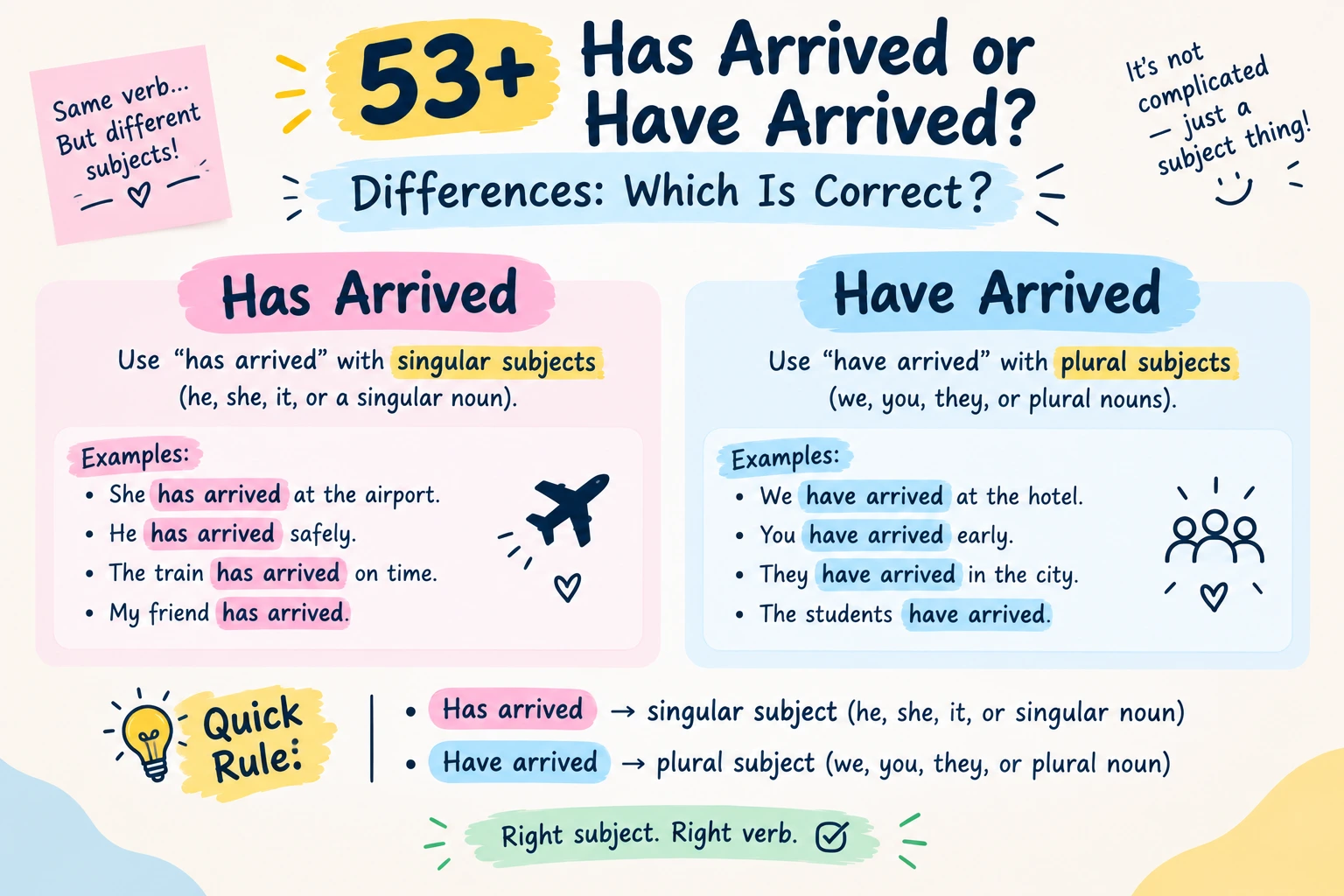
“Has arrived” or “have arrived”—which one should you use? This small grammar difference can cause a surprising amount of confusion, especially when you are writing emails, messages, announcements, or professional updates. Both expressions are correct, but they are used with different subjects.
The key is understanding whether the subject is singular or plural. “Has arrived” normally goes with a singular subject, while “have arrived” is used with plural subjects and with certain pronouns such as “I,” “you,” and “we.” Once you understand this basic rule, choosing between them becomes much easier.
In this guide, we will explain the difference between “has arrived” and “have arrived” in simple English. You will also find 53+ examples and alternative ways to express arrival naturally in casual, academic, and professional situations.
Section 1: What Does “Has Arrived” or “Have Arrived” Mean?
Both “has arrived” and “have arrived” use the present perfect tense.
They describe something or someone that has reached a particular place, or an event that has happened recently.
The main difference is the subject.
“Has arrived”
Use has arrived with singular third-person subjects:
- He has arrived.
- She has arrived.
- It has arrived.
- The package has arrived.
- The manager has arrived.
- The bus has arrived.
For example:
“The teacher has arrived.”
The subject “teacher” is singular, so we use has.
“Have arrived”
Use have arrived with:
- I
- You
- We
- They
- Plural nouns
For example:
“The students have arrived.”
The subject “students” is plural, so we use have.
You can remember the basic pattern like this:
Singular third person → has arrived
I/You/We/They + plural subjects → have arrived
The word “arrived” does not change. The helping verb changes according to the subject.
Section 2: When to Use “Has Arrived” and “Have Arrived”
You can use these expressions in everyday conversations, professional emails, announcements, schoolwork, and formal writing.
Everyday Conversation
“My brother has arrived.”
Here, “brother” is singular.
“My friends have arrived.”
Here, “friends” is plural.
Text Messages
“The food has arrived.”
or
“The guests have arrived.”
Both are natural in casual texting.
Professional Emails
“The requested document has arrived.”
This sounds appropriate when referring to one document.
For multiple documents:
“The requested documents have arrived.”
Announcements
“The guest speaker has arrived.”
This is suitable when one speaker has reached the venue.
For multiple speakers:
“The guest speakers have arrived.”
Academic Writing
“The results have arrived from the laboratory.”
Here, “results” is plural.
Formal Communication
“The shipment has arrived at the warehouse.”
But:
“The shipments have arrived at the warehouse.”
The verb changes because the subject changes from singular to plural.
Section 3: Is It Polite or Professional?
Yes. Both “has arrived” and “have arrived” are grammatically correct and completely appropriate for professional communication when used with the correct subject.
They can appear in emails, reports, announcements, business updates, academic writing, and formal notices.
For example:
“The requested information has arrived.”
This sounds professional and neutral.
You can also make the sentence more conversational:
“The documents have arrived. I’ll review them shortly.”
The grammar does not change based on whether the situation is formal or casual. What changes is usually the surrounding vocabulary.
For professional writing, avoid unnecessarily casual expressions such as:
“The package finally showed up!”
Instead, you might write:
“The package has arrived.”
The most important thing is to make sure the helping verb agrees with the subject.
Below are 54 useful ways to talk about arrival. Each example also shows when has arrived or have arrived is grammatically appropriate.
1. He has arrived.
Meaning: One male person has reached the destination.
Tone: Neutral
Example Sentence: “He has arrived at the office and is waiting for you.”
Short Explanation: Use “has” because “he” is singular.
Purpose and Personalization: This is one of the simplest examples of the present perfect tense.
2. She has arrived.
Meaning: One female person has reached the destination.
Tone: Neutral
Example Sentence: “She has arrived at the venue.”
Short Explanation: “She” is singular, so it takes “has.”
3. They have arrived.
Meaning: More than one person has reached the destination.
Tone: Neutral
Example Sentence: “They have arrived and are waiting outside.”
Short Explanation: “They” takes “have,” even when it refers to people collectively.
4. We have arrived.
Meaning: The speaker and others have reached a place.
Tone: Casual, neutral
Example Sentence: “We have arrived at the hotel.”
Short Explanation: “We” always takes “have” in the present perfect.
5. I have arrived.
Meaning: The speaker has reached a destination.
Tone: Neutral
Example Sentence: “I have arrived at the meeting location.”
Short Explanation: “I” takes “have,” not “has.”
6. You have arrived.
Meaning: Someone has reached a place.
Tone: Neutral
Example Sentence: “You have arrived just in time.”
Short Explanation: “You” takes “have,” whether it refers to one person or several.
7. The package has arrived.
Meaning: One package has been delivered.
Tone: Neutral, professional
Example Sentence: “The package has arrived at reception.”
Short Explanation: “Package” is singular, so use “has.”
8. The packages have arrived.
Meaning: Multiple packages have been delivered.
Tone: Neutral
Example Sentence: “The packages have arrived at the warehouse.”
Short Explanation: “Packages” is plural, so use “have.”
9. The student has arrived.
Meaning: One student has reached the location.
Tone: Formal, neutral
Example Sentence: “The student has arrived for the interview.”
Short Explanation: “Student” is singular.
10. The students have arrived.
Meaning: Several students have reached the location.
Tone: Formal, neutral
Example Sentence: “The students have arrived for the examination.”
Short Explanation: The plural subject “students” requires “have.”
11. The bus has arrived.
Meaning: One bus has reached the stop.
Tone: Neutral
Example Sentence: “The bus has arrived, so we can leave now.”
Short Explanation: “Bus” is singular.
12. The buses have arrived.
Meaning: More than one bus has reached the location.
Tone: Neutral
Example Sentence: “The buses have arrived outside the school.”
Short Explanation: “Buses” is plural.
13. The train has arrived.
Meaning: One train has reached the station.
Tone: Neutral
Example Sentence: “The train has arrived at platform three.”
Short Explanation: Use “has” because “train” is singular.
14. The trains have arrived.
Meaning: Multiple trains have reached the station.
Tone: Neutral
Example Sentence: “The trains have arrived on schedule.”
Short Explanation: “Trains” is plural and therefore takes “have.”
15. The guests have arrived.
Meaning: Several guests have reached the event.
Tone: Formal, friendly
Example Sentence: “The guests have arrived, so we can begin dinner.”
Short Explanation: “Guests” is plural.
16. The guest has arrived.
Meaning: One guest has reached the event.
Tone: Formal, neutral
Example Sentence: “The guest has arrived and is ready for the interview.”
Short Explanation: “Guest” is singular.
17. The manager has arrived.
Meaning: One manager has reached the workplace.
Tone: Professional
Example Sentence: “The manager has arrived for the scheduled meeting.”
Short Explanation: Singular subject → “has.”
18. The managers have arrived.
Meaning: Several managers have reached the workplace.
Tone: Professional
Example Sentence: “The managers have arrived for the quarterly meeting.”
Short Explanation: Plural subject → “have.”
19. My friend has arrived.
Meaning: One friend has reached the location.
Tone: Casual
Example Sentence: “My friend has arrived, so I’ll call you later.”
Short Explanation: “Friend” is singular.
20. My friends have arrived.
Meaning: Several friends have reached the location.
Tone: Casual
Example Sentence: “My friends have arrived, and we’re heading inside.”
Short Explanation: “Friends” is plural.
21. The letter has arrived.
Meaning: One letter has been received.
Tone: Neutral, formal
Example Sentence: “The letter has arrived this morning.”
Short Explanation: “Letter” is singular.
22. The letters have arrived.
Meaning: Multiple letters have been received.
Tone: Neutral
Example Sentence: “The letters have arrived from the university.”
Short Explanation: “Letters” is plural.
23. The email has arrived.
Meaning: One email has been received.
Tone: Professional, neutral
Example Sentence: “Your email has arrived safely.”
Short Explanation: “Email” is singular.
24. The emails have arrived.
Meaning: Multiple emails have been received.
Tone: Professional
Example Sentence: “The emails have arrived in my inbox.”
Short Explanation: The plural “emails” takes “have.”
25. The results have arrived.
Meaning: Results have been received or released.
Tone: Academic, professional
Example Sentence: “The examination results have arrived.”
Short Explanation: “Results” is plural, so use “have.”
26. The result has arrived.
Meaning: One result has been received.
Tone: Neutral
Example Sentence: “The final result has arrived.”
Short Explanation: “Result” is singular.
27. The order has arrived.
Meaning: One order has been delivered.
Tone: Neutral, professional
Example Sentence: “Your order has arrived at the front desk.”
Short Explanation: “Order” is singular.
28. The orders have arrived.
Meaning: Multiple orders have been delivered.
Tone: Professional
Example Sentence: “All the customer orders have arrived.”
Short Explanation: “Orders” is plural.
29. The shipment has arrived.
Meaning: One shipment has reached its destination.
Tone: Professional
Example Sentence: “The shipment has arrived at the distribution center.”
Short Explanation: “Shipment” is singular.
30. The shipments have arrived.
Meaning: Multiple shipments have reached their destinations.
Tone: Professional
Example Sentence: “The shipments have arrived earlier than expected.”
Short Explanation: “Shipments” is plural.
31. The new employee has arrived.
Meaning: One new employee has reached the workplace.
Tone: Professional
Example Sentence: “The new employee has arrived for orientation.”
Short Explanation: The subject is singular.
32. The new employees have arrived.
Meaning: Several new employees have reached the workplace.
Tone: Professional
Example Sentence: “The new employees have arrived for their first training session.”
Short Explanation: The plural noun “employees” requires “have.”
33. Our teacher has arrived.
Meaning: One teacher has reached the classroom.
Tone: Casual, academic
Example Sentence: “Our teacher has arrived, so let’s put our phones away.”
Short Explanation: “Teacher” is singular.
34. Our teachers have arrived.
Meaning: More than one teacher has reached the location.
Tone: Academic
Example Sentence: “Our teachers have arrived for the school event.”
Short Explanation: “Teachers” is plural.
35. The doctor has arrived.
Meaning: One doctor has reached the location.
Tone: Neutral, professional
Example Sentence: “The doctor has arrived and will see you shortly.”
Short Explanation: “Doctor” is singular.
36. The doctors have arrived.
Meaning: Several doctors have reached the location.
Tone: Professional
Example Sentence: “The doctors have arrived for the conference.”
Short Explanation: “Doctors” is plural.
37. The team has arrived.
Meaning: One team, considered as a single group, has reached the location.
Tone: Professional
Example Sentence: “The team has arrived at the stadium.”
Short Explanation: In standard American English, a collective noun such as “team” is usually treated as singular when acting as one unit.
38. The teams have arrived.
Meaning: Multiple teams have reached the location.
Tone: Neutral
Example Sentence: “The teams have arrived for the tournament.”
Short Explanation: “Teams” is clearly plural, so use “have.”
39. Everyone has arrived.
Meaning: All expected people are now present.
Tone: Neutral, professional
Example Sentence: “Everyone has arrived, so we can begin the meeting.”
Short Explanation: “Everyone” looks like it refers to many people, but grammatically it is singular and takes “has.”
40. Someone has arrived.
Meaning: An unspecified person has reached the location.
Tone: Neutral
Example Sentence: “Someone has arrived at the reception desk.”
Short Explanation: “Someone” is grammatically singular.
41. Nobody has arrived.
Meaning: Not one person has arrived.
Tone: Neutral
Example Sentence: “Nobody has arrived for the appointment yet.”
Short Explanation: “Nobody” is singular, so it takes “has.”
42. Everyone has finally arrived.
Meaning: All expected people are now present after waiting.
Tone: Casual, relieved
Example Sentence: “Everyone has finally arrived, so we can start the celebration.”
Short Explanation: “Everyone” remains singular even though it refers to multiple people.
43. Both have arrived.
Meaning: Two people or things have reached the destination.
Tone: Neutral
Example Sentence: “Both have arrived safely.”
Short Explanation: “Both” refers to two, so it takes “have.”
44. All have arrived.
Meaning: Everyone or everything expected is now present.
Tone: Formal, neutral
Example Sentence: “All have arrived, and the ceremony can begin.”
Short Explanation: “All” can take “have” when referring to multiple people or things.
45. Several have arrived.
Meaning: A number of people or things have reached the destination.
Tone: Formal, neutral
Example Sentence: “Several have arrived early for the event.”
Short Explanation: “Several” is plural and therefore takes “have.”
46. Many have arrived.
Meaning: A large number of people or things have reached the destination.
Tone: Neutral
Example Sentence: “Many have arrived before the doors officially opened.”
Short Explanation: “Many” is plural.
47. A few have arrived.
Meaning: Some people or things have reached the location.
Tone: Casual, neutral
Example Sentence: “A few have arrived, but most guests are still on their way.”
Short Explanation: “A few” refers to more than one, so use “have.”
48. The first group has arrived.
Meaning: One group has reached the destination.
Tone: Neutral
Example Sentence: “The first group has arrived at the venue.”
Short Explanation: “Group” is singular even though it contains several people.
49. The first groups have arrived.
Meaning: Multiple groups have reached the destination.
Tone: Neutral
Example Sentence: “The first groups have arrived at the event.”
Short Explanation: “Groups” is plural.
50. The entire family has arrived.
Meaning: All members of one family have reached the destination.
Tone: Warm, casual
Example Sentence: “The entire family has arrived for the wedding.”
Short Explanation: “Family” is treated as a singular collective noun here.
51. The families have arrived.
Meaning: Multiple families have reached the location.
Tone: Neutral
Example Sentence: “The families have arrived for the celebration.”
Short Explanation: “Families” is plural.
52. The news has arrived.
Meaning: New information has been received.
Tone: Formal, neutral
Example Sentence: “The news has arrived from the central office.”
Short Explanation: “News” is grammatically singular in English, so it takes “has.”
53. The updates have arrived.
Meaning: Multiple updates have been received.
Tone: Professional
Example Sentence: “The latest updates have arrived from the project team.”
Short Explanation: “Updates” is plural, so use “have.”
54. The final confirmation has arrived.
Meaning: One final confirmation has been received.
Tone: Professional
Example Sentence: “The final confirmation has arrived, so we can proceed.”
Short Explanation: “Confirmation” is singular and therefore takes “has.”
Quick Rule to Remember
If you are unsure whether to use has arrived or have arrived, look at the subject first.
Use:
Has arrived with:
- He
- She
- It
- Everyone
- Someone
- Nobody
- A singular noun
- A singular collective noun
Use:
Have arrived with:
- I
- You
- We
- They
- Both
- Several
- Many
- A few
- Plural nouns
Compare:
The student has arrived.
The students have arrived.
The package has arrived.
The packages have arrived.
Everyone has arrived.
They have arrived.
This simple comparison solves most “has arrived or have arrived” questions.
Conclusion
Understanding the difference between “has arrived” and “have arrived” becomes easy once you focus on the subject. Use has arrived with singular third-person subjects and singular nouns, while have arrived works with “I,” “you,” “we,” “they,” and plural subjects.
These expressions are useful in everything from casual conversations to professional emails and formal announcements. The most important habit is to check subject-verb agreement before choosing the helping verb.
Once this pattern becomes familiar, you will naturally know which form sounds correct.
Discover more
funny answers to are you still alive