
“What’s up?” is one of those questions that sounds simple but can lead to almost any kind of conversation. Usually, the person asking is not looking for a detailed report about your day. They are simply checking in, starting a conversation, or saying hello in a casual way.
Of course, answering “Nothing much” every single time can get boring. A funny answer can instantly make the conversation more interesting and show off your personality without requiring a long response.
That is why having a few clever responses ready can be useful. Whether you are texting a close friend, replying to a classmate, joking with a coworker, or talking to someone you like, the right response can turn an ordinary greeting into something memorable.
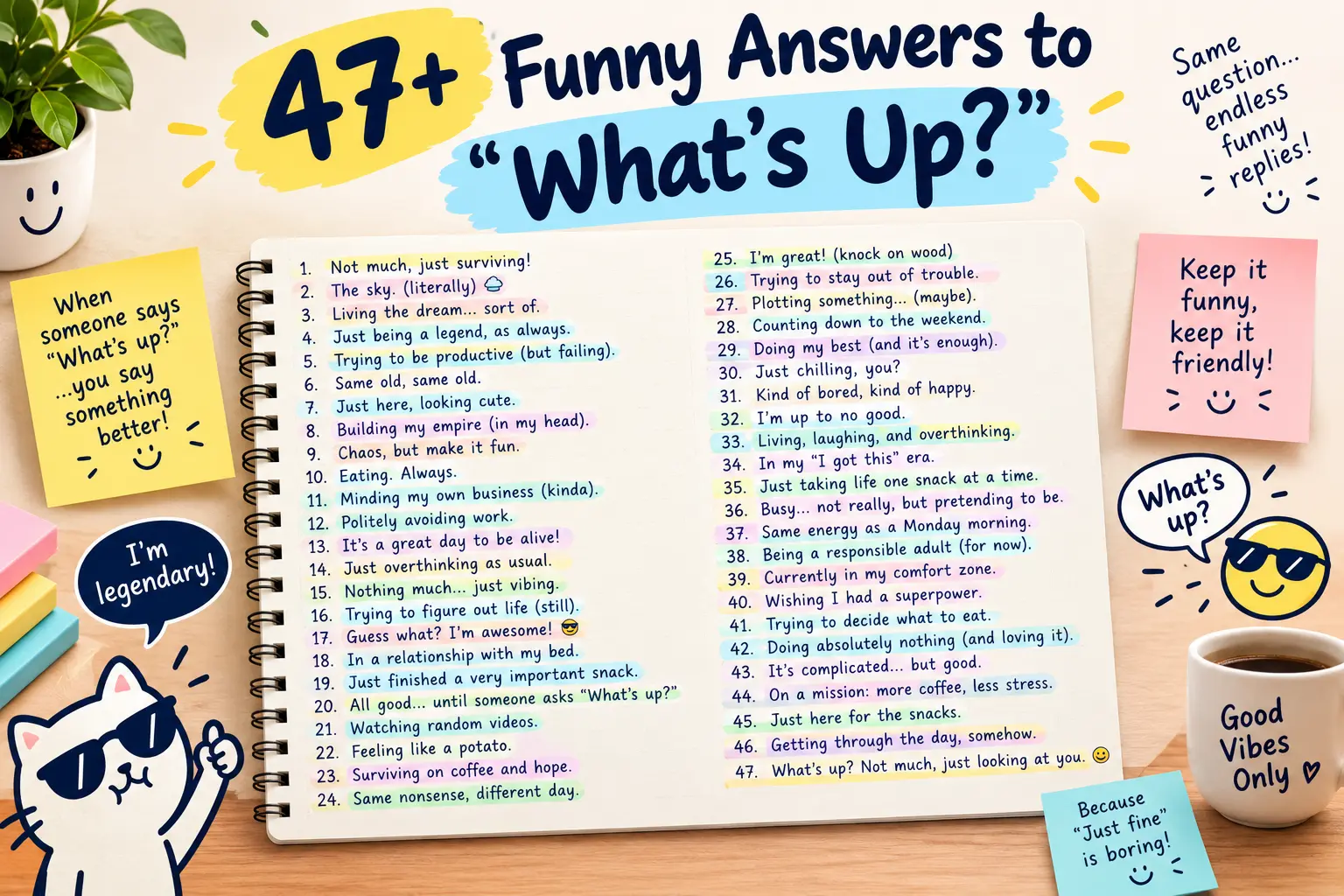
Here are 47+ funny answers to “What’s up?” that range from mildly sarcastic to completely ridiculous.
Section 1: What Does “Funny Answers to What’s Up?” Mean?
“What’s up?” is an informal way of asking someone how they are, what they are doing, or whether anything interesting is happening.
Depending on the situation, it can mean:
- “How are you?”
- “What are you doing?”
- “What’s happening?”
- “Anything interesting going on?”
- “How’s everything?”
The phrase usually has a relaxed, friendly tone. It is common among friends, classmates, coworkers, and people who already know each other.
When someone asks, “What’s up?” you do not necessarily need to give a serious answer. A funny response can keep the conversation light and make the other person laugh.
For example, instead of saying, “Nothing much,” you could say, “My stress levels, apparently.”
The best funny answers are usually short, unexpected, and suited to the person you are talking to.
Section 2: When to Use Funny Answers to “What’s Up?”
Funny answers work best in casual situations where humor is welcome.
You can use them when:
Texting a friend:
“What’s up?”
“Mostly my rent.”
Talking to a classmate:
“What’s up?”
“My grades, hopefully.”
Chatting with a sibling:
“What’s up?”
“Several things, but none of them are productive.”
Talking to a coworker you know well:
“What’s up?”
“Deadlines and my blood pressure.”
Replying to someone you like:
“What’s up?”
“Apparently, this conversation.”
However, context matters. A funny response may not be appropriate when speaking to a manager, attending a formal meeting, writing a professional email, or responding to someone you do not know well.
The goal is to make the conversation more enjoyable, not make the other person uncomfortable.
Section 3: Is It Polite or Professional?
Funny answers to “What’s up?” are generally polite in casual conversations, but they are not always suitable for professional communication.
If a close friend asks, “What’s up?” you have plenty of freedom to be sarcastic, dramatic, or ridiculous.
With a coworker, your response should depend on your relationship. A light joke such as “Just surviving Monday” is usually safer than an overly personal or sarcastic comment.
In a formal workplace setting, you may want to keep your response simple:
“Not much, just working through a few tasks.”
Or:
“Doing well, thanks. How about you?”
The same rule applies to emails and formal speeches. “What’s up?” itself is already quite informal, so humorous answers are generally better suited to texting, social conversations, and relaxed workplace interactions.
When in doubt, match the other person’s level of formality.
1. “My blood pressure.”
Meaning: You are joking that something stressful is happening.
Tone: Sarcastic and relatable.
Example Sentence: “What’s up?” “My blood pressure, mostly.”
Short Explanation: This works especially well when your day has already been chaotic.
Purpose and Personalization: Use it with friends who understand your sense of humor.
2. “The ceiling, apparently.”
Meaning: You are taking “what’s up” literally.
Tone: Classic, silly, and playful.
Example Sentence: “Hey, what’s up?” “The ceiling, apparently. You?”
Short Explanation: It is an old-school joke, but it still works because it catches the person off guard.
Purpose and Personalization: Perfect for a quick text or casual conversation.
3. “My stress levels.”
Meaning: You are humorously admitting that you are stressed.
Tone: Dry and relatable.
Example Sentence: “What’s up?” “My stress levels. They’re doing great.”
Short Explanation: The contrast between “doing great” and being stressed makes the answer funny.
Purpose and Personalization: Great when talking about school, work, or deadlines.
4. “Not my productivity.”
Meaning: You are joking that you are not getting much done.
Tone: Self-deprecating and casual.
Example Sentence: “What’s up?” “Not my productivity, unfortunately.”
Short Explanation: It is an easy response when you are procrastinating.
Purpose and Personalization: Particularly relatable among students and busy friends.
5. “My workload, unfortunately.”
Meaning: You have a lot of work to deal with.
Tone: Lightly sarcastic.
Example Sentence: “What’s up?” “My workload. It never left.”
Short Explanation: It turns a common complaint into a playful response.
Purpose and Personalization: Works well with classmates and coworkers.
6. “Nothing except my expectations.”
Meaning: You are joking about having unrealistic expectations.
Tone: Witty and slightly dramatic.
Example Sentence: “What’s up?” “Nothing except my expectations of myself.”
Short Explanation: This response has a clever, self-aware tone.
Purpose and Personalization: Good for conversations with friends who appreciate dry humor.
7. “Several things, none of them useful.”
Meaning: You have things going on, but they are not productive.
Tone: Dry and humorous.
Example Sentence: “What’s up?” “Several things, none of them useful.”
Short Explanation: The unexpected wording makes an ordinary response more interesting.
Purpose and Personalization: Great for texting when you want to sound casually witty.
8. “My screen time.”
Meaning: You have probably spent too much time on your phone.
Tone: Modern and self-aware.
Example Sentence: “What’s up?” “My screen time. And it’s concerning.”
Short Explanation: This is relatable without needing much explanation.
Purpose and Personalization: Works especially well in casual group chats.
9. “The consequences of my decisions.”
Meaning: You are joking that your choices have created problems.
Tone: Dramatic and sarcastic.
Example Sentence: “What’s up?” “Mostly the consequences of my decisions.”
Short Explanation: The dramatic wording makes a simple greeting unexpectedly funny.
Purpose and Personalization: Best with friends who enjoy exaggerated humor.
10. “My caffeine intake.”
Meaning: You are running on coffee or another caffeinated drink.
Tone: Casual and relatable.
Example Sentence: “What’s up?” “My caffeine intake, apparently.”
Short Explanation: It works particularly well during busy mornings or study sessions.
Purpose and Personalization: A good choice for classmates and coworkers.
11. “The usual chaos.”
Meaning: Life is busy or unpredictable.
Tone: Relaxed and humorous.
Example Sentence: “What’s up?” “The usual chaos. Nothing new.”
Short Explanation: It gives a funny answer without revealing too much.
Purpose and Personalization: Useful when you want to keep the conversation casual.
12. “My to-do list, and I’m losing.”
Meaning: You have too many tasks.
Tone: Playful and relatable.
Example Sentence: “What’s up?” “My to-do list, and I’m losing badly.”
Short Explanation: The exaggerated competition makes the response entertaining.
Purpose and Personalization: Great for school or work conversations.
13. “My problems, but they’re not invited.”
Meaning: You are joking about dealing with problems.
Tone: Playful and dramatic.
Example Sentence: “What’s up?” “My problems, but I definitely didn’t invite them.”
Short Explanation: It adds personality to an otherwise ordinary response.
Purpose and Personalization: Use it with friends who enjoy dramatic humor.
14. “Not much. I’m saving my drama for later.”
Meaning: Nothing major is happening right now.
Tone: Playful and confident.
Example Sentence: “What’s up?” “Not much. I’m saving my drama for later.”
Short Explanation: It suggests that you are intentionally keeping things low-key.
Purpose and Personalization: Great for texting friends.
15. “My patience, slowly disappearing.”
Meaning: You are becoming frustrated.
Tone: Dry and sarcastic.
Example Sentence: “What’s up?” “My patience, slowly disappearing.”
Short Explanation: It works especially well when something annoying has happened.
Purpose and Personalization: Good for casual conversations about stressful days.
16. “A lot, but I’m pretending everything is fine.”
Meaning: You have plenty happening but are joking about handling it.
Tone: Honest, dramatic, and funny.
Example Sentence: “What’s up?” “A lot, but I’m pretending everything is fine.”
Short Explanation: The humor comes from the exaggerated contrast.
Purpose and Personalization: Best with close friends.
17. “My ambition. My motivation left hours ago.”
Meaning: You still have goals, but your energy is gone.
Tone: Sarcastic and relatable.
Example Sentence: “What’s up?” “My ambition. My motivation left hours ago.”
Short Explanation: It turns procrastination into a clever response.
Purpose and Personalization: Ideal for study or work chats.
18. “Absolutely nothing, and I’m committed to it.”
Meaning: You are proudly doing nothing.
Tone: Confident and humorous.
Example Sentence: “What’s up?” “Absolutely nothing, and I’m committed to it.”
Short Explanation: The confidence makes the laziness funny.
Purpose and Personalization: Perfect for relaxed weekends.
19. “My expectations are up. My energy isn’t.”
Meaning: Your goals are high, but your energy is low.
Tone: Witty and self-aware.
Example Sentence: “What’s up?” “My expectations are up. My energy isn’t.”
Short Explanation: The contrast creates a clever one-liner.
Purpose and Personalization: Works well in conversations about school, work, or life.
20. “Just waiting for my main-character moment.”
Meaning: You are joking about waiting for something exciting to happen.
Tone: Playful and modern.
Example Sentence: “What’s up?” “Just waiting for my main-character moment.”
Short Explanation: It gives the conversation a dramatic, humorous twist.
Purpose and Personalization: Best for friends and social media conversations.
21. “My Wi-Fi connection and my emotional stability.”
Meaning: Both your internet and your mood are unreliable.
Tone: Absurd and playful.
Example Sentence: “What’s up?” “My Wi-Fi connection and my emotional stability.”
Short Explanation: The unexpected pairing makes the answer memorable.
Purpose and Personalization: Great for online chats and group messages.
22. “The rent. Every single month.”
Meaning: You are joking about the financial burden of paying rent.
Tone: Dry and relatable.
Example Sentence: “What’s up?” “The rent. Every single month.”
Short Explanation: It takes the question literally and adds a relatable complaint.
Purpose and Personalization: Best with friends who appreciate everyday humor.
23. “My sleep schedule. It’s beyond saving.”
Meaning: Your sleeping habits are chaotic.
Tone: Dramatic and casual.
Example Sentence: “What’s up?” “My sleep schedule. It’s beyond saving.”
Short Explanation: A funny choice when you have been staying up too late.
Purpose and Personalization: Especially useful in late-night conversations.
24. “Currently accepting snacks and compliments.”
Meaning: You are jokingly asking for food or praise.
Tone: Playful and confident.
Example Sentence: “What’s up?” “Currently accepting snacks and compliments.”
Short Explanation: It gives the other person two funny ways to respond.
Purpose and Personalization: Great for casual texting.
25. “My level of confusion.”
Meaning: You are confused about something.
Tone: Dry and understated.
Example Sentence: “What’s up?” “My level of confusion, honestly.”
Short Explanation: It is simple but gives the conversation personality.
Purpose and Personalization: Useful when you do not want to explain the whole story yet.
26. “Not much. Just professionally procrastinating.”
Meaning: You are avoiding your responsibilities with impressive dedication.
Tone: Witty and sarcastic.
Example Sentence: “What’s up?” “Not much. Just professionally procrastinating.”
Short Explanation: The word “professionally” makes ordinary procrastination sound like a career.
Purpose and Personalization: Perfect for students and office workers.
27. “My bank balance, unfortunately.”
Meaning: You are joking about money problems.
Tone: Dry and relatable.
Example Sentence: “What’s up?” “My bank balance, unfortunately.”
Short Explanation: It uses “what’s up” literally while turning the answer into a joke.
Purpose and Personalization: Best used with friends who understand your humor.
28. “Just out here making questionable decisions.”
Meaning: You are joking about your choices.
Tone: Playful and slightly rebellious.
Example Sentence: “What’s up?” “Just out here making questionable decisions.”
Short Explanation: It creates curiosity without revealing anything serious.
Purpose and Personalization: Great for casual texts.
29. “My standards, hopefully.”
Meaning: You are joking that your standards are increasing.
Tone: Confident and witty.
Example Sentence: “What’s up?” “My standards, hopefully.”
Short Explanation: It can be playful without being overly serious.
Purpose and Personalization: Works well in conversations with close friends.
30. “The plot, apparently.”
Meaning: You are joking that something unexpected is happening.
Tone: Dramatic and clever.
Example Sentence: “What’s up?” “The plot, apparently.”
Short Explanation: It makes an ordinary situation sound like a dramatic story.
Purpose and Personalization: Perfect when something surprising has happened.
31. “My motivation is taking a personal day.”
Meaning: You do not feel motivated.
Tone: Light and humorous.
Example Sentence: “What’s up?” “My motivation is taking a personal day.”
Short Explanation: Giving motivation a “personal day” turns procrastination into a funny excuse.
Purpose and Personalization: Excellent for school or work conversations.
32. “Nothing I can explain without a presentation.”
Meaning: Too much is happening to explain quickly.
Tone: Clever and dramatic.
Example Sentence: “What’s up?” “Honestly, nothing I can explain without a presentation.”
Short Explanation: It humorously exaggerates how complicated your situation is.
Purpose and Personalization: Great when there is a long story behind your answer.
33. “Just trying to keep my life in beta testing.”
Meaning: You are still figuring things out.
Tone: Clever and modern.
Example Sentence: “What’s up?” “Just trying to keep my life in beta testing.”
Short Explanation: It compares life to unfinished software, creating a nerdy but memorable joke.
Purpose and Personalization: Particularly suitable for tech-minded friends.
34. “My responsibilities are calling. I’m ignoring them.”
Meaning: You are avoiding your tasks.
Tone: Honest and sarcastic.
Example Sentence: “What’s up?” “My responsibilities are calling. I’m ignoring them.”
Short Explanation: The response is funny because it admits what everyone sometimes does.
Purpose and Personalization: Works well when procrastination is the topic.
35. “Just trying to look productive.”
Meaning: You may not actually be doing much.
Tone: Dry and casual.
Example Sentence: “What’s up?” “Just trying to look productive.”
Short Explanation: It is short enough to feel natural but still has personality.
Purpose and Personalization: Great for workplace or study conversations.
36. “My patience has left the chat.”
Meaning: You have run out of patience.
Tone: Modern and sarcastic.
Example Sentence: “What’s up?” “My patience has officially left the chat.”
Short Explanation: The phrase borrows language from online conversations to make the response funnier.
Purpose and Personalization: Best for texting and social media.
37. “Nothing much. Just waiting for something dramatic.”
Meaning: Your day is currently boring.
Tone: Playful and slightly dramatic.
Example Sentence: “What’s up?” “Nothing much. Just waiting for something dramatic.”
Short Explanation: It turns boredom into a joke.
Purpose and Personalization: Great when chatting with someone who likes gossip or storytelling.
38. “My ability to overthink everything.”
Meaning: You tend to think too much about things.
Tone: Self-aware and humorous.
Example Sentence: “What’s up?” “My ability to overthink everything, as usual.”
Short Explanation: It is relatable and works without needing a long explanation.
Purpose and Personalization: Ideal for close friends.
39. “The temperature, if we’re being technical.”
Meaning: You are deliberately interpreting “what’s up” literally.
Tone: Clever and deadpan.
Example Sentence: “What’s up?” “The temperature, if we’re being technical.”
Short Explanation: The overly technical wording is what makes the answer funny.
Purpose and Personalization: Great for someone who appreciates dry humor.
40. “Just another episode of me figuring things out.”
Meaning: Life is a work in progress.
Tone: Funny, thoughtful, and casual.
Example Sentence: “What’s up?” “Just another episode of me figuring things out.”
Short Explanation: It gives an honest answer while keeping the mood light.
Purpose and Personalization: Good for conversations about everyday life.
41. “My curiosity, and it has questions.”
Meaning: You are curious about what is happening.
Tone: Clever and playful.
Example Sentence: “What’s up?” “My curiosity, and it has questions.”
Short Explanation: It turns a normal greeting into a slightly mysterious response.
Purpose and Personalization: Great when you want the other person to ask a follow-up question.
42. “Just collecting stories for my future memoir.”
Meaning: You are joking that your daily experiences are becoming material for a book.
Tone: Dramatic and witty.
Example Sentence: “What’s up?” “Just collecting stories for my future memoir.”
Short Explanation: It works particularly well after something ridiculous has happened.
Purpose and Personalization: Use it when your day has been unusually eventful.
43. “The bare minimum, but I’m exceeding expectations.”
Meaning: You are joking about doing very little while pretending it is impressive.
Tone: Confident and sarcastic.
Example Sentence: “What’s up?” “The bare minimum, but I’m exceeding expectations.”
Short Explanation: The contradiction makes the answer funny.
Purpose and Personalization: Excellent for conversations about work or studying.
44. “Just waiting for my brain to load.”
Meaning: You are tired or mentally slow.
Tone: Cute, casual, and humorous.
Example Sentence: “What’s up?” “Nothing yet. My brain is still loading.”
Short Explanation: Comparing your brain to a computer makes the answer instantly relatable.
Purpose and Personalization: Particularly useful in morning conversations.
45. “A questionable amount of confidence.”
Meaning: You are feeling unusually confident.
Tone: Playful and self-aware.
Example Sentence: “What’s up?” “A questionable amount of confidence.”
Short Explanation: It suggests you are confident enough to be slightly dangerous with your decisions.
Purpose and Personalization: Great when you are about to do something ambitious or spontaneous.
46. “Just enough chaos to keep things interesting.”
Meaning: Your day is busy or unpredictable, but you are enjoying it.
Tone: Positive and playful.
Example Sentence: “What’s up?” “Just enough chaos to keep things interesting.”
Short Explanation: It turns a potentially stressful situation into something lighthearted.
Purpose and Personalization: Works well in both casual texts and relaxed workplace conversations.
47. “My sense of responsibility, barely.”
Meaning: You are joking about struggling to stay responsible.
Tone: Dry and self-deprecating.
Example Sentence: “What’s up?” “My sense of responsibility, barely hanging on.”
Short Explanation: It is funny because it exaggerates a common everyday struggle.
Purpose and Personalization: Best for friends who enjoy sarcastic humor.
48. “Not much. Just pretending I have everything under control.”
Meaning: You are joking about appearing more organized than you actually are.
Tone: Honest, relatable, and witty.
Example Sentence: “What’s up?” “Not much. Just pretending I have everything under control.”
Short Explanation: This works because almost everyone has moments when they feel less organized than they appear.
Purpose and Personalization: A strong choice for casual conversations with friends, classmates, or coworkers.
Conclusion
A simple “What’s up?” does not have to receive the same boring answer every time. A funny response can make a conversation feel more natural, personal, and memorable.
The best answer depends on your personality and the person asking. You can go with dry sarcasm, clever wordplay, exaggerated drama, or something completely ridiculous.
Just remember to read the room. Humor works best when it fits the relationship and the situation.
Experiment with different expressions, but keep your responses natural. The funniest answer is often the one that sounds effortless rather than rehearsed.
Discover more
other ways to say you dont want to miss this