

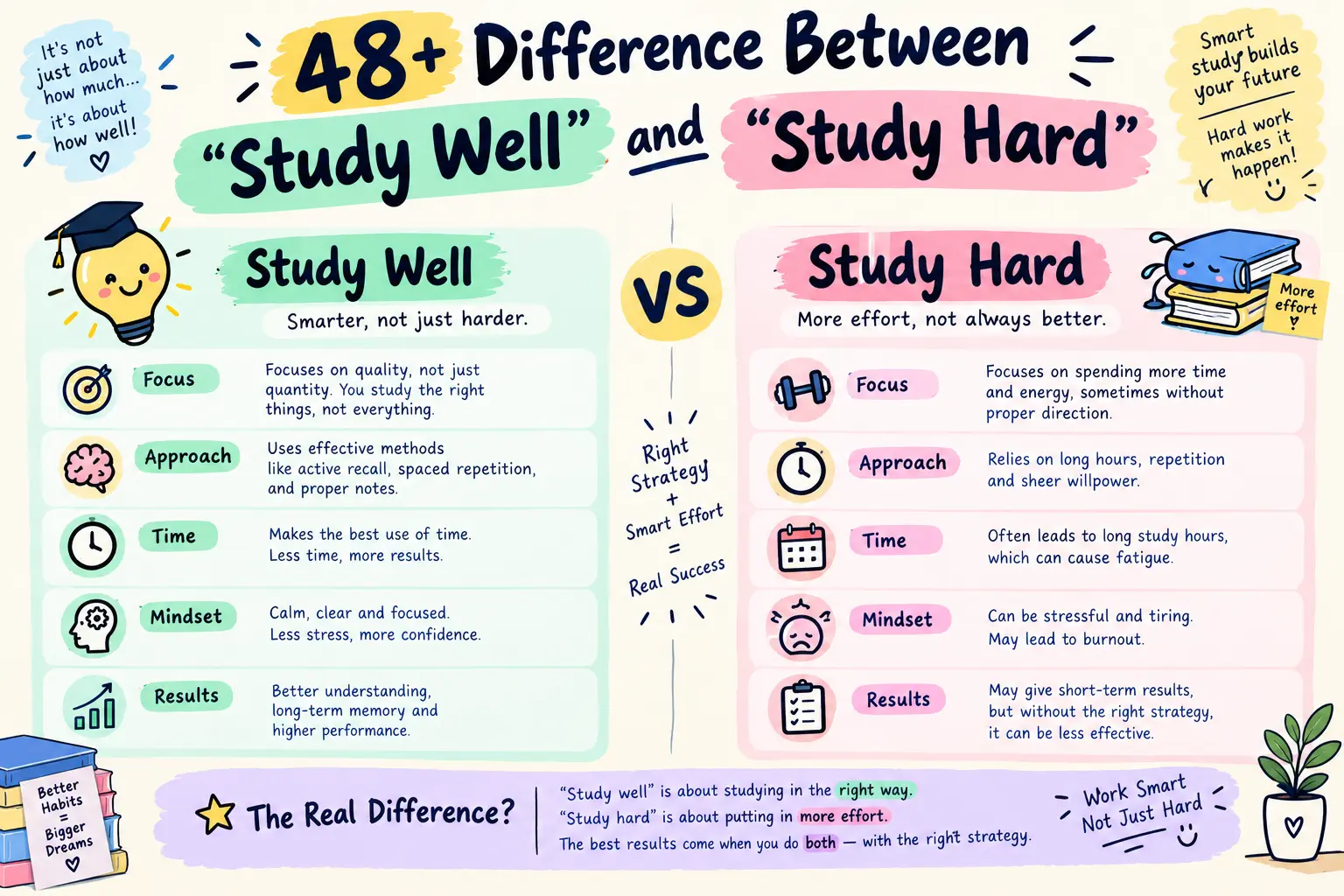
“Study well” and “study hard” may sound almost identical, but they actually describe two different approaches to learning. One focuses mainly on how effectively you study, while the other emphasizes how much effort and dedication you put into studying. Understanding this difference can help students, teachers, parents, and even professionals communicate more precisely.
For example, a student can study hard for six hours but use ineffective methods and remember very little. Another student might study well for three hours by using active recall, practice questions, and focused revision. In everyday English, both expressions are common, but choosing the right one depends on the message you want to convey. This guide explains the difference between “study well” and “study hard,” when to use each expression, and more than 48 natural alternatives you can use in conversations, advice, messages, and educational writing.
Section 1: What Does “Difference Between Study Well and Study Hard” Mean?
The main difference is effectiveness versus effort.
What does “study well” mean?
“Study well” generally means studying effectively, carefully, and successfully. It focuses on the quality of your study habits and how well you understand or retain information.
For example:
“Make sure you study well for tomorrow’s exam.”
This can mean studying with concentration, understanding the material, reviewing properly, and using effective techniques.
What does “study hard” mean?
“Study hard” means putting significant effort, time, and determination into studying.
For example:
“You need to study hard if you want to improve your grades.”
The focus here is on effort, discipline, and dedication.
The simple difference
Think of it this way:
Study hard = How much effort you put in.
Study well = How effectively you use that effort.
Ideally, good studying combines both. Working hard without studying effectively can waste time, while studying efficiently without enough effort may not be enough for a difficult subject.
Section 2: When to Use It
“Study well” and “study hard” are commonly used when giving advice, encouragement, reminders, or motivation.
You might tell a friend:
“Study hard for your final exams.”
Here, you are encouraging them to put in serious effort.
You might instead say:
“Study well and make sure you understand the concepts.”
Here, the focus is on learning effectively rather than simply spending more time with books.
In casual conversations
“Study hard tonight. Your test is tomorrow!”
In academic advice
“Students should study well by reviewing material regularly.”
In motivational speeches
“Work hard, study consistently, and believe in your ability to improve.”
In messages to students
“Study well and get enough rest before the exam.”
In professional or educational writing
“Effective study habits can improve comprehension and long-term retention.”
The expressions are usually more natural in educational and personal contexts than in formal business communication.
Section 3: Is It Polite or Professional?
Both “study well” and “study hard” are polite and completely understandable, but they are generally informal or neutral rather than highly formal.
“Study hard” is especially common in conversations between teachers, parents, friends, and students.
For example:
“Study hard and do your best!”
It sounds encouraging and supportive.
“Study well” can sound slightly more focused on quality:
“I hope you study well and feel confident about the exam.”
In formal academic writing, however, you may prefer phrases such as “study effectively,” “prepare thoroughly,” “review the material carefully,” or “develop effective study habits.”
The important point is that “study hard” does not necessarily mean “study effectively.” A person can work extremely hard while using poor study techniques. Likewise, studying well does not necessarily mean studying for very long hours.
1. Study Effectively
Meaning: Study in a way that produces strong learning results.
Tone: Academic, practical, professional.
“Try to study effectively instead of simply spending more hours at your desk.”
Short Explanation: This emphasizes the quality of your study methods rather than the number of hours you spend.
Purpose and Personalization: Use this when discussing smart study strategies, productivity, or exam preparation.
2. Study Diligently
Meaning: Study with consistent care, effort, and attention.
Tone: Formal, encouraging.
“She studied diligently throughout the semester.”
Short Explanation: “Diligently” combines effort with consistency and responsibility.
Purpose and Personalization: Useful in academic writing, teacher feedback, and formal descriptions of a student’s work.
3. Study Consistently
Meaning: Study regularly rather than only before an exam.
Tone: Practical, motivational.
“You will remember more if you study consistently throughout the semester.”
Short Explanation: This focuses on regular effort and avoids last-minute cramming.
Purpose and Personalization: Ideal for long-term exam preparation.
4. Study Smart
Meaning: Use efficient methods rather than relying only on long study hours.
Tone: Casual, motivational.
“Don’t just study longer; learn how to study smart.”
Short Explanation: This is one of the clearest alternatives for explaining the difference between effort and effectiveness.
Purpose and Personalization: Great for students looking for better ways to manage their study time.
5. Study Efficiently
Meaning: Get useful learning results without wasting time or energy.
Tone: Professional, practical.
“Learning to study efficiently can make exam preparation less stressful.”
Short Explanation: It focuses on achieving more from the time you spend studying.
Purpose and Personalization: Particularly useful when discussing productivity and time management.
6. Prepare Thoroughly
Meaning: Prepare for something carefully and completely.
Tone: Formal, professional.
“Make sure you prepare thoroughly before the final examination.”
Short Explanation: This goes beyond simply studying and suggests complete preparation.
Purpose and Personalization: Suitable for academic advice, interviews, tests, and presentations.
7. Put in the Effort
Meaning: Make a serious attempt and invest time and energy.
Tone: Motivational, conversational.
“If you put in the effort, you will gradually see improvement.”
Short Explanation: This expression focuses directly on hard work.
Purpose and Personalization: Use it when encouraging someone who needs motivation.
8. Work Hard at Your Studies
Meaning: Put substantial effort into academic work.
Tone: Encouraging, traditional.
“He worked hard at his studies throughout the year.”
Short Explanation: This is a natural way to emphasize dedication.
Purpose and Personalization: Works well in conversations between teachers, parents, and students.
9. Apply Yourself to Your Studies
Meaning: Give focused and serious attention to your education.
Tone: Formal, motivational.
“If you apply yourself to your studies, you can make significant progress.”
Short Explanation: “Apply yourself” suggests discipline and concentration.
Purpose and Personalization: A polished alternative for formal or motivational advice.
10. Give Your Studies Your Full Attention
Meaning: Focus completely on studying without unnecessary distractions.
Tone: Serious, supportive.
“Give your studies your full attention during the final week.”
Short Explanation: This emphasizes concentration rather than simply spending time studying.
Purpose and Personalization: Useful when distractions are affecting someone’s preparation.
11. Focus on Understanding
Meaning: Concentrate on understanding concepts instead of memorizing information blindly.
Tone: Academic, thoughtful.
“Focus on understanding the topic rather than memorizing every sentence.”
Short Explanation: This highlights the quality of learning.
Purpose and Personalization: Especially useful for subjects that require reasoning and application.
12. Learn Actively
Meaning: Participate actively in the learning process.
Tone: Academic, modern.
“Try to learn actively by solving questions instead of only reading your notes.”
Short Explanation: Active learning involves doing something with the information rather than passively reading it.
Purpose and Personalization: Useful when discussing modern study techniques.
13. Review Carefully
Meaning: Examine previously learned material with attention.
Tone: Neutral, practical.
“Review the difficult chapters carefully before the exam.”
Short Explanation: This emphasizes accuracy and attention.
Purpose and Personalization: Ideal for revision plans and exam preparation.
14. Revise Thoroughly
Meaning: Review material in detail before an examination or assessment.
Tone: Academic, formal.
“Revise thoroughly before attempting the final paper.”
Short Explanation: “Revise” is particularly common in British English and South Asian educational contexts.
Purpose and Personalization: A useful alternative when talking specifically about exam preparation.
15. Study with Purpose
Meaning: Study with a clear objective rather than studying aimlessly.
Tone: Motivational, thoughtful.
“Study with purpose instead of simply counting the hours.”
Short Explanation: This emphasizes having a reason and strategy behind your study session.
Purpose and Personalization: Great for students who spend long hours studying without clear goals.
16. Study with Focus
Meaning: Concentrate fully on the material.
Tone: Motivational, practical.
“Study with focus for 45 minutes, then take a short break.”
Short Explanation: The phrase highlights concentration rather than duration.
Purpose and Personalization: Useful for productivity advice.
17. Study with Discipline
Meaning: Follow a structured and consistent study routine.
Tone: Serious, motivational.
“Study with discipline if you want to make steady progress.”
Short Explanation: Discipline suggests continuing even when motivation is low.
Purpose and Personalization: Best for discussions about long-term academic success.
18. Study with Concentration
Meaning: Give your full mental attention to learning.
Tone: Formal, academic.
“Students should study with concentration during revision sessions.”
Short Explanation: This focuses specifically on mental focus.
Purpose and Personalization: Useful for academic advice and classroom contexts.
19. Make the Most of Your Study Time
Meaning: Use available study time as effectively as possible.
Tone: Practical, encouraging.
“Make the most of your study time by removing unnecessary distractions.”
Short Explanation: This captures the idea of studying well rather than simply studying longer.
Purpose and Personalization: Excellent for productivity-focused advice.
20. Make Your Study Sessions Count
Meaning: Ensure your study time produces meaningful progress.
Tone: Motivational, conversational.
“Don’t worry about studying all night; make your study sessions count.”
Short Explanation: This emphasizes results rather than hours.
Purpose and Personalization: Great for encouraging efficient preparation.
21. Put Quality Into Your Studying
Meaning: Focus on the quality and effectiveness of your learning.
Tone: Thoughtful, motivational.
“Put quality into your studying instead of measuring success by hours alone.”
Short Explanation: This directly contrasts effective study with excessive study time.
Purpose and Personalization: Useful for explaining the difference between “well” and “hard.”
22. Give It Your Best Effort
Meaning: Try as hard as you reasonably can.
Tone: Supportive, motivational.
“Give your final preparation your best effort.”
Short Explanation: This emphasizes effort and determination.
Purpose and Personalization: Good for motivational messages before important exams.
23. Give It Your Best Shot
Meaning: Make your strongest attempt.
Tone: Casual, encouraging.
“Study well, stay calm, and give the exam your best shot.”
Short Explanation: This is an informal way to encourage someone to make a serious effort.
Purpose and Personalization: Best for friends and casual conversations.
24. Stay Dedicated to Your Studies
Meaning: Continue giving consistent effort and attention to education.
Tone: Motivational, supportive.
“Stay dedicated to your studies, even when progress feels slow.”
Short Explanation: Dedication suggests commitment over time.
Purpose and Personalization: Useful for long-term academic goals.
25. Stay Committed to Learning
Meaning: Continue making learning a priority.
Tone: Motivational, professional.
“Stay committed to learning even after the examination is over.”
Short Explanation: This focuses on a lasting attitude toward education rather than one exam.
Purpose and Personalization: Particularly suitable for speeches, mentoring, and educational writing.
26. Work Toward Mastery
Meaning: Aim to understand a subject deeply rather than simply pass a test.
Tone: Academic, ambitious.
“Instead of memorizing formulas, work toward mastery of the concepts.”
Short Explanation: Mastery represents deep understanding and long-term knowledge.
Purpose and Personalization: Ideal for advanced students and academic discussions.
27. Build Strong Study Habits
Meaning: Develop reliable behaviors that support effective learning.
Tone: Practical, educational.
“Building strong study habits is more useful than cramming the night before an exam.”
Short Explanation: This emphasizes sustainable learning practices.
Purpose and Personalization: Great for students who want long-term improvement.
28. Develop an Effective Study Routine
Meaning: Create a structured approach to studying.
Tone: Practical, professional.
“Develop an effective study routine before your exams become overwhelming.”
Short Explanation: A routine can help turn effort into consistent progress.
Purpose and Personalization: Useful when discussing planning and organization.
29. Study Strategically
Meaning: Choose study methods based on your goals and needs.
Tone: Academic, intelligent.
“Study strategically by spending more time on the topics you find difficult.”
Short Explanation: Strategic studying means making deliberate decisions instead of studying everything equally.
Purpose and Personalization: Excellent for exam preparation.
30. Use Your Study Time Wisely
Meaning: Spend study time on activities that provide meaningful results.
Tone: Practical, supportive.
“Use your study time wisely instead of rereading the same chapter repeatedly.”
Short Explanation: This emphasizes efficiency and decision-making.
Purpose and Personalization: Helpful for students struggling with time management.
31. Study with Intention
Meaning: Study with a specific purpose or objective.
Tone: Thoughtful, motivational.
“Study with intention and set a clear goal for every session.”
Short Explanation: It encourages students to know what they want to accomplish.
Purpose and Personalization: Useful for creating focused study plans.
32. Learn with Understanding
Meaning: Focus on genuine comprehension rather than memorization alone.
Tone: Academic, thoughtful.
“Learn with understanding so you can apply the concept in unfamiliar questions.”
Short Explanation: This is particularly important for analytical subjects.
Purpose and Personalization: Great for mathematics, science, programming, and other problem-solving subjects.
33. Put in Consistent Work
Meaning: Make regular effort over time.
Tone: Motivational, practical.
“Put in consistent work instead of trying to learn everything the night before.”
Short Explanation: Consistency often matters more than occasional bursts of extreme effort.
Purpose and Personalization: Ideal for long-term preparation.
34. Stay on Top of Your Studies
Meaning: Keep up with academic responsibilities and avoid falling behind.
Tone: Casual, practical.
“Try to stay on top of your studies throughout the semester.”
Short Explanation: This suggests regular attention and organization.
Purpose and Personalization: Common in everyday student conversations.
35. Keep Up With Your Coursework
Meaning: Complete academic work regularly and on time.
Tone: Neutral, academic.
“Keeping up with your coursework will make exam season much easier.”
Short Explanation: This emphasizes consistency rather than last-minute effort.
Purpose and Personalization: Useful for university and school settings.
36. Prepare Intelligently
Meaning: Use thoughtful and effective preparation methods.
Tone: Professional, motivational.
“Prepare intelligently by identifying the topics most likely to need revision.”
Short Explanation: This emphasizes strategy over simply increasing study hours.
Purpose and Personalization: Good for exam planning and academic coaching.
37. Prioritize Your Learning
Meaning: Give the most important topics your attention first.
Tone: Practical, organized.
“Prioritize your learning by reviewing the most difficult chapters first.”
Short Explanation: This encourages students to allocate effort wisely.
Purpose and Personalization: Especially useful when preparation time is limited.
38. Focus on Progress, Not Just Hours
Meaning: Measure studying by what you learn rather than how long you sit at a desk.
Tone: Motivational, modern.
“Focus on progress, not just hours spent studying.”
Short Explanation: This is a clear way to explain the difference between studying hard and studying well.
Purpose and Personalization: Great for students who equate long study sessions with effective learning.
39. Work Smarter, Not Just Harder
Meaning: Improve your methods instead of only increasing your effort.
Tone: Motivational, conversational.
“Work smarter, not just harder, when preparing for your exams.”
Short Explanation: This phrase captures the central difference between quality and quantity.
Purpose and Personalization: One of the most natural expressions for discussing efficient studying.
40. Learn Efficiently
Meaning: Gain knowledge effectively while minimizing wasted effort.
Tone: Academic, practical.
“Learning efficiently can help you retain more information in less time.”
Short Explanation: It focuses on the outcome and method of learning.
Purpose and Personalization: Useful in discussions about productivity and learning techniques.
41. Study Productively
Meaning: Spend study time on activities that lead to useful progress.
Tone: Practical, modern.
“I studied productively for two hours and completed three difficult topics.”
Short Explanation: Productivity focuses on what you accomplish rather than how long you study.
Purpose and Personalization: Useful when discussing realistic study schedules.
42. Engage Deeply With the Material
Meaning: Explore and understand the subject at a deeper level.
Tone: Academic, advanced.
“Students should engage deeply with the material rather than memorize isolated facts.”
Short Explanation: This expression emphasizes meaningful learning.
Purpose and Personalization: Particularly suitable for academic essays and advanced study advice.
43. Retain What You Learn
Meaning: Remember and understand information over time.
Tone: Academic, practical.
“Use active recall to retain what you learn.”
Short Explanation: This focuses on the result of effective studying.
Purpose and Personalization: Useful when discussing memory and revision strategies.
44. Understand the Material Thoroughly
Meaning: Gain a complete understanding of the subject.
Tone: Academic, formal.
“Make sure you understand the material thoroughly before moving to advanced topics.”
Short Explanation: This places comprehension above simply completing study hours.
Purpose and Personalization: Ideal for difficult or concept-based subjects.
45. Study With a Clear Strategy
Meaning: Follow a deliberate plan for learning.
Tone: Practical, organized.
“Study with a clear strategy instead of jumping randomly between chapters.”
Short Explanation: A strategy helps turn effort into measurable progress.
Purpose and Personalization: Useful for students preparing for large examinations.
46. Be Intentional About Learning
Meaning: Make conscious decisions about what and how you study.
Tone: Thoughtful, modern.
“Be intentional about learning instead of simply completing assignments.”
Short Explanation: This focuses on purposeful learning rather than passive academic routines.
Purpose and Personalization: Suitable for educational advice and personal development.
47. Put in Focused Effort
Meaning: Combine hard work with concentration and direction.
Tone: Motivational, practical.
“Put in focused effort rather than studying for hours without a clear goal.”
Short Explanation: This combines the ideas behind studying hard and studying well.
Purpose and Personalization: Useful when encouraging balanced study habits.
48. Combine Effort With Strategy
Meaning: Work hard while also choosing effective methods.
Tone: Motivational, thoughtful.
“The best approach is to combine effort with strategy.”
Short Explanation: This may be the clearest summary of the difference between the two expressions.
Purpose and Personalization: Perfect for advice about academic success.
49. Balance Hard Work With Smart Learning
Meaning: Combine dedication with effective study techniques.
Tone: Motivational, practical.
“Balance hard work with smart learning if you want sustainable academic progress.”
Short Explanation: This recognizes that effort and effectiveness work best together.
Purpose and Personalization: Use it when giving comprehensive study advice.
50. Aim for Effective Effort
Meaning: Make your effort both substantial and productive.
Tone: Thoughtful, motivational.
“Aim for effective effort rather than simply increasing your study hours.”
Short Explanation: This expression captures the idea that effort matters most when it produces meaningful learning.
Purpose and Personalization: Useful for essays, educational articles, and motivational advice.
Conclusion
The difference between “study well” and “study hard” comes down to quality versus effort. Studying hard means putting in serious time, energy, and dedication, while studying well means using that effort effectively to understand and retain information. The strongest approach is not to choose one over the other but to combine both. Work consistently, use effective techniques, understand your material, and make your study time count. Whether you say “study smart,” “prepare thoroughly,” or “work toward mastery,” the goal remains the same: learn in a way that creates real progress. Smart effort beats wasted effort every time.
Discover more
other ways to say you dont want to miss this