
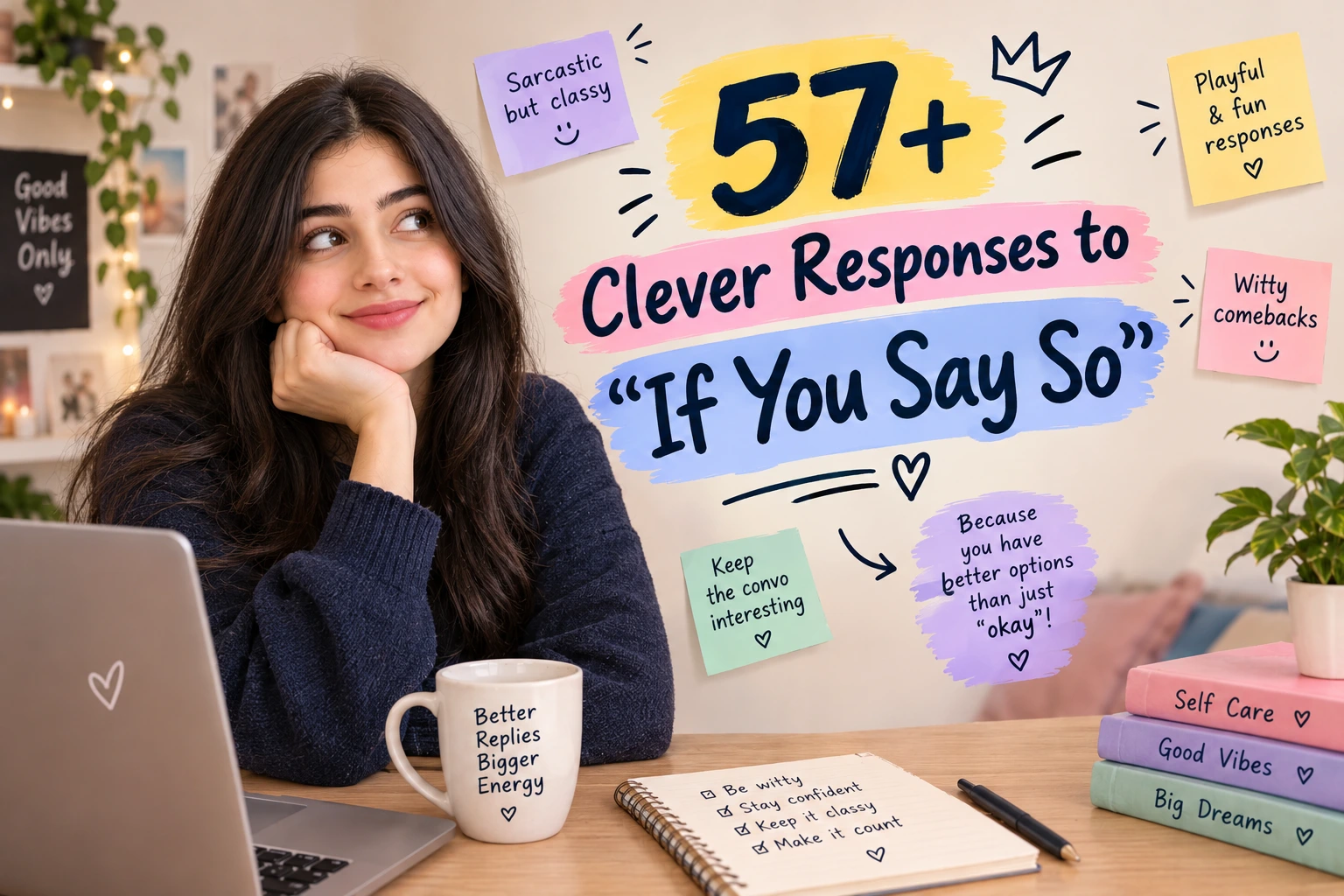
Sometimes, a simple “If you say so” can carry much more meaning than the words themselves. Depending on the speaker’s tone, it can sound playful, doubtful, sarcastic, accepting, dismissive, or even quietly challenging. That is why knowing how to respond can make a conversation much more interesting.
Instead of replying with the same predictable phrases, you can choose a response that matches the mood and your relationship with the other person. Whether you are dealing with a coworker, friend, family member, or someone teasing you, the right words can keep the conversation light, confident, or thoughtful.
These 57+ clever responses to “If you say so” will help you handle different situations naturally. From witty comebacks and confident replies to polite and mature responses, there is an option for almost every conversational mood.
What Does “If You Say So” Mean?
“If you say so” is an expression used when someone accepts, acknowledges, or responds to another person’s statement without necessarily agreeing with it.
Its meaning depends heavily on tone and context.
For example:
- “I think this is the easiest solution.”
- “If you say so.”
Here, the speaker may simply be accepting the opinion. But if someone says it sarcastically, it can imply, “I don’t really believe you, but I’ll let you think that.”
It can also be playful between friends:
“I’m definitely the funniest person here.”
“If you say so.”
In this case, the phrase may be teasing rather than genuinely dismissive.
Because the expression can carry different emotional meanings, your response should match the situation. A witty comeback may work with a friend, while a calm and professional response is better at work.
When to Use It
Responses to “If you say so” can be used in many everyday situations, depending on the relationship and tone of the conversation.
In casual conversations, you can use humor or playful confidence.
Example:
“You know I’m always right.”
“I’ll let you keep believing that.”
In a workplace conversation, a calm response can prevent unnecessary tension.
Example:
“If you say so.”
“Fair enough. Let’s see how it works out.”
In texting, short and witty responses usually work best.
Example:
“If you say so.”
“I do say so.”
You can also use thoughtful responses when the other person seems unconvinced:
“If you say so.”
“You don’t have to agree with me. Let’s talk it through.”
The key is to understand the mood before choosing your words.
Is It Polite or Professional?
“If you say so” is not automatically rude or unprofessional. Its tone depends largely on delivery and context.
In casual conversations, it can be completely harmless and even funny. Friends often use it to tease one another without any serious disagreement.
However, in professional communication, the phrase can sometimes sound dismissive or passive-aggressive, especially when there is disagreement.
For example:
“If you say so, but I don’t think that will work.”
This may sound confrontational in a workplace setting.
A more professional alternative would be:
“I understand your perspective. Let’s consider the options.”
When responding to someone who says “If you say so,” try to avoid escalating the conversation. A confident but respectful response often communicates your point more effectively than a sharp comeback.
1. I Do Say So
Meaning: A confident acknowledgment of what you just said.
Tone: Confident, playful.
Example: “If you say so.” “I do say so.”
Short Explanation: This is short, clever, and works especially well when someone is playfully challenging your statement.
Purpose and Personalization: Add a little humor through your delivery to make it sound confident rather than defensive.
2. And I Stand by It
Meaning: You are confident in your opinion.
Tone: Confident, assertive.
Example: “If you say so.” “And I stand by it.”
Short Explanation: Use this when you genuinely believe what you said and do not feel the need to back down.
Purpose and Personalization: It works well in discussions where you want to show conviction without becoming argumentative.
3. You Don’t Have to Believe Me
Meaning: The other person is free to disagree.
Tone: Calm, mature.
Example: “If you say so.” “You don’t have to believe me.”
Short Explanation: This response avoids unnecessary conflict and shows that you are comfortable with different opinions.
Purpose and Personalization: Great for situations where proving yourself is less important than keeping the conversation peaceful.
4. We’ll See About That
Meaning: Time will eventually reveal who is correct.
Tone: Playful, confident.
Example: “If you say so.” “We’ll see about that.”
Short Explanation: This creates a little suspense without turning the conversation into an argument.
Purpose and Personalization: Perfect for friendly debates or predictions.
5. I Guess Time Will Tell
Meaning: The future will prove whether the statement was correct.
Tone: Thoughtful, neutral.
Example: “If you say so.” “I guess time will tell.”
Short Explanation: This is a mature response when neither person can immediately prove their point.
Purpose and Personalization: Use it when you want to end a disagreement gracefully.
6. You Sound Convinced
Meaning: You are playfully pointing out the other person’s reaction.
Tone: Teasing, witty.
Example: “If you say so.” “You sound convinced.”
Short Explanation: This turns their doubtful response back into a lighthearted observation.
Purpose and Personalization: Best used with someone who appreciates playful banter.
7. That’s One Way to Look at It
Meaning: You acknowledge their perspective without necessarily agreeing.
Tone: Polite, diplomatic.
Example: “If you say so.” “That’s one way to look at it.”
Short Explanation: This response keeps disagreements from becoming unnecessarily heated.
Purpose and Personalization: Particularly useful when you want to remain respectful while maintaining your own position.
8. I’ll Take That as Agreement
Meaning: You jokingly interpret their response as agreement.
Tone: Funny, playful.
Example: “If you say so.” “I’ll take that as agreement.”
Short Explanation: This is a classic playful comeback when the conversation is lighthearted.
Purpose and Personalization: Use it with friends or colleagues who understand your humor.
9. That’s All the Confirmation I Needed
Meaning: You humorously pretend their response proves your point.
Tone: Witty, confident.
Example: “If you say so.” “That’s all the confirmation I needed.”
Short Explanation: This makes the exchange humorous without requiring a serious argument.
Purpose and Personalization: Especially effective in playful debates.
10. I’ll Let You Process That
Meaning: You are giving the other person time to think about your point.
Tone: Playful, slightly cheeky.
Example: “If you say so.” “I’ll let you process that.”
Short Explanation: This response adds confidence and humor to the conversation.
Purpose and Personalization: Use carefully because it can sound slightly smug in a serious discussion.
11. You Heard Me Right
Meaning: You are confirming that your statement was intentional.
Tone: Direct, confident.
Example: “If you say so.” “You heard me right.”
Short Explanation: This works when someone sounds surprised or doubtful about what you said.
Purpose and Personalization: Keep your delivery calm to make it sound confident rather than confrontational.
12. Believe It or Not
Meaning: The other person may doubt you, but you believe your statement is true.
Tone: Casual, confident.
Example: “If you say so.” “Believe it or not, I’m serious.”
Short Explanation: This response acknowledges their skepticism while reinforcing your point.
Purpose and Personalization: Useful when someone is clearly questioning what you said.
13. You Can Check for Yourself
Meaning: The other person can verify the information independently.
Tone: Confident, straightforward.
Example: “If you say so.” “You can check for yourself.”
Short Explanation: This moves the conversation away from personal disagreement and toward evidence.
Purpose and Personalization: A strong option when discussing facts or practical matters.
14. Fair Enough
Meaning: You accept that the other person has a different perspective.
Tone: Calm, mature.
Example: “If you say so.” “Fair enough. We can agree to disagree.”
Short Explanation: This is one of the safest ways to keep a disagreement respectful.
Purpose and Personalization: Ideal for professional or emotionally sensitive conversations.
15. We’ll Agree to Disagree
Meaning: You recognize that neither person is changing their position.
Tone: Diplomatic, mature.
Example: “If you say so.” “We’ll agree to disagree.”
Short Explanation: It ends a circular debate without creating additional tension.
Purpose and Personalization: Particularly useful in workplace and family discussions.
16. That’s Your Call
Meaning: The other person can make their own decision.
Tone: Calm, independent.
Example: “If you say so.” “That’s your call.”
Short Explanation: This communicates that you have shared your perspective and will respect their choice.
Purpose and Personalization: Good when you do not want to keep persuading someone.
17. I’m Comfortable With What I Said
Meaning: You are confident in your statement.
Tone: Self-assured, mature.
Example: “If you say so.” “I’m comfortable with what I said.”
Short Explanation: This communicates confidence without attacking the other person.
Purpose and Personalization: A useful response when you want to remain composed during disagreement.
18. You Don’t Sound Convinced
Meaning: You have noticed their skepticism.
Tone: Observant, playful.
Example: “If you say so.” “You don’t sound convinced.”
Short Explanation: This directly acknowledges the underlying tone of their response.
Purpose and Personalization: Use it when you want to invite a more honest conversation.
19. What Would Convince You?
Meaning: You are asking what evidence or explanation they need.
Tone: Curious, constructive.
Example: “If you say so.” “What would convince you?”
Short Explanation: Instead of arguing, this response opens the door to meaningful discussion.
Purpose and Personalization: Excellent for serious conversations and problem-solving.
20. You Seem Skeptical
Meaning: You recognize that the other person doubts your statement.
Tone: Neutral, observant.
Example: “If you say so.” “You seem skeptical.”
Short Explanation: This identifies the mood without immediately responding defensively.
Purpose and Personalization: Follow it with a question if you want to understand their concerns.
21. And That’s Okay
Meaning: You accept that they may not share your opinion.
Tone: Calm, accepting.
Example: “If you say so.” “And that’s okay. We don’t have to agree.”
Short Explanation: This demonstrates emotional maturity and reduces tension.
Purpose and Personalization: Particularly useful when the disagreement is personal.
22. I’m Not Here to Convince You
Meaning: You are comfortable letting someone hold their own opinion.
Tone: Independent, composed.
Example: “If you say so.” “I’m not here to convince you.”
Short Explanation: This response shows that you do not need external approval for every opinion.
Purpose and Personalization: Use it when the discussion is becoming repetitive.
23. You Can Think That
Meaning: You allow the other person to maintain their opinion.
Tone: Casual, slightly teasing.
Example: “If you say so.” “You can think that.”
Short Explanation: This can be playful but may sound dismissive if delivered too sharply.
Purpose and Personalization: Best reserved for casual conversations.
24. Whatever Helps You Sleep at Night
Meaning: A humorous way of saying you are not bothered by their opinion.
Tone: Sarcastic, funny.
Example: “If you say so.” “Whatever helps you sleep at night.”
Short Explanation: This is a cheeky response that works best when both people are joking.
Purpose and Personalization: Avoid it in professional conversations because it can sound dismissive.
25. I’ll Pretend That’s a Yes
Meaning: You jokingly interpret their uncertain response as agreement.
Tone: Playful, humorous.
Example: “If you say so.” “I’ll pretend that’s a yes.”
Short Explanation: It keeps the conversation light when there is no serious disagreement.
Purpose and Personalization: Great for friendly teasing.
26. I’ll Take Your Silence as Support
Meaning: You humorously treat their lack of agreement as support.
Tone: Witty, playful.
Example: “If you say so.” “I’ll take your silence as support.”
Short Explanation: This exaggerates the situation for comic effect.
Purpose and Personalization: Best suited to informal conversations.
27. Don’t Hurt Yourself Agreeing With Me
Meaning: A humorous acknowledgment that the other person clearly does not agree.
Tone: Sarcastic, playful.
Example: “If you say so.” “Don’t hurt yourself agreeing with me.”
Short Explanation: This makes their skepticism part of the joke.
Purpose and Personalization: Use only when the relationship supports sarcastic humor.
28. Your Enthusiasm Is Inspiring
Meaning: You jokingly point out their lack of enthusiasm.
Tone: Sarcastic, witty.
Example: “If you say so.” “Your enthusiasm is inspiring.”
Short Explanation: The contrast between the words and their actual attitude creates the humor.
Purpose and Personalization: Works well in playful conversations.
29. I Can Feel the Excitement
Meaning: You are joking about their doubtful or unimpressed reaction.
Tone: Funny, sarcastic.
Example: “If you say so.” “I can feel the excitement from here.”
Short Explanation: This exaggerates their lack of enthusiasm in a humorous way.
Purpose and Personalization: Keep it light so it does not sound hostile.
30. That’s Quite the Vote of Confidence
Meaning: You jokingly describe their doubtful response as support.
Tone: Witty, sarcastic.
Example: “If you say so.” “That’s quite the vote of confidence.”
Short Explanation: It is clever because it says the opposite of what their tone suggests.
Purpose and Personalization: Great for friendly banter.
31. I’ll Try to Survive the Doubt
Meaning: You humorously acknowledge that they do not believe you.
Tone: Playful, dramatic.
Example: “If you say so.” “I’ll try to survive the doubt.”
Short Explanation: The exaggerated wording makes an ordinary disagreement funny.
Purpose and Personalization: Best for close friends and casual chats.
32. Your Skepticism Has Been Noted
Meaning: You acknowledge their doubt without arguing.
Tone: Dry, witty.
Example: “If you say so.” “Your skepticism has been noted.”
Short Explanation: This has a slightly formal tone that makes it amusing in casual conversations.
Purpose and Personalization: Works particularly well over text.
33. Duly Noted
Meaning: You acknowledge what the person has said.
Tone: Formal, concise.
Example: “If you say so.” “Duly noted.”
Short Explanation: This is brief and neutral, making it useful when you do not want to prolong the exchange.
Purpose and Personalization: Suitable for professional settings when you want to remain composed.
34. Point Taken
Meaning: You understand their perspective.
Tone: Mature, professional.
Example: “If you say so.” “Point taken. I’ll think about it.”
Short Explanation: This demonstrates that you are listening without necessarily agreeing.
Purpose and Personalization: A strong choice for workplace discussions.
35. I Hear You
Meaning: You acknowledge what the other person is saying.
Tone: Empathetic, calm.
Example: “If you say so.” “I hear you, even if I see it differently.”
Short Explanation: This keeps communication respectful while leaving room for disagreement.
Purpose and Personalization: Especially useful during sensitive conversations.
36. Let’s Leave It There
Meaning: You prefer to end the disagreement for now.
Tone: Calm, diplomatic.
Example: “If you say so.” “Let’s leave it there for now.”
Short Explanation: This prevents a minor disagreement from becoming an unnecessary argument.
Purpose and Personalization: Useful in both personal and professional situations.
37. Maybe You’ll Change Your Mind
Meaning: You believe they may eventually reconsider.
Tone: Playful, confident.
Example: “If you say so.” “Maybe you’ll change your mind later.”
Short Explanation: This keeps the conversation open without demanding immediate agreement.
Purpose and Personalization: Use it when the disagreement is light rather than serious.
38. Keep That Opinion Handy
Meaning: A humorous way of telling someone to keep their opinion.
Tone: Witty, teasing.
Example: “If you say so.” “Keep that opinion handy; you might need it later.”
Short Explanation: The playful wording adds personality to the exchange.
Purpose and Personalization: Works best with friends.
39. I’ll Remember You Said That
Meaning: You imply that future events may prove your point.
Tone: Playful, confident.
Example: “If you say so.” “I’ll remember you said that.”
Short Explanation: This creates a fun sense of anticipation.
Purpose and Personalization: Good for predictions, challenges, or friendly debates.
40. Let’s Put It to the Test
Meaning: You suggest using evidence or experience to settle the disagreement.
Tone: Confident, constructive.
Example: “If you say so.” “Let’s put it to the test.”
Short Explanation: Rather than continuing the argument, you suggest finding out what actually happens.
Purpose and Personalization: Excellent for practical discussions.
41. Actions Will Speak Louder
Meaning: Actual results will matter more than opinions.
Tone: Thoughtful, confident.
Example: “If you say so.” “Actions will speak louder than opinions here.”
Short Explanation: This shifts attention from words to results.
Purpose and Personalization: Suitable for work, projects, and serious conversations.
42. Let’s See How It Plays Out
Meaning: The outcome will eventually become clear.
Tone: Calm, mature.
Example: “If you say so.” “Let’s see how it plays out.”
Short Explanation: This avoids unnecessary debate while keeping the discussion open.
Purpose and Personalization: A natural choice when the answer depends on future events.
43. You May Be Right
Meaning: You acknowledge that their perspective could be valid.
Tone: Humble, thoughtful.
Example: “If you say so.” “You may be right; I’ll consider it.”
Short Explanation: This response shows openness without forcing you to completely change your position.
Purpose and Personalization: Excellent for mature conversations.
44. I Could Be Wrong
Meaning: You recognize the possibility that your opinion may not be correct.
Tone: Humble, mature.
Example: “If you say so.” “I could be wrong, but here’s how I see it.”
Short Explanation: This encourages honest discussion instead of turning the conversation into a competition.
Purpose and Personalization: Particularly effective in professional or academic settings.
45. Let’s Look at the Facts
Meaning: You want evidence rather than assumptions.
Tone: Logical, professional.
Example: “If you say so.” “Let’s look at the facts before we decide.”
Short Explanation: This redirects the conversation toward objective information.
Purpose and Personalization: A strong response for workplace, academic, or practical discussions.
46. What Makes You Say That?
Meaning: You are asking about the reasoning behind their response.
Tone: Curious, thoughtful.
Example: “If you say so.” “What makes you say that?”
Short Explanation: Instead of assuming their attitude, you invite them to explain it.
Purpose and Personalization: Useful when you sense there is more behind their words.
47. Tell Me What You Really Think
Meaning: You want their honest opinion.
Tone: Direct, open.
Example: “If you say so.” “Tell me what you really think.”
Short Explanation: This encourages more genuine communication.
Purpose and Personalization: Best when you have a comfortable relationship with the person.
48. That Didn’t Sound Very Convincing
Meaning: You noticed that their response lacked genuine agreement.
Tone: Teasing, observant.
Example: “If you say so.” “That didn’t sound very convincing.”
Short Explanation: This directly addresses the doubtful tone behind their words.
Purpose and Personalization: Use it lightly to avoid making the other person defensive.
49. You Can Keep Your Doubts
Meaning: You accept that they remain unconvinced.
Tone: Confident, slightly playful.
Example: “If you say so.” “You can keep your doubts; I’m still confident.”
Short Explanation: This communicates self-assurance without needing their approval.
Purpose and Personalization: Good for casual disagreements.
50. Confidence Doesn’t Require a Committee Vote
Meaning: You do not need everyone’s approval to believe in your decision.
Tone: Clever, confident.
Example: “If you say so.” “Confidence doesn’t require a committee vote.”
Short Explanation: This is a polished comeback for situations where someone questions your confidence.
Purpose and Personalization: Best when you want a sophisticated rather than aggressive response.
51. I’ll Take My Chances
Meaning: You are willing to accept the possibility of being wrong.
Tone: Confident, independent.
Example: “If you say so.” “I’ll take my chances.”
Short Explanation: This shows that you are comfortable making your own judgment.
Purpose and Personalization: Useful when someone is warning you or questioning your decision.
52. I’m Good With My Answer
Meaning: You are satisfied with your position.
Tone: Calm, self-assured.
Example: “If you say so.” “I’m good with my answer.”
Short Explanation: This closes the discussion without sounding unnecessarily aggressive.
Purpose and Personalization: Suitable for conversations where you want to establish a clear boundary.
53. No Pressure to Agree
Meaning: You respect their freedom to have a different opinion.
Tone: Friendly, mature.
Example: “If you say so.” “No pressure to agree with me.”
Short Explanation: This removes the competitive element from the conversation.
Purpose and Personalization: A particularly useful response when discussing opinions rather than facts.
54. We Don’t Have to See It the Same Way
Meaning: Different opinions can coexist.
Tone: Respectful, mature.
Example: “If you say so.” “We don’t have to see it the same way.”
Short Explanation: This is a healthy way to handle disagreements without making them personal.
Purpose and Personalization: Works well with friends, coworkers, and family.
55. That’s Your Perspective
Meaning: You recognize their viewpoint without adopting it yourself.
Tone: Neutral, thoughtful.
Example: “If you say so.” “That’s your perspective, and I respect it.”
Short Explanation: This separates respect for the person from agreement with their opinion.
Purpose and Personalization: Excellent for mature discussions.
56. I’ll Let the Results Decide
Meaning: You prefer evidence and outcomes to settle the disagreement.
Tone: Confident, practical.
Example: “If you say so.” “I’ll let the results decide.”
Short Explanation: This response shifts the focus away from personal opinions and toward measurable outcomes.
Purpose and Personalization: Especially useful for projects, work decisions, and friendly challenges.
57. Well, I Said What I Said
Meaning: You are standing firmly by your statement.
Tone: Confident, casual.
Example: “If you say so.” “Well, I said what I said.”
Short Explanation: This is a memorable and confident response when you do not want to keep explaining yourself.
Purpose and Personalization: Best for informal conversations where a little attitude is acceptable.
58. We’ll Just Have to See
Meaning: The situation will eventually reveal the answer.
Tone: Calm, mysterious, confident.
Example: “If you say so.” “We’ll just have to see.”
Short Explanation: This keeps the response short while suggesting that the conversation is not settled yet.
Purpose and Personalization: A versatile option for both playful predictions and genuine disagreements.
Conclusion
The phrase “If you say so” can mean agreement, doubt, sarcasm, acceptance, or playful skepticism, so the best response depends on the situation. A clever comeback can make a casual conversation more entertaining, while a calm and thoughtful response can prevent a disagreement from becoming unnecessarily tense. The 57+ alternatives above give you options for everything from friendly teasing to professional discussions. Experiment with different expressions, but always consider the other person’s tone and your relationship with them. The most effective response is one that sounds natural, confident, and genuinely like you.
Discover more
funny responses to any plans this weekend