
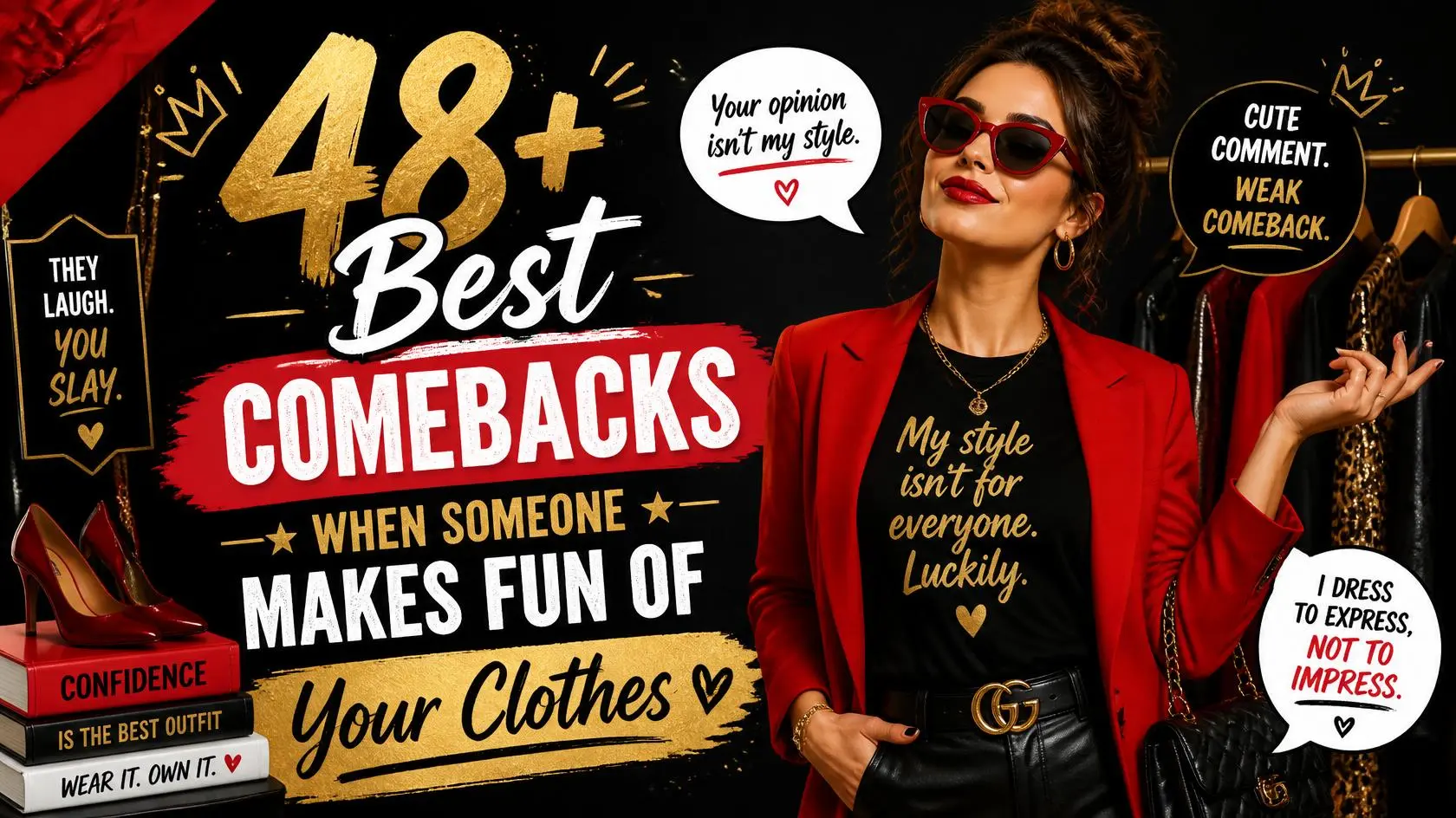
Someone makes a comment about your clothes, and suddenly you do not know what to say. It can be annoying, embarrassing, or simply funny. The good news is that you do not need a harsh insult to handle the situation. A clever comeback can help you stay calm and confident. It can also turn an awkward moment into a funny one. The best response depends on the situation. You might want to joke with a friend. You might need to set a clear boundary with someone who keeps criticizing you. In other cases, a simple answer is enough.
This guide shares funny, clever, confident, and classy comebacks when someone makes fun of your clothes. You will also learn when to use each type of response and how to avoid making the situation worse.
What Does “Best Comebacks When Someone Makes Fun of Your Clothes” Mean?
The phrase “best comebacks when someone makes fun of your clothes” means clever responses to comments about your outfit or personal style.
Someone might say:
“Why are you wearing that?”
They may be joking. They may also be trying to embarrass you.
Your response can change the mood of the conversation.
For example, you could say:
“Good thing you are not the one wearing it.”
This answer is short and confident. It also reminds the other person that your clothes are your choice.
A comeback does not have to be rude. You can be funny without insulting anyone. You can also be firm when someone crosses a line.
When to Use These Comebacks
These responses work best in casual and social situations.
With Friends
Friends often tease each other about clothes.
You can answer with humor when the comment is harmless.
Example:
Friend: “That outfit is certainly a choice.”
You: “A very intentional one.”
At School or College
Someone may comment on your outfit in front of others.
A short and calm response can stop the conversation.
Example:
Them: “Why do you always dress like that?”
You: “Because I like it.”
In Social Situations
A playful response can keep things relaxed.
Example:
Them: “Everyone is going to notice that outfit.”
You: “Looks like it is already working.”
At Work
Be more careful in professional settings.
Avoid rude or aggressive comebacks.
Example:
Them: “I would have chosen something different.”
You: “That is fair. I like my choice.”
Over Text
Short replies usually work best in messages.
Example:
Them: “That outfit is interesting.”
You: “Thanks for noticing.”
Is It Polite or Professional?
It depends on the comeback you choose.
A funny response can be polite. A sarcastic response can also work in casual conversations.
However, an insulting response may create more problems.
For example:
“You do not have to like it. I do.”
This is confident without being rude.
For a professional setting, use something calmer:
“Everyone has different preferences.”
If someone keeps making comments, you can be more direct:
“You do not have to like my clothes, but please stop commenting on them.”
The key is to match your response to the situation.
50 Best Comebacks When Someone Makes Fun of Your Clothes
Funny and Playful Comebacks
1. “Good thing you are not wearing it.”
Meaning: Your outfit is your choice.
Tone: Funny and confident.
Example:
“Good thing you are not wearing it.”
Why use it: Use this when someone acts as if they should choose your clothes.
2. “Thanks for noticing.”
Meaning: You are treating their criticism like a compliment.
Tone: Playful.
Example:
“Thanks for noticing. I appreciate the attention.”
Why use it: This works well when someone clearly wants a reaction.
3. “I was going for memorable.”
Meaning: You are happy that your outfit stands out.
Tone: Light and confident.
Example:
“I was going for memorable. Looks like it worked.”
Why use it: Turn their comment into something positive.
4. “I like keeping things interesting.”
Meaning: You are comfortable with your personal style.
Tone: Playful.
Example:
“You really chose that outfit?”
“Of course. I like keeping things interesting.”
Why use it: This is great for friendly teasing.
5. “Apparently, my outfit is today’s main topic.”
Meaning: They are giving your clothes a lot of attention.
Tone: Funny and sarcastic.
Example:
“Apparently, my outfit is today’s main topic.”
Why use it: Use this when someone keeps talking about what you are wearing.
6. “Noted. I am still wearing it.”
Meaning: You heard their opinion, but you are not changing your choice.
Tone: Calm and funny.
Example:
“I do not really like that shirt.”
“Noted. I am still wearing it.”
Why use it: It ends the discussion without an argument.
7. “You noticed, so I guess it worked.”
Meaning: Their attention proves the outfit stood out.
Tone: Clever.
Example:
“That outfit gets attention.”
“You noticed, so I guess it worked.”
Why use it: This turns criticism into confidence.
8. “Different tastes keep life interesting.”
Meaning: People do not have to like the same things.
Tone: Friendly and mature.
Example:
“That is not really my style.”
“Different tastes keep life interesting.”
Why use it: Choose this when you want to stay friendly.
9. “Fortunately, we do not need matching wardrobes.”
Meaning: You can have different styles.
Tone: Funny.
Example:
“I would never wear that.”
“Fortunately, we do not need matching wardrobes.”
Why use it: This works well with friends.
10. “I will add your review to my collection.”
Meaning: You are joking about their opinion.
Tone: Playful and sarcastic.
Example:
“I will add your review to my collection.”
Why use it: It keeps the situation light.
Confident Comebacks
11. “I dress for myself.”
Meaning: You choose clothes based on your own preferences.
Tone: Confident.
Example:
“I dress for myself, not for everyone’s approval.”
Why use it: Use this when someone expects you to follow their opinion.
12. “You do not have to like it.”
Meaning: Their approval is not necessary.
Tone: Calm and firm.
Example:
“You do not have to like it. I do.”
Why use it: This is simple and direct.
13. “My style is not up for a vote.”
Meaning: Other people do not get to decide what you wear.
Tone: Confident.
Example:
“My style is not up for a vote.”
Why use it: This works when several people start giving opinions.
14. “I am comfortable with my choice.”
Meaning: You feel good about what you are wearing.
Tone: Mature.
Example:
“You can have your opinion. I am comfortable with my choice.”
Why use it: Use this when you want to stay calm.
15. “Your opinion does not change mine.”
Meaning: Their comment will not affect your decision.
Tone: Firm.
Example:
“Your opinion does not change mine.”
Why use it: This is useful when someone keeps trying to convince you.
16. “I chose it because I like it.”
Meaning: You do not need another reason for your choice.
Tone: Simple and confident.
Example:
“Why would you wear that?”
“I chose it because I like it.”
Why use it: Keep this response ready for unnecessary questions.
17. “We clearly have different tastes.”
Meaning: You and the other person like different styles.
Tone: Calm.
Example:
“We clearly have different tastes, and that is okay.”
Why use it: This avoids turning a small disagreement into an argument.
18. “I am not looking for fashion approval.”
Meaning: You do not need anyone to approve your outfit.
Tone: Confident.
Example:
“I am not looking for fashion approval, but thanks for the review.”
Why use it: It works well when someone gives unwanted advice.
19. “I know what I like.”
Meaning: You trust your own preferences.
Tone: Self assured.
Example:
“I know what I like, and I like this.”
Why use it: It is short and easy to use.
20. “I am good with my choice.”
Meaning: You are satisfied with your outfit.
Tone: Calm.
Example:
“I am good with my choice, but thanks for the concern.”
Why use it: This keeps the conversation respectful.
Clever and Sarcastic Comebacks
21. “Thank you for the unsolicited fashion advice.”
Meaning: You did not ask for their opinion.
Tone: Sarcastic.
Example:
“Thank you for the unsolicited fashion advice.”
Why use it: Use this when someone keeps giving unwanted comments.
22. “I will survive this fashion disagreement.”
Meaning: Their opinion is not a big deal.
Tone: Dry and funny.
Example:
“I will survive this fashion disagreement somehow.”
Why use it: This makes their criticism sound less serious.
23. “I am glad my outfit gave you something to discuss.”
Meaning: You noticed how much attention they are giving your clothes.
Tone: Sarcastic.
Example:
“I am glad my outfit gave you something to discuss.”
Why use it: Use this when someone will not stop talking about your clothes.
24. “That is a lot of concern about my wardrobe.”
Meaning: You are questioning why they care so much.
Tone: Dry and witty.
Example:
“That is a lot of concern about my wardrobe.”
Why use it: This puts the attention back on their unnecessary comment.
25. “I did not know my outfit needed a committee review.”
Meaning: They are taking your outfit far too seriously.
Tone: Sarcastic.
Example:
“I did not know my outfit needed a committee review.”
Why use it: This works when several people are giving opinions.
26. “I will alert the fashion authorities.”
Meaning: You are joking about their serious reaction.
Tone: Playful.
Example:
“I will alert the fashion authorities immediately.”
Why use it: Perfect for harmless teasing.
27. “Breaking news: someone dislikes my outfit.”
Meaning: You are pretending their opinion is major news.
Tone: Funny.
Example:
“Breaking news: someone dislikes my outfit.”
Why use it: This is especially good for casual conversations.
28. “I will try to recover from that review.”
Meaning: You are exaggerating their criticism for humor.
Tone: Dramatic and funny.
Example:
“I will try to recover from that devastating review.”
Why use it: It makes the situation feel less serious.
29. “Your review has been received.”
Meaning: You heard the comment, but you are not acting on it.
Tone: Dry.
Example:
“Your review has been received.”
Why use it: This works particularly well over text.
30. “I appreciate your contribution to the fashion discussion.”
Meaning: You are joking about their unwanted opinion.
Tone: Sarcastic.
Example:
“I appreciate your contribution to the fashion discussion.”
Why use it: Use it when someone is taking a casual comment too seriously.
Classy and Mature Comebacks
31. “It is okay if my style is not your style.”
Meaning: Different people have different preferences.
Tone: Mature.
Example:
“It is okay if my style is not your style.”
Why use it: This is a strong response without any hostility.
32. “Everyone has different preferences.”
Meaning: People naturally like different things.
Tone: Polite.
Example:
“Everyone has different preferences, and that is perfectly fine.”
Why use it: This works in many social situations.
33. “I respect your opinion, but I disagree.”
Meaning: You can respect someone without agreeing with them.
Tone: Respectful.
Example:
“I respect your opinion, but I disagree.”
Why use it: This is ideal when you want to keep the conversation calm.
34. “You are entitled to your opinion.”
Meaning: They can have their view, but you do not need to accept it.
Tone: Firm and mature.
Example:
“You are entitled to your opinion, and I am comfortable with mine.”
Why use it: Use this when someone is pushing their opinion too strongly.
35. “I am happy with what I am wearing.”
Meaning: You feel comfortable with your choice.
Tone: Positive.
Example:
“I am happy with what I am wearing, so that is what matters to me.”
Why use it: It keeps the focus on your own comfort.
36. “There is no need for us to agree.”
Meaning: You can have different opinions without arguing.
Tone: Mature.
Example:
“There is no need for us to agree about everything.”
Why use it: This is useful during a disagreement.
37. “I appreciate the honesty, but I will keep my choice.”
Meaning: You heard their opinion, but you are not changing your decision.
Tone: Respectful and confident.
Example:
“I appreciate the honesty, but I will keep my choice.”
Why use it: This works when someone is giving genuine feedback.
38. “I prefer expressing my own style.”
Meaning: Your clothes are part of your personal expression.
Tone: Thoughtful.
Example:
“I prefer expressing my own style instead of following every trend.”
Why use it: This response keeps the conversation positive.
39. “I am comfortable being different.”
Meaning: You do not need to dress like everyone else.
Tone: Confident.
Example:
“I am comfortable being different.”
Why use it: This is a good response to comments about your unique style.
40. “My clothes do not need everyone’s approval.”
Meaning: You do not depend on other people’s opinions.
Tone: Firm.
Example:
“My clothes do not need everyone’s approval.”
Why use it: Use this when someone keeps seeking a reaction from you.
Short and Direct Comebacks
41. “And yet, here I am.”
Meaning: Their criticism has changed nothing.
Tone: Dry and confident.
Example:
“You really do not like that outfit?”
“And yet, here I am.”
Why use it: It is short and effective.
42. “Noted.”
Meaning: You heard them, but you are not bothered.
Tone: Calm.
Example:
“That is not my favorite outfit.”
“Noted.”
Why use it: Sometimes saying less is more powerful.
43. “I like it.”
Meaning: Your own opinion matters to you.
Tone: Confident.
Example:
“Why would you wear that?”
“Because I like it.”
Why use it: It is direct and easy to remember.
44. “Thanks for sharing.”
Meaning: You acknowledge the comment without inviting more discussion.
Tone: Polite with a dry edge.
Example:
“I would never wear that.”
“Thanks for sharing.”
Why use it: This can quickly end an unwanted conversation.
45. “Moving on.”
Meaning: You do not want to continue the conversation.
Tone: Firm.
Example:
“You should change your outfit.”
“Moving on.”
Why use it: Use this when someone refuses to drop the subject.
46. “That is your perspective.”
Meaning: Their opinion is not a universal fact.
Tone: Mature.
Example:
“That outfit makes no sense.”
“That is your perspective.”
Why use it: This keeps the response calm.
47. “I am still wearing it.”
Meaning: Their comment did not change your decision.
Tone: Direct.
Example:
“You should change.”
“I am still wearing it.”
Why use it: Use it when someone is trying to pressure you.
48. “Anyway, I like it.”
Meaning: You are ending the discussion.
Tone: Casual.
Example:
“That color is not for you.”
“Anyway, I like it.”
Why use it: It is simple and natural.
49. “You noticed. Cool.”
Meaning: You acknowledge their attention without taking the comment seriously.
Tone: Dry and casual.
Example:
“That outfit is definitely different.”
“You noticed. Cool.”
Why use it: This works well in casual conversations and texts.
50. “I am not taking fashion applications today.”
Meaning: You are jokingly refusing unwanted advice.
Tone: Funny and confident.
Example:
“You should really change that.”
“Sorry, I am not taking fashion applications today.”
Why use it: It sets a boundary while keeping the mood light.
Real Life Situations
When a Friend Is Teasing You
If your friend is only joking, you do not need to get defensive.
Try:
“Thanks for noticing. I appreciate the attention.”
It keeps the conversation fun.
When Someone Keeps Criticizing Your Clothes
Repeated comments can become annoying.
Try:
“You do not have to like it, but you do not need to keep commenting on it.”
This sets a clear boundary.
When Someone Comments in Front of Others
Do not let the situation turn into a public argument.
Try:
“My style is not up for a vote.”
Then move on.
When Someone Gives Genuine Feedback
Not every opinion is meant to be insulting.
Try:
“It is okay if my style is not your style.”
This keeps the conversation respectful.
When You Do Not Want to Respond
You do not always need a clever comeback.
Simply say:
“Noted.”
Then change the subject.
What to Avoid
1. Do Not Attack Their Appearance
Avoid turning the conversation into a competition about looks.
Focus on their comment instead.
2. Do Not Over Explain
You do not need to defend every clothing choice.
A short answer is often enough.
3. Do Not Escalate a Small Joke
If someone is only teasing you, a playful response may work better than an angry one.
4. Do Not Take Every Opinion Personally
People have different tastes.
Someone disliking your outfit does not make your choice wrong.
5. Do Not Use Aggressive Replies at Work
A response that works with a close friend may not work in a professional setting.
Choose your words carefully.
6. Do Not Forget Your Goal
Your goal is not to win every argument.
Your goal is to stay confident and handle the situation well.
Pro Tips for Choosing the Right Comeback
Keep It Short
A short comeback is easier to remember.
It also gives the other person less room to argue.
Match Their Tone
Use humor when they are joking.
Use a firm response when they are being disrespectful.
Use a calm response when they are simply sharing an opinion.
Stay Confident
You do not need an insult to sound confident.
Sometimes the strongest response is:
“I like what I am wearing.”
That is enough.
Conclusion
When someone makes fun of your clothes, you have plenty of ways to respond. You can be funny. You can be sarcastic. You can also stay completely calm. The best comeback is the one that fits the situation and feels natural to you. If a friend is teasing you, use humor. If someone crosses a boundary, be direct. If the comment does not matter, simply move on.
Most importantly, do not let one person’s opinion decide how you feel about your choices. Wear what makes you comfortable. Speak with confidence. And remember that you do not need everyone’s a
Discover more
how to respond to youre a rockstar