

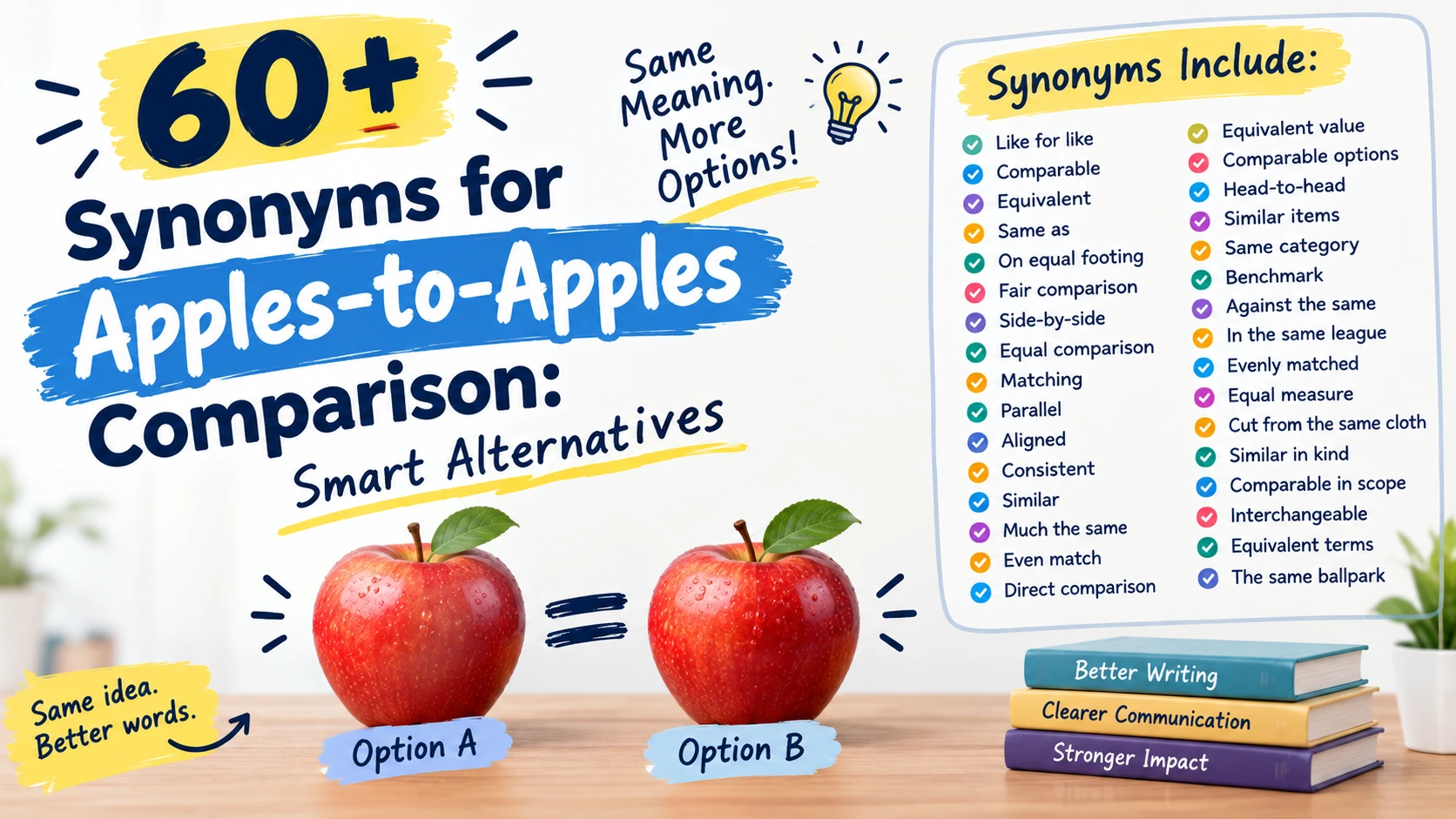
Have you ever needed to compare two products, services, ideas, or opportunities fairly without making your writing sound repetitive? The expression “apples-to-apples comparison” is a popular way to describe a fair evaluation of two things using the same standards. It is especially useful in business discussions, research, shopping decisions, and everyday conversations. However, repeating the same phrase can make your writing feel predictable, particularly when you want to sound polished and professional.
Fortunately, there are plenty of alternatives that communicate the same idea with greater precision. Expressions such as “like-for-like comparison,” “direct comparison,” and “comparison on equal terms” can help you explain your point more naturally. The best choice depends on your audience, purpose, and writing style. In this guide, you will discover more than 60 synonyms for apples-to-apples comparison, complete with meanings, tones, practical examples, and advice on when to use each expression.
What Does “Apples-to-Apples Comparison” Mean?
An apples-to-apples comparison is a fair evaluation of two or more things using equivalent criteria. It ensures that you compare similar features, conditions, quantities, or standards rather than drawing conclusions from unrelated information.
For example, comparing two laptops with the same memory, storage capacity, and warranty provides a more meaningful comparison than comparing a basic model with a premium one. Similarly, businesses may compare suppliers using the same delivery requirements, product specifications, and payment terms.
The expression comes from the idea that apples should be compared with apples rather than oranges. Although both are fruits, their differences can make a direct comparison misleading if the purpose is to evaluate identical characteristics.
The phrase generally has a practical, analytical tone. It suggests fairness, consistency, and careful decision-making. Its alternatives can sound more formal, technical, conversational, or persuasive, depending on the situation.
When to Use “Apples-to-Apples Comparison”
This expression works in many situations, but choosing an alternative can make your meaning clearer and better suited to your audience.
In business and professional writing: Use expressions such as “like-for-like comparison” or “comparison on equivalent terms” when discussing budgets, vendors, performance, or proposals.
Example: “We need a like-for-like comparison of all three suppliers before making a decision.”
In academic writing and research: Terms such as “comparative analysis” and “evaluation using consistent criteria” communicate a more analytical approach.
Example: “The study evaluates both methods using consistent criteria.”
In emails and meetings: A simple expression such as “a fair comparison” or “a direct comparison” keeps your message clear and approachable.
Example: “Could you revise the estimates so we can make a fair comparison?”
In shopping and product reviews: “Side-by-side comparison” and “like-for-like assessment” help readers understand how products differ under similar conditions.
Example: “A side-by-side comparison of the two phones makes their battery performance easier to evaluate.”
In presentations and reports: Expressions such as “standardized comparison” and “comparison under equivalent conditions” emphasize consistency and reliability.
Example: “The report presents a standardized comparison of annual operating costs.”
Is “Apples-to-Apples Comparison” Polite or Professional?
Yes. “Apples-to-apples comparison” is generally professional, neutral, and widely understood in business communication. It is especially useful when you want to highlight fairness or point out that two proposals cannot be compared meaningfully without aligning their assumptions.
However, it is somewhat conversational and idiomatic. In highly formal reports, technical documents, or academic papers, an expression such as “comparison using equivalent criteria” may be more precise.
The phrase is also not always interchangeable with every alternative. A “side-by-side comparison,” for example, simply places information next to each other; it does not automatically guarantee that the comparison is fair. Likewise, a “comparative analysis” can examine differences between items that are not identical.
The best approach is to select wording that reflects what you are actually doing. If you are comparing equivalent products, use “like-for-like comparison.” If you are examining similarities and differences more broadly, “comparative analysis” may be more appropriate.
The following alternatives offer different levels of formality and precision. Each includes its meaning, tone, example sentence, and guidance on when it works best.
1. Like-for-Like Comparison
Meaning: Comparing similar products, services, or situations using equivalent features or conditions.
Tone: Professional, analytical.
Example: “We conducted a like-for-like comparison of the two service providers before selecting a contract.”
Why and when to use it: This is one of the closest alternatives to “apples-to-apples comparison.” It is particularly useful in procurement, finance, pricing, and business reports.
2. Direct Comparison
Meaning: Examining two things against each other without unnecessary intermediaries.
Tone: Clear, neutral.
Example: “A direct comparison of the two proposals revealed a significant difference in maintenance costs.”
Why and when to use it: Choose this phrase when you want simple, accessible wording. Make sure the criteria are equivalent if fairness is important to your point.
3. Fair Comparison
Meaning: An evaluation that gives each option an equal and reasonable basis for assessment.
Tone: Neutral, considerate.
Example: “We need a fair comparison of the candidates’ experience and qualifications.”
Why and when to use it: This is ideal when fairness matters more than technical detail, especially in hiring, budgeting, and decision-making.
4. Comparison on Equal Terms
Meaning: Assessing options under the same conditions or standards.
Tone: Formal, precise.
Example: “The proposals should be evaluated on equal terms before the committee makes its recommendation.”
Why and when to use it: Use this phrase in formal correspondence, policy discussions, or reports where consistency is essential.
5. Side-by-Side Comparison
Meaning: Placing two or more options next to each other to examine their features and differences.
Tone: Accessible, practical.
Example: “The side-by-side comparison makes it easier to identify which subscription offers better value.”
Why and when to use it: This phrase works well in presentations, product reviews, and comparison charts. Remember that the options still need comparable criteria to make the evaluation fair.
6. Equivalent Comparison
Meaning: Comparing items that are equivalent in the aspects relevant to the evaluation.
Tone: Formal, analytical.
Example: “An equivalent comparison of operating costs will help us estimate the long-term savings.”
Why and when to use it: This expression can be useful when explaining a methodology, although “comparison using equivalent criteria” is often more natural and precise.
7. Like-for-Like Assessment
Meaning: Evaluating comparable items using the same assessment standards.
Tone: Professional, methodical.
Example: “The team completed a like-for-like assessment of the software packages.”
Why and when to use it: Use this alternative when you want to emphasize the evaluation process rather than simply presenting the comparison.
8. Comparative Analysis
Meaning: A systematic examination of similarities, differences, strengths, and weaknesses.
Tone: Academic, professional.
Example: “Our comparative analysis examines the cost, reliability, and performance of both systems.”
Why and when to use it: This phrase is particularly effective in research papers, business reports, and strategic discussions. Unlike an apples-to-apples comparison, it does not necessarily require identical options.
9. Standardized Comparison
Meaning: Comparing options according to a consistent set of rules or measurements.
Tone: Technical, objective.
Example: “A standardized comparison of the applications will help reduce inconsistencies in the selection process.”
Why and when to use it: Choose this expression when measurements, scoring systems, or evaluation procedures need to remain consistent.
10. Equivalent-Basis Comparison
Meaning: Assessing options on a comparable foundation with aligned assumptions or conditions.
Tone: Technical, formal.
Example: “The financial team prepared an equivalent-basis comparison of the proposed investment plans.”
Why and when to use it: This wording can suit financial or technical discussions. In general business writing, “comparison on an equivalent basis” may sound more natural.
11. Standardized Evaluation
Meaning: Assessing multiple options using the same process and criteria.
Tone: Formal, methodical.
Example: “All applicants will undergo a standardized evaluation based on the published selection criteria.”
Why and when to use it: Use this phrase when a consistent assessment procedure matters, particularly in recruitment, education, and quality control.
12. Consistent Comparison
Meaning: Evaluating options without changing the standards from one option to another.
Tone: Straightforward, professional.
Example: “Using the same reporting period allows us to make a consistent comparison of quarterly revenue.”
Why and when to use it: This is useful when explaining how to maintain consistency across financial results, performance data, or business metrics.
13. Uniform Assessment
Meaning: Applying the same assessment standards to each item or candidate.
Tone: Formal, procedural.
Example: “A uniform assessment ensures that every supplier is judged against the same requirements.”
Why and when to use it: This phrase works well in compliance, recruitment, education, and procurement settings.
14. Equal-Footing Comparison
Meaning: Comparing options from a position where neither receives an unfair advantage.
Tone: Professional, fairness-focused.
Example: “The revised proposal places both vendors on an equal footing for evaluation.”
Why and when to use it: “On an equal footing” is a natural expression for discussions about fairness. It can describe the conditions for comparison, although it does not guarantee that all underlying differences have been removed.
15. Objective Comparison
Meaning: Evaluating options according to evidence and defined standards rather than personal preference.
Tone: Analytical, impartial.
Example: “An objective comparison of the available data will help us choose the most reliable solution.”
Why and when to use it: Use this expression when you want to emphasize evidence-based decision-making. Objectivity depends on the quality of the criteria and data.
16. Balanced Comparison
Meaning: Considering relevant advantages and disadvantages of each option fairly.
Tone: Thoughtful, neutral.
Example: “The report provides a balanced comparison of the benefits and limitations of both approaches.”
Why and when to use it: This is suitable for reports, recommendations, reviews, and presentations where you want to avoid a one-sided assessment.
17. Parallel Comparison
Meaning: Examining two or more options alongside one another using corresponding categories.
Tone: Analytical, structured.
Example: “The parallel comparison highlights differences in installation time and ongoing support.”
Why and when to use it: This expression is useful for structured tables and technical reviews, although “side-by-side comparison” is more familiar to general audiences.
18. Comparable Assessment
Meaning: Evaluating items using methods that make the results meaningfully comparable.
Tone: Formal, analytical.
Example: “The researchers used a comparable assessment method for both groups.”
Why and when to use it: Choose this phrase when discussing research, performance measurements, or evaluations where the method itself matters.
19. Direct Evaluation
Meaning: Assessing options directly against defined requirements or standards.
Tone: Clear, professional.
Example: “The committee conducted a direct evaluation of both proposals against the project’s objectives.”
Why and when to use it: This expression works in formal recommendations and decision-making documents. It emphasizes the act of evaluation rather than the fairness of the comparison alone.
20. Benchmark-Based Comparison
Meaning: Comparing options against a common reference point or performance standard.
Tone: Technical, business-focused.
Example: “The benchmark-based comparison shows how each platform performs against industry standards.”
Why and when to use it: Use this when a benchmark provides a common basis for evaluating performance, quality, or efficiency.
21. Criteria-Based Comparison
Meaning: Evaluating options against a defined set of criteria.
Tone: Structured, objective.
Example: “We used a criteria-based comparison to assess cost, usability, security, and support.”
Why and when to use it: This is useful for selecting vendors, evaluating proposals, and comparing services. It is particularly effective when you need to explain how a decision was reached.
22. Standard-for-Standard Comparison
Meaning: Comparing corresponding features or standards across different options.
Tone: Technical, precise.
Example: “The engineers completed a standard-for-standard comparison of the two equipment specifications.”
Why and when to use it: This phrase may work in specialized internal discussions, but it is less conventional than “comparison against the same standards.”
23. Equal-Measure Comparison
Meaning: Assessing each option using the same measurements or yardsticks.
Tone: Concise, analytical.
Example: “An equal-measure comparison of delivery performance revealed that both providers met the target.”
Why and when to use it: This is an understandable descriptive expression, though “comparison using the same measures” is more idiomatic in formal writing.
24. Apples-to-Apples Assessment
Meaning: Evaluating comparable items using aligned conditions and criteria.
Tone: Conversational, professional.
Example: “The revised spreadsheet gives us an apples-to-apples assessment of each supplier’s pricing.”
Why and when to use it: This variation retains the familiar idiom while emphasizing the evaluation process. It works well in meetings and business emails.
25. Equivalent-Conditions Comparison
Meaning: Comparing options under the same relevant circumstances.
Tone: Technical, precise.
Example: “The testing team repeated the experiment under equivalent conditions to improve the validity of the comparison.”
Why and when to use it: Use this expression in research, testing, and product evaluations where environmental or operating conditions may influence the outcome.
26. Matched Comparison
Meaning: Comparing items or groups matched on relevant characteristics.
Tone: Analytical, research-oriented.
Example: “The analysts used a matched comparison of stores with similar customer traffic.”
Why and when to use it: This phrase is particularly appropriate when items have been selected or paired based on shared characteristics. In research, it can have a more specific methodological meaning.
27. Direct Benchmarking
Meaning: Comparing performance directly against a relevant benchmark or another option.
Tone: Business-focused, technical.
Example: “Direct benchmarking helped us identify where the new process could improve efficiency.”
Why and when to use it: Choose this when performance standards, targets, or leading practices provide the basis for evaluation.
28. Comparative Evaluation
Meaning: Assessing the relative merits and limitations of two or more options.
Tone: Formal, analytical.
Example: “The comparative evaluation considers the reliability and total cost of ownership of each system.”
Why and when to use it: This phrase is suitable for business reports, academic work, and formal recommendations. It can cover a wider range of comparisons than apples-to-apples evaluation.
29. Uniform Comparison
Meaning: Comparing options using consistent categories and standards.
Tone: Formal, straightforward.
Example: “A uniform comparison of annual expenses will make the budget review more reliable.”
Why and when to use it: Use this when consistency in the comparison process is the main concern.
30. Standard-for-Standard Evaluation
Meaning: Evaluating corresponding requirements or specifications using the same standards.
Tone: Technical, methodical.
Example: “The compliance team completed a standard-for-standard evaluation of the proposed systems.”
Why and when to use it: This expression can be understood in technical contexts, but “evaluation against the same standards” is usually clearer for a broad audience.
31. Equitable Comparison
Meaning: A comparison designed to give each option a fair opportunity to be assessed.
Tone: Formal, fairness-focused.
Example: “The revised process supports an equitable comparison of proposals from businesses of different sizes.”
Why and when to use it: This phrase is useful when fairness and impartial treatment are central to the decision. Equitable treatment may require accounting for relevant differences rather than treating every detail identically.
32. Common-Basis Evaluation
Meaning: Assessing different options using a shared set of assumptions or reference conditions.
Tone: Formal, analytical.
Example: “The finance team prepared a common-basis evaluation after aligning the payment schedules.”
Why and when to use it: This is useful in financial planning, cost analysis, and business proposals where different assumptions could distort the result.
33. Equivalent-Standard Assessment
Meaning: Evaluating options against the same applicable standards.
Tone: Formal, technical.
Example: “Each product underwent an equivalent-standard assessment before approval.”
Why and when to use it: Use this when quality requirements or performance standards need to be applied consistently.
34. Uniform-Basis Assessment
Meaning: Assessing alternatives on the same foundation or under the same assumptions.
Tone: Formal, analytical.
Example: “A uniform-basis assessment of the estimates helped identify the most cost-effective option.”
Why and when to use it: This phrase can suit financial and operational analysis. For everyday writing, “assessment on the same basis” is more natural.
35. Comparable-Conditions Assessment
Meaning: Evaluating options under sufficiently similar circumstances to make the results meaningful.
Tone: Technical, research-oriented.
Example: “The team conducted a comparable-conditions assessment of battery performance.”
Why and when to use it: This works well for experiments, testing, and operational evaluations where conditions can affect the outcome.
36. Standardized Benchmarking
Meaning: Comparing performance against benchmarks using a consistent method.
Tone: Technical, professional.
Example: “Standardized benchmarking helped the company compare service performance across its regional offices.”
Why and when to use it: Use this in performance management, operations, and quality improvement when a consistent benchmarking method is important.
37. Like-for-Like Evaluation
Meaning: Assessing comparable items using the same relevant requirements and measures.
Tone: Professional, practical.
Example: “The procurement team completed a like-for-like evaluation of the revised supplier bids.”
Why and when to use it: This is a natural alternative for procurement and business decisions, especially when different proposals initially include different features or assumptions.
38. Equivalent-Value Comparison
Meaning: Comparing options after aligning the value or scope of what is being assessed.
Tone: Financial, analytical.
Example: “An equivalent-value comparison helped us distinguish the lower upfront price from the better long-term offer.”
Why and when to use it: This phrase can be useful when price alone is misleading. For many business contexts, “comparison of equivalent offerings” may be more precise.
39. Matched-Feature Comparison
Meaning: Comparing products or services using corresponding features.
Tone: Practical, product-focused.
Example: “The matched-feature comparison focuses on storage, battery life, and warranty coverage.”
Why and when to use it: This works well for product reviews, software selection, and technology purchasing. It helps readers focus on features that are genuinely comparable.
40. Consistent-Criteria Evaluation
Meaning: Assessing all options against the same defined criteria.
Tone: Professional, objective.
Example: “We used a consistent-criteria evaluation to assess each applicant’s qualifications.”
Why and when to use it: This is a clear, precise option for recruitment, procurement, academic research, and performance reviews.
41. Comparable-Value Assessment
Meaning: Evaluating alternatives based on relevant value measures that can reasonably be compared.
Tone: Analytical, commercial.
Example: “The comparable-value assessment considered both the purchase price and the included support services.”
Why and when to use it: Use this when comparing value rather than cost alone. Explain which value measures you are using if the context is complex.
42. Equivalent-Scope Comparison
Meaning: Comparing options that cover the same or a similar range of work, features, or services.
Tone: Business-focused, precise.
Example: “We requested revised quotations to enable an equivalent-scope comparison of the contractors’ bids.”
Why and when to use it: This is particularly useful for project proposals, consulting services, construction bids, and outsourced work.
43. Matched-Parameter Analysis
Meaning: Comparing items using aligned variables or parameters.
Tone: Technical, analytical.
Example: “The engineering team performed a matched-parameter analysis of the two prototypes.”
Why and when to use it: Choose this for technical evaluations where measurable variables must remain consistent.
44. Consistent-Basis Analysis
Meaning: Analyzing alternatives using the same underlying assumptions or reference framework.
Tone: Formal, analytical.
Example: “The analyst recalculated both forecasts to provide a consistent-basis analysis.”
Why and when to use it: This is useful in finance, forecasting, and research when different assumptions might make the results misleading.
45. Direct Feature Comparison
Meaning: Comparing corresponding features of two or more items.
Tone: Clear, practical.
Example: “A direct feature comparison shows which application offers the reporting tools our team needs.”
Why and when to use it: Use this for product pages, buying guides, presentations, and software reviews. It is more specific than the general term “direct comparison.”
46. Equivalent-Input Comparison
Meaning: Comparing results produced using the same or equivalent inputs.
Tone: Technical, analytical.
Example: “The researchers used equivalent-input comparisons to assess the models’ output quality.”
Why and when to use it: This phrase is suitable for experiments, data analysis, and system testing where differences in input could influence the results.
47. Controlled Comparison
Meaning: Comparing options while controlling relevant factors that could influence the outcome.
Tone: Scientific, methodical.
Example: “The laboratory conducted a controlled comparison to determine whether the revised material improved durability.”
Why and when to use it: This expression is useful for experiments and performance tests. It is more specific than a typical apples-to-apples comparison because it emphasizes controlling relevant variables.
48. Harmonized Comparison
Meaning: Comparing information after aligning differences in definitions, formats, or measurement methods.
Tone: Technical, formal.
Example: “The analysts produced a harmonized comparison after standardizing the reporting categories.”
Why and when to use it: Use this when data from different departments, countries, or systems must be made consistent before analysis.
49. Normalized Comparison
Meaning: Comparing data after adjusting it to a common scale or reference.
Tone: Technical, data-focused.
Example: “A normalized comparison of energy consumption allowed us to account for differences in production volume.”
Why and when to use it: This is appropriate for statistics, finance, engineering, and analytics when values need to be adjusted to support a meaningful comparison.
50. Benchmark-Aligned Assessment
Meaning: Evaluating options against a shared benchmark or reference standard.
Tone: Professional, performance-focused.
Example: “The benchmark-aligned assessment showed which service provider met the required response times.”
Why and when to use it: Use this when you have a defined performance target or industry standard against which all options can be assessed.
51. Parallel Evaluation
Meaning: Evaluating two or more options through corresponding steps or categories.
Tone: Structured, professional.
Example: “The team conducted a parallel evaluation of the two implementation plans.”
Why and when to use it: This works well when separate options are reviewed using the same process. It emphasizes the evaluation structure rather than guaranteeing equivalence.
52. Common-Metric Comparison
Meaning: Comparing options using the same measurable indicators.
Tone: Data-driven, technical.
Example: “The common-metric comparison allowed us to evaluate customer satisfaction across all four branches.”
Why and when to use it: This phrase is useful for dashboards, business analytics, operational reports, and performance measurement.
53. Equal-Standard Evaluation
Meaning: Applying the same standards to each option during an assessment.
Tone: Formal, impartial.
Example: “The review panel used an equal-standard evaluation process for every proposal.”
Why and when to use it: This phrase can emphasize consistency and fairness in selection processes. “Evaluation against the same standards” is a more natural alternative in most formal writing.
54. Consistent-Measure Comparison
Meaning: Comparing options using the same measurements or indicators.
Tone: Analytical, straightforward.
Example: “A consistent-measure comparison of monthly expenses revealed where costs had increased.”
Why and when to use it: Use this for tracking performance, reviewing budgets, and comparing results across time periods.
55. Common-Framework Analysis
Meaning: Examining different options within the same analytical framework.
Tone: Academic, strategic.
Example: “The report uses a common-framework analysis to compare the risks and benefits of both strategies.”
Why and when to use it: This is suitable for research, strategic planning, and policy analysis where the same conceptual structure is applied to each option.
56. Equivalent-Parameter Evaluation
Meaning: Evaluating options using corresponding parameters or measurement criteria.
Tone: Technical, precise.
Example: “The engineers used equivalent-parameter evaluation to assess the performance of the replacement components.”
Why and when to use it: This is most appropriate in specialized technical writing. In general communication, “evaluation using the same parameters” is easier to understand.
57. Common-Reference Comparison
Meaning: Comparing alternatives against the same reference point.
Tone: Analytical, neutral.
Example: “The common-reference comparison showed how far each product exceeded the minimum performance requirement.”
Why and when to use it: Use this when a shared reference point, such as a baseline or target, is central to the evaluation.
58. Equivalent-Scale Comparison
Meaning: Comparing results after putting them on the same or a meaningfully comparable scale.
Tone: Technical, data-focused.
Example: “The team converted both scores to an equivalent scale before reviewing the results.”
Why and when to use it: This phrase is useful in scoring systems, survey analysis, and data comparisons when the original measures differ.
59. Harmonized Assessment
Meaning: Evaluating options after aligning the relevant criteria or measurement methods.
Tone: Formal, technical.
Example: “The harmonized assessment made it possible to review submissions from several regional offices consistently.”
Why and when to use it: Use this for cross-departmental, international, or multi-source evaluations where methods need to be aligned first.
60. Standardized Comparative Analysis
Meaning: A systematic comparison that follows a consistent method and set of criteria.
Tone: Academic, professional.
Example: “The research team conducted a standardized comparative analysis of the two training programs.”
Why and when to use it: This is useful for research reports, organizational reviews, and formal studies. It combines the systematic nature of comparative analysis with a consistent evaluation method.
61. Equivalent-Offering Comparison
Meaning: Comparing products or services that provide a similar scope of features or benefits.
Tone: Commercial, practical.
Example: “We requested updated quotations to ensure an equivalent-offering comparison between the software providers.”
Why and when to use it: This phrase is particularly useful in purchasing decisions, where different vendors may bundle features, support, or services differently.
62. Same-Basis Comparison
Meaning: Comparing items using the same assumptions, conditions, or underlying standards.
Tone: Simple, professional.
Example: “Please calculate both estimates on the same basis so we can compare them accurately.”
Why and when to use it: This is one of the clearest alternatives for everyday business writing. It works especially well in emails, financial discussions, and project planning.
63. Equivalent-Conditions Evaluation
Meaning: Assessing options under comparable conditions so that the results can be interpreted fairly.
Tone: Formal, scientific.
Example: “The team repeated the evaluation under equivalent conditions to verify the initial findings.”
Why and when to use it: Choose this for product testing, experiments, and technical assessments where different conditions could affect the results.
64. Like-for-Like Benchmarking
Meaning: Comparing comparable products, teams, or processes against one another using consistent measures.
Tone: Business-focused, analytical.
Example: “Like-for-like benchmarking revealed that the revised process reduced processing time across comparable departments.”
Why and when to use it: This phrase is especially useful for operational performance, retail analysis, and business improvement initiatives.
65. Fair-Value Comparison
Meaning: Comparing options by considering their value using relevant and consistent measures.
Tone: Commercial, analytical.
Example: “A fair-value comparison helped us look beyond the initial price and consider ongoing maintenance costs.”
Why and when to use it: This is helpful when assessing the overall value of competing offers. In accounting or finance, however, “fair value” can have a specific technical meaning, so use it carefully.
66. Comparable-Offering Assessment
Meaning: Evaluating products or services that offer a similar scope or level of provision.
Tone: Professional, commercial.
Example: “The procurement team completed a comparable-offering assessment before negotiating the final contract.”
Why and when to use it: This works well when different proposals need to be aligned for scope, service levels, or included features before they can be evaluated meaningfully.
67. Same-Standard Comparison
Meaning: Comparing options according to the same requirements or performance standards.
Tone: Clear, practical.
Example: “We need a same-standard comparison of the training providers before selecting a program.”
Why and when to use it: The meaning is clear, but “comparison using the same standards” is more natural and polished in most professional documents.
68. Comparable-Basis Analysis
Meaning: An analysis that aligns the important assumptions or criteria so that results can be meaningfully compared.
Tone: Formal, analytical.
Example: “The analyst prepared a comparable-basis analysis after adjusting both forecasts to the same reporting period.”
Why and when to use it: This can work in finance, forecasting, and research. For maximum clarity, explain which assumptions or measures have been aligned.
How to Choose the Best Alternative
With so many options, the best phrase depends on what you want your reader to understand.
| Situation | Recommended expression |
|---|---|
| Everyday conversation | Fair comparison |
| Business email | Like-for-like comparison |
| Supplier selection | Comparison on equal terms |
| Research paper | Comparative analysis |
| Product review | Side-by-side comparison |
| Financial report | Same-basis comparison |
| Scientific testing | Controlled comparison |
| Data analysis | Normalized comparison |
| Performance review | Benchmark-based comparison |
| Formal evaluation | Consistent-criteria evaluation |
| Project quotations | Equivalent-scope comparison |
| Comparing customer metrics | Common-metric comparison |
One important distinction: some phrases describe the fairness of the comparison, while others describe the method used to conduct it. For example, “like-for-like comparison” emphasizes equivalent items, “normalized comparison” emphasizes adjusted data, and “comparative analysis” describes a broader analytical process.
Choose the expression that accurately reflects your method rather than selecting the most complicated phrase simply because it sounds impressive.
Conclusion
Finding the right synonym for “apples-to-apples comparison” can make your writing clearer, more precise, and better suited to your audience. Whether you are comparing supplier quotations, evaluating products, analyzing research data, or discussing business strategies, expressions such as “like-for-like comparison,” “comparison on equal terms,” and “consistent-criteria evaluation” help communicate your point effectively.
The key is to match the phrase to the context and ensure that your comparison is genuinely fair. Experiment with these alternatives, keep your wording natural, and choose clarity over complexity. A well-expressed comparison does more than highlight differences; it helps people make better-informed decisions.
Discover more