
Dealing with someone who plays games can be frustrating. One moment they seem interested, and the next, they disappear, change their story, or treat your feelings like a joke. In those situations, it is natural to want a response that makes your point clearly. However, the strongest comeback is not always the one designed to hurt someone. A calm, confident response can have a much bigger impact because it shows that you recognize the behavior and will not accept it.
If you are looking for what to say to a player to hurt him, this guide takes a better approach. These 52+ responses are sharp, confident, and sometimes witty, but they focus on boundaries rather than personal attacks. You can use them in texts, conversations, or situations where someone has treated you casually or disrespectfully.
What Does “What to Say to a Player to Hurt Him” Mean?
The phrase usually refers to finding a strong response for someone who repeatedly flirts, makes promises, plays with people’s feelings, or refuses to communicate honestly.
The goal is often to make the person realize that their behavior has consequences. However, insulting their appearance, identity, or personal insecurities is rarely necessary.
A confident response can communicate something much more powerful:
“I see what you are doing, and I am not participating.”
That kind of statement protects your dignity while putting the responsibility back on the other person.
When to Use It
These responses are best used when someone repeatedly ignores your boundaries, gives mixed signals, or treats you as an option.
When Someone Keeps Flirting Without Serious Intent
“I am looking for something genuine, so I am going to step back.”
When Someone Gives Mixed Signals
“Your actions have been pretty clear, even if your words have not.”
When Someone Comes Back After Disappearing
“I have already moved on from this conversation.”
When Someone Tries to Keep You as an Option
“I am not interested in being someone’s backup plan.”
When Someone Disrespects Your Time
“My time matters too, so I am choosing not to continue this.”
Is It Polite or Professional?
These responses are generally designed for personal conversations rather than professional settings.
At work, it is better to avoid insults, sarcasm, or personal remarks. A simple statement such as “I would prefer to keep our communication professional” is much more appropriate.
In personal situations, you can be direct, witty, or firm without deliberately trying to emotionally damage someone.
The best comeback is usually the one that ends the situation with confidence rather than creating another argument.
Calm and Confident Responses
1. “I am not interested in playing games.”
Meaning: You want honest communication.
Tone: Confident.
“I like straightforward conversations, so I am not interested in playing games.”
Why use it: It establishes a clear boundary without creating unnecessary drama.
2. “I know what I bring to the table.”
Meaning: You recognize your own value.
Tone: Self assured.
“You do not have to convince me of my worth. I know what I bring to the table.”
Why use it: Use this when someone tries to make you feel replaceable.
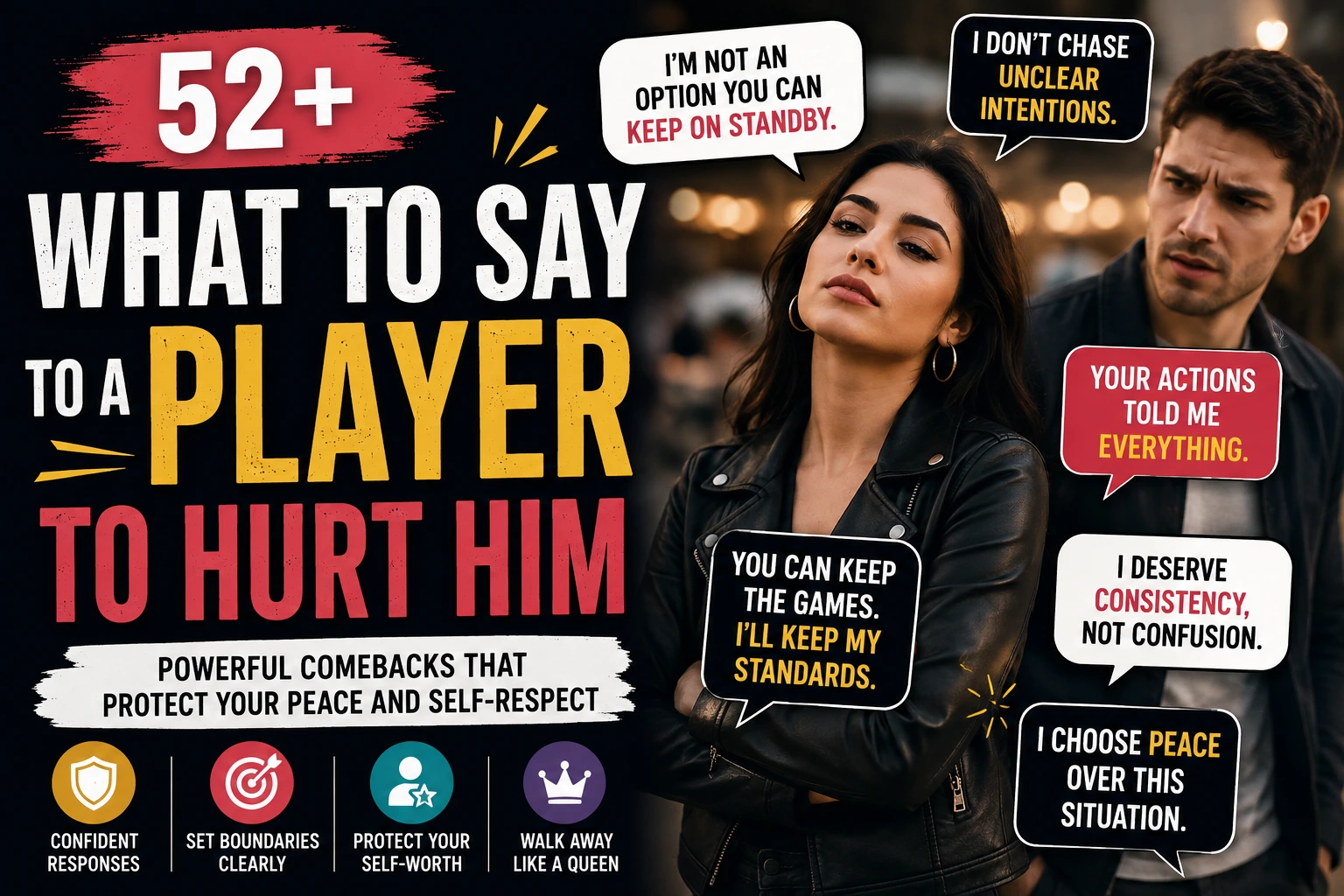
3. “I am not an option you can keep on standby.”
Meaning: You refuse to be treated as a backup.
Tone: Firm.
“If you are unsure about me, that is fine, but I am not an option you can keep on standby.”
Why use it: It communicates self respect clearly.
4. “Your actions told me everything I needed to know.”
Meaning: Their behavior revealed their intentions.
Tone: Mature.
“You did not have to explain yourself. Your actions told me everything I needed to know.”
Why use it: Good when someone tries to explain away repeated behavior.
5. “I expect consistency, not confusion.”
Meaning: You want reliable behavior.
Tone: Direct.
“I am not asking for perfection. I expect consistency, not confusion.”
Why use it: Perfect for mixed signals.
6. “I am choosing peace over this situation.”
Meaning: You are ending unnecessary conflict.
Tone: Mature.
“This situation is becoming exhausting, so I am choosing peace over it.”
Why use it: It closes the conversation without escalating it.
7. “You are free to do what you want. So am I.”
Meaning: You will not control or chase them.
Tone: Calm and confident.
“You are free to make your choices, and I am free to make mine.”
Why use it: Strong when someone expects you to wait around.
8. “I am not competing for someone’s attention.”
Meaning: You will not compete with other people.
Tone: Self respecting.
“If there are several people in the picture, I am stepping out. I am not competing for attention.”
Why use it: Useful when someone keeps multiple romantic options open.
9. “I would rather have honesty than attention.”
Meaning: Genuine communication matters more than flirting.
Tone: Thoughtful.
“Your attention is nice, but I would rather have honesty.”
Why use it: It shifts the conversation toward what actually matters.
10. “I do not chase unclear intentions.”
Meaning: You will not pursue someone who is inconsistent.
Tone: Confident.
“If you are unsure about what you want, that is okay. I do not chase unclear intentions.”
Why use it: Short, direct, and easy to send by text.
Sharp but Respectful Responses
11. “You are not as mysterious as you think.”
Meaning: Their behavior is easy to recognize.
Tone: Witty.
“The disappearing and returning routine is pretty predictable. You are not as mysterious as you think.”
Why use it: A playful response when someone believes their behavior is clever.
12. “I noticed the pattern.”
Meaning: You have recognized repeated behavior.
Tone: Calm.
“You disappear, come back, and expect everything to continue. I noticed the pattern.”
Why use it: Sometimes a short statement has more impact than an argument.
13. “That strategy might work on someone else.”
Meaning: You are not falling for their behavior.
Tone: Witty.
“The charm is obvious, but that strategy might work on someone else.”
Why use it: Good for someone relying heavily on rehearsed flirting.
14. “I am not impressed by words without actions.”
Meaning: You value behavior over promises.
Tone: Mature.
“You can say whatever you want, but I am not impressed by words without actions.”
Why use it: Strong when someone repeatedly makes promises.
15. “You made your priorities pretty obvious.”
Meaning: Their choices revealed what matters to them.
Tone: Firm.
“I do not need another explanation. You made your priorities pretty obvious.”
Why use it: Useful when behavior has already answered the question.
16. “I do not need to decode mixed signals.”
Meaning: You refuse to analyze confusing behavior.
Tone: Confident.
“If I have to constantly decode your behavior, this is not worth my time.”
Why use it: Great for inconsistent communication.
17. “You can keep the games. I will keep my standards.”
Meaning: You choose your standards over the relationship.
Tone: Bold.
“You can keep the games. I will keep my standards.”
Why use it: A memorable response when someone repeatedly crosses boundaries.
18. “I am not available for casual disrespect.”
Meaning: You will not tolerate disrespect.
Tone: Firm.
“I am happy to communicate, but I am not available for casual disrespect.”
Why use it: Strong without becoming insulting.
19. “I am not confused. I am just done.”
Meaning: You have made your decision.
Tone: Direct.
“I understand the situation perfectly. I am not confused. I am just done.”
Why use it: Ideal when someone keeps trying to restart the same argument.
20. “You lost access when you stopped showing respect.”
Meaning: Respect is a condition for continued communication.
Tone: Assertive.
“There is no drama here. You lost access when you stopped showing respect.”
Why use it: Use it when someone expects continued access to your attention.
Witty Responses
21. “The audition is over.”
Meaning: You are no longer interested in participating.
Tone: Playful.
“Thanks for the performance, but the audition is over.”
Why use it: A humorous way to close a conversation.
22. “That routine needs a new script.”
Meaning: Their behavior feels repetitive.
Tone: Sarcastic but light.
“I have heard this one before. That routine needs a new script.”
Why use it: Works when someone repeats the same lines.
23. “Nice attempt, but I am not buying it.”
Meaning: You recognize the tactic.
Tone: Playful.
“Nice attempt, but I am not buying it this time.”
Why use it: Good for light teasing without personal insults.
24. “You really thought that would work twice?”
Meaning: You have learned from previous behavior.
Tone: Witty.
“You disappeared last time and came back with the same excuse. You really thought that would work twice?”
Why use it: Best when someone repeats a failed approach.
25. “I have officially unsubscribed.”
Meaning: You are ending your involvement.
Tone: Humorous.
“Thanks, but I have officially unsubscribed from this kind of conversation.”
Why use it: A playful text response when you want to leave without arguing.
26. “That chapter is closed.”
Meaning: You are moving forward.
Tone: Mature.
“I appreciate the memories, but that chapter is closed.”
Why use it: Works when you want closure rather than conflict.
27. “I am not part of your rotation.”
Meaning: You refuse to be treated as one of several options.
Tone: Bold.
“I am looking for something genuine, so I am not part of anyone’s rotation.”
Why use it: Clear and self respecting.
28. “You can keep the charm. I will keep my judgment.”
Meaning: Flattery will not change your decision.
Tone: Witty.
“The charm is entertaining, but I will keep my judgment.”
Why use it: Useful when someone tries to distract from their behavior with compliments.
29. “I am not impressed by a well rehearsed routine.”
Meaning: You recognize practiced flirting.
Tone: Sharp.
“The compliments are nice, but I am not impressed by a well rehearsed routine.”
Why use it: Use this when someone’s words feel insincere.
30. “Save the performance for someone who asked.”
Meaning: You do not want exaggerated behavior.
Tone: Sarcastic.
“You do not need to explain everything. Save the performance for someone who asked.”
Why use it: Best for situations where someone is being unnecessarily dramatic.
Mature Boundary Setting
31. “I deserve communication that feels clear.”
Meaning: You expect honesty.
Tone: Mature.
“I am looking for communication that feels clear and respectful.”
Why use it: A healthier alternative to attacking someone.
32. “This dynamic is not working for me.”
Meaning: The relationship pattern is unhealthy for you.
Tone: Mature.
“I have thought about it, and this dynamic is not working for me.”
Why use it: Excellent for ending an uncomfortable situation.
33. “I am stepping away from this.”
Meaning: You are choosing distance.
Tone: Calm.
“I do not want to continue this conversation, so I am stepping away.”
Why use it: Useful when a conversation becomes disrespectful.
34. “I need something more genuine.”
Meaning: You want sincerity.
Tone: Thoughtful.
“You seem like a nice person, but I need something more genuine.”
Why use it: Direct without being cruel.
35. “We clearly want different things.”
Meaning: Your expectations do not match.
Tone: Mature.
“There is no need to argue. We clearly want different things.”
Why use it: Good for ending incompatibility respectfully.
36. “I am not comfortable with this behavior.”
Meaning: You are setting a personal boundary.
Tone: Firm.
“I want to be honest. I am not comfortable with this behavior.”
Why use it: Useful when you want to address a specific problem.
37. “Respect is not optional for me.”
Meaning: Respect is a basic requirement.
Tone: Strong.
“We can disagree, but respect is not optional for me.”
Why use it: A powerful boundary statement.
38. “I am not going to argue about my standards.”
Meaning: You will not defend your boundaries.
Tone: Confident.
“You do not have to agree with my standards, but I am not going to argue about them.”
Why use it: Helpful when someone challenges your expectations.
39. “I would rather walk away than settle.”
Meaning: You prioritize self respect.
Tone: Confident.
“I would rather walk away than settle for something that does not feel right.”
Why use it: Good when someone pressures you to accept less than you want.
40. “I am choosing people who choose me.”
Meaning: You want mutual effort.
Tone: Empowering.
“At this point, I am choosing people who choose me consistently.”
Why use it: A positive way to express your expectations.
Short Responses for Texting
41. “Not interested in the games.”
Meaning: You are declining the behavior.
Tone: Direct.
“Thanks, but I am not interested in the games.”
Why use it: Short and easy to send.
42. “I have moved on.”
Meaning: You are no longer emotionally invested.
Tone: Calm.
“No hard feelings. I have moved on.”
Why use it: Ideal when someone returns after a long absence.
43. “That does not work for me.”
Meaning: You reject the situation.
Tone: Firm.
“Keeping things unclear does not work for me.”
Why use it: Simple and powerful.
44. “I will pass.”
Meaning: You are declining.
Tone: Casual.
“Thanks, but I will pass.”
Why use it: Useful when you do not want a long discussion.
45. “We are done here.”
Meaning: You are ending the conversation.
Tone: Direct.
“I have said what I needed to say. We are done here.”
Why use it: Use it when further discussion is unnecessary.
46. “Take care.”
Meaning: You are ending communication peacefully.
Tone: Polite.
“I do not think this is going anywhere. Take care.”
Why use it: Sometimes a calm ending is more effective than a sharp comeback.
47. “I know better now.”
Meaning: You have learned from the experience.
Tone: Confident.
“I used to overlook these things. I know better now.”
Why use it: Good when someone expects you to accept the same behavior again.
48. “I am good, thanks.”
Meaning: You are declining without hostility.
Tone: Casual.
“Want to start over?” “I am good, thanks.”
Why use it: A short response that does not invite unnecessary discussion.
49. “No hard feelings, just no.”
Meaning: You are declining clearly.
Tone: Calm.
“I appreciate you reaching out, but no hard feelings, just no.”
Why use it: Good when you want to avoid unnecessary hostility.
50. “I do not owe this another chance.”
Meaning: You are allowed to move on.
Tone: Assertive.
“You had your opportunity, and I do not owe this another chance.”
Why use it: Useful when someone repeatedly asks for another opportunity.
51. “My answer is still no.”
Meaning: Your boundary has not changed.
Tone: Firm.
“I understand what you are saying, but my answer is still no.”
Why use it: Especially useful when someone refuses to accept your decision.
52. “I am not the person for this.”
Meaning: You are choosing not to participate.
Tone: Mature.
“If this is the kind of relationship you want, I am not the person for this.”
Why use it: This focuses on compatibility rather than insults.
53. “I wish you well, but I am moving forward.”
Meaning: You are ending things peacefully.
Tone: Mature and respectful.
“I have decided to move on. I wish you well, but I am moving forward.”
Why use it: A strong closing statement when you want genuine closure.
Real Life Situations and the Best Response
When Someone Keeps Coming Back After Disappearing
Best reply:
“I noticed the pattern, and I am not interested in repeating it.”
This makes your position clear without turning the conversation into an argument.
When Someone Gives You Mixed Signals
Best reply:
“I expect consistency, not confusion.”
It communicates exactly what you expect without attacking the other person.
When Someone Tries to Make You Jealous
Best reply:
“I am not competing for someone’s attention.”
This shows that you will not participate in unnecessary competition.
When You Are No Longer Interested
Best reply:
“No hard feelings. I have moved on.”
Short, mature, and difficult to misinterpret.
When Someone Disrespects Your Boundaries
Best reply:
“Respect is not optional for me.”
This clearly establishes where you stand.
What to Avoid
1. Personal insults
Attacking someone’s appearance, body, intelligence, family, or insecurities usually creates more drama rather than solving the problem.
2. Threats
A comeback should never become a threat. If the situation feels unsafe or aggressive, create distance instead.
3. Long explanations
You do not need a ten paragraph message to prove your point. A short boundary can be much stronger.
4. Trying too hard to appear unbothered
If you are genuinely upset, you do not have to perform indifference. Calm honesty is more convincing.
5. Reopening the conversation repeatedly
If you have already made your decision, repeating the argument usually gives the situation more attention than it deserves.
6. Trying to destroy someone’s confidence
The goal should be to protect your dignity, not deliberately damage another person’s self esteem.
Pro Tips for a Strong Comeback
Keep it short
The more you explain, the more opportunities someone has to argue with you. Say what you mean and stop there.
Focus on behavior
Instead of attacking the person, describe what they did.
For example:
“I do not appreciate being contacted only when it is convenient for you.”
That is stronger than a personal insult because it addresses the actual problem.
Let your actions support your words
A confident statement means little if you continue accepting the same behavior. Set the boundary, then follow through.
Conclusion
The most powerful response to a player is not necessarily the one that hurts the most. It is the one that shows you recognize the behavior, understand your worth, and refuse to participate in something that does not respect you.
A sharp comeback can feel satisfying for a moment, but a clear boundary can protect your peace for much longer. Whether you choose something witty like “The audition is over” or something mature like “I am choosing people who choose me,” let your response reflect confidence rather than cruelty.
Discover more
other words for too much to handle