
Every meaningful connection starts with a simple desire to know someone a little better. Whether you are meeting a new classmate, joining a workplace, making friends, attending a networking event, or developing a deeper relationship, “getting to know each other” is a phrase we use constantly. But sometimes, repeating the same expression can make your writing feel predictable.
That is where the right alternatives can make a difference. Instead of always saying “getting to know each other,” you can choose expressions that capture the exact kind of connection you mean—whether it is becoming acquainted, building rapport, finding common ground, sharing experiences, or developing a deeper understanding. These alternatives can make emails sound more polished, conversations more natural, and articles more engaging.
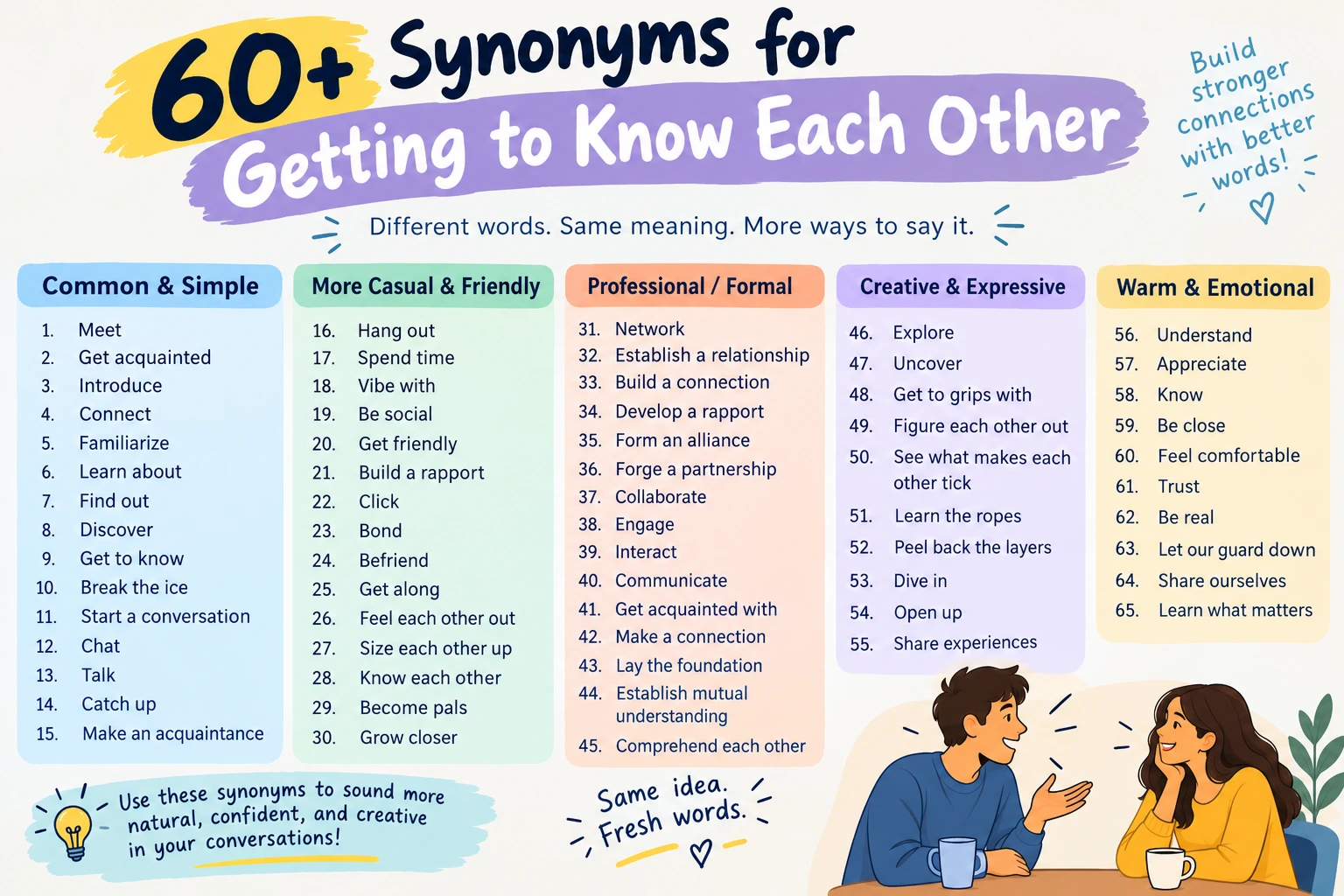
In this guide, we explore 60+ synonyms for getting to know each other, with meanings, tones, examples, and explanations to help you choose the right expression for every situation.
What Does “Getting to Know Each Other” Mean?
“Getting to know each other” means spending time communicating or interacting with another person so that both people can learn more about each other.
This may involve discovering someone’s personality, interests, background, opinions, experiences, values, or goals. The phrase usually suggests that familiarity develops gradually rather than immediately.
For example:
“We have only worked together for a few weeks, so we are still getting to know each other.”
The phrase has a generally friendly, neutral, and approachable tone. It can describe people meeting for the first time, new colleagues becoming familiar with one another, classmates forming friendships, or existing acquaintances developing a stronger connection.
Its exact meaning depends on context. “Getting to know each other” can be as simple as learning someone’s interests or as meaningful as understanding their perspective and personality on a deeper level.
When to Use It
“Getting to know each other” is versatile enough for casual, professional, academic, and social situations.
In casual conversation, you might say:
“We should spend some time together and get to know each other better.”
In the workplace:
“The team-building activity gave us an opportunity to get to know each other outside the office.”
In an email:
“I look forward to getting to know you and learning more about your work.”
In a speech:
“Today gives us a wonderful opportunity to get to know each other.”
At university:
“Orientation week helped us get to know each other before classes began.”
The phrase is particularly useful when you want to sound warm without making the relationship sound overly serious or personal.
Is “Getting to Know Each Other” Polite or Professional?
Yes. “Getting to know each other” is polite, natural, and appropriate for many professional situations.
However, some alternatives may be more suitable depending on the setting. In a formal email, “becoming acquainted” or “building rapport” may sound more polished. At a networking event, “establishing connections” or “building professional relationships” may be more appropriate.
For friends, classmates, or casual conversations, simpler expressions such as “getting to know one another,” “spending time together,” or “getting closer” sound more natural.
The important thing is to match the expression with the relationship. You do not need to use complicated vocabulary simply to sound professional. A natural phrase that fits the situation will almost always communicate better.
1. Becoming Acquainted
Meaning: Gradually becoming familiar with another person.
Tone: Formal, polite, professional
“The conference gave us an excellent opportunity to become acquainted.”
Why and when to use it: Use this when you want a polished alternative in formal or professional writing.
Purpose and Personalization: It works especially well in business emails, networking situations, formal introductions, and professional events.
2. Getting to Know One Another
Meaning: Learning more about each other through interaction and conversation.
Tone: Friendly, natural, neutral
“The workshop gave everyone time to get to know one another.”
Why and when to use it: This is one of the closest alternatives to the original phrase.
Purpose and Personalization: It sounds natural while offering a little variation in your writing.
3. Learning More About Each Other
Meaning: Discovering more information about one another.
Tone: Friendly, thoughtful
“We spent the afternoon learning more about each other’s interests.”
Why and when to use it: Use this when you want to emphasize discovering interests, experiences, or backgrounds.
Purpose and Personalization: It works well for conversations, introductions, group activities, and new friendships.
4. Getting Acquainted
Meaning: Becoming familiar with someone.
Tone: Formal, neutral
“The new employees spent the morning getting acquainted.”
Why and when to use it: Use this when people have recently met and are beginning to become familiar.
Purpose and Personalization: It is concise and particularly useful in workplace or academic settings.
5. Building a Connection
Meaning: Developing a relationship or sense of understanding.
Tone: Warm, professional
“The project gave us an opportunity to build a strong connection.”
Why and when to use it: Use this when you want to emphasize the relationship rather than simply learning information about someone.
Purpose and Personalization: It works well for friendships, teamwork, networking, and community relationships.
6. Connecting With One Another
Meaning: Developing a sense of familiarity, understanding, or relationship.
Tone: Friendly, modern, warm
“The retreat gave everyone a chance to connect with one another.”
Why and when to use it: Use this for social events, group activities, or situations where people are forming relationships.
Purpose and Personalization: It sounds contemporary and natural without being overly casual.
7. Building Rapport
Meaning: Developing mutual trust, comfort, and understanding.
Tone: Professional, sophisticated
“The manager spent time building rapport with the new team.”
Why and when to use it: Use this when trust and comfortable communication are important.
Purpose and Personalization: This is especially useful in business, leadership, interviews, education, and customer service.
8. Developing Familiarity
Meaning: Becoming increasingly familiar with another person.
Tone: Formal, professional
“Regular meetings helped the two teams develop familiarity with one another.”
Why and when to use it: Use this in formal or analytical writing.
Purpose and Personalization: It is more objective than “getting to know each other,” making it suitable for reports and professional documents.
9. Forming a Connection
Meaning: Beginning to establish a relationship.
Tone: Warm, neutral
“The students quickly began forming connections with their classmates.”
Why and when to use it: Use this when describing the early stages of a relationship.
Purpose and Personalization: It works well for friendships, networking, teamwork, and social events.
10. Creating a Connection
Meaning: Establishing a bond or sense of understanding.
Tone: Friendly, positive
“Shared interests helped us create a connection almost immediately.”
Why and when to use it: Use this when you want to emphasize the process of developing a relationship.
Purpose and Personalization: It is particularly natural in personal stories and reflective writing.
11. Building a Relationship
Meaning: Developing a relationship through interaction, trust, and communication.
Tone: Professional, warm
“Successful teamwork begins with building strong relationships.”
Why and when to use it: Use this when the relationship itself is the main focus.
Purpose and Personalization: It works equally well in professional and personal contexts.
12. Developing a Relationship
Meaning: Gradually creating a stronger relationship.
Tone: Professional, thoughtful
“The mentoring program helped students develop relationships with experienced professionals.”
Why and when to use it: Use this when describing relationships that develop over time.
Purpose and Personalization: It sounds polished in reports, articles, presentations, and workplace communication.
13. Growing Closer
Meaning: Becoming more emotionally or personally connected.
Tone: Warm, personal
“As we worked together, we gradually grew closer.”
Why and when to use it: Use this when a relationship is becoming more meaningful.
Purpose and Personalization: It is better suited to friendships and personal relationships than formal business writing.
14. Becoming More Familiar With One Another
Meaning: Gradually learning how another person thinks, communicates, or behaves.
Tone: Neutral, professional
“The first few meetings helped the teams become more familiar with one another.”
Why and when to use it: Use this when you want a careful and neutral expression.
Purpose and Personalization: It is particularly appropriate for workplaces, classrooms, and group projects.
15. Learning About One Another
Meaning: Discovering information about each other.
Tone: Friendly, thoughtful
“The group enjoyed learning about one another’s backgrounds.”
Why and when to use it: Use this when people are sharing experiences, backgrounds, or perspectives.
Purpose and Personalization: It fits classrooms, workshops, team activities, and social gatherings.
16. Discovering More About Each Other
Meaning: Gradually uncovering new things about one another.
Tone: Warm, curious
“Traveling together allowed us to discover more about each other.”
Why and when to use it: Use this when the process feels exploratory or interesting.
Purpose and Personalization: It adds a more engaging quality to personal writing.
17. Exploring Common Ground
Meaning: Discovering shared interests, experiences, beliefs, or goals.
Tone: Thoughtful, professional
“The discussion helped the participants explore common ground.”
Why and when to use it: Use this when people are trying to identify similarities.
Purpose and Personalization: It is excellent for networking, teamwork, diplomacy, and meaningful discussions.
18. Finding Common Ground
Meaning: Discovering things that people share.
Tone: Friendly, professional
“We quickly found common ground through our shared interest in technology.”
Why and when to use it: Use this when similarities help people connect.
Purpose and Personalization: It makes introductions and networking conversations sound purposeful.
19. Establishing a Connection
Meaning: Creating an initial relationship or bond.
Tone: Professional, polished
“The meeting helped establish a connection between the two organizations.”
Why and when to use it: Use this for professional relationships and formal networking.
Purpose and Personalization: It is stronger and more business-oriented than simply saying “getting to know each other.”
20. Making a Connection
Meaning: Creating a meaningful relationship or sense of understanding.
Tone: Friendly, modern
“We made a connection after discovering that we had similar goals.”
Why and when to use it: Use it when a relationship develops naturally.
Purpose and Personalization: It works well in casual conversations, networking, and personal storytelling.
21. Strengthening Our Bond
Meaning: Making an existing relationship stronger.
Tone: Warm, personal
“The trip gave us plenty of opportunities to strengthen our bond.”
Why and when to use it: Use this when people already know each other and want to become closer.
Purpose and Personalization: It is ideal for friends, families, teammates, and close relationships.
22. Building a Bond
Meaning: Developing a strong personal connection.
Tone: Warm, personal
“Working on the project together helped us build a strong bond.”
Why and when to use it: Use this when a relationship is becoming emotionally meaningful.
Purpose and Personalization: It works especially well for friendships and team relationships.
23. Getting Closer
Meaning: Becoming more familiar, comfortable, or emotionally connected.
Tone: Casual, warm
“We started getting closer after spending more time together.”
Why and when to use it: Use this in informal conversations about developing relationships.
Purpose and Personalization: It sounds natural in personal stories and everyday speech.
24. Spending Time Together
Meaning: Being together to share experiences and develop familiarity.
Tone: Casual, warm
“Spending time together helped us understand each other better.”
Why and when to use it: Use this when shared time is the main way people become familiar.
Purpose and Personalization: It is simple, natural, and highly versatile.
25. Sharing Experiences
Meaning: Talking about or participating in experiences together.
Tone: Warm, reflective
“Sharing experiences helped the new classmates feel more comfortable around each other.”
Why and when to use it: Use this when stories or activities help people connect.
Purpose and Personalization: It gives more depth to the idea of getting to know someone.
26. Opening Up to Each Other
Meaning: Sharing personal thoughts, feelings, or experiences.
Tone: Personal, emotional
“Over time, we became comfortable opening up to each other.”
Why and when to use it: Use this when conversations become more personal.
Purpose and Personalization: It suggests trust and emotional comfort, making it stronger than ordinary acquaintance.
27. Sharing Stories
Meaning: Telling each other personal or interesting experiences.
Tone: Casual, warm
“We spent the evening sharing stories and laughing together.”
Why and when to use it: Use this for relaxed social situations.
Purpose and Personalization: It creates a vivid description of how people become familiar.
28. Understanding Each Other Better
Meaning: Developing greater knowledge of another person’s thoughts, feelings, or perspective.
Tone: Thoughtful, warm
“The conversation helped us understand each other better.”
Why and when to use it: Use this when communication is helping people overcome misunderstandings.
Purpose and Personalization: It is particularly useful for relationships, teamwork, and difficult conversations.
29. Building Mutual Understanding
Meaning: Developing understanding between people in both directions.
Tone: Formal, professional
“The discussion was designed to build mutual understanding between the teams.”
Why and when to use it: Use this when emphasizing two-way communication.
Purpose and Personalization: It is excellent for professional, academic, diplomatic, and organizational settings.
30. Establishing Familiarity
Meaning: Becoming familiar through repeated interaction.
Tone: Formal, academic
“Regular interaction helped establish familiarity among the participants.”
Why and when to use it: Use this in formal writing where precision matters.
Purpose and Personalization: It sounds objective and analytical.
31. Cultivating a Connection
Meaning: Carefully developing a meaningful relationship over time.
Tone: Sophisticated, thoughtful
“The program encourages participants to cultivate meaningful connections.”
Why and when to use it: Use this when the relationship requires intentional effort.
Purpose and Personalization: It is an elegant choice for speeches, articles, and professional writing.
32. Nurturing a Relationship
Meaning: Carefully supporting and strengthening a relationship.
Tone: Warm, sophisticated
“Regular communication is essential for nurturing professional relationships.”
Why and when to use it: Use this when discussing relationships that require continued attention.
Purpose and Personalization: It emphasizes that meaningful relationships grow over time.
33. Developing Mutual Trust
Meaning: Gradually creating trust between people.
Tone: Professional, thoughtful
“Open communication helped the team develop mutual trust.”
Why and when to use it: Use this when trust is a major part of the relationship.
Purpose and Personalization: It works particularly well in leadership, teamwork, mentoring, and professional settings.
34. Building Trust With One Another
Meaning: Creating confidence and reliability between people.
Tone: Professional, warm
“The first few weeks were important for building trust with one another.”
Why and when to use it: Use this when familiarity develops through reliability and communication.
Purpose and Personalization: It is more specific than “getting to know each other.”
35. Familiarizing Ourselves With One Another
Meaning: Becoming familiar with each other.
Tone: Formal, professional
“The introductory session allowed everyone to familiarize themselves with one another.”
Why and when to use it: Use this for formal introductions and organizational settings.
Purpose and Personalization: It works well in academic programs, corporate events, and formal communication.
36. Creating Meaningful Connections
Meaning: Developing relationships that have genuine value.
Tone: Warm, motivational
“University is also about creating meaningful connections.”
Why and when to use it: Use this when you want your language to feel deeper and more inspirational.
Purpose and Personalization: It is excellent for speeches, social campaigns, blogs, and events.
37. Making Meaningful Connections
Meaning: Forming relationships that feel valuable and genuine.
Tone: Warm, inspirational
“The conference brought students together to make meaningful connections.”
Why and when to use it: Use this when ordinary networking feels too superficial.
Purpose and Personalization: It emphasizes quality rather than quantity.
38. Building Meaningful Relationships
Meaning: Developing valuable and genuine relationships.
Tone: Professional, warm
“Strong communities are built by creating meaningful relationships.”
Why and when to use it: Use this when talking about relationships that can develop over time.
Purpose and Personalization: It works for networking, friendships, education, and community-building.
39. Getting to Know Someone Better
Meaning: Becoming more familiar with a particular person.
Tone: Casual, friendly
“I’d love to get to know you better.”
Why and when to use it: Use this when speaking directly about one person.
Purpose and Personalization: It sounds natural and expresses genuine curiosity.
40. Discovering Shared Interests
Meaning: Finding hobbies, topics, or activities that people both enjoy.
Tone: Friendly, conversational
“We started discovering shared interests during our first few conversations.”
Why and when to use it: Use this when common hobbies help people connect.
Purpose and Personalization: It is particularly useful when describing new friendships.
41. Finding Shared Interests
Meaning: Identifying interests that people have in common.
Tone: Casual, friendly
“Finding shared interests made it easier for everyone to start talking.”
Why and when to use it: Use this when common interests make introductions easier.
Purpose and Personalization: It works especially well for students, new teams, and social gatherings.
42. Exploring Each Other’s Perspectives
Meaning: Learning how other people think or view situations.
Tone: Thoughtful, professional
“The discussion allowed us to explore each other’s perspectives.”
Why and when to use it: Use this when the focus is on ideas and viewpoints.
Purpose and Personalization: It is excellent for meetings, debates, classrooms, and collaborative projects.
43. Exchanging Perspectives
Meaning: Sharing different viewpoints with one another.
Tone: Professional, intellectual
“The meeting gave us an opportunity to exchange perspectives.”
Why and when to use it: Use this when people connect by discussing ideas.
Purpose and Personalization: It is particularly effective in academic and professional environments.
44. Sharing Our Backgrounds
Meaning: Talking about personal, educational, cultural, or professional experiences.
Tone: Friendly, thoughtful
“We began by sharing our backgrounds and learning what brought everyone to the program.”
Why and when to use it: Use this when introductions involve personal or professional history.
Purpose and Personalization: It makes the concept more specific and descriptive.
45. Introducing Ourselves
Meaning: Sharing basic information about who we are.
Tone: Neutral, professional
“We started the meeting by introducing ourselves.”
Why and when to use it: Use this during the initial stage of meeting people.
Purpose and Personalization: It is best for first meetings because it does not necessarily imply a deeper relationship.
46. Breaking the Ice
Meaning: Making people feel more relaxed when they first meet.
Tone: Casual, friendly
“The game helped everyone break the ice before the workshop began.”
Why and when to use it: Use this when people need help becoming comfortable with each other.
Purpose and Personalization: It focuses on overcoming initial awkwardness.
47. Getting Comfortable With Each Other
Meaning: Becoming relaxed and at ease around one another.
Tone: Casual, warm
“It took a few meetings for everyone to get comfortable with each other.”
Why and when to use it: Use this when people are becoming less awkward or reserved.
Purpose and Personalization: It is natural for new teams, classmates, roommates, and friends.
48. Becoming Comfortable Around One Another
Meaning: Developing ease and confidence in each other’s company.
Tone: Warm, neutral
“After a few weeks, the new teammates became comfortable around one another.”
Why and when to use it: Use it when familiarity develops naturally over time.
Purpose and Personalization: It emphasizes emotional ease rather than simply exchanging information.
49. Building a Sense of Community
Meaning: Creating feelings of belonging and connection within a group.
Tone: Warm, motivational, professional
“The activities were designed to build a sense of community among students.”
Why and when to use it: Use this when discussing a group rather than just two people.
Purpose and Personalization: It works particularly well for schools, universities, workplaces, and organizations.
50. Creating a Sense of Belonging
Meaning: Helping people feel accepted, connected, and included.
Tone: Warm, inclusive
“The orientation helped new students create a sense of belonging.”
Why and when to use it: Use this when relationships are connected to inclusion.
Purpose and Personalization: It adds emotional depth to the idea of meeting others.
51. Getting to Know One Another’s Personalities
Meaning: Learning about each person’s character and behavior.
Tone: Friendly, thoughtful
“The activities helped us get to know one another’s personalities.”
Why and when to use it: Use this when personality differences or similarities matter.
Purpose and Personalization: It works well for new teams, friendships, and group activities.
52. Understanding One Another’s Personalities
Meaning: Developing an understanding of how people think and behave.
Tone: Thoughtful, analytical
“Living together taught us to understand one another’s personalities.”
Why and when to use it: Use this when familiarity has developed beyond basic introductions.
Purpose and Personalization: It suggests a deeper level of understanding.
53. Sharing Personal Stories
Meaning: Telling each other stories from personal experiences.
Tone: Warm, conversational
“We spent the evening sharing personal stories and discovering unexpected similarities.”
Why and when to use it: Use this when people connect through meaningful experiences.
Purpose and Personalization: It creates a more vivid and emotional description than simply saying “talking.”
54. Having Meaningful Conversations
Meaning: Talking about subjects that create genuine understanding or connection.
Tone: Thoughtful, warm
“We had several meaningful conversations during the retreat.”
Why and when to use it: Use this when conversations move beyond small talk.
Purpose and Personalization: It is ideal for describing deeper friendships and reflective moments.
55. Moving Beyond Small Talk
Meaning: Progressing from surface-level conversation to deeper discussion.
Tone: Modern, thoughtful
“Once we moved beyond small talk, we discovered how much we had in common.”
Why and when to use it: Use this when emphasizing deeper communication.
Purpose and Personalization: It is especially effective for blogs, social content, and personal writing.
56. Getting Beneath the Surface
Meaning: Learning deeper aspects of someone’s thoughts, personality, or experiences.
Tone: Thoughtful, expressive
“The conversation helped us get beneath the surface and understand each other better.”
Why and when to use it: Use this when superficial conversation is not enough.
Purpose and Personalization: It gives writing a more reflective and sophisticated tone.
57. Developing a Deeper Understanding
Meaning: Gaining more profound knowledge of another person or perspective.
Tone: Professional, thoughtful
“The interviews helped the team develop a deeper understanding of their clients.”
Why and when to use it: Use this when you want to emphasize depth and insight.
Purpose and Personalization: It works particularly well in professional, academic, and analytical contexts.
58. Deepening Our Connection
Meaning: Making an existing connection stronger and more meaningful.
Tone: Warm, personal
“The experience gave us a chance to deepen our connection.”
Why and when to use it: Use this when people already know each other and want to become closer.
Purpose and Personalization: It is more emotionally meaningful than simply saying “getting to know each other.”
59. Strengthening Our Relationship
Meaning: Making an existing relationship stronger.
Tone: Warm, professional
“The project helped us strengthen our relationship as colleagues.”
Why and when to use it: Use this when a relationship already exists.
Purpose and Personalization: It works for both personal and professional relationships.
60. Fostering Connections
Meaning: Encouraging relationships to develop and grow.
Tone: Professional, sophisticated
“The event was created to foster connections among young professionals.”
Why and when to use it: Use this in formal descriptions of events, programs, or communities.
Purpose and Personalization: It sounds polished without being unnecessarily complicated.
61. Cultivating Relationships
Meaning: Developing and maintaining relationships intentionally.
Tone: Sophisticated, professional
“Successful leaders understand the importance of cultivating relationships.”
Why and when to use it: Use this when relationships require time and consistent effort.
Purpose and Personalization: It is particularly effective in leadership, networking, business, and personal-development writing.
62. Forging New Connections
Meaning: Creating new relationships through shared experiences or opportunities.
Tone: Strong, professional, motivational
“The conference gave students a chance to forge new connections.”
Why and when to use it: Use this when emphasizing new and potentially valuable relationships.
Purpose and Personalization: It gives your writing an energetic and confident tone.
63. Forming New Relationships
Meaning: Beginning relationships with people you have recently met.
Tone: Neutral, professional
“Moving to a new city often means forming new relationships.”
Why and when to use it: Use this when you want a straightforward alternative.
Purpose and Personalization: It is suitable for articles, academic writing, workplace communication, and everyday conversation.
64. Expanding Our Social Connections
Meaning: Meeting more people and developing a wider network.
Tone: Professional, modern
“University can be an excellent opportunity for expanding our social connections.”
Why and when to use it: Use this when the focus is on meeting a wider range of people.
Purpose and Personalization: It works well in discussions about networking, university life, and communities.
65. Getting to Know People
Meaning: Becoming familiar with people through interaction.
Tone: Casual, natural
“Moving to a new city is exciting because you get to know so many new people.”
Why and when to use it: Use this when talking generally about meeting people.
Purpose and Personalization: It is simple and conversational.
66. Making New Friends
Meaning: Developing friendships with people you have recently met.
Tone: Casual, warm
“Starting university is a great opportunity for making new friends.”
Why and when to use it: Use this when the relationship is specifically becoming a friendship.
Purpose and Personalization: It is more specific than “getting to know each other.”
67. Building New Friendships
Meaning: Gradually developing new friendships.
Tone: Friendly, warm
“Joining a club can make building new friendships much easier.”
Why and when to use it: Use this when friendship is the intended outcome.
Purpose and Personalization: It works well in school, university, lifestyle, and personal-development content.
68. Growing in Understanding
Meaning: Gradually developing greater insight into another person.
Tone: Reflective, sophisticated
“As we worked together, we continued growing in our understanding of one another.”
Why and when to use it: Use this for thoughtful or reflective writing.
Purpose and Personalization: It emphasizes the gradual development of understanding.
69. Learning From One Another
Meaning: Gaining knowledge, perspectives, or experiences from each other.
Tone: Positive, educational, thoughtful
“The workshop encouraged participants to learn from one another.”
Why and when to use it: Use this when relationships develop through exchanging knowledge.
Purpose and Personalization: It is especially useful for classrooms, teams, mentoring programs, and collaborative environments.
70. Connecting on a Deeper Level
Meaning: Developing a more meaningful understanding or relationship.
Tone: Emotional, thoughtful
“The conversation allowed us to connect on a deeper level.”
Why and when to use it: Use this when interaction goes beyond ordinary small talk.
Purpose and Personalization: It is excellent for personal writing and reflective conversations.
71. Getting to Know Each Other More Deeply
Meaning: Developing a more profound understanding of one another.
Tone: Thoughtful, personal
“The retreat gave us time to get to know each other more deeply.”
Why and when to use it: Use this when you want to emphasize depth.
Purpose and Personalization: It works well for meaningful conversations and personal reflection.
72. Building Stronger Connections
Meaning: Making relationships more established and meaningful.
Tone: Professional, warm, motivational
“The workshop encouraged employees to build stronger connections across departments.”
Why and when to use it: Use this when people already have some familiarity.
Purpose and Personalization: It is a strong choice for workplace communication and community initiatives.
73. Creating Stronger Bonds
Meaning: Developing deeper and more lasting relationships.
Tone: Warm, emotional
“Shared experiences can help create stronger bonds between teammates.”
Why and when to use it: Use this when emphasizing closeness and trust.
Purpose and Personalization: It is especially effective for friendships, teams, families, and group experiences.
74. Building Bridges
Meaning: Creating understanding and connection between people or groups.
Tone: Inspirational, professional
“Open dialogue can help build bridges between people with different perspectives.”
Why and when to use it: Use this metaphorical expression when differences exist between people.
Purpose and Personalization: It is powerful in speeches, leadership writing, community work, and discussions about communication.
Conclusion
There is much more to “getting to know each other” than simply meeting someone and exchanging a few words. Depending on the situation, you may be becoming acquainted, building rapport, finding common ground, sharing experiences, fostering connections, or developing a deeper understanding. Each expression adds its own shade of meaning and emotion.
The best alternative is not necessarily the most sophisticated one. Choose the phrase that naturally matches your relationship, audience, and purpose. Whether you are writing an email, giving a speech, making friends, or describing a meaningful conversation, the right words can make your communication feel more genuine, precise, and memorable.
Discover more
how to respond to merry christmas texts