
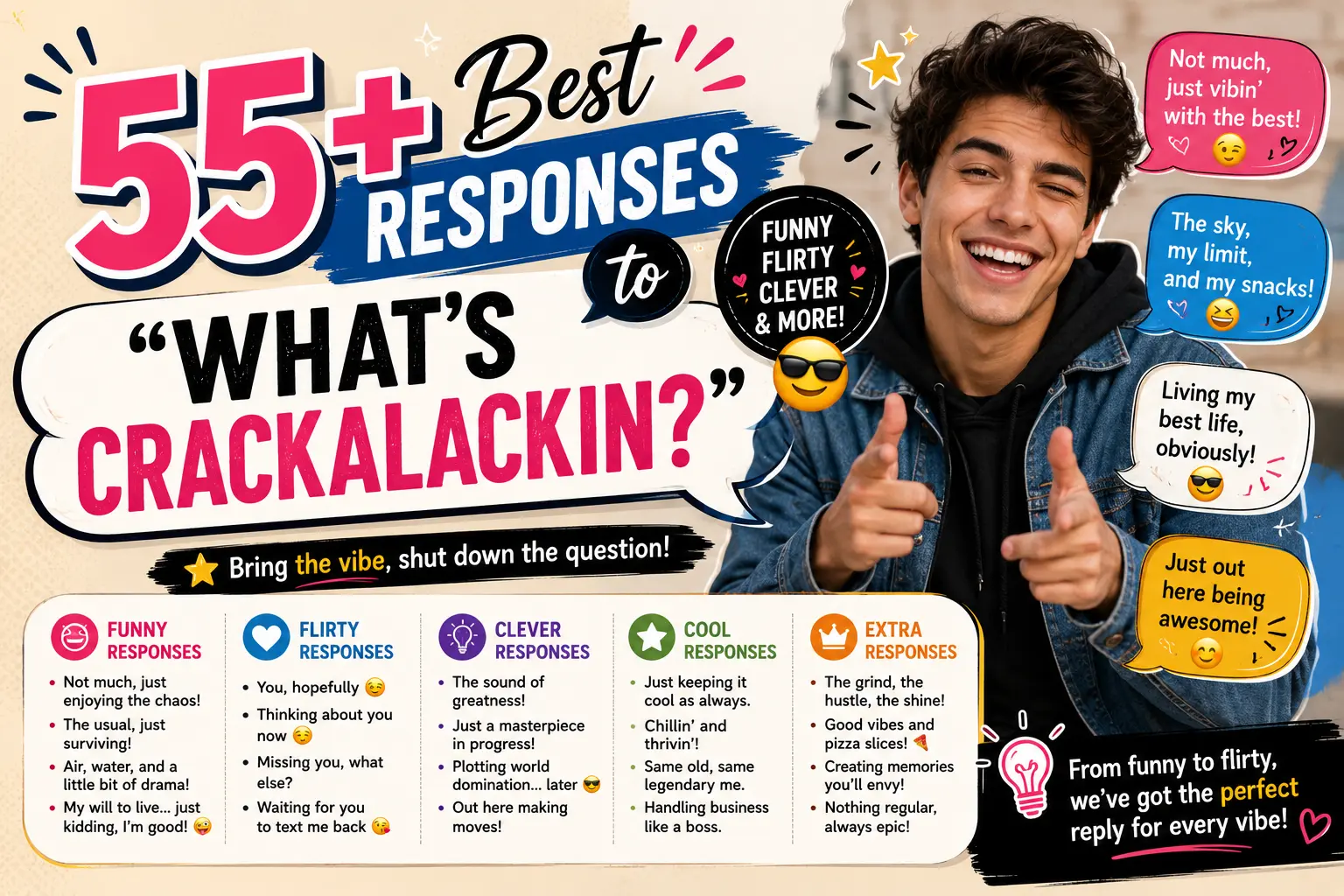
Sometimes a simple “What’s crackalackin?” deserves more than a boring “Not much.” This playful slang greeting is usually meant to ask what is happening, what is new, or how things are going. Because the phrase is casual and energetic, your response can match that same spirit.
You can keep your reply friendly, make it funny, sound confident, or turn the conversation into something more interesting. The best response depends on who is texting you and the mood of the conversation.
Whether a friend sends it, someone you like uses it, or you simply want a clever comeback, having a few options ready can make texting easier. Below, you will find 55+ best responses to “What’s crackalackin?”, along with meanings, tones, examples, and practical tips for choosing the right one.
1. What Does “What’s Crackalackin?” Mean?
“What’s crackalackin?” is a playful slang expression that basically means “What’s happening?”, “What’s going on?”, or “What’s new?”
It is usually used as a casual greeting between friends or people who are comfortable with each other.
For example:
Person: “Hey, what’s crackalackin?”
You: “Not much. Just surviving Monday.”
The phrase has a relaxed and humorous tone. It is not normally used in formal situations, such as job interviews, business emails, or academic writing.
Because the expression is playful, you do not need to give a serious answer. A short, funny, or equally playful response can keep the conversation going.
2. When to Use It
“What’s crackalackin?” works best in casual conversations. You might hear it in text messages, group chats, social media comments, or conversations with friends.
With a friend
“What’s crackalackin?”
“Just chilling. What about you?”
In a group chat
“Okay, what’s crackalackin, people?”
“Absolute chaos, as usual.”
With someone you like
“Hey, what’s crackalackin?”
“Not much, but your message just improved my evening.”
With a close classmate
“What’s crackalackin?”
“Trying to finish this assignment before it finishes me.”
However, avoid using the phrase in formal emails, professional reports, or serious business conversations. It is intentionally informal and playful.
3. Is “What’s Crackalackin?” Polite or Professional?
“What’s crackalackin?” is casual and friendly, but it is not professional.
The expression is usually harmless when used with friends, classmates, siblings, or people you know well. It can make a conversation feel relaxed and humorous.
However, it may sound too informal in a workplace email or a conversation with someone you have never met.
For example, instead of writing:
“Hi, what’s crackalackin?”
to a professional contact, you could write:
“Hi, how are things going?”
In casual conversations, though, there is plenty of room for creativity. A funny response can make the exchange more memorable.
Polite and Appreciative Responses
1. “Not much, just enjoying the day.”
Meaning: You are doing fine and keeping things relaxed.
Tone: Friendly and positive.
“Not much, just enjoying the day. How about you?”
This is a simple response when you want to keep the conversation easygoing.
2. “Everything’s good on my end.”
Meaning: Things are going well for you.
Tone: Friendly and calm.
“Everything’s good on my end. What have you been up to?”
Use it when you want to sound positive without being overly playful.
3. “Just taking it easy. What about you?”
Meaning: You are relaxing and having a quiet moment.
Tone: Casual and warm.
“Just taking it easy after a long day. What about you?”
This works especially well in everyday texting.
4. “Nothing too wild. I’m doing pretty well.”
Meaning: Nothing unusual is happening, and you are fine.
Tone: Relaxed and friendly.
“Nothing too wild. I’m doing pretty well today.”
It gives the other person an easy opening to continue the conversation.
5. “All good here. Glad to hear from you.”
Meaning: You are doing well and appreciate their message.
Tone: Warm and appreciative.
“All good here. Glad to hear from you after so long.”
Use this when you genuinely want to reconnect.
6. “Just having a quiet day.”
Meaning: Your day is calm and uneventful.
Tone: Simple and conversational.
“Just having a quiet day and catching up on a few things.”
This is a natural response when you do not have much news.
7. “Doing well. What’s new with you?”
Meaning: You are fine and want to hear their updates.
Tone: Friendly and interested.
“Doing well. What’s new with you these days?”
It shifts the conversation back to the other person.
8. “Just keeping busy, but everything’s good.”
Meaning: You have things to do, but everything is going well.
Tone: Mature and friendly.
“Just keeping busy with school, but everything’s good.”
This works well when you want to give a little context.
9. “Nothing crazy. Life’s treating me well.”
Meaning: Your life is going smoothly.
Tone: Positive and relaxed.
“Nothing crazy. Life’s treating me well lately.”
It gives the conversation a confident but natural feel.
10. “Same old, same old. I’m good, though.”
Meaning: Nothing major has changed.
Tone: Casual and familiar.
“Same old, same old. I’m good, though. How are you?”
Use this with someone you already know well.
11. “Not much, but I’m happy you asked.”
Meaning: Nothing special is happening, but you appreciate their interest.
Tone: Warm and friendly.
“Not much, but I’m happy you asked. How’s your day going?”
This keeps the exchange positive without sounding forced.
Flirty and Playful Responses
12. “You, apparently.”
Meaning: You are joking that the person texting is what is happening.
Tone: Playful and slightly flirty.
“What’s crackalackin?” “You, apparently.”
This works when you already have a playful dynamic.
13. “My mood improved when you showed up.”
Meaning: Their message made your day better.
Tone: Playful and warm.
“Honestly, my mood improved when you showed up.”
Use this when you want to give the conversation a sweet twist.
14. “Depends. What are you bringing to the conversation?”
Meaning: You are teasing them and challenging them to make the conversation interesting.
Tone: Confident and playful.
“What’s crackalackin?” “Depends. What are you bringing to the conversation?”
This is a fun choice when you want to keep things lively.
15. “Apparently, you’re checking up on me.”
Meaning: You are teasing them for messaging you.
Tone: Teasing and playful.
“Apparently, you’re checking up on me again.”
It works best when you already have a comfortable relationship.
16. “Nothing yet. You planning to change that?”
Meaning: You are playfully asking whether they have something interesting planned.
Tone: Flirty and confident.
“Nothing yet. You planning to change that?”
This can turn an ordinary greeting into a more engaging conversation.
17. “A conversation with you, hopefully.”
Meaning: You would like to keep talking to them.
Tone: Warm and playful.
“What’s crackalackin?” “A conversation with you, hopefully.”
It is direct without being overly serious.
18. “Just waiting for something interesting to happen.”
Meaning: You are inviting them to make the conversation more exciting.
Tone: Playful.
“Just waiting for something interesting to happen.”
Use it when you want to leave the door open for more conversation.
19. “You tell me. You started this.”
Meaning: You are jokingly putting the responsibility on them.
Tone: Teasing and confident.
“What’s crackalackin?” “You tell me. You started this.”
This is great for playful texting.
20. “My schedule was boring until now.”
Meaning: Their message made your day more interesting.
Tone: Playful and light.
“My schedule was boring until now.”
It gives the other person a subtle compliment.
21. “A little chaos, a little charm.”
Meaning: Your day has been unpredictable but fun.
Tone: Playful and confident.
“What’s crackalackin?” “A little chaos, a little charm.”
This response has a more creative feel.
22. “Apparently, this conversation.”
Meaning: You are joking that the conversation itself is the exciting event.
Tone: Witty and playful.
“Apparently, this conversation. Let’s see where it goes.”
It keeps the response light without being too direct.
Confident and Self-Assured Responses
23. “Just doing my thing.”
Meaning: You are focused on your own life.
Tone: Confident and relaxed.
“Just doing my thing and staying productive.”
This is short, natural, and self-assured.
24. “Building something good.”
Meaning: You are working toward something meaningful.
Tone: Ambitious and confident.
“Just building something good and staying focused.”
Use this when you want to show that you have your own goals.
25. “Making progress, one day at a time.”
Meaning: You are steadily working toward your goals.
Tone: Motivational and mature.
“Making progress, one day at a time. How about you?”
This gives a more thoughtful answer to a casual question.
26. “Keeping my peace and minding my business.”
Meaning: You are avoiding unnecessary drama.
Tone: Confident and slightly witty.
“Just keeping my peace and minding my business.”
Use it when you want a confident response without explaining too much.
27. “Doing better than yesterday.”
Meaning: You are focused on personal improvement.
Tone: Positive and mature.
“Doing better than yesterday, so I can’t complain.”
This works when you want to keep things optimistic.
28. “Staying focused. You?”
Meaning: You are concentrating on your priorities.
Tone: Direct and confident.
“Staying focused on my goals. You?”
It is brief but communicates confidence.
29. “Keeping life interesting.”
Meaning: You are making the most of your time.
Tone: Confident and upbeat.
“Keeping life interesting and trying new things.”
This answer can encourage the other person to ask follow-up questions.
30. “Just making things happen.”
Meaning: You are actively working toward your goals.
Tone: Ambitious and confident.
“Just making things happen instead of waiting around.”
It has an energetic and self-assured tone.
31. “Busy becoming a better version of myself.”
Meaning: You are focused on personal growth.
Tone: Motivational and mature.
“Busy becoming a better version of myself these days.”
Use it when you want to turn a casual question into a meaningful response.
32. “Living life on my own terms.”
Meaning: You are making your own choices and following your priorities.
Tone: Strong and independent.
“Just living life on my own terms.”
This response works well when you want to sound independent.
33. “Keeping things moving.”
Meaning: You are continuing to work, grow, or stay active.
Tone: Confident and casual.
“Keeping things moving and staying productive.”
It is useful when you want a short but positive answer.
Funny and Savage Responses
34. “My last brain cell is working overtime.”
Meaning: You are joking that you are mentally exhausted.
Tone: Funny and self-deprecating.
“What’s crackalackin?” “My last brain cell is working overtime.”
This works especially well after a long day of studying or work.
35. “My productivity has officially left the chat.”
Meaning: You are joking that you are no longer being productive.
Tone: Funny and casual.
“My productivity has officially left the chat.”
It is perfect for a relaxed conversation.
36. “Bills. Apparently, they never stop.”
Meaning: You are joking about everyday responsibilities.
Tone: Dry and humorous.
“What’s crackalackin?” “Bills. Apparently, they never stop.”
This gives a relatable twist to the conversation.
37. “Absolutely nothing, and I’m committed to it.”
Meaning: You are proudly doing nothing.
Tone: Funny and confident.
“Absolutely nothing, and I’m committed to it.”
Use this when you are relaxing and do not feel like giving a serious update.
38. “Just trying to make it through the plot.”
Meaning: You are joking that life feels like a complicated story.
Tone: Witty and humorous.
“Just trying to make it through the plot without spoilers.”
It works especially well with friends who enjoy sarcastic humor.
39. “My plans are currently buffering.”
Meaning: You have no clear plans yet.
Tone: Funny and modern.
“My plans are currently buffering. Check back later.”
This is a great quick response for texting.
40. “Chaos, but make it organized.”
Meaning: Things are busy but still under control.
Tone: Funny and confident.
“Chaos, but make it organized. You know the vibe.”
Use this when you have a lot going on.
41. “The usual nonsense.”
Meaning: Your day contains the same funny problems as usual.
Tone: Casual and humorous.
“The usual nonsense. Nothing too dramatic.”
This works best with close friends.
42. “My schedule is fighting for its life.”
Meaning: You have too many things to do.
Tone: Funny and dramatic.
“My schedule is fighting for its life today.”
It adds humor to a stressful situation without becoming too serious.
43. “Trying to look busy so nobody gives me more work.”
Meaning: You are joking about avoiding extra responsibilities.
Tone: Funny and sarcastic.
“Trying to look busy so nobody gives me more work.”
This is a good workplace joke when used with someone you know well.
44. “Surviving with questionable levels of confidence.”
Meaning: You are managing, even if you are not completely sure what you are doing.
Tone: Self-aware and funny.
“Surviving with questionable levels of confidence.”
It is a playful way to describe a chaotic day.
Curious, Thoughtful, and Mature Responses
45. “A lot, actually. What do you want to know?”
Meaning: You have things happening and are willing to share.
Tone: Open and conversational.
“A lot, actually. What do you want to know?”
This encourages the other person to ask a more specific question.
46. “Quite a few things. What’s on your mind?”
Meaning: You are inviting them to explain why they asked.
Tone: Thoughtful and mature.
“Quite a few things. What’s on your mind?”
This response moves the conversation beyond small talk.
47. “A few interesting things have happened lately.”
Meaning: Something noteworthy has happened in your life.
Tone: Calm and intriguing.
“A few interesting things have happened lately. I’ll tell you about them.”
It naturally creates curiosity.
48. “I’ve been working on a few new goals.”
Meaning: You have been focusing on personal development.
Tone: Mature and positive.
“I’ve been working on a few new goals lately.”
Use this when you want to talk about something meaningful.
49. “I’ve had a busy week. How has yours been?”
Meaning: Your week has been full, and you want to hear about theirs.
Tone: Friendly and mature.
“I’ve had a busy week. How has yours been?”
It keeps the conversation balanced.
50. “A little of everything. What about you?”
Meaning: Several things have been happening.
Tone: Casual and thoughtful.
“A little of everything, honestly. What about you?”
This is useful when there is no single answer to the question.
51. “Just taking things one day at a time.”
Meaning: You are dealing with life gradually rather than worrying about everything at once.
Tone: Calm and reflective.
“Just taking things one day at a time and seeing how things go.”
It gives a thoughtful answer without oversharing.
52. “Nothing major, but I’ve been keeping busy.”
Meaning: Nothing significant has happened, but your schedule is full.
Tone: Mature and conversational.
“Nothing major, but I’ve been keeping busy with a few projects.”
This works well when catching up with someone.
53. “A few things are changing, actually.”
Meaning: Some changes are happening in your life.
Tone: Thoughtful and slightly intriguing.
“A few things are changing, actually. I’ll tell you more soon.”
It gives the other person a reason to ask another question.
54. “I’ve been learning a lot lately.”
Meaning: You have been gaining new knowledge or experience.
Tone: Positive and reflective.
“I’ve been learning a lot lately, both personally and professionally.”
This is a good response when you want a meaningful conversation.
55. “Life’s been interesting. What about yours?”
Meaning: Your life has had some interesting moments, and you want to hear their story too.
Tone: Warm and mature.
“Life’s been interesting lately. What about yours?”
It keeps the conversation open without giving too much information.
56. “There’s a story behind that question.”
Meaning: You have something interesting to share.
Tone: Mysterious and conversational.
“There’s definitely a story behind that question. What made you ask?”
This is ideal when you want to turn a simple greeting into a deeper conversation.
57. “More than I can fit into one text.”
Meaning: A lot has been happening in your life.
Tone: Playful and thoughtful.
“More than I can fit into one text. You might need the full version.”
This response creates an easy opportunity for a longer conversation.
5. Best Responses for Real-Life Situations
When a friend says “What’s crackalackin?”
Keep it relaxed and natural.
Best reply:
“The usual nonsense. What’s up with you?”
This matches their casual energy without making the conversation awkward.
When someone you like says it
A playful answer can keep the conversation interesting.
Best reply:
“Not much, but your message just made things more interesting.”
It is warm without being too intense.
When you have had a stressful day
You can be honest while still keeping the tone light.
Best reply:
“My schedule is fighting for its life today.”
It gives them something to respond to and may even lead to a supportive conversation.
When you want to sound confident
Keep your answer short and focused.
Best reply:
“Just doing my thing and making things happen.”
It shows that you are comfortable with your own life.
When you want to start a deeper conversation
Give them an opening to ask more.
Best reply:
“A lot, actually. What do you want to know?”
This turns a casual greeting into a more meaningful conversation.
6. Is It Better to Be Funny or Serious?
There is no single perfect response to “What’s crackalackin?” The best answer depends on the relationship and the mood.
If you are talking to a close friend, a funny response can work well. If someone you like sends the message, a playful answer may keep the conversation engaging.
However, if you barely know the person, start with something simple. You can always become more playful once you understand their sense of humor.
The main goal is to match their energy without forcing it.
7. What to Avoid
1. Giving a completely unrelated answer
A response should still connect to the casual nature of the question.
2. Trying too hard to be funny
A clever response works best when it sounds natural. Do not force a joke into every conversation.
3. Using overly formal language
“What’s crackalackin?” is casual slang. A response such as “I am currently experiencing a satisfactory afternoon” will probably sound strange.
4. Giving too much information
You do not need to explain your entire day. A short answer can be enough.
5. Ignoring the other person
If you want the conversation to continue, add a question such as “What about you?”
8. Pro Tips for Better Responses
Match their energy
If someone sends a playful greeting, you can respond playfully. If their message feels casual, there is no need to sound overly serious.
Give them something to respond to
Instead of saying only “Nothing,” try:
“Not much. I’m planning something interesting this weekend. What about you?”
Now the other person has something to ask about.
Keep it authentic
The funniest response is not always the best response. Choose something that actually sounds like you.
9. Bonus: Quick One-Liner Responses
For a fast reply, try one of these:
- “Just vibing and surviving.”
- “The usual chaos.”
- “Nothing but good energy.”
- “Just making things happen.”
- “My plans are buffering.”
- “A little chaos, honestly.”
- “Living the plot.”
- “Nothing wild. What about you?”
- “You tell me.”
- “More than you probably want to know.”
Conclusion
“What’s crackalackin?” is a playful way to ask what is happening or what is new. Since the phrase is casual, your response can be just as relaxed. You can keep it simple, make it funny, show confidence, or use it as an opening for a deeper conversation.
The best response is not necessarily the cleverest one. It is the one that fits your personality and the person you are talking to. Try different responses, match the mood, and let the conversation develop naturally.
Discover more