
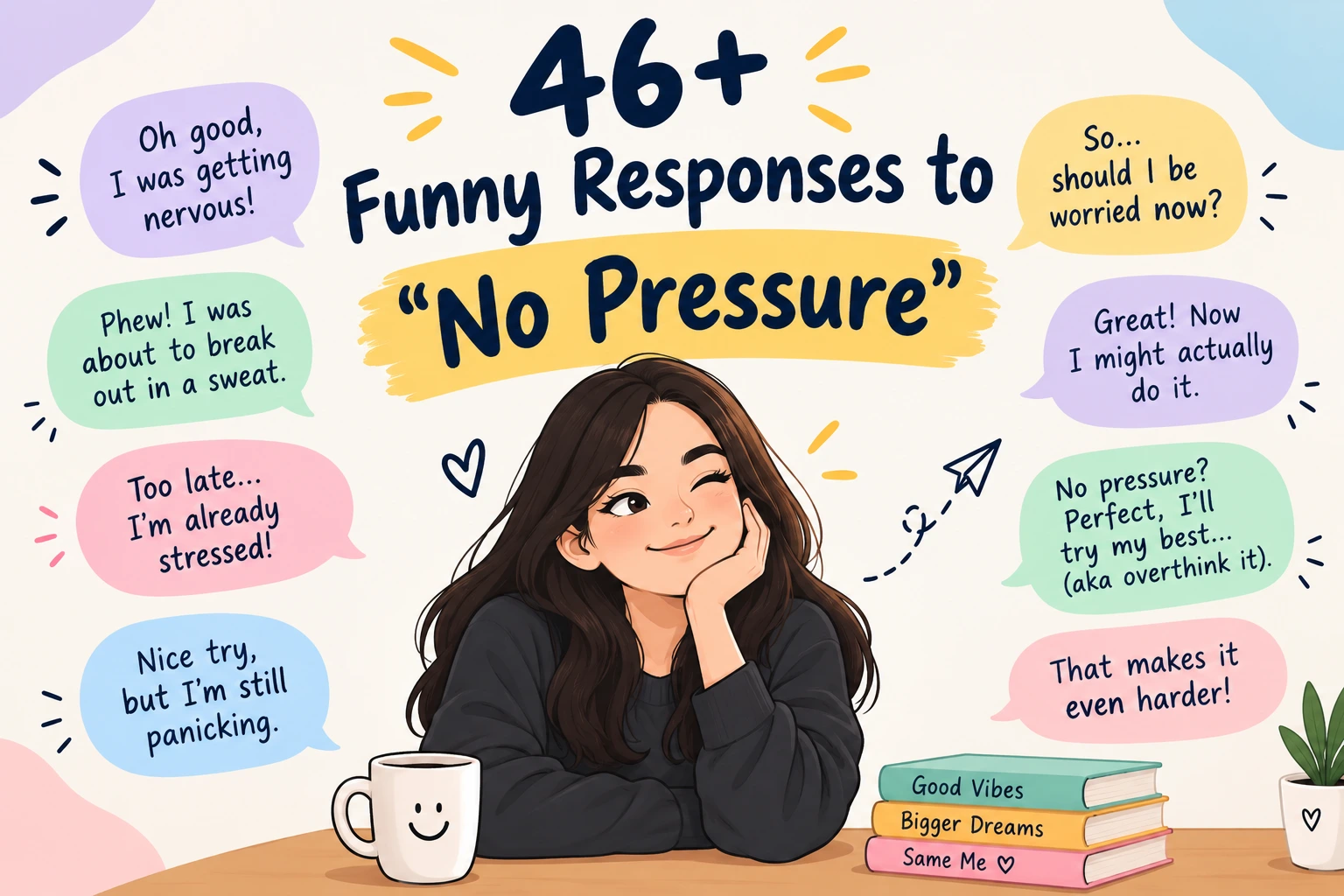
Sometimes, “no pressure” is the exact phrase that creates pressure. Whether someone says it before an important task, a big decision, a first date, an exam, or a presentation, the words can sound reassuring while secretly making you feel like the entire world is watching. That is why a funny response can instantly make the conversation lighter. Instead of replying with a predictable “Thanks,” you can use humor, sarcasm, confidence, or playful exaggeration to match the situation. Knowing different funny responses to no pressure helps you communicate naturally while showing personality. The right response can turn an awkward moment into a memorable one, especially when talking with friends, coworkers, classmates, or someone you like. Here are creative alternatives that range from subtly witty to completely ridiculous, so you can choose one that actually sounds like you.
What Does “Funny Responses to No Pressure” Mean?
The phrase “no pressure” is usually meant to reassure someone that they should not feel stressed, rushed, or obligated to perform perfectly. However, depending on the situation, it can have an unintentionally funny effect.
For example, someone might say, “No pressure, but everyone is waiting for your presentation.” Technically, they are trying to be encouraging. Emotionally, it can sound like: “Your performance determines the fate of civilization.”
Funny responses play with that contrast. They acknowledge the situation while adding humor, sarcasm, confidence, or exaggeration. The best response depends on your relationship with the person and the seriousness of the moment.
When to Use It
Funny responses to “no pressure” work best in casual conversations, friendly workplace chats, group discussions, texting, social media, and situations where humor is already welcome.
You might say, “Perfect. I only work well under unreasonable amounts of pressure anyway,” before a presentation. With a friend, you could reply, “Thanks, I was worried I might accidentally relax.”
In professional settings, keep the humor mild. A playful response such as “I’ll try not to make this a historic event” can work with a friendly coworker, while an exaggerated sarcastic response may be better saved for close friends.
The key is to read the room. Humor should make the situation more comfortable, not make someone regret trying to encourage you.
Is It Polite or Professional?
A funny response to “no pressure” can be perfectly polite, but its professionalism depends on the wording and relationship.
With close friends, you can be sarcastic, dramatic, or deliberately ridiculous. At work, choose humor that is light and self-aware rather than insulting or overly sarcastic. For example, “Absolutely no pressure—I’ll just pretend this is a casual Tuesday” is playful without being inappropriate.
In emails, speeches, interviews, or formal meetings, subtle humor is usually safer than jokes that could be misunderstood. If you are unsure whether the audience will appreciate your humor, use a confident and friendly response instead.
The goal is not simply to be funny. It is to acknowledge the situation, keep the conversation relaxed, and show personality without crossing a social boundary.
1. “Perfect. I’ll just casually panic.”
Meaning: You are jokingly admitting that you are going to feel stressed anyway.
Tone: Playful and sarcastic.
Example: “No pressure.” “Perfect. I’ll just casually panic.”
This works especially well with friends when you want to exaggerate your reaction for comedic effect.
2. “No pressure? Excellent. I love a challenge with unnecessary drama.”
Meaning: You are treating the situation as much more dramatic than it really is.
Tone: Witty and dramatic.
Example: “No pressure, but the whole team is counting on you.” “Excellent. I love a challenge with unnecessary drama.”
Use this when someone has unintentionally made the situation sound extremely important.
3. “Good, because I left my pressure at home.”
Meaning: You are pretending that pressure is something you can physically leave behind.
Tone: Lighthearted and silly.
Example: “No pressure.” “Good, because I left my pressure at home.”
It is short, unexpected, and works particularly well in casual conversations.
4. “Thanks. I was almost worried this would be stressful.”
Meaning: You are humorously pointing out the obvious contradiction.
Tone: Dry and sarcastic.
Example: “No pressure, but this presentation is going to the director.” “Thanks. I was almost worried this would be stressful.”
This is ideal when you enjoy understated humor.
5. “No pressure? Just the fate of humanity, then.”
Meaning: You are exaggerating the importance of the task.
Tone: Dramatic and funny.
Example: “No pressure, just make sure the event goes perfectly.” “No pressure? Just the fate of humanity, then.”
Use it when someone has given you a seemingly enormous responsibility.
6. “I’ll try to disappoint everyone equally.”
Meaning: You are joking that you cannot possibly satisfy everyone.
Tone: Self-deprecating and sarcastic.
Example: “No pressure. Everyone has high expectations.” “I’ll try to disappoint everyone equally.”
This works best with people who understand your sense of humor.
7. “Absolutely. I’m completely relaxed. Internally, however, it’s chaos.”
Meaning: You appear calm while secretly feeling nervous.
Tone: Relatable and witty.
Example: “No pressure before the interview.” “Absolutely. I’m completely relaxed. Internally, however, it’s chaos.”
It is especially relatable before exams, interviews, presentations, and first dates.
8. “No pressure. Just mild emotional destruction.”
Meaning: You are exaggerating how stressful the situation feels.
Tone: Darkly playful.
Example: “No pressure about tomorrow’s exam.” “No pressure. Just mild emotional destruction.”
Use this with close friends who appreciate exaggerated humor.
9. “Thanks, I’ll add that to my collection of reasons to overthink.”
Meaning: You are joking about becoming more anxious because of the comment.
Tone: Clever and relatable.
Example: “No pressure, but make a good impression.” “Thanks, I’ll add that to my collection of reasons to overthink.”
This is perfect for conversations with chronic overthinkers.
10. “No pressure. I’ll simply lower my expectations to zero.”
Meaning: You are jokingly removing the pressure by expecting nothing from yourself.
Tone: Dry and self-aware.
Example: “No pressure about the competition.” “No pressure. I’ll simply lower my expectations to zero.”
Use it when you want humor without being too dramatic.
11. “Fantastic. I perform best when everyone is watching.”
Meaning: You are joking about the opposite being true.
Tone: Confident and sarcastic.
Example: “No pressure, but the whole class will be there.” “Fantastic. I perform best when everyone is watching.”
It works well before public speaking or performances.
12. “No pressure. Just a tiny mountain of expectations.”
Meaning: You are exaggerating the expectations placed on you.
Tone: Playful.
Example: “No pressure, but they expect a lot from this project.” “No pressure. Just a tiny mountain of expectations.”
This response keeps the mood humorous without sounding rude.
13. “I appreciate the reassurance. It made everything ten times scarier.”
Meaning: You are joking that the reassurance had the opposite effect.
Tone: Dry and sarcastic.
Example: “No pressure.” “I appreciate the reassurance. It made everything ten times scarier.”
Use it when someone has unintentionally made you more nervous.
14. “Sure. I’ll just pretend my heart isn’t doing cardio.”
Meaning: You are joking about feeling nervous.
Tone: Funny and relatable.
Example: “No pressure before the interview.” “Sure. I’ll just pretend my heart isn’t doing cardio.”
It is particularly good for texting friends before stressful events.
15. “No pressure? Say less. I’m already sweating.”
Meaning: You are humorously showing that you are nervous.
Tone: Casual and expressive.
Example: “No pressure, but you need to impress them.” “Say less. I’m already sweating.”
This is a natural choice for informal chats.
16. “Don’t worry, I’ll only overthink this for the next six business days.”
Meaning: You are joking about obsessing over the situation.
Tone: Sarcastic and modern.
Example: “No pressure about your answer.” “Don’t worry, I’ll only overthink this for the next six business days.”
It works especially well in texting.
17. “Wonderful. My anxiety was getting bored.”
Meaning: You are pretending that the situation has given your anxiety something to do.
Tone: Dark humor and playful sarcasm.
Example: “No pressure about tomorrow.” “Wonderful. My anxiety was getting bored.”
Use this with friends who understand your humor.
18. “I’ll treat it like a casual life-or-death situation.”
Meaning: You are exaggerating the seriousness of the task.
Tone: Dramatic and humorous.
Example: “No pressure during the final presentation.” “I’ll treat it like a casual life-or-death situation.”
This is a great response when the stakes feel unnecessarily high.
19. “No pressure. I’m just here to create history.”
Meaning: You are jokingly treating an ordinary task as legendary.
Tone: Confident and dramatic.
Example: “No pressure on the project.” “No pressure. I’m just here to create history.”
It can add a fun, confident energy to the conversation.
20. “I’ll do my best to look like I know what I’m doing.”
Meaning: You are humorously admitting uncertainty.
Tone: Self-deprecating and friendly.
Example: “No pressure during the meeting.” “I’ll do my best to look like I know what I’m doing.”
This is especially relatable among coworkers or classmates.
21. “No pressure. Just bring snacks and moral support.”
Meaning: You are jokingly asking for emotional assistance.
Tone: Friendly and playful.
Example: “No pressure about the exam.” “No pressure. Just bring snacks and moral support.”
Use it when you want to make a stressful situation feel lighter.
22. “I’ll try not to make this unnecessarily cinematic.”
Meaning: You are joking that you will avoid turning the situation into a dramatic movie scene.
Tone: Clever and witty.
Example: “No pressure about the decision.” “I’ll try not to make this unnecessarily cinematic.”
This is a subtle option for someone who likes sophisticated humor.
23. “Relax? I thought we were going for maximum drama.”
Meaning: You are intentionally contradicting the reassuring message.
Tone: Playful and dramatic.
Example: “No pressure.” “Relax? I thought we were going for maximum drama.”
It is best for close friends and playful conversations.
24. “No pressure. I’ll just summon my imaginary confidence.”
Meaning: You are pretending to have confidence that you do not actually feel.
Tone: Self-aware and funny.
Example: “No pressure before your speech.” “I’ll just summon my imaginary confidence.”
This is useful when you want to acknowledge nervousness without sounding defeated.
25. “Perfect. I was looking for an excuse to become dramatic.”
Meaning: You are joking that the situation gives you permission to overreact.
Tone: Playful.
Example: “No pressure, but this matters.” “Perfect. I was looking for an excuse to become dramatic.”
Use it when the conversation is already lighthearted.
26. “No pressure. Just me, my thoughts, and 47 backup plans.”
Meaning: You are joking about overplanning.
Tone: Witty and relatable.
Example: “No pressure about the trip.” “No pressure. Just me, my thoughts, and 47 backup plans.”
It is perfect for planners and chronic overthinkers.
27. “I’ll try to keep the panic professionally contained.”
Meaning: You will attempt to remain calm and professional.
Tone: Professional with a humorous edge.
Example: “No pressure during the client meeting.” “I’ll try to keep the panic professionally contained.”
This can work surprisingly well in friendly workplace conversations.
28. “No pressure. I’m only carrying everyone’s expectations.”
Meaning: You are humorously exaggerating the responsibility.
Tone: Dramatic and sarcastic.
Example: “No pressure, but we really need this to work.” “I’m only carrying everyone’s expectations.”
Use this when teammates are putting a lot of responsibility on you.
29. “Great. I’ll put ‘panic gracefully’ on today’s agenda.”
Meaning: You are joking about staying composed while stressed.
Tone: Clever and workplace-friendly.
Example: “No pressure during the presentation.” “Great. I’ll put ‘panic gracefully’ on today’s agenda.”
It is a good choice when you want humor that remains relatively professional.
30. “No pressure. I’m just going to wing it with confidence.”
Meaning: You plan to rely on confidence rather than perfect preparation.
Tone: Confident and playful.
Example: “No pressure about the interview.” “I’m just going to wing it with confidence.”
This response gives a nervous situation a more positive spin.
31. “I was calm until you said ‘no pressure.’”
Meaning: The phrase itself made you feel nervous.
Tone: Dry and humorous.
Example: “No pressure, but this is important.” “I was calm until you said ‘no pressure.’”
This is one of the simplest and most natural responses.
32. “No pressure. I’ll just pretend this is not extremely important.”
Meaning: You are joking about trying to remain relaxed.
Tone: Sarcastic and casual.
Example: “No pressure about the results.” “I’ll just pretend this is not extremely important.”
Use it when you want a response that feels conversational rather than scripted.
33. “Sure, and I’ll just casually achieve perfection.”
Meaning: You are jokingly accepting an unrealistic expectation.
Tone: Confident and sarcastic.
Example: “No pressure. Make it perfect.” “Sure, I’ll just casually achieve perfection.”
It is particularly effective when someone expects flawless work.
34. “No pressure. Just don’t blink while I’m trying to impress everyone.”
Meaning: You are playfully acknowledging the pressure to perform.
Tone: Flirty, playful, or humorous.
Example: “No pressure on your first date.” “Just don’t blink while I’m trying to impress everyone.”
This can work especially well when flirting or joking with someone you like.
35. “I’ll take that as a gentle invitation to panic.”
Meaning: You are humorously interpreting reassurance as pressure.
Tone: Clever and sarcastic.
Example: “No pressure about the deadline.” “I’ll take that as a gentle invitation to panic.”
This is a polished alternative for people who enjoy dry humor.
36. “No pressure. I’ll just consult my extremely qualified imaginary assistant.”
Meaning: You are joking that you need imaginary help.
Tone: Absurd and playful.
Example: “No pressure. We need an answer now.” “I’ll consult my extremely qualified imaginary assistant.”
It works best when the situation is informal.
37. “Thanks. My confidence just left the group chat.”
Meaning: You are joking that your confidence disappeared.
Tone: Modern and witty.
Example: “No pressure, but everyone is watching.” “Thanks. My confidence just left the group chat.”
This is especially natural for texting and social media conversations.
38. “No pressure. I’ll just make a small sacrifice to the productivity gods.”
Meaning: You are humorously suggesting that success requires supernatural help.
Tone: Absurd and playful.
Example: “No pressure on finishing this tonight.” “I’ll make a small sacrifice to the productivity gods.”
Use it among friends or coworkers who enjoy silly humor.
39. “I’ll try to remain emotionally employed.”
Meaning: You are joking about surviving a stressful situation.
Tone: Quirky and sarcastic.
Example: “No pressure during the meeting.” “I’ll try to remain emotionally employed.”
This unusual response can make a conversation more memorable.
40. “No pressure. Just vibes, deadlines, and questionable decisions.”
Meaning: You are humorously summarizing a chaotic situation.
Tone: Casual and witty.
Example: “How is the project going?” “No pressure. Just vibes, deadlines, and questionable decisions.”
It works especially well for group projects and busy workdays.
41. “I’ll be calm, collected, and completely pretending.”
Meaning: You are joking that your calmness will be an act.
Tone: Dry and self-aware.
Example: “No pressure before your speech.” “I’ll be calm, collected, and completely pretending.”
This is a great response when you want subtle humor rather than exaggeration.
42. “No pressure. I’ll simply become a different person for five minutes.”
Meaning: You are joking that you need to transform into a confident version of yourself.
Tone: Dramatic and playful.
Example: “No pressure before the interview.” “I’ll simply become a different person for five minutes.”
It adds humor while still expressing determination.
43. “Sure. Let me just activate my final boss mode.”
Meaning: You are pretending to enter an intense, powerful mode.
Tone: Playful and confident.
Example: “No pressure, but we need to win.” “Sure. Let me activate my final boss mode.”
This works especially well among younger audiences and gaming communities.
44. “No pressure. I’ll just pretend I’ve done this professionally for years.”
Meaning: You are jokingly planning to fake confidence.
Tone: Confident and self-deprecating.
Example: “No pressure on your first presentation.” “I’ll pretend I’ve done this professionally for years.”
Use it when you want to laugh at your own lack of experience.
45. “I accept this completely unnecessary challenge.”
Meaning: You are playfully treating the situation as a challenge.
Tone: Confident and humorous.
Example: “No pressure, but I need this done perfectly.” “I accept this completely unnecessary challenge.”
It is useful when you want humor that also sounds motivated.
46. “No pressure. I’ll just trust the process and my questionable instincts.”
Meaning: You are humorously expressing uncertainty while remaining optimistic.
Tone: Playful and self-aware.
Example: “No pressure. Just choose the right design.” “I’ll trust the process and my questionable instincts.”
This works particularly well for creative projects.
47. “Absolutely no pressure. I’m only one minor inconvenience away from a documentary.”
Meaning: You are exaggerating how dramatic the situation feels.
Tone: Dramatic and absurd.
Example: “No pressure about the competition.” “Absolutely no pressure. I’m only one minor inconvenience away from a documentary.”
Use this when you want a more exaggerated, ridiculous response.
48. “No pressure. I’ll just add this to my personal collection of character-building experiences.”
Meaning: You are humorously framing a stressful event as something that will make you stronger.
Tone: Witty and reflective.
Example: “No pressure about leading the meeting.” “I’ll add it to my collection of character-building experiences.”
This is a smart option when you want humor with a little maturity.
49. “Don’t worry, I’m only taking this approximately 900% seriously.”
Meaning: You are jokingly admitting that you are taking the situation very seriously.
Tone: Exaggerated and playful.
Example: “No pressure about the competition.” “Don’t worry, I’m only taking this approximately 900% seriously.”
It is ideal for friends, teammates, or classmates.
50. “No pressure. I’ve got this—or at least a very convincing impression that I do.”
Meaning: You are expressing confidence while admitting uncertainty.
Tone: Confident, funny, and self-aware.
Example: “No pressure before the interview.” “I’ve got this—or at least a very convincing impression that I do.”
This is one of the best all-purpose responses because it combines humor with optimism.
Conclusion
The best funny responses to “no pressure” do more than make someone laugh. They help you acknowledge an awkward or stressful moment without taking it too seriously. Whether you prefer dry sarcasm, playful confidence, dramatic exaggeration, or self-deprecating humor, there is an expression for almost every situation. The key is choosing a response that matches your relationship with the other person and the setting. Try different funny responses to no pressure alternatives naturally instead of forcing humor into every conversation. A well-timed witty line can make your communication warmer, more memorable, and much more personal.
Discover more