
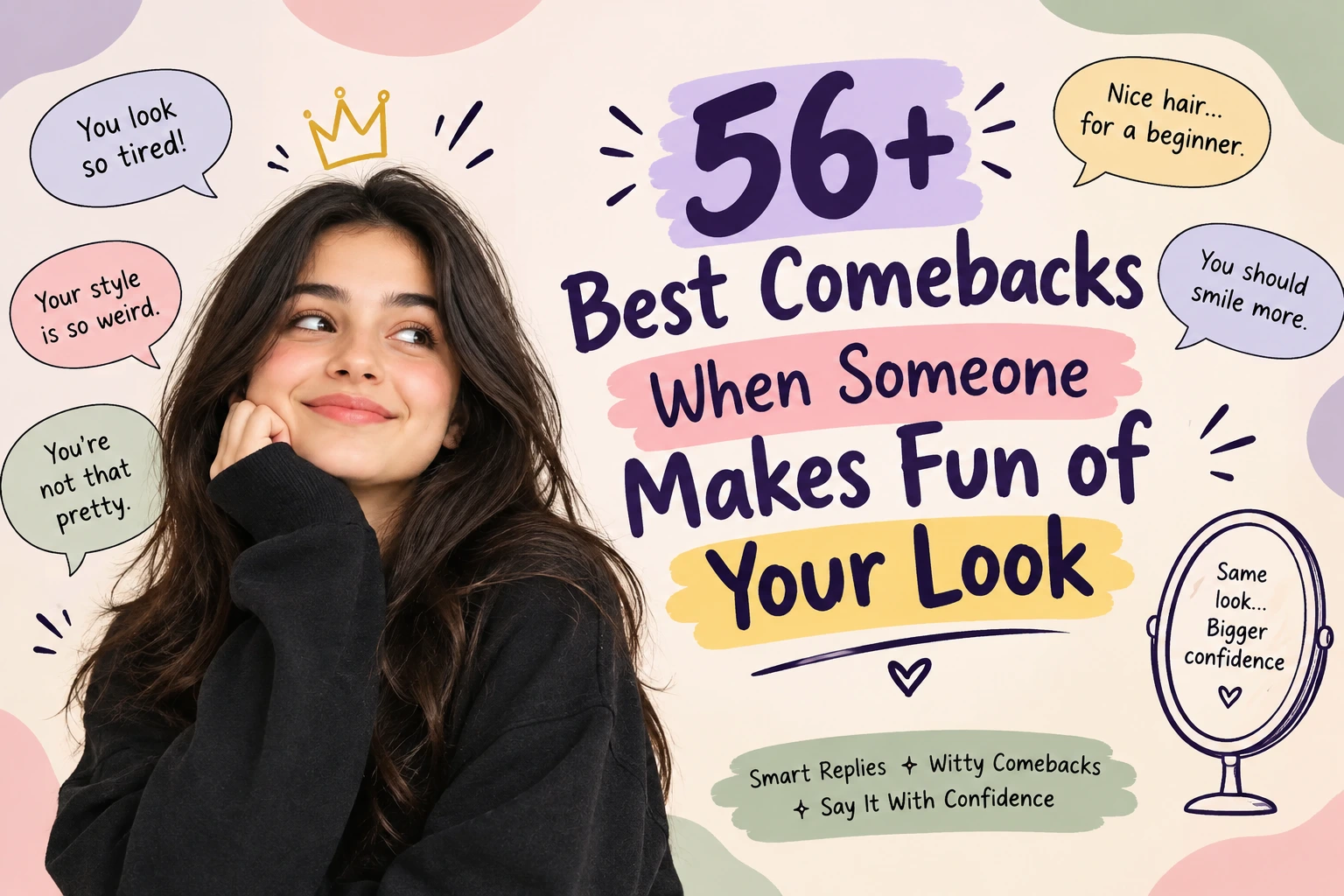
Being made fun of for your appearance can hurt, especially when the comments come from friends, classmates, coworkers, or people you trust. Sometimes, you might laugh it off, but other times, you wish you had the perfect response ready. The right comeback can help you stand up for yourself, protect your confidence, and make it clear that disrespectful comments aren’t welcome.
However, responding doesn’t always mean insulting someone back. A clever remark, a calm statement, or a touch of humor can communicate confidence without turning a small disagreement into a bigger argument. Whether you prefer a witty response, a sharp comeback, or a mature way to set boundaries, having a few options can make difficult interactions easier. Here are more than 60 comebacks for different situations, along with examples to help you choose words that suit your personality.
What Do Comebacks When Someone Makes Fun of Your Looks Mean?
Comebacks are short, thoughtful, humorous, or assertive responses to someone’s remarks. When someone makes fun of your looks, a comeback can help you respond to their comment without allowing it to define how you feel about yourself.
Some comebacks use humor to make an awkward moment less uncomfortable. Others communicate self-respect, challenge someone’s behavior, or establish clear boundaries.
For example, if someone says, “You look terrible today,” you could respond, “Good thing your opinion isn’t part of my outfit.”
A comeback doesn’t have to be cruel or aggressive to be effective. Sometimes, a calm “Please don’t comment on my appearance” communicates more confidence than a lengthy argument.
When to Use These Comebacks
The right comeback depends on who is making the comment, where it happens, and how comfortable you feel responding.
- With friends: A playful comeback can work when everyone understands the joke and nobody is genuinely hurt.
- At school or university: A confident, direct response can help you establish boundaries with classmates.
- At work: Keep your response professional and focus on stopping inappropriate comments rather than exchanging insults.
- On social media: A short, witty response may be enough. You can also ignore, block, or report repeated harassment.
- With family members: A calm but firm response can help communicate that jokes about your appearance are unwelcome.
- With strangers: You don’t owe anyone a response. Walking away is often the safest and simplest choice.
Are Comebacks When Someone Makes Fun of Your Looks Polite or Professional?
Comebacks can be confident, humorous, or confrontational, depending on the words you choose. While playful responses may be appropriate among close friends, aggressive or insulting remarks can make an uncomfortable situation worse.
In professional settings, it’s generally more effective to set a clear boundary than to insult someone in return. For example, “I’d prefer that we keep comments about my appearance out of our conversations” is direct without being disrespectful.
With friends, a lighthearted response such as “That’s a bold opinion for someone who wasn’t asked” may work if the situation is genuinely playful.
However, if someone repeatedly makes hurtful comments, you don’t have to keep finding clever responses. You can end the conversation, seek support, or report the behavior when appropriate.
1. Funny and Witty Comebacks
These responses use humor to defuse awkward moments while showing that you don’t necessarily take every comment seriously.
1. “Good thing I didn’t get dressed for your approval.”
Meaning: Your appearance isn’t something you choose to satisfy other people’s expectations.
Tone: Confident, witty, and playful.
Example: “You really think that outfit looks good?” “Good thing I didn’t get dressed for your approval.”
Why and when to use it: This is useful when someone criticizes your clothing or appearance without being invited to comment. It communicates independence without a personal insult.
2. “I’ll let you know when I ask for your opinion.”
Meaning: You aren’t interested in unsolicited criticism.
Tone: Sarcastic and assertive.
Example: “You should really do something about your hair.” “I’ll let you know when I ask for your opinion.”
Why and when to use it: Use this when someone repeatedly gives you unwanted advice about your appearance.
3. “Wow, did you rehearse that comment?”
Meaning: Suggests that the other person’s remark was unnecessary or predictable.
Tone: Dry humor and sarcasm.
Example: Someone makes another joke about your appearance. You smile and ask, “Wow, did you rehearse that comment?”
Why and when to use it: This works in casual situations when you want to highlight how unnecessary a remark was.
4. “That’s an interesting use of your free time.”
Meaning: Points out that criticizing someone else’s appearance is a strange thing to spend time doing.
Tone: Subtly sarcastic.
Example: “Your hairstyle looks ridiculous.” “That’s an interesting use of your free time.”
Why and when to use it: Choose this when you want to redirect attention toward the other person’s behavior instead of defending your appearance.
5. “I’ll add that to my list of things I didn’t ask about.”
Meaning: Makes it clear that the comment wasn’t requested or particularly useful.
Tone: Funny and dismissive.
Example: “Those glasses don’t suit you.” “I’ll add that to my list of things I didn’t ask about.”
Why and when to use it: This is suitable for casual exchanges when you want to end an unnecessary discussion with humor.
6. “Your opinion arrived without an invitation.”
Meaning: The other person has offered criticism that you never requested.
Tone: Clever and mildly sarcastic.
Example: “You’d look better without that jacket.” “Your opinion arrived without an invitation.”
Why and when to use it: Use this when someone feels entitled to comment on your clothing or appearance.
7. “I didn’t realize my appearance was today’s main topic.”
Meaning: Highlights how strangely focused someone is on your looks.
Tone: Witty and composed.
Example: During lunch, a classmate repeatedly comments on your appearance. You respond, “I didn’t realize my appearance was today’s main topic.”
Why and when to use it: This works particularly well when someone keeps bringing up your looks in a group conversation.
8. “Thanks for the unsolicited review.”
Meaning: Treats the criticism as an unnecessary review rather than something worth taking seriously.
Tone: Dry, sarcastic, and confident.
Example: “Your outfit could use some improvement.” “Thanks for the unsolicited review.”
Why and when to use it: This is a short response for situations where you want to acknowledge a remark without inviting further discussion.
9. “I’ll survive without your fashion advice.”
Meaning: You don’t need the other person’s approval or guidance to decide how to dress.
Tone: Playful and self-assured.
Example: “You really need to change your style.” “I’ll survive without your fashion advice.”
Why and when to use it: Use this when someone is unnecessarily critical of your clothing choices.
10. “Was that supposed to be your best joke?”
Meaning: Challenges the quality of a supposedly funny remark.
Tone: Teasing and sarcastic.
Example: Someone makes a joke about your appearance in front of friends. You calmly ask, “Was that supposed to be your best joke?”
Why and when to use it: This can work when someone is clearly trying to get a laugh at your expense, although it may provoke further teasing.
2. Confident and Self-Respecting Comebacks
These responses focus on confidence and self-worth. They help you communicate that your appearance isn’t open for public judgment.
11. “I’m comfortable with how I look, and that’s what matters.”
Meaning: You accept your appearance and don’t need other people’s approval.
Tone: Mature, confident, and reassuring.
Example: “You should change your hairstyle.” “I’m comfortable with how I look, and that’s what matters.”
Why and when to use it: This is useful when someone questions your personal style or tries to make you feel insecure.
12. “My confidence doesn’t depend on your opinion.”
Meaning: Someone else’s criticism doesn’t determine your self-worth.
Tone: Strong, direct, and self-assured.
Example: “You aren’t as attractive as you think.” “My confidence doesn’t depend on your opinion.”
Why and when to use it: Choose this when someone is deliberately trying to undermine your confidence.
13. “I don’t need to meet your standards to feel good about myself.”
Meaning: Your standards and expectations for yourself don’t have to match someone else’s.
Tone: Empowering and assertive.
Example: “You’d look better if you dressed differently.” “I don’t need to meet your standards to feel good about myself.”
Why and when to use it: This is particularly useful when someone repeatedly tries to impose their preferences on you.
14. “I’m not here to impress everyone.”
Meaning: You don’t feel obligated to make your appearance appealing to every person you meet.
Tone: Independent and confident.
Example: “Why don’t you try looking more presentable?” “I’m not here to impress everyone.”
Why and when to use it: Use this when you want to communicate that your personal choices don’t require universal approval.
15. “I know my worth, and it isn’t up for debate.”
Meaning: Your value as a person isn’t determined by someone else’s judgment.
Tone: Firm and empowering.
Example: “You really think you’re that attractive?” “I know my worth, and it isn’t up for debate.”
Why and when to use it: This is useful when someone makes repeated comments intended to make you question your self-worth.
16. “My appearance is my choice, not your responsibility.”
Meaning: You are responsible for your own appearance, not for satisfying another person’s preferences.
Tone: Assertive and independent.
Example: “You should really do something different with your look.” “My appearance is my choice, not your responsibility.”
Why and when to use it: Choose this when someone tries to control how you look or present yourself.
17. “I’m happy with myself, and that’s enough.”
Meaning: Personal acceptance matters more to you than outside approval.
Tone: Calm, mature, and positive.
Example: “You don’t look as good as you think.” “I’m happy with myself, and that’s enough.”
Why and when to use it: This works when you want to respond confidently without turning the interaction into an argument.
18. “I refuse to measure myself by someone else’s standards.”
Meaning: You don’t allow other people’s expectations to define your value.
Tone: Thoughtful and self-respecting.
Example: “You’d be more attractive if you changed your style.” “I refuse to measure myself by someone else’s standards.”
Why and when to use it: Use this when the conversation involves unrealistic expectations about appearance.
19. “Your approval was never a requirement.”
Meaning: You don’t need someone else’s permission or approval to feel comfortable with yourself.
Tone: Sharp and confident.
Example: “I don’t think that look suits you.” “Your approval was never a requirement.”
Why and when to use it: This is a concise response when someone assumes their opinion should influence your personal choices.
20. “I have better things to focus on than your criticism.”
Meaning: You choose to spend your attention on more meaningful things.
Tone: Composed and assertive.
Example: “Your appearance could use some work.” “I have better things to focus on than your criticism.”
Why and when to use it: This is useful when you want to end a conversation instead of continuing to defend yourself.
3. Savage but Classy Comebacks
These responses are sharper and more sarcastic, but they avoid attacking someone’s physical appearance in return.
21. “That’s a lot of confidence for such an unnecessary comment.”
Meaning: Points out the contrast between someone’s confidence in criticizing you and the lack of need for their remark.
Tone: Sharp and sarcastic.
Example: “Your face looks strange today.” “That’s a lot of confidence for such an unnecessary comment.”
Why and when to use it: Use this when someone makes a deliberately rude comment and you want to challenge their behavior.
22. “Being rude isn’t the same as being honest.”
Meaning: Reminds someone that honesty doesn’t justify unnecessary cruelty.
Tone: Direct and mature.
Example: “I’m just being honest. You don’t look good.” “Being rude isn’t the same as being honest.”
Why and when to use it: This is especially useful when someone tries to excuse hurtful remarks by claiming they’re simply telling the truth.
23. “You could have kept that thought to yourself.”
Meaning: Makes it clear that the comment was unnecessary.
Tone: Blunt and controlled.
Example: “I don’t like how you look today.” “You could have kept that thought to yourself.”
Why and when to use it: Choose this when you want to make your disapproval clear without exchanging insults.
24. “That’s an opinion, not a fact.”
Meaning: Reminds the other person that their judgment about your appearance is subjective.
Tone: Logical and confident.
Example: “You look terrible in that outfit.” “That’s an opinion, not a fact.”
Why and when to use it: This works well when someone presents their personal taste as an objective truth.
25. “Your comment says more about your manners than my appearance.”
Meaning: Shifts the focus from your looks to the other person’s behavior.
Tone: Classy, pointed, and assertive.
Example: “Your hair looks awful.” “Your comment says more about your manners than my appearance.”
Why and when to use it: Use this when someone makes a rude remark in a social setting and you want to call attention to their lack of courtesy.
26. “Not every thought needs to become a conversation.”
Meaning: Suggests that people should exercise judgment before expressing unnecessary criticism.
Tone: Witty and restrained.
Example: “You look so different without makeup.” “Not every thought needs to become a conversation.”
Why and when to use it: This is effective when someone comments on your appearance without considering whether the remark is appropriate.
27. “I expected a conversation, not a personal review.”
Meaning: Makes it clear that you didn’t invite criticism about your looks.
Tone: Sarcastic and composed.
Example: You’re talking with a classmate when they suddenly criticize your appearance. You respond, “I expected a conversation, not a personal review.”
Why and when to use it: This works when someone unexpectedly turns an ordinary interaction into a discussion about your appearance.
28. “You seem unusually invested in how I look.”
Meaning: Points out how much attention the other person is paying to your appearance.
Tone: Sarcastic and confident.
Example: Someone makes several comments about your outfit in one afternoon. You say, “You seem unusually invested in how I look.”
Why and when to use it: Choose this when the remarks have become repetitive and you want to highlight the pattern.
29. “I didn’t know my appearance required a committee review.”
Meaning: Humorously challenges the idea that other people should collectively judge your looks.
Tone: Witty and dry.
Example: Several classmates criticize your outfit. You respond, “I didn’t know my appearance required a committee review.”
Why and when to use it: This can be useful in a group setting where several people are making unsolicited comments.
30. “Let’s focus on something more worthwhile.”
Meaning: Suggests that discussing your appearance is a waste of time.
Tone: Calm, dismissive, and mature.
Example: “Your new haircut isn’t flattering.” “Let’s focus on something more worthwhile.”
Why and when to use it: Use this when you want to move the conversation forward without encouraging further criticism.
4. Short and Sharp Comebacks
Sometimes, the most effective response is a short sentence that makes your boundaries clear. These options are especially useful when you don’t want to prolong an uncomfortable interaction.
31. “And your point is?”
Meaning: Challenges the purpose of the other person’s remark.
Tone: Direct and slightly confrontational.
Example: “Your outfit looks weird.” “And your point is?”
Why and when to use it: This works when someone makes an unnecessary comment and you want them to explain why they said it.
32. “Unnecessary, but noted.”
Meaning: Acknowledges the remark while making it clear that it wasn’t needed.
Tone: Dry and concise.
Example: “That haircut doesn’t suit you.” “Unnecessary, but noted.”
Why and when to use it: Choose this when you want a brief response that doesn’t invite a lengthy argument.
33. “That’s not your decision.”
Meaning: Reminds someone that your appearance is a personal choice.
Tone: Firm and straightforward.
Example: “You should stop wearing clothes like that.” “That’s not your decision.”
Why and when to use it: This is particularly appropriate when someone attempts to dictate your appearance.
34. “Let’s not make this personal.”
Meaning: Encourages the other person to stop turning a conversation into personal criticism.
Tone: Calm and diplomatic.
Example: During a disagreement, someone begins making comments about your looks. You respond, “Let’s not make this personal.”
Why and when to use it: This is helpful when you want to prevent an ordinary disagreement from escalating into personal attacks.
35. “Keep the comments to yourself.”
Meaning: Directly asks someone to stop making remarks about your appearance.
Tone: Firm and unmistakable.
Example: “You really don’t look good in that.” “Keep the comments to yourself.”
Why and when to use it: Use this when softer responses haven’t stopped unwanted comments.
36. “I didn’t ask.”
Meaning: Communicates that you didn’t invite the person’s opinion.
Tone: Blunt and dismissive.
Example: “You should change your hairstyle.” “I didn’t ask.”
Why and when to use it: This is useful in casual conversations when you want to reject unsolicited criticism quickly.
37. “Let’s agree to disagree.”
Meaning: Accepts that you and the other person have different opinions without continuing the argument.
Tone: Diplomatic and composed.
Example: “That outfit looks terrible.” “Let’s agree to disagree.”
Why and when to use it: Choose this when you want to end a disagreement without making it more personal.
38. “That’s your perspective.”
Meaning: Recognizes that the comment reflects the other person’s opinion rather than an established fact.
Tone: Neutral and confident.
Example: “You don’t look good in that color.” “That’s your perspective.”
Why and when to use it: This works when you want to acknowledge a remark without accepting its judgment.
39. “I’m not interested in that discussion.”
Meaning: Clearly communicates that you don’t want to discuss your appearance.
Tone: Mature and assertive.
Example: “Why don’t you change your appearance?” “I’m not interested in that discussion.”
Why and when to use it: This is useful when you want to end a conversation without explaining or defending yourself.
40. “Let’s leave my appearance out of it.”
Meaning: Establishes a clear boundary against personal remarks.
Tone: Professional and firm.
Example: A colleague makes a personal comment during a disagreement. You respond, “Let’s leave my appearance out of it.”
Why and when to use it: This is particularly effective in workplaces, classrooms, and other settings where respectful communication matters.
5. Mature and Boundary-Setting Comebacks
These responses are particularly useful when the remarks are genuinely hurtful, repeated, or made by someone who should respect you.
41. “I don’t appreciate comments about my appearance.”
Meaning: Clearly expresses that remarks about your looks make you uncomfortable.
Tone: Respectful and assertive.
Example: A friend repeatedly comments on your weight. You say, “I don’t appreciate comments about my appearance.”
Why and when to use it: This is one of the most useful responses when you want to establish a straightforward personal boundary.
42. “Please don’t make jokes about how I look.”
Meaning: Politely but firmly asks someone to stop making appearance-related jokes.
Tone: Calm and direct.
Example: Your classmates keep joking about your hairstyle. You tell them, “Please don’t make jokes about how I look.”
Why and when to use it: Choose this when you want to address teasing without responding with another insult.
43. “I know you may think it’s funny, but I don’t.”
Meaning: Explains that a joke isn’t enjoyable for you, even if the other person finds it amusing.
Tone: Honest and mature.
Example: A friend repeatedly jokes about your facial features. You explain, “I know you may think it’s funny, but I don’t.”
Why and when to use it: This is helpful when someone dismisses hurtful comments as harmless jokes.
44. “My appearance isn’t an invitation for criticism.”
Meaning: Reminds others that your appearance doesn’t give them permission to criticize you.
Tone: Confident and boundary-focused.
Example: Someone criticizes your clothes at a social gathering. You respond, “My appearance isn’t an invitation for criticism.”
Why and when to use it: Use this when you need to communicate that your personal choices deserve respect.
45. “I’d appreciate it if you respected my boundaries.”
Meaning: Requests that someone recognize and respect the limits you’ve established.
Tone: Mature and diplomatic.
Example: After asking a friend to stop making comments about your looks, you add, “I’d appreciate it if you respected my boundaries.”
Why and when to use it: This is especially suitable when the same person continues making unwanted comments after you’ve already spoken up.
46. “There’s more to me than my appearance.”
Meaning: Reminds someone that your identity and value extend beyond your physical features.
Tone: Thoughtful and self-assured.
Example: Someone repeatedly focuses on how you look instead of your achievements. You respond, “There’s more to me than my appearance.”
Why and when to use it: Choose this when you want to redirect attention toward your character, interests, or accomplishments.
47. “I’d rather be judged by my actions and character.”
Meaning: Emphasizes that your behavior and values matter more to you than your physical appearance.
Tone: Mature and reflective.
Example: A classmate makes an unnecessary comment about your looks. You say, “I’d rather be judged by my actions and character.”
Why and when to use it: This is useful in conversations where you want to communicate what you believe truly matters.
48. “That comment was hurtful, and I want you to know it.”
Meaning: Honestly communicates the emotional effect of someone’s words.
Tone: Vulnerable, direct, and sincere.
Example: Someone you trust makes a joke about your appearance. You tell them, “That comment was hurtful, and I want you to know it.”
Why and when to use it: This is particularly important when the person making the remark is a friend, family member, or partner whose behavior affects you.
49. “Respect should be part of every conversation.”
Meaning: Emphasizes that people should communicate with consideration, even when they disagree.
Tone: Principled and assertive.
Example: A coworker makes a personal remark during a disagreement. You respond, “Respect should be part of every conversation.”
Why and when to use it: This is useful when you want to bring the discussion back to respectful communication.
50. “I deserve the same respect I give others.”
Meaning: Affirms that respectful treatment should be mutual.
Tone: Empowering and mature.
Example: A friend makes another joke about your appearance after you’ve asked them to stop. You say, “I deserve the same respect I give others.”
Why and when to use it: Choose this when someone repeatedly disregards your feelings or personal boundaries.
6. Clever and Unbothered Comebacks
These responses communicate that you aren’t interested in allowing someone’s comments to control your mood. They work best when you genuinely feel comfortable rather than forcing yourself to appear unaffected.
51. “Fortunately, I have bigger things to worry about.”
Meaning: Suggests that your attention is focused on more meaningful matters.
Tone: Relaxed and confident.
Example: Someone criticizes your appearance before an important presentation. You respond, “Fortunately, I have bigger things to worry about.”
Why and when to use it: This is a good option when you want to move past an unnecessary comment and focus on your priorities.
52. “I’ll be just fine without that opinion.”
Meaning: Communicates that you don’t need the other person’s approval to feel comfortable.
Tone: Calm and self-assured.
Example: “I don’t like your new look.” “I’ll be just fine without that opinion.”
Why and when to use it: Use this when you want to show that the remark hasn’t changed your personal choices.
53. “My day was going perfectly until that unnecessary comment.”
Meaning: Humorously points out that the other person’s remark disrupted an otherwise pleasant moment.
Tone: Playful and sarcastic.
Example: A friend makes a joke about your appearance while you’re enjoying lunch. You respond, “My day was going perfectly until that unnecessary comment.”
Why and when to use it: This can work with friends when the comment is relatively minor and you want to signal that it wasn’t welcome.
54. “I’m choosing not to give that comment my attention.”
Meaning: Deliberately refuses to engage with unnecessary criticism.
Tone: Mature and composed.
Example: Someone makes a rude remark in a group chat. You reply, “I’m choosing not to give that comment my attention.”
Why and when to use it: This is useful when engaging further would only prolong an unproductive exchange.
55. “I have no interest in changing myself for someone else’s comfort.”
Meaning: Expresses your commitment to making personal choices without being controlled by others’ expectations.
Tone: Strong and independent.
Example: A relative repeatedly criticizes your clothing. You explain, “I have no interest in changing myself for someone else’s comfort.”
Why and when to use it: Use this when someone expects you to change your appearance simply because they prefer a different style.
56. “My peace matters more than winning an argument.”
Meaning: Prioritizes emotional well-being over proving a point.
Tone: Thoughtful and composed.
Example: A disagreement about your appearance starts becoming heated. You say, “My peace matters more than winning an argument,” and step away.
Why and when to use it: This is useful when a conversation is becoming unnecessarily stressful and you want to disengage.
57. “I don’t have to respond to every opinion I hear.”
Meaning: Recognizes that choosing not to engage can be a deliberate decision.
Tone: Calm and self-assured.
Example: Someone makes another joke about your looks at a gathering. You decide not to engage and later explain, “I don’t have to respond to every opinion I hear.”
Why and when to use it: Choose this when ignoring a remark is more effective than responding to it.
58. “My self-respect isn’t negotiable.”
Meaning: Establishes that you won’t accept treatment that undermines your dignity.
Tone: Firm and empowering.
Example: A classmate continues making personal jokes despite being asked to stop. You respond, “My self-respect isn’t negotiable.”
Why and when to use it: This is suitable when someone repeatedly crosses your boundaries and you need to communicate that the behavior must stop.
59. “I’d rather spend my energy on people who lift me up.”
Meaning: Emphasizes your preference for supportive relationships rather than constant criticism.
Tone: Positive and reflective.
Example: Someone keeps making negative remarks about your appearance. You respond, “I’d rather spend my energy on people who lift me up.”
Why and when to use it: Use this when you want to disengage from a negative interaction and focus on more supportive relationships.
60. “Your comment doesn’t define who I am.”
Meaning: Separates your identity and self-worth from another person’s criticism.
Tone: Confident, reassuring, and empowering.
Example: Someone makes a hurtful remark about your facial features. You respond, “Your comment doesn’t define who I am.”
Why and when to use it: This is useful when a comment feels personal and you want to remind yourself and the other person that one remark doesn’t determine your value.
Real-Life Situations: Choosing the Right Comeback
When Your Friend Makes Fun of Your Looks
If a close friend makes a harmless joke and you are comfortable joking back, a playful response can keep things light.
Suggested reply: “I’ll let you know when I ask for your fashion advice.”
However, if the joke genuinely hurts, be honest rather than pretending to enjoy it.
When a Classmate Makes Fun of Your Appearance
Repeated teasing at school or university can become uncomfortable, especially when it happens in front of other people.
Suggested reply: “Please don’t make comments about my appearance.”
A direct boundary is often more useful than an insulting comeback. If the behavior continues, consider speaking to someone you trust or a university representative.
When a Coworker Comments on Your Looks
In a professional setting, appearance-related remarks can be inappropriate, particularly when they are repeated or personal.
Suggested reply: “I’d prefer that we keep our conversations professional and avoid comments about my appearance.”
If the behavior persists, document what happened and consider raising it through the appropriate workplace channels.
When Someone Makes Fun of You in Public
Being criticized in front of others can make the situation especially uncomfortable. You don’t need to turn the moment into a public argument.
Suggested reply: “That’s an unnecessary comment. Let’s move on.”
This response addresses the behavior without escalating the interaction.
When a Family Member Makes Hurtful Comments
Family members may sometimes dismiss appearance-related remarks as jokes or advice. You can still establish boundaries respectfully.
Suggested reply: “I know you may not mean to hurt me, but I’d appreciate it if you stopped commenting on my appearance.”
This gives the person an opportunity to understand how their words affect you.
What to Avoid When Responding to Appearance-Related Insults
1. Insulting Their Appearance in Return
Attacking someone’s physical features might feel satisfying in the moment, but it can escalate the conflict and reinforce the same behavior you’re trying to challenge.
2. Feeling Obligated to Laugh
You don’t have to laugh at a joke that hurts you. Pretending to enjoy repeated teasing can make it harder for others to understand your boundaries.
3. Overexplaining Yourself
You don’t need to justify your hairstyle, clothing, body, or facial features. A short, clear response is often sufficient.
4. Turning Every Comment Into an Argument
Not every remark deserves a lengthy discussion. Sometimes, changing the subject or walking away is a more useful response.
5. Ignoring Repeated Harassment
If someone repeatedly targets your appearance, a clever comeback may not solve the underlying problem. Consider seeking support from a trusted person or an appropriate authority.
6. Confusing Confidence With Aggression
Being confident doesn’t mean you need to humiliate someone else. You can be firm, direct, and self-respecting without becoming cruel.
Pro Tips for Handling Comments About Your Looks
1. Match Your Response to the Situation
A playful comment from a close friend and repeated harassment from a classmate are two very different situations. Use humor only when it feels comfortable and safe. When someone repeatedly crosses a boundary, be direct.
2. Keep Your Body Language Calm
A steady voice, relaxed posture, and brief response can communicate confidence. You don’t have to raise your voice or prove that you’re unaffected to make your point.
3. Remember That Silence Is Also a Choice
You don’t owe everyone a clever comeback. If a conversation is becoming uncomfortable or unsafe, you can walk away, block the person, or seek support. Protecting your peace matters more than delivering the perfect response.
Conclusion
When someone makes fun of your looks, the right response is one that protects your dignity without unnecessarily escalating the situation. A witty comeback can work among friends, while a firm boundary is often more effective when a comment is genuinely hurtful. You don’t need to prove your attractiveness, defend every personal choice, or respond to every insult. Confidence comes from recognizing your worth and deciding how you want to be treated. Ultimately, the most powerful response isn’t always the sharpest one; sometimes, it’s simply refusing to let someone else’s unkind words define you.
Discover more
other ways to say thank you for your cooperation