
Someone texts you, “What are you up to?” and suddenly, you have no idea what to say. Do you give a simple answer, make a joke, flirt a little, or use the opportunity to start an interesting conversation? The right response depends on who is asking, how well you know them, and what kind of conversation you want to have.
“What are you up to?” is one of the most common ways people check in with friends, start conversations with crushes, or connect with colleagues. Although the question sounds simple, your reply can influence where the conversation goes next.
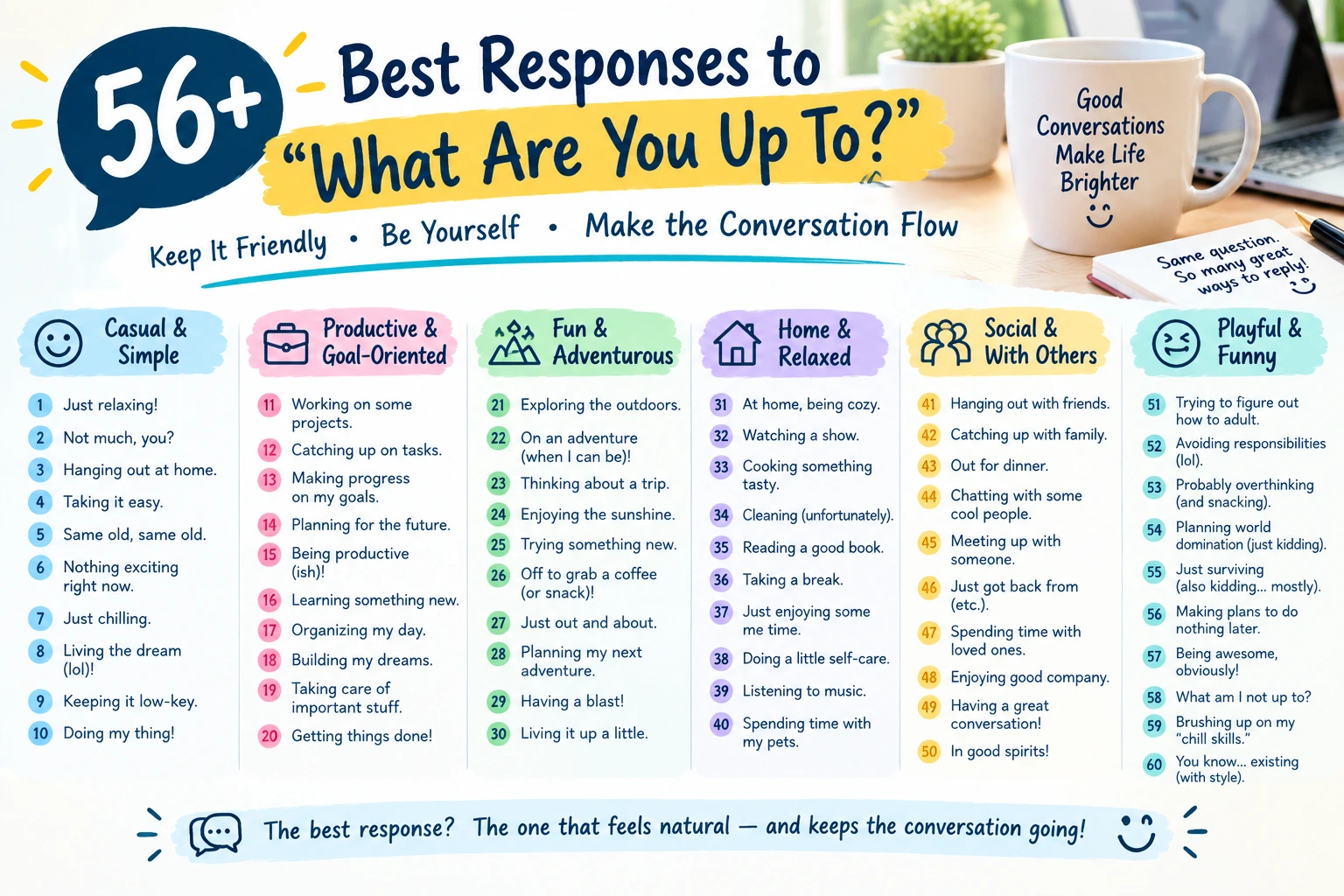
Instead of always saying “Nothing much” or “Not much, you?”, try something more personal. In this guide, you will find 56+ best responses to “What are you up to?”, including funny, flirty, confident, casual, and professional options. Each response comes with its meaning, tone, and a natural example to help you choose the perfect words.
Section 1: What Does “What Are You Up To?” Mean?
“What are you up to?” is an informal expression that asks what someone is doing at the moment or what they have planned. Depending on the situation, it can also be a friendly way to check in, start a conversation, or show interest in someone’s life.
For example, a friend might text you this question because they want to hang out. A crush might use it as an excuse to talk to you, while a colleague may be checking on your current work.
The meaning often depends on the context.
- Casual meaning: What are you doing right now?
- Social meaning: What’s happening in your life?
- Friendly meaning: How have you been spending your time?
- Flirty meaning: Are you free to talk, or can we spend some time together?
- Professional meaning: What task or project are you currently working on?
The phrase is not automatically romantic. Sometimes, it is simply a conversation starter. Paying attention to the person’s tone and your relationship with them helps you respond naturally.
This question works in several situations, from casual texting to workplace conversations. However, your wording should match the setting.
1. When texting friends
Use it when you want to check in, make plans, or start a conversation.
Example: “Hey, what are you up to this evening? Want to grab something to eat?”
It sounds relaxed and friendly, making it suitable for everyday conversations.
2. When texting your crush
The question can open the door to a longer conversation without making your intentions too obvious.
Example: “What are you up to? I was hoping we’d get a chance to talk.”
It feels personal without being overly intense.
3. When talking to family
You can use it to check on someone’s activities or see whether they are available.
Example: “What are you up to? Mom needs a little help with dinner.”
The expression is natural and familiar in everyday family conversations.
4. When making plans
Ask the question when you want to find out whether someone is available.
Example: “What are you up to on Saturday? There’s a new café I’d like to try.”
This approach makes it easy to suggest an activity.
5. In professional settings
The phrase is common in casual workplace conversations, especially among colleagues who know each other well.
Example: “What are you working on today? I wanted to discuss the next project.”
For a more formal email or conversation, use a clearer alternative such as “What are you currently working on?” or “Could you share an update on your current priorities?”
6. In emails and messages
In a friendly email, the phrase can sound natural. In formal business communication, however, it may feel too casual.
Casual: “Hi, what are you up to this weekend?”
Professional: “Hi, could you let me know what you are currently working on?”
Choose your wording according to your relationship with the recipient.
Section 3: Is “What Are You Up To?” Polite or Professional?
Yes, “What are you up to?” is generally polite, but its level of formality depends on the situation.
In casual conversations, it is friendly, relaxed, and natural. It works well with friends, siblings, classmates, and people you know personally.
In professional settings, it can be appropriate when speaking with familiar colleagues. However, if you are contacting a manager, client, professor, or someone you do not know well, a more specific question may sound more respectful.
Consider these alternatives:
- Casual: “What are you up to today?”
- Polite: “How are you spending your day?”
- Professional: “What are your current priorities?”
- Work-related: “What project are you currently working on?”
- Formal: “Could you provide an update on your current activities?”
One important detail: “What are you up to?” can sometimes suggest suspicion, especially when someone asks it in a questioning tone. For example, “What are you up to now?” might sound playful between friends or slightly accusatory during an argument.
The safest approach is to consider your relationship, the setting, and the tone of the conversation before responding.
Section 4: 60 Best Responses to “What Are You Up To?”
Here are 60 responses for different situations, including everyday texting, humor, flirting, confidence, and professional communication.
Category 1: Casual and Friendly Responses
These replies are perfect for friends, classmates, siblings, and people you feel comfortable talking to.
1. Not much, just relaxing.
Meaning: You are taking it easy and not doing anything particularly demanding.
Tone: Casual and friendly.
Example: “Not much, just relaxing after a long day. What about you?”
Why and when to use it: Use this when you want a simple, honest response that keeps the conversation open.
Personalization: Add what you are relaxing with, such as music, a show, or a cup of tea.
2. Just taking it one day at a time.
Meaning: You are handling things as they come rather than worrying too much about the future.
Tone: Calm and thoughtful.
Example: “Just taking it one day at a time and trying to stay productive.”
Why and when to use it: This works when you want to sound relaxed without explaining every detail of your day.
3. Just catching up on a few things.
Meaning: You are completing tasks or activities you have not had time for.
Tone: Natural and conversational.
Example: “Just catching up on a few things I left unfinished yesterday.”
Why and when to use it: Choose this response when you are busy but still want to sound approachable.
4. Nothing exciting, just the usual.
Meaning: Your day is fairly ordinary.
Tone: Relaxed and friendly.
Example: “Nothing exciting, just the usual classes and assignments.”
Why and when to use it: This is ideal when you do not have anything special to share but want to answer naturally.
5. Just enjoying some downtime.
Meaning: You are spending time resting or doing something enjoyable.
Tone: Casual and composed.
Example: “Just enjoying some downtime after a pretty hectic week.”
Why and when to use it: Use it when you want to emphasize that you are taking a break.
6. Working on a few personal goals.
Meaning: You are focusing on things you want to accomplish.
Tone: Motivated and positive.
Example: “Working on a few personal goals and trying to stay consistent.”
Why and when to use it: This response is useful when you want to share a little about your priorities without giving a long explanation.
7. Just listening to music.
Meaning: You are relaxing or passing the time with music.
Tone: Easygoing.
Example: “Just listening to music and letting the evening pass. What about you?”
Why and when to use it: It is a natural answer that gives the other person an easy opportunity to ask about your music taste.
8. Trying to make the most of my day.
Meaning: You are attempting to use your time productively or enjoyably.
Tone: Positive and motivated.
Example: “Trying to make the most of my day before the week gets busy.”
Why and when to use it: Choose this when you want to sound optimistic without pretending to be busy every minute.
9. Just spending some time with family.
Meaning: You are enjoying time with relatives.
Tone: Warm and personal.
Example: “Just spending some time with family. It’s been a while since we all sat together.”
Why and when to use it: This is a good response when you want to share something personal but not overly private.
10. Nothing much. What’s going on with you?
Meaning: You are not doing anything special and want to hear about the other person.
Tone: Friendly and engaging.
Example: “Nothing much. What’s going on with you? You seem unusually quiet today.”
Why and when to use it: Use this when you want to keep the conversation moving instead of ending it with a one-word answer.
Category 2: Funny and Playful Responses
These replies are useful when you share a playful relationship with the person asking.
11. Trying to look busy.
Meaning: You are joking about appearing productive.
Tone: Funny and self-aware.
Example: “Trying to look busy until someone gives me an actual task.”
Why and when to use it: Use this with friends or colleagues who appreciate light humor.
12. Avoiding my responsibilities, obviously.
Meaning: You are joking that you are procrastinating.
Tone: Playful and relatable.
Example: “Avoiding my responsibilities, obviously. My assignments can wait another five minutes.”
Why and when to use it: This works especially well with friends who understand your sense of humor.
13. Living my best life, one snack at a time.
Meaning: You are enjoying small comforts, especially food.
Tone: Funny and lighthearted.
Example: “Living my best life, one snack at a time. Want to join me?”
Why and when to use it: Choose this when the conversation is relaxed and you want to make the other person smile.
14. Waiting for my motivation to arrive.
Meaning: You want to be productive but have not found the energy yet.
Tone: Humorous and relatable.
Example: “Waiting for my motivation to arrive. It seems to be running late.”
Why and when to use it: This is a fun response when you are procrastinating or having a lazy day.
15. Trying to figure out what day it is.
Meaning: You are so relaxed or busy that you have lost track of time.
Tone: Silly and casual.
Example: “Trying to figure out what day it is. This week has been a blur.”
Why and when to use it: Use this when your schedule has been confusing or every day feels the same.
16. Planning my escape from adult responsibilities.
Meaning: You are joking about wanting a break from everyday obligations.
Tone: Sarcastic and playful.
Example: “Planning my escape from adult responsibilities. Do you know a place with unlimited holidays?”
Why and when to use it: This is ideal for conversations about work, bills, deadlines, or general adult life.
17. Being productive in theory.
Meaning: You intend to get things done, but your actions may not match your plans.
Tone: Dry humor.
Example: “Being productive in theory. In practice, I’ve been scrolling for an hour.”
Why and when to use it: Choose this when you want to joke about procrastination without taking yourself too seriously.
18. Trying to remember why I walked into this room.
Meaning: You are joking about forgetting what you intended to do.
Tone: Silly and relatable.
Example: “Trying to remember why I walked into this room. My brain clearly has other plans.”
Why and when to use it: This works best with people who enjoy everyday observational humor.
19. Negotiating with my to-do list.
Meaning: You have several tasks and are deciding which ones to complete.
Tone: Witty and conversational.
Example: “Negotiating with my to-do list. So far, neither side is cooperating.”
Why and when to use it: Use this when someone asks about your day and you want to make your workload sound amusing.
20. Waiting for life to send me a plot twist.
Meaning: You are hoping something interesting will happen.
Tone: Dramatic and playful.
Example: “Waiting for life to send me a plot twist. The current storyline is getting predictable.”
Why and when to use it: This is a good option for a friend who enjoys dramatic jokes and imaginative conversations.
Category 3: Flirty and Romantic Responses
If your crush or partner asks what you are doing, these replies can show interest without making the conversation uncomfortable. Choose one that matches your relationship and the level of flirting you both enjoy.
21. Thinking about someone, actually.
Meaning: You are hinting that a particular person is on your mind.
Tone: Subtly flirty.
Example: “Thinking about someone, actually. Should I tell you who?”
Why and when to use it: Use this when you already share a playful connection and want to create a little curiosity.
22. Waiting for your message, apparently.
Meaning: You are suggesting that hearing from the person makes your day better.
Tone: Sweet and flirtatious.
Example: “Waiting for your message, apparently. You finally showed up.”
Why and when to use it: This works when you are comfortable teasing the other person about texting.
23. Nothing much. Want to change that?
Meaning: You are inviting the other person to make the conversation more interesting.
Tone: Confident and flirty.
Example: “Nothing much. Want to change that? We could find something fun to do.”
Why and when to use it: Choose this when you want to suggest spending time together without being too direct.
24. Just wishing you were here.
Meaning: You would enjoy having the person around.
Tone: Romantic and affectionate.
Example: “Just wishing you were here. This movie would be more fun with you.”
Why and when to use it: This is best for someone you are dating or a crush with whom you already share mutual interest.
25. Trying to decide whether to text you or wait for you to text me.
Meaning: You are admitting that you wanted to talk to them.
Tone: Playful and honest.
Example: “Trying to decide whether to text you or wait for you to text me. You made the decision for me.”
Why and when to use it: Use this when you want to show interest without hiding behind overly cool behavior.
26. My day just got more interesting.
Meaning: Their message has made you happier or more excited.
Tone: Warm and subtly romantic.
Example: “My day just got more interesting. What made you think of me?”
Why and when to use it: This is a good choice when you want to welcome their attention and encourage further conversation.
27. Wouldn’t you like to know?
Meaning: You are playfully making the other person curious.
Tone: Teasing and flirty.
Example: “Wouldn’t you like to know? Maybe I’ll tell you if you ask nicely.”
Why and when to use it: This works best when you already have a teasing dynamic. Avoid it if the other person needs a straightforward answer.
28. Just making room for a little conversation with you.
Meaning: You are making it clear that you are happy to talk to them.
Tone: Sweet and attentive.
Example: “Just making room for a little conversation with you. How’s your evening going?”
Why and when to use it: Use this when you want to sound interested without making a bold romantic declaration.
29. Trying to think of a good excuse to see you.
Meaning: You want to spend time with the person but are presenting it playfully.
Tone: Bold and flirtatious.
Example: “Trying to think of a good excuse to see you. Honestly, I might not need one.”
Why and when to use it: Choose this when you want to hint at meeting in person and feel comfortable being direct.
30. Waiting for you to make my evening better.
Meaning: You are suggesting that talking to or spending time with them would improve your evening.
Tone: Romantic and confident.
Example: “Waiting for you to make my evening better. Are we talking or making plans?”
Why and when to use it: This is suitable for an established flirtation or a relationship where affectionate teasing feels natural.
Category 4: Confident and Independent Responses
These replies show that you have your own interests, responsibilities, and priorities. They are especially useful when you want to share what you are doing without sounding defensive or trying too hard to impress someone.
31. Working on something important to me.
Meaning: You are focusing on a personal priority.
Tone: Confident and purposeful.
Example: “Working on something important to me. I’ve been meaning to give it more time.”
Why and when to use it: Use this when you want to communicate that your time is valuable without explaining every detail.
32. Making progress on my goals.
Meaning: You are taking steps toward something you want to achieve.
Tone: Motivated and self-assured.
Example: “Making progress on my goals, one step at a time. How about you?”
Why and when to use it: This is a good response when you are focused on studies, career development, fitness, or personal growth.
33. Keeping myself busy with things that matter.
Meaning: You are investing your time in meaningful activities.
Tone: Mature and confident.
Example: “Keeping myself busy with things that matter and trying to maintain a good routine.”
Why and when to use it: Choose this when you want to emphasize your priorities without sounding dismissive.
34. Taking some time for myself.
Meaning: You are prioritizing rest, reflection, or personal well-being.
Tone: Calm and self-respecting.
Example: “Taking some time for myself today. It’s been a busy week.”
Why and when to use it: This is useful when you want to communicate that you are unavailable without making it personal.
35. Learning something new.
Meaning: You are developing a skill or expanding your knowledge.
Tone: Curious and positive.
Example: “Learning something new about web development. There’s always something else to explore.”
Why and when to use it: Use this when you are studying, practicing a hobby, or building a new skill.
36. Focused on my next move.
Meaning: You are considering your next step or planning ahead.
Tone: Strategic and confident.
Example: “Focused on my next move and figuring out how to approach the next stage of my career.”
Why and when to use it: This works well when discussing career plans, academic goals, or personal decisions.
37. Building better habits.
Meaning: You are working on improving your everyday routine.
Tone: Motivational and grounded.
Example: “Building better habits and trying to be more consistent with my schedule.”
Why and when to use it: Choose this when you want to share a positive change without exaggerating your progress.
38. Taking care of what needs to be done.
Meaning: You are handling your responsibilities.
Tone: Practical and composed.
Example: “Taking care of what needs to be done before I can properly relax.”
Why and when to use it: This is a straightforward response when you have errands, work, or assignments to complete.
39. Enjoying my own company for a change.
Meaning: You are comfortable spending time alone.
Tone: Independent and relaxed.
Example: “Enjoying my own company for a change. A quiet evening was exactly what I needed.”
Why and when to use it: Use this when you want to express independence without implying that you dislike other people’s company.
40. Making today count.
Meaning: You are trying to use your day meaningfully.
Tone: Positive and determined.
Example: “Making today count by finishing a few things I’ve been putting off.”
Why and when to use it: This response suits conversations with motivated friends or anyone who asks about your current plans.
Category 5: Polite and Professional Responses
These alternatives are useful for colleagues, classmates, supervisors, clients, and other professional contacts. They provide more information than a vague reply while keeping the tone respectful.
41. I’m currently working on a few priorities.
Meaning: You are handling important tasks.
Tone: Professional and composed.
Example: “I’m currently working on a few priorities, including the upcoming project deadline.”
Why and when to use it: Use this when a colleague asks what you are doing and you want to communicate that you are occupied.
42. I’m making progress on my current project.
Meaning: You are working toward completing a project.
Tone: Professional and informative.
Example: “I’m making progress on my current project and expect to have an update soon.”
Why and when to use it: This works well in workplace conversations when someone wants to know how your work is going.
43. I’m catching up on some pending tasks.
Meaning: You are completing work that remains unfinished.
Tone: Neutral and professional.
Example: “I’m catching up on some pending tasks before moving on to the next assignment.”
Why and when to use it: Choose this when you are managing your workload or clearing outstanding responsibilities.
44. I’m preparing for an upcoming deadline.
Meaning: You are getting your work ready before a due date.
Tone: Professional and focused.
Example: “I’m preparing for an upcoming deadline, so I’m reviewing the final details today.”
Why and when to use it: This is useful when you need to explain why you are busy without sharing unnecessary details.
45. I’m reviewing the next steps.
Meaning: You are assessing what needs to happen next.
Tone: Organized and professional.
Example: “I’m reviewing the next steps for the project before we finalize the timeline.”
Why and when to use it: Use this when your work involves planning, coordination, or decision-making.
46. I’m coordinating with the team.
Meaning: You are communicating with colleagues to organize shared work.
Tone: Collaborative and professional.
Example: “I’m coordinating with the team to make sure everyone is aligned on the deliverables.”
Why and when to use it: This is a suitable response when your work involves group tasks or project management.
47. I’m focusing on a few key deliverables.
Meaning: You are concentrating on specific results that need to be completed.
Tone: Formal and results-oriented.
Example: “I’m focusing on a few key deliverables before the end of the week.”
Why and when to use it: Choose this for workplace conversations where the other person needs a concise overview of your responsibilities.
48. I’m finalizing some details.
Meaning: You are completing the last parts of a task or project.
Tone: Professional and concise.
Example: “I’m finalizing some details for the presentation and should be ready shortly.”
Why and when to use it: This works well when a project is nearly complete and you want to give a clear status update.
49. I’m exploring a few new ideas.
Meaning: You are considering possibilities or developing potential solutions.
Tone: Creative and professional.
Example: “I’m exploring a few new ideas for our next campaign.”
Why and when to use it: Use this when you are brainstorming, researching, or planning something new.
50. I’m working toward a few upcoming milestones.
Meaning: You are making progress toward important targets.
Tone: Strategic and professional.
Example: “I’m working toward a few upcoming milestones and keeping track of our progress.”
Why and when to use it: This is useful for project updates, team discussions, and conversations about professional objectives.
Category 6: Thoughtful and Conversation-Starting Responses
Sometimes the best response does more than answer the question. It gives the other person a reason to continue talking.
51. A little bit of everything, honestly.
Meaning: You are handling several different activities.
Tone: Honest and conversational.
Example: “A little bit of everything, honestly. Studying, running errands, and trying to find some time to relax.”
Why and when to use it: This is a natural option when your day has been busy but you do not want to list every activity.
52. Trying to figure out what I want to do next.
Meaning: You are thinking about your plans or deciding between options.
Tone: Reflective and open.
Example: “Trying to figure out what I want to do next. I have a free evening and too many options.”
Why and when to use it: Choose this when you want to invite suggestions or start a discussion about plans.
53. Taking a break and recharging a little.
Meaning: You are resting to regain your energy.
Tone: Calm and self-aware.
Example: “Taking a break and recharging a little after a long day at university.”
Why and when to use it: This is a good response when you want to be honest about needing some rest.
54. Trying something different today.
Meaning: You are doing an activity outside your usual routine.
Tone: Curious and positive.
Example: “Trying something different today instead of spending the whole evening on my phone.”
Why and when to use it: Use this when you want to share a small change or encourage the other person to ask what you are doing.
55. Thinking about a few things lately.
Meaning: You have been reflecting on personal matters, plans, or decisions.
Tone: Thoughtful and slightly serious.
Example: “Thinking about a few things lately, especially what I want to focus on this year.”
Why and when to use it: Choose this when you are comfortable opening the door to a deeper conversation. You do not have to share more than you want.
56. Just seeing where the day takes me.
Meaning: You have no strict plans and are open to whatever happens.
Tone: Relaxed and spontaneous.
Example: “Just seeing where the day takes me. I might go out later if something interesting comes up.”
Why and when to use it: This is perfect when you want to sound flexible and open to suggestions.
57. Trying to make time for the things I enjoy.
Meaning: You are prioritizing hobbies or activities that make you happy.
Tone: Balanced and thoughtful.
Example: “Trying to make time for the things I enjoy instead of filling every hour with work.”
Why and when to use it: This works when you want to share a positive change in your lifestyle.
58. Planning something I’ve been looking forward to.
Meaning: You are preparing for an activity or event that excites you.
Tone: Enthusiastic and inviting.
Example: “Planning something I’ve been looking forward to. I’ll tell you about it when everything is confirmed.”
Why and when to use it: Use this when you want to share a hint without revealing every detail.
59. Trying to make sense of a few things.
Meaning: You are working through a problem or thinking carefully about a situation.
Tone: Reflective and mature.
Example: “Trying to make sense of a few things at the moment. I’ll probably have a clearer idea soon.”
Why and when to use it: This is suitable when you are dealing with a decision and want to acknowledge it without going into detail.
60. Nothing set in stone yet. Why, what’s on your mind?
Meaning: Your plans are flexible, and you are interested in hearing what the other person has in mind.
Tone: Open and engaging.
Example: “Nothing set in stone yet. Why, what’s on your mind? Are you planning something?”
Why and when to use it: This is one of the most useful options when someone might be about to invite you somewhere. It answers the question and encourages them to explain their intentions.
Conclusion
The best responses to “What are you up to?” depend on your mood, your relationship with the other person, and the kind of conversation you want to create. A simple reply works perfectly for everyday texting, while a playful or flirty response can add personality when the moment feels right. In professional settings, a clear and specific answer is usually more effective.
Experiment with different expressions, but do not feel pressured to make every reply clever. Authenticity matters more than finding the perfect line. Sometimes, a genuine answer followed by a thoughtful question is all it takes to turn a simple message into a meaningful conversation.
Discover more
how to respond to happy canada day



Pingback: 60+ Synonyms for Apples-to-Apples Comparison: Smart Alternatives - sayitdiffrent.com