
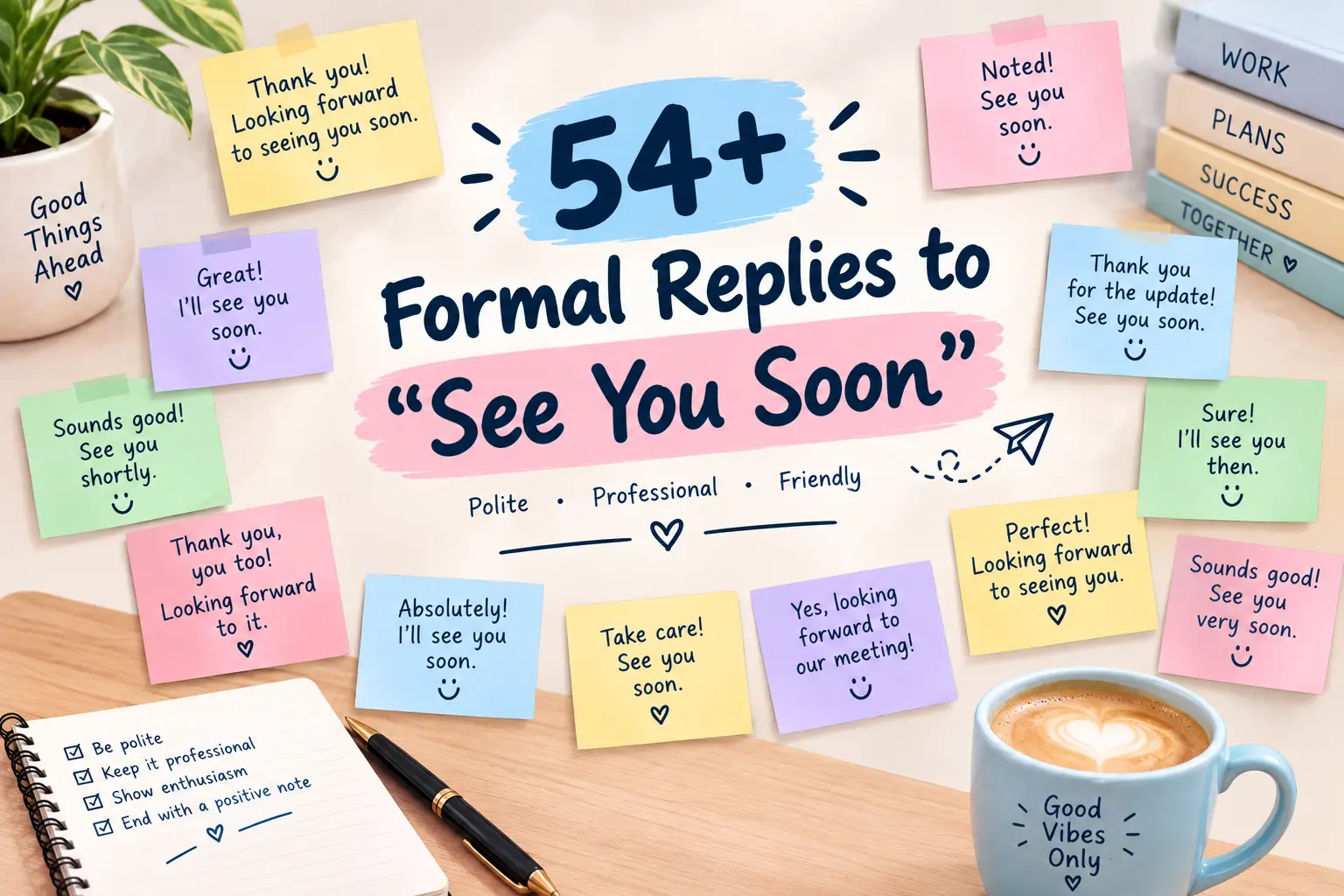
“See you soon” is a warm and friendly way to end a conversation. But in a professional setting, you may want a response that sounds more polished.
The right reply can show respect while still keeping the conversation warm. This is especially useful when speaking with a manager, client, teacher, colleague, interviewer, or professional contact.
A formal response does not have to sound cold or overly serious. Small changes in wording can make your message feel more thoughtful and appropriate.
Instead of always saying “See you soon,” you can choose an expression that matches the situation. You might want to sound professional, appreciative, warm, confident, or simply polite.
In this guide, you will find 54+ formal replies to “See you soon”. Each option includes its meaning, tone, example, and a quick explanation to help you choose the right response.
What Does “Formal Replies to See You Soon” Mean?
“See you soon” means that someone expects or hopes to meet you again in the near future.
It is commonly used when ending a conversation, meeting, appointment, or informal message.
For example:
“Thank you for meeting with me today. See you soon.”
The phrase has a positive and friendly tone. It suggests that the next meeting is expected and that the person looks forward to it.
In formal situations, you can respond with a more polished version. Your choice may depend on your relationship with the person and the setting.
When to Use It
Formal replies to “See you soon” are useful in many situations.
You can use them after a business meeting, interview, appointment, presentation, or professional event.
They also work well in emails and workplace messages.
For example:
“Thank you for your time. I look forward to seeing you again soon.”
You can also use a warmer response with a colleague:
“It was a pleasure speaking with you. I look forward to our next meeting.”
For a teacher, mentor, or professional contact, you might say:
“Thank you for your time. I look forward to speaking with you again.”
The key is to match your response to the level of formality.
Is It Polite or Professional?
“Yes, see you soon” is polite, but it is usually more casual than formal.
It works well with friends, classmates, familiar colleagues, and people you already know well.
In a formal setting, a slightly more polished response can sound better. Phrases such as “I look forward to seeing you again” or “I look forward to our next meeting” are professional and respectful.
You do not need to sound overly formal, though. The best response is one that feels natural for the situation.
54+ Other Ways to Say “See You Soon” Formally
1. I look forward to seeing you again.
Meaning: You are expressing that you expect and welcome another meeting.
Tone: Formal, warm, professional.
“Thank you for your time today. I look forward to seeing you again.”
Why to use it: This is one of the safest choices for professional conversations.
Purpose and Personalization: It works especially well after meetings, interviews, and appointments.
2. I look forward to our next meeting.
Meaning: You are showing that you expect another professional meeting.
Tone: Professional and confident.
“Thank you for the productive discussion. I look forward to our next meeting.”
Why to use it: It is ideal for business conversations.
Purpose and Personalization: Use it when another meeting has already been planned or is likely.
3. I look forward to speaking with you again.
Meaning: You are expressing interest in another conversation.
Tone: Formal and courteous.
“Thank you for your guidance. I look forward to speaking with you again.”
Why to use it: It works well when the next interaction may be a call or conversation.
Purpose and Personalization: It is useful for clients, mentors, teachers, and colleagues.
4. I look forward to our next conversation.
Meaning: You are welcoming another discussion.
Tone: Professional and warm.
“It was a pleasure discussing the project. I look forward to our next conversation.”
Why to use it: It sounds polished without being too stiff.
Purpose and Personalization: Great for professional emails and follow-ups.
5. I hope to see you again soon.
Meaning: You hope another meeting will happen soon.
Tone: Polite and warm.
“It was a pleasure meeting you. I hope to see you again soon.”
Why to use it: It adds warmth while remaining respectful.
Purpose and Personalization: Use it after conferences, networking events, or professional introductions.
6. I look forward to seeing you in the near future.
Meaning: You expect or hope to meet again soon.
Tone: Formal and polished.
“Thank you for meeting with me. I look forward to seeing you in the near future.”
Why to use it: It sounds more formal than the original phrase.
Purpose and Personalization: Best suited to formal correspondence.
7. Until our next meeting, I wish you well.
Meaning: You are ending the conversation politely while referring to your next meeting.
Tone: Formal and respectful.
“Thank you for your time today. Until our next meeting, I wish you well.”
Why to use it: It creates a courteous closing.
Purpose and Personalization: Suitable for formal emails and professional events.
8. I look forward to reconnecting with you.
Meaning: You hope to speak or meet again.
Tone: Professional and friendly.
“It was wonderful discussing the project. I look forward to reconnecting with you.”
Why to use it: It works particularly well when you have not spoken for some time.
Purpose and Personalization: A strong choice for networking and business relationships.
9. I look forward to meeting with you again.
Meaning: You expect another formal meeting.
Tone: Professional and direct.
“Thank you for the discussion. I look forward to meeting with you again.”
Why to use it: It clearly fits business communication.
Purpose and Personalization: Use it after interviews, consultations, or meetings.
10. I hope our paths cross again soon.
Meaning: You hope to meet the person again.
Tone: Warm, polished, and slightly personal.
“It was a pleasure meeting you. I hope our paths cross again soon.”
Why to use it: It sounds more thoughtful than a standard closing.
Purpose and Personalization: Great for networking events and professional introductions.
11. I look forward to continuing our discussion.
Meaning: You want to continue talking about the topic later.
Tone: Professional and purposeful.
“We covered several important points today. I look forward to continuing our discussion.”
Why to use it: It works well when a conversation is not finished.
Purpose and Personalization: Especially useful in business emails.
12. I look forward to further discussions.
Meaning: You welcome future conversations.
Tone: Formal and businesslike.
“Thank you for sharing your ideas. I look forward to further discussions.”
Why to use it: It is concise and professional.
Purpose and Personalization: Suitable for formal follow-up messages.
13. It will be a pleasure to see you again.
Meaning: You would be happy to meet the person again.
Tone: Warm and formal.
“Thank you for your time today. It will be a pleasure to see you again.”
Why to use it: It adds warmth without sounding too casual.
Purpose and Personalization: A good choice after a successful meeting.
14. I am looking forward to our next meeting.
Meaning: You are anticipating another meeting.
Tone: Professional and positive.
“The discussion was very helpful. I am looking forward to our next meeting.”
Why to use it: It sounds natural in workplace communication.
Purpose and Personalization: Works well in emails and direct messages.
15. I look forward to catching up with you soon.
Meaning: You hope to speak again and exchange updates.
Tone: Warm and professional.
“Thank you for the update. I look forward to catching up with you soon.”
Why to use it: It is less formal but still appropriate for familiar colleagues.
Purpose and Personalization: Best when you already know the person.
16. I hope to have the opportunity to meet again.
Meaning: You would welcome another meeting.
Tone: Formal and respectful.
“It was a pleasure speaking with you. I hope to have the opportunity to meet again.”
Why to use it: It sounds thoughtful and professional.
Purpose and Personalization: Useful when the next meeting is not yet confirmed.
17. I look forward to our next opportunity to connect.
Meaning: You hope to communicate again.
Tone: Professional and polished.
“Thank you for the valuable discussion. I look forward to our next opportunity to connect.”
Why to use it: It works even when the next interaction may be online.
Purpose and Personalization: Great for networking and business relationships.
18. I look forward to staying in touch.
Meaning: You want to maintain communication.
Tone: Professional and friendly.
“It was a pleasure meeting you. I look forward to staying in touch.”
Why to use it: It is useful when there is no specific future meeting.
Purpose and Personalization: Ideal after networking or professional introductions.
19. I hope we can meet again soon.
Meaning: You would like another meeting to happen soon.
Tone: Polite and warm.
“Thank you for the opportunity. I hope we can meet again soon.”
Why to use it: It sounds sincere without being overly formal.
Purpose and Personalization: Suitable for professional and semi-formal settings.
20. I look forward to seeing you at our next appointment.
Meaning: You expect to meet again at a scheduled appointment.
Tone: Formal and professional.
“Thank you for your time today. I look forward to seeing you at our next appointment.”
Why to use it: It fits appointments and scheduled meetings.
Purpose and Personalization: Replace “appointment” with the specific event when needed.
21. I look forward to our next engagement.
Meaning: You expect another professional interaction.
Tone: Formal and businesslike.
“Thank you for your cooperation. I look forward to our next engagement.”
Why to use it: It sounds polished in business settings.
Purpose and Personalization: Best for formal professional communication.
22. I look forward to future opportunities to work together.
Meaning: You hope to collaborate again.
Tone: Professional and positive.
“Thank you for the successful project. I look forward to future opportunities to work together.”
Why to use it: It ends a professional relationship on a positive note.
Purpose and Personalization: Excellent for clients, partners, and colleagues.
23. I hope we have the chance to meet again.
Meaning: You would like another opportunity to meet.
Tone: Warm and polite.
“It was wonderful speaking with you. I hope we have the chance to meet again.”
Why to use it: It sounds genuine without being too formal.
Purpose and Personalization: Good for networking situations.
24. I look forward to our continued communication.
Meaning: You want to keep communicating.
Tone: Formal and professional.
“Thank you for your assistance. I look forward to our continued communication.”
Why to use it: It works well in written correspondence.
Purpose and Personalization: Use it when regular communication is expected.
25. I look forward to speaking with you at our next appointment.
Meaning: You expect another conversation during a scheduled appointment.
Tone: Formal and courteous.
“Thank you for your time today. I look forward to speaking with you at our next appointment.”
Why to use it: It clearly confirms future communication.
Purpose and Personalization: Useful for professional services and consultations.
26. I look forward to our next opportunity to meet.
Meaning: You hope another meeting will take place.
Tone: Formal and warm.
“Thank you for joining us today. I look forward to our next opportunity to meet.”
Why to use it: It sounds polished and respectful.
Purpose and Personalization: Suitable for conferences and business events.
27. I hope to have the pleasure of seeing you again.
Meaning: You would be pleased to meet again.
Tone: Very formal and courteous.
“It was a pleasure meeting you. I hope to have the pleasure of seeing you again.”
Why to use it: It creates a gracious closing.
Purpose and Personalization: Best for formal introductions and special occasions.
28. Until we meet again, I wish you all the best.
Meaning: You are ending warmly while expecting another meeting.
Tone: Formal and thoughtful.
“Thank you for your support. Until we meet again, I wish you all the best.”
Why to use it: It combines professionalism with warmth.
Purpose and Personalization: Great for farewell messages and professional transitions.
29. I look forward to welcoming you again.
Meaning: You would be happy to receive or meet the person again.
Tone: Formal and hospitable.
“Thank you for visiting our office. I look forward to welcoming you again.”
Why to use it: It is especially useful when you are hosting someone.
Purpose and Personalization: Great for businesses, events, and professional hospitality.
30. I look forward to your next visit.
Meaning: You expect or welcome another visit.
Tone: Polite and professional.
“Thank you for stopping by. I look forward to your next visit.”
Why to use it: It works well for offices, organizations, and professional services.
Purpose and Personalization: Keep it warm by adding a short thank-you before the phrase.
31. I hope to welcome you again soon.
Meaning: You hope the person visits again.
Tone: Warm and professional.
“Thank you for attending the event. I hope to welcome you again soon.”
Why to use it: It sounds gracious and positive.
Purpose and Personalization: Useful for hosts, organizations, and event teams.
32. I look forward to our next interaction.
Meaning: You expect another conversation or meeting.
Tone: Formal and neutral.
“Thank you for your time. I look forward to our next interaction.”
Why to use it: It fits situations where the next contact may take different forms.
Purpose and Personalization: Suitable for formal business communication.
33. I look forward to continuing our work together.
Meaning: You want the professional relationship to continue.
Tone: Professional and collaborative.
“Thank you for your contribution. I look forward to continuing our work together.”
Why to use it: It ends a work conversation on a positive note.
Purpose and Personalization: Ideal for teams, clients, and business partners.
34. I look forward to collaborating again.
Meaning: You hope to work together in the future.
Tone: Professional and positive.
“It was a pleasure working with you. I look forward to collaborating again.”
Why to use it: It is concise and natural.
Purpose and Personalization: Great after completing a project.
35. I hope we have another opportunity to work together.
Meaning: You would welcome another professional project.
Tone: Formal and warm.
“Thank you for your excellent work. I hope we have another opportunity to work together.”
Why to use it: It shows appreciation and interest in future cooperation.
Purpose and Personalization: Excellent for clients and project partners.
36. I look forward to reconnecting at the next event.
Meaning: You expect to meet again at a future event.
Tone: Professional and friendly.
“It was great speaking with you today. I look forward to reconnecting at the next event.”
Why to use it: It feels natural at conferences and networking events.
Purpose and Personalization: Mention the event name for a more personal touch.
37. I look forward to our next discussion.
Meaning: You expect another conversation.
Tone: Formal and professional.
“Thank you for sharing your perspective. I look forward to our next discussion.”
Why to use it: It is short and polished.
Purpose and Personalization: Works well in emails and business meetings.
38. I appreciate the opportunity to connect and look forward to speaking again.
Meaning: You value the interaction and welcome another conversation.
Tone: Formal and appreciative.
“I appreciate the opportunity to connect and look forward to speaking again.”
Why to use it: It combines gratitude with a positive closing.
Purpose and Personalization: Excellent for networking emails.
39. It was a pleasure speaking with you. I look forward to our next conversation.
Meaning: You enjoyed the discussion and expect another one.
Tone: Formal and warm.
“It was a pleasure speaking with you. I look forward to our next conversation.”
Why to use it: It provides a complete and polished closing.
Purpose and Personalization: Ideal after interviews, meetings, and calls.
40. Thank you for your time. I look forward to seeing you again.
Meaning: You appreciate their time and expect another meeting.
Tone: Professional and respectful.
“Thank you for your time today. I look forward to seeing you again.”
Why to use it: It is a safe choice for almost any formal situation.
Purpose and Personalization: Add the person’s name or meeting topic when appropriate.
41. It was a pleasure meeting with you. I look forward to our next meeting.
Meaning: You enjoyed the meeting and expect another one.
Tone: Formal and professional.
“It was a pleasure meeting with you. I look forward to our next meeting.”
Why to use it: It sounds polished without feeling distant.
Purpose and Personalization: Great for clients, managers, and professional contacts.
42. I look forward to continuing our partnership.
Meaning: You want the professional relationship to continue.
Tone: Formal and business-focused.
“Thank you for your continued support. I look forward to continuing our partnership.”
Why to use it: It is ideal for business relationships.
Purpose and Personalization: Best when working with a client, supplier, or partner.
43. I look forward to staying connected.
Meaning: You want to maintain the relationship.
Tone: Professional and friendly.
“It was a pleasure meeting you. I look forward to staying connected.”
Why to use it: It is less formal than “continued communication” but still polished.
Purpose and Personalization: Perfect for networking.
44. I hope to speak with you again in the near future.
Meaning: You hope to have another conversation soon.
Tone: Formal and courteous.
“Thank you for your insights. I hope to speak with you again in the near future.”
Why to use it: It sounds respectful and thoughtful.
Purpose and Personalization: Useful when no exact date has been arranged.
45. I look forward to our next opportunity to collaborate.
Meaning: You hope to work together again.
Tone: Professional and optimistic.
“Thank you for your contribution. I look forward to our next opportunity to collaborate.”
Why to use it: It focuses on future teamwork.
Purpose and Personalization: Strong for project-based relationships.
46. I look forward to welcoming you back.
Meaning: You would be pleased to see the person return.
Tone: Warm and professional.
“Thank you for visiting our office. I look forward to welcoming you back.”
Why to use it: It sounds friendly while remaining formal.
Purpose and Personalization: Best for hosts, offices, and professional services.
47. I hope to see you at our next gathering.
Meaning: You hope the person attends a future event.
Tone: Polite and warm.
“Thank you for joining us today. I hope to see you at our next gathering.”
Why to use it: It works well for events and organizations.
Purpose and Personalization: Mention the event when known.
48. I look forward to our next opportunity to speak.
Meaning: You expect another conversation.
Tone: Formal and courteous.
“Thank you for your thoughtful response. I look forward to our next opportunity to speak.”
Why to use it: It is suitable for professional correspondence.
Purpose and Personalization: Useful when you do not know when the next conversation will happen.
49. I look forward to hearing from you again.
Meaning: You hope the person contacts you again.
Tone: Professional and polite.
“Thank you for your message. I look forward to hearing from you again.”
Why to use it: It is especially useful when the next contact will be by email or phone.
Purpose and Personalization: Great for clients, recruiters, and business contacts.
50. I hope we can reconnect soon.
Meaning: You would like to communicate again soon.
Tone: Warm and professional.
“It was a pleasure speaking with you. I hope we can reconnect soon.”
Why to use it: It sounds natural without being overly formal.
Purpose and Personalization: Excellent for networking and former colleagues.
51. I look forward to meeting again at a future opportunity.
Meaning: You hope to meet again when the opportunity arises.
Tone: Formal and polished.
“Thank you for the conversation. I look forward to meeting again at a future opportunity.”
Why to use it: It works when no specific meeting has been planned.
Purpose and Personalization: Useful for formal networking situations.
52. I look forward to seeing you at our next scheduled meeting.
Meaning: You expect to meet at a planned meeting.
Tone: Formal and precise.
“Thank you for your time. I look forward to seeing you at our next scheduled meeting.”
Why to use it: It clearly refers to an arranged meeting.
Purpose and Personalization: Ideal for workplace communication.
53. Until our next meeting, thank you again for your time.
Meaning: You are politely closing the conversation while referring to the next meeting.
Tone: Formal and appreciative.
“Until our next meeting, thank you again for your time and support.”
Why to use it: It combines appreciation with a professional closing.
Purpose and Personalization: Great for formal emails.
54. I look forward to seeing you again at the earliest opportunity.
Meaning: You hope to meet again as soon as a suitable opportunity arises.
Tone: Very formal and professional.
“Thank you for your valuable input. I look forward to seeing you again at the earliest opportunity.”
Why to use it: It is suitable for highly formal correspondence.
Purpose and Personalization: Use it when a formal tone is more appropriate than a casual one.
55. I look forward to our paths crossing again.
Meaning: You hope to meet the person again in the future.
Tone: Warm, polished, and thoughtful.
“It was a pleasure meeting you. I look forward to our paths crossing again.”
Why to use it: It feels personal while remaining professional.
Purpose and Personalization: A strong option for networking and professional events.
56. Until we meet again, I wish you continued success.
Meaning: You are ending the conversation while wishing the person well.
Tone: Formal, respectful, and positive.
“Thank you for your time and support. Until we meet again, I wish you continued success.”
Why to use it: It creates a thoughtful and memorable closing.
Purpose and Personalization: Especially useful for professional farewells and business relationships.
Conclusion
A good response to “See you soon” can be more than a simple goodbye. The right words can show respect, appreciation, and genuine interest in staying connected.
For formal situations, phrases such as “I look forward to seeing you again” and “I look forward to our next meeting” are safe and professional choices.
For warmer situations, you can choose expressions such as “I hope our paths cross again soon.”
The key is to match your words to the person and setting. Try different expressions and choose the one that feels natural. A thoughtful closing can leave a strong final impression.
Discover more