
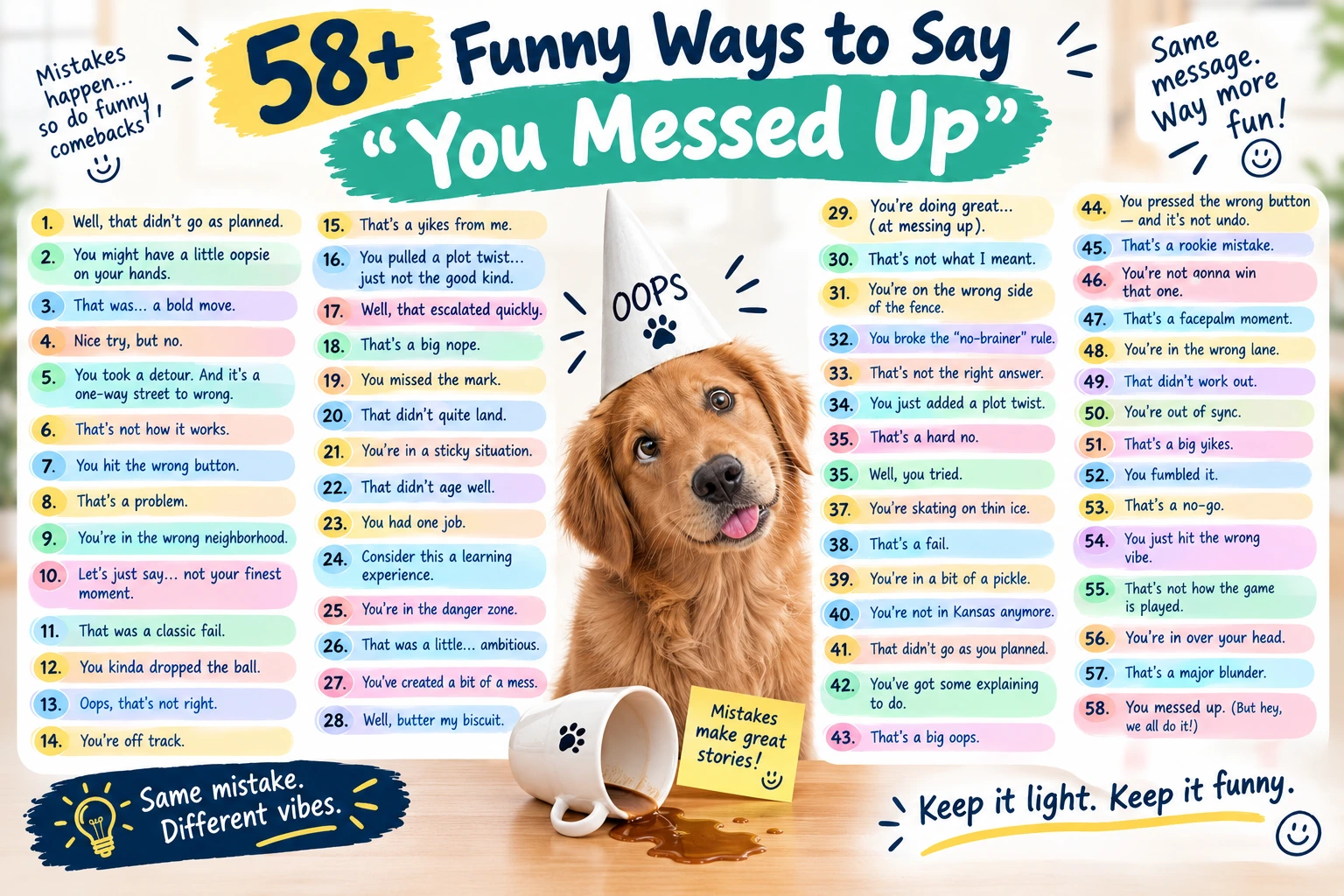
Everyone makes mistakes, but admitting one doesn’t always have to feel awkward. Sometimes, the best way to handle a small blunder is to laugh at yourself and move on. Instead of simply saying “I messed up,” you can use a funny, clever, or playful expression that acknowledges the mistake without making the situation unnecessarily serious.
Funny alternatives can make conversations more relaxed, especially when the mistake is harmless and everyone involved has a sense of humor. They can also add personality to texts, conversations, social posts, and casual workplace interactions. From “I took a scenic route to failure” to “Well, that could have gone better,” there are countless creative ways to admit that something didn’t go according to plan.
In this guide, you’ll discover 58+ funny ways to say you messed up, along with their meanings, tones, examples, and practical situations where each expression works best.
Section 1: What Does “You Messed Up” Mean?
“You messed up” means that someone made a mistake, made an error in judgment, or handled something incorrectly.
For example:
“I messed up the schedule and accidentally put the meeting on the wrong day.”
The phrase is usually casual and direct. Depending on how it is delivered, it can sound serious, apologetic, humorous, or even self-deprecating.
When you’re talking about your own mistake, funny alternatives can make the admission feel lighter:
“Apparently, I chose chaos today.”
“Well, that was not my finest moment.”
“I have successfully complicated something simple.”
These expressions work best when the mistake isn’t serious and humor won’t minimize someone else’s feelings.
Section 2: When to Use Funny Ways to Say You Messed Up
Funny expressions are most appropriate when the situation is relatively harmless and the people involved appreciate humor.
1. Casual Conversations
You can use them with friends, siblings, classmates, or people you know well.
Example:
“I completely forgot your birthday. My brain has officially resigned.”
2. Text Messages
Humorous phrases work especially well in texts because they make apologies or admissions feel less stiff.
Example:
“Welp. I have made a tiny administrative disaster.”
3. Social Media Captions
A funny phrase can turn a harmless mistake into an entertaining caption.
Example:
“Proof that confidence and competence are not always roommates.”
4. Group Chats
If you made a small mistake in a group project or conversation, humor can make the admission less awkward.
Example:
“Guys, I may have taken us in the completely wrong direction.”
5. Casual Workplace Conversations
Some playful expressions can work among coworkers who have a relaxed relationship.
Example:
“I may have accidentally created a problem where none existed.”
However, avoid joking when the mistake has serious consequences or involves someone who may be upset.
6. Everyday Situations
Forgot the keys? Sent the wrong message? Misread the instructions? A lighthearted expression can make the moment less uncomfortable.
Example:
“Apparently, reading instructions was not on today’s schedule.”
Section 3: Is “You Messed Up” Polite or Professional?
“You messed up” is generally casual rather than formal or professional.
It can be perfectly acceptable among friends or in relaxed conversations, but it may sound too blunt in a professional environment.
Instead of saying:
“I messed up the report.”
A more professional version might be:
“I noticed an error in the report, and I’ll correct it.”
If the workplace culture is relaxed, a small joke can sometimes be appropriate:
“I appear to have given the spreadsheet a little too much creative freedom.”
The key is context. Humor should never replace accountability, especially when the mistake affects other people.
Funny and Playful Alternatives
1. Well, That Went Brilliantly
Meaning: You are jokingly saying that something went badly.
Tone: Sarcastic, playful.
Example Sentence: “I deleted the wrong file. Well, that went brilliantly.”
Short Explanation:
This sarcastic phrase works when the outcome is clearly the opposite of brilliant.
Purpose and Personalization:
Great for friends or casual conversations where everyone understands the joke.
2. Oops, I Did a Thing
Meaning: You made a mistake or caused an unexpected problem.
Tone: Playful, casual.
Example Sentence: “Oops, I did a thing. The settings are completely different now.”
Short Explanation:
The deliberately vague wording makes the mistake sound humorous.
Purpose and Personalization:
Perfect for texts and group chats.
3. I May Have Made a Slight Error
Meaning: You made a mistake, but you’re dramatically understating it.
Tone: Dry, sarcastic.
Example Sentence: “I may have made a slight error by sending the email to the entire class.”
Short Explanation:
The humor comes from calling an obvious blunder a “slight error.”
Purpose and Personalization:
Use it when the mistake is noticeable but harmless.
4. That Was Not My Finest Moment
Meaning: You acknowledge that you didn’t handle something particularly well.
Tone: Self-deprecating, lighthearted.
Example Sentence: “I walked into the wrong classroom. That was not my finest moment.”
Short Explanation:
It admits the mistake without being overly dramatic.
Purpose and Personalization:
A versatile option for everyday situations.
5. I Took the Scenic Route to Failure
Meaning: You made a complicated series of mistakes before reaching the wrong result.
Tone: Clever, humorous.
Example Sentence: “It took me three attempts to fix it. I really took the scenic route to failure.”
Short Explanation:
The phrase humorously compares making mistakes to taking an unnecessarily long journey.
Purpose and Personalization:
Excellent when the mistake involved several unnecessary steps.
6. Well, That Could Have Gone Better
Meaning: The situation didn’t go as planned.
Tone: Dry, understated.
Example Sentence: “I forgot the presentation file. Well, that could have gone better.”
Short Explanation:
Its understatement makes it naturally funny.
Purpose and Personalization:
Useful when you want humor without sounding too dramatic.
7. I Have Questions for My Past Self
Meaning: You made a decision that you now regret or don’t understand.
Tone: Witty, reflective.
Example Sentence: “Why did I rename every file manually? I have questions for my past self.”
Short Explanation:
It turns your mistake into a humorous conversation with your earlier self.
Purpose and Personalization:
Great for everyday mistakes and funny posts.
8. I Chose Chaos
Meaning: Your actions unintentionally created confusion or trouble.
Tone: Playful, dramatic.
Example Sentence: “I clicked one button and changed everything. Apparently, I chose chaos.”
Short Explanation:
This makes a small mistake sound intentionally dramatic.
Purpose and Personalization:
Works especially well in casual chats.
9. I Have Made a Tiny Disaster
Meaning: You caused a problem, usually a relatively harmless one.
Tone: Dramatic, funny.
Example Sentence: “I mixed up all the labels. I have made a tiny disaster.”
Short Explanation:
Calling a minor mistake a “tiny disaster” adds comic exaggeration.
Purpose and Personalization:
Use it when the situation is fixable.
10. I Apparently Forgot How Things Work
Meaning: You made a basic mistake that you normally wouldn’t make.
Tone: Self-deprecating.
Example Sentence: “I put the batteries in backward. Apparently, I forgot how things work.”
Short Explanation:
It pokes fun at your own temporary confusion.
Purpose and Personalization:
Good for harmless everyday blunders.
11. My Brain Took the Day Off
Meaning: You weren’t thinking clearly when you made the mistake.
Tone: Casual, humorous.
Example Sentence: “I completely missed the obvious answer. My brain took the day off.”
Short Explanation:
It humorously separates the mistake from your usual abilities.
Purpose and Personalization:
Useful for minor mental slips.
12. I Have Entered My Mistake Era
Meaning: You’re joking that you’ve started making a series of mistakes.
Tone: Trendy, playful.
Example Sentence: “First I lost my notes, then I forgot the deadline. I’ve entered my mistake era.”
Short Explanation:
The exaggerated “era” framing makes ordinary mistakes sound entertaining.
Purpose and Personalization:
Great for casual texts and social captions.
13. I Fumbled That One
Meaning: You failed to handle a situation successfully.
Tone: Casual, humorous.
Example Sentence: “I had the perfect answer and forgot it. I fumbled that one.”
Short Explanation:
A short and natural way to admit a minor mistake.
Purpose and Personalization:
Especially suitable for conversations with friends.
14. I Dropped the Ball
Meaning: You failed to complete something or missed an important detail.
Tone: Casual, idiomatic.
Example Sentence: “I forgot to send the attachment. I definitely dropped the ball.”
Short Explanation:
This common expression clearly communicates responsibility.
Purpose and Personalization:
It can work in both casual and moderately professional conversations.
15. I Went Full Amateur
Meaning: You made a surprisingly basic mistake.
Tone: Self-deprecating, playful.
Example Sentence: “I forgot to save the document. I went full amateur.”
Short Explanation:
The phrase exaggerates the mistake for comic effect.
Purpose and Personalization:
Best when you’re comfortable making fun of your own error.
Clever and Sarcastic Alternatives
16. I Have Successfully Made Things Worse
Meaning: Your attempt to help or fix something accidentally made it worse.
Tone: Sarcastic, humorous.
Example Sentence: “I tried to organize the files and now nobody can find anything. I have successfully made things worse.”
Short Explanation:
The formal-sounding wording makes the failure funnier.
Purpose and Personalization:
Great for harmless workplace or group-project mistakes.
17. Mission: Accomplished. Unfortunately
Meaning: You completed something, but the result was bad.
Tone: Sarcastic.
Example Sentence: “I finished reorganizing the folder. Mission: accomplished. Unfortunately.”
Short Explanation:
The contradiction creates the humor.
Purpose and Personalization:
Ideal for situations where your goal technically happened but the result wasn’t useful.
18. I Understood the Assignment Incorrectly
Meaning: You misunderstood what you were supposed to do.
Tone: Witty, casual.
Example Sentence: “Everyone made a presentation, and I made a poster. I understood the assignment incorrectly.”
Short Explanation:
A playful way to admit you interpreted instructions differently.
Purpose and Personalization:
Useful for school, group projects, and casual conversations.
19. I Have Created an Unscheduled Plot Twist
Meaning: Your mistake unexpectedly changed the situation.
Tone: Creative, humorous.
Example Sentence: “The meeting was supposed to be online, and I showed up in person. I created an unscheduled plot twist.”
Short Explanation:
It turns an awkward mistake into a funny story.
Purpose and Personalization:
Great for harmless surprises.
20. I Made a Boldly Incorrect Decision
Meaning: You confidently made the wrong choice.
Tone: Sarcastic, clever.
Example Sentence: “I chose the wrong deadline from the calendar. A boldly incorrect decision.”
Short Explanation:
The word “boldly” exaggerates your confidence in the wrong choice.
Purpose and Personalization:
Perfect for self-deprecating humor.
21. I Have Been Defeated by Basic Instructions
Meaning: You couldn’t follow simple instructions correctly.
Tone: Dry, humorous.
Example Sentence: “The instructions had three steps. I completed approximately none of them correctly.”
Short Explanation:
The contrast between simple instructions and your failure creates the joke.
Purpose and Personalization:
Good for harmless mistakes.
22. I Made a Strategic Miscalculation
Meaning: You made a mistake in judgment.
Tone: Formal-sounding, sarcastic.
Example Sentence: “I thought I could finish everything in ten minutes. A strategic miscalculation.”
Short Explanation:
The serious vocabulary makes an ordinary mistake sound hilariously important.
Purpose and Personalization:
Excellent for playful workplace conversations.
23. My Master Plan Has Encountered Difficulties
Meaning: Your plan didn’t work.
Tone: Dramatic, witty.
Example Sentence: “I planned to finish early, but I forgot half the materials. My master plan has encountered difficulties.”
Short Explanation:
The grand wording contrasts with the simple mistake.
Purpose and Personalization:
Use it when the failure is minor and funny.
24. I Have Outplayed Myself
Meaning: Your own actions caused your problem.
Tone: Clever, humorous.
Example Sentence: “I locked myself out because I left my keys inside. I have outplayed myself.”
Short Explanation:
It suggests you accidentally defeated yourself.
Purpose and Personalization:
Perfect for ironic mistakes.
25. I Accidentally Chose the Wrong Timeline
Meaning: You made a decision that led things in the wrong direction.
Tone: Absurd, playful.
Example Sentence: “I sent the draft before finishing it. Apparently, I chose the wrong timeline.”
Short Explanation:
The exaggerated idea of alternate timelines makes the mistake sound ridiculous.
Purpose and Personalization:
Best for friends and informal conversations.
Dramatic and Exaggerated Alternatives
26. The Situation Has Escaped My Control
Meaning: Something went wrong unexpectedly.
Tone: Dramatic, humorous.
Example Sentence: “I started reorganizing my desk and somehow made it messier. The situation has escaped my control.”
Short Explanation:
The overly dramatic wording makes a small problem funny.
Purpose and Personalization:
Great for harmless chaos.
27. I Have Unlocked a New Level of Confusion
Meaning: You managed to make a situation even more confusing.
Tone: Playful, dramatic.
Example Sentence: “I tried to explain the problem and somehow made it more confusing. I’ve unlocked a new level of confusion.”
Short Explanation:
It frames confusion like an achievement in a game.
Purpose and Personalization:
Perfect for conversations with friends or classmates.
28. Well, I Certainly Made an Entrance
Meaning: You made a noticeable mistake when starting something.
Tone: Sarcastic, playful.
Example Sentence: “I joined the meeting and immediately called the wrong person by name. Well, I certainly made an entrance.”
Short Explanation:
It turns an embarrassing moment into a funny observation.
Purpose and Personalization:
Useful for social or professional mishaps.
29. I Have Become the Problem
Meaning: You recognize that your own actions caused the issue.
Tone: Self-aware, humorous.
Example Sentence: “I spent twenty minutes looking for my phone while holding it. I have become the problem.”
Short Explanation:
This is funny because it acknowledges your own role directly.
Purpose and Personalization:
Great for relatable everyday mistakes.
30. Everything Was Fine Until I Arrived
Meaning: You’re joking that your involvement caused the problem.
Tone: Self-deprecating, dramatic.
Example Sentence: “The printer worked perfectly until I tried using it. Everything was fine until I arrived.”
Short Explanation:
It humorously exaggerates your impact on the situation.
Purpose and Personalization:
Best for harmless technical or everyday mishaps.
31. I Have Disturbed the Natural Order of Things
Meaning: You accidentally disrupted something that was working normally.
Tone: Dramatic, absurd.
Example Sentence: “I rearranged the folders and now nobody knows where anything is. I have disturbed the natural order of things.”
Short Explanation:
The grand language makes a minor mistake sound epic.
Purpose and Personalization:
Ideal for playful situations.
32. The Universe Has Witnessed My Mistake
Meaning: You made a mistake that feels particularly embarrassing.
Tone: Dramatic, humorous.
Example Sentence: “I waved back at someone who wasn’t waving at me. The universe has witnessed my mistake.”
Short Explanation:
The exaggeration makes an awkward moment easier to laugh about.
Purpose and Personalization:
Perfect for social mishaps.
33. I Have Made History for All the Wrong Reasons
Meaning: You made an unusually memorable mistake.
Tone: Dramatic, sarcastic.
Example Sentence: “I somehow submitted the blank document. I’ve made history for all the wrong reasons.”
Short Explanation:
It humorously exaggerates the significance of the mistake.
Purpose and Personalization:
Use it when telling a funny story afterward.
34. I Have Discovered a New Method of Doing It Wrong
Meaning: You made a mistake in an unusual way.
Tone: Witty, self-deprecating.
Example Sentence: “Everyone else finished the setup in five minutes. I’ve discovered a new method of doing it wrong.”
Short Explanation:
The wording makes failure sound like an innovation.
Purpose and Personalization:
Great for playful self-commentary.
35. This Was a Bold Experiment in Failure
Meaning: Your attempt didn’t work at all.
Tone: Sarcastic, clever.
Example Sentence: “I tried fixing the formatting and somehow broke every heading. This was a bold experiment in failure.”
Short Explanation:
It reframes a mistake as an imaginary scientific experiment.
Purpose and Personalization:
Excellent for harmless creative or technical mistakes.
Short and Funny Ways to Admit a Mistake
36. Oops. My Bad.
Meaning: You acknowledge a small mistake.
Tone: Casual, friendly.
Example Sentence: “Oops, my bad. I sent you the old version.”
Short Explanation:
Simple, natural, and immediately understandable.
Purpose and Personalization:
Best for quick conversations.
37. Welp, I Messed That Up
Meaning: You admit that something went wrong.
Tone: Casual, humorous.
Example Sentence: “Welp, I messed that up. Let me try again.”
Short Explanation:
“Welp” gives the admission a relaxed, humorous feel.
Purpose and Personalization:
Perfect for texts and informal chats.
38. Oopsie, That Was Me
Meaning: You admit responsibility for a mistake.
Tone: Playful, light.
Example Sentence: “Oopsie, that was me. I moved the file.”
Short Explanation:
The playful wording softens a small admission.
Purpose and Personalization:
Use it only when the situation is genuinely minor.
39. Yeah… That One’s on Me
Meaning: You accept responsibility for the mistake.
Tone: Casual, accountable.
Example Sentence: “Yeah, that one’s on me. I misunderstood the instructions.”
Short Explanation:
It combines accountability with a relaxed tone.
Purpose and Personalization:
A useful option when you want humor without avoiding responsibility.
40. I Did a Little Oops
Meaning: You made a small mistake.
Tone: Playful, informal.
Example Sentence: “I did a little oops and accidentally closed the document.”
Short Explanation:
The intentionally childish phrasing makes the admission playful.
Purpose and Personalization:
Best for casual conversations.
41. Oops, That Wasn’t the Plan
Meaning: Something happened differently from what you intended.
Tone: Lighthearted.
Example Sentence: “I ordered the wrong size. Oops, that wasn’t the plan.”
Short Explanation:
A simple way to acknowledge an unexpected outcome.
Purpose and Personalization:
Works in everyday conversations.
42. Well, I Tried
Meaning: Your attempt wasn’t successful.
Tone: Dry, humorous.
Example Sentence: “I tried fixing the printer. Well, I tried.”
Short Explanation:
The phrase humorously accepts defeat.
Purpose and Personalization:
Good for low-stakes failures.
43. Consider That a Learning Experience
Meaning: You made a mistake but can learn from it.
Tone: Positive, witty.
Example Sentence: “I forgot to save the file. Consider that a learning experience.”
Short Explanation:
It turns a mistake into a constructive lesson.
Purpose and Personalization:
Useful when you want humor with a positive message.
44. I’ll Pretend That Didn’t Happen
Meaning: You jokingly acknowledge an embarrassing mistake.
Tone: Playful, self-deprecating.
Example Sentence: “I just called my teacher ‘Mom.’ I’ll pretend that didn’t happen.”
Short Explanation:
It works well for harmless embarrassing moments.
Purpose and Personalization:
Best with people who understand your humor.
Modern, Witty, and Creative Alternatives
45. My Confidence Exceeded My Accuracy
Meaning: You were more confident than correct.
Tone: Clever, self-aware.
Example Sentence: “I confidently gave everyone the wrong room number. My confidence exceeded my accuracy.”
Short Explanation:
A polished way to joke about being confidently wrong.
Purpose and Personalization:
Excellent for academic or workplace humor.
46. I Was Operating Without Adult Supervision
Meaning: You made a questionable decision without thinking it through.
Tone: Playful, sarcastic.
Example Sentence: “I bought five notebooks when I already had twelve. I was operating without adult supervision.”
Short Explanation:
The phrase humorously suggests you needed someone to supervise your decision.
Purpose and Personalization:
Great for harmless personal decisions.
47. My Decision-Making Department Is Under Review
Meaning: You made a poor decision.
Tone: Corporate satire, humorous.
Example Sentence: “I forgot the appointment again. My decision-making department is under review.”
Short Explanation:
It turns your brain into a fictional organization.
Purpose and Personalization:
Ideal for workplace-style humor.
48. I’d Like to File a Complaint Against Myself
Meaning: You are unhappy with your own decision.
Tone: Witty, dramatic.
Example Sentence: “I sent the message to the wrong group. I’d like to file a complaint against myself.”
Short Explanation:
It humorously treats your mistake as something deserving an official complaint.
Purpose and Personalization:
Perfect for embarrassing but harmless mistakes.
49. My Internal Quality Control Failed
Meaning: You failed to catch your own mistake.
Tone: Clever, professional humor.
Example Sentence: “I submitted the document with a typo in the title. My internal quality control failed.”
Short Explanation:
This gives a corporate spin to an ordinary mistake.
Purpose and Personalization:
Works particularly well among coworkers.
50. I Have Been Betrayed by My Own Judgment
Meaning: You made a poor decision.
Tone: Dramatic, humorous.
Example Sentence: “I thought I could remember the deadline without writing it down. I’ve been betrayed by my own judgment.”
Short Explanation:
The dramatic wording makes the mistake sound like a personal betrayal.
Purpose and Personalization:
Great for self-deprecating humor.
51. My Brain Has Submitted Its Resignation
Meaning: You temporarily failed to think clearly.
Tone: Dramatic, playful.
Example Sentence: “I read the same sentence five times and still missed the point. My brain has submitted its resignation.”
Short Explanation:
A funny way to describe temporary confusion.
Purpose and Personalization:
Use it for harmless mental slips.
52. I Have Officially Complicated a Simple Task
Meaning: You made something unnecessarily difficult.
Tone: Self-aware, humorous.
Example Sentence: “It should have taken five minutes, but I somehow spent an hour on it. I’ve officially complicated a simple task.”
Short Explanation:
It acknowledges inefficiency in a lighthearted way.
Purpose and Personalization:
Excellent for relatable everyday mistakes.
53. I Turned a Minor Problem Into a Side Quest
Meaning: You made a simple problem much more complicated.
Tone: Playful, modern.
Example Sentence: “I only needed to change one setting, but now I’m troubleshooting everything. I turned a minor problem into a side quest.”
Short Explanation:
The gaming reference makes the situation sound amusing rather than frustrating.
Purpose and Personalization:
Great for casual conversations and group chats.
54. I Accidentally Added Character to the Situation
Meaning: You made an unexpected mistake that changed things.
Tone: Clever, positive.
Example Sentence: “I used the wrong font on every slide. I accidentally added character to the presentation.”
Short Explanation:
It humorously reframes a mistake as creativity.
Purpose and Personalization:
Best when the mistake is harmless and easily fixed.
55. That Was an Unplanned Demonstration of What Not to Do
Meaning: Your mistake accidentally showed others what they shouldn’t do.
Tone: Sarcastic, witty.
Example Sentence: “I clicked the wrong option and reset everything. That was an unplanned demonstration of what not to do.”
Short Explanation:
It turns failure into an imaginary educational demonstration.
Purpose and Personalization:
Useful when you’re comfortable laughing at your own mistake.
56. I Have Provided a Valuable Lesson Through Personal Experience
Meaning: You learned from making a mistake.
Tone: Dry, sarcastic.
Example Sentence: “I forgot the backup, so now I know exactly why backups matter. I’ve provided a valuable lesson through personal experience.”
Short Explanation:
The overly formal wording creates the humor.
Purpose and Personalization:
Works especially well for self-deprecating storytelling.
57. Apparently, I’m the Plot Twist
Meaning: Your actions unexpectedly changed the situation.
Tone: Playful, dramatic.
Example Sentence: “Everyone had the correct schedule except me. Apparently, I’m the plot twist.”
Short Explanation:
A funny way to acknowledge that your mistake became the unexpected event.
Purpose and Personalization:
Great for group chats and casual conversations.
58. I Have Made Decisions
Meaning: You made questionable choices without directly admitting they were bad.
Tone: Dry, sarcastic.
Example Sentence: “I bought the wrong supplies again. I have made decisions.”
Short Explanation:
The vague wording makes it funny because everyone knows what it really means.
Purpose and Personalization:
Perfect for understated humor.
59. The Evidence Suggests I Was Wrong
Meaning: The situation clearly proves that your decision was incorrect.
Tone: Dry, clever.
Example Sentence: “The result is completely different from what I expected. The evidence suggests I was wrong.”
Short Explanation:
It sounds like a serious investigation into an obvious mistake.
Purpose and Personalization:
Great for witty conversations.
60. I Have Learned Absolutely Nothing—Yet
Meaning: You jokingly suggest that you might repeat the mistake.
Tone: Sarcastic, playful.
Example Sentence: “I forgot my charger again. I have learned absolutely nothing—yet.”
Short Explanation:
The “yet” adds a humorous suggestion that improvement is still possible.
Purpose and Personalization:
Use it for recurring but harmless mistakes.
61. Well, That’s Going in the Personal History Books
Meaning: You made a memorable mistake.
Tone: Dramatic, humorous.
Example Sentence: “I walked into the wrong meeting and stayed for ten minutes. That’s going in the personal history books.”
Short Explanation:
It exaggerates the importance of an embarrassing moment.
Purpose and Personalization:
Great for telling funny stories later.
62. I’d Like to Blame the Software, but It Was Me
Meaning: You accept responsibility instead of blaming technology.
Tone: Self-aware, witty.
Example Sentence: “I entered the wrong information. I’d like to blame the software, but it was me.”
Short Explanation:
The fake excuse followed by accountability creates the humor.
Purpose and Personalization:
Excellent for workplace or technical situations.
How to Choose the Right Funny Expression
Not every funny phrase works in every situation. The best choice depends on how serious the mistake is, who you’re talking to, and whether humor is appropriate.
For a small everyday mistake, try:
- “Oops, my bad.”
- “Welp, I messed that up.”
- “That was not my finest moment.”
- “Well, I tried.”
For dry humor, choose:
- “The evidence suggests I was wrong.”
- “Mission: accomplished. Unfortunately.”
- “My confidence exceeded my accuracy.”
- “I have made decisions.”
For dramatic humor, try:
- “I chose chaos.”
- “I have disturbed the natural order of things.”
- “My master plan has encountered difficulties.”
- “I have become the problem.”
For workplace-friendly humor, consider:
- “I made a strategic miscalculation.”
- “My internal quality control failed.”
- “I’d like to blame the software, but it was me.”
- “I have officially complicated a simple task.”
The funniest response is usually the one that fits your personality and doesn’t make light of someone else’s frustration.
Common Mistakes to Avoid
1. Joking About Serious Mistakes
If your mistake caused significant harm, loss, or stress, don’t rely on humor to avoid accountability.
A sincere apology is more appropriate.
2. Blaming Someone Else
Funny self-deprecating humor works best when you’re willing to own your mistake.
3. Overdoing the Joke
One clever line is usually enough. Too much humor can make a simple situation feel even more awkward.
4. Using Humor With the Wrong Audience
A joke that works with your best friend might not work with your teacher, manager, client, or someone you barely know.
5. Making Someone Else the Punchline
If you’re admitting your own mistake, make yourself the subject of the joke rather than embarrassing another person.
Pro Tips for Making Your Mistakes Sound Funny
Use exaggeration.
Turning a tiny mistake into an imaginary “international crisis” can create harmless humor.
Try understatement.
Saying “That could have gone better” after an obvious blunder can be funnier than making a huge joke.
Make yourself the punchline.
Self-aware humor usually feels more friendly than blaming someone else.
Keep accountability intact.
A funny phrase can acknowledge the mistake, but it shouldn’t replace fixing it.
Match the audience.
Always consider whether the other person is in the mood for humor.
Know when to be serious.
If someone has genuinely been affected by your mistake, prioritize a sincere apology over a clever line.
Conclusion
Knowing funny ways to say “you messed up” can make harmless mistakes feel much easier to admit. Clever expressions such as “I chose chaos,” “My confidence exceeded my accuracy,” or “I have successfully made things worse” add personality while acknowledging what happened. The key is to use humor thoughtfully and choose expressions that match the situation. When the mistake is minor, a playful response can turn an awkward moment into a memorable one. Experiment with different styles, from dry sarcasm to dramatic exaggeration, while remembering that genuine accountability should always come first.
Discover more