
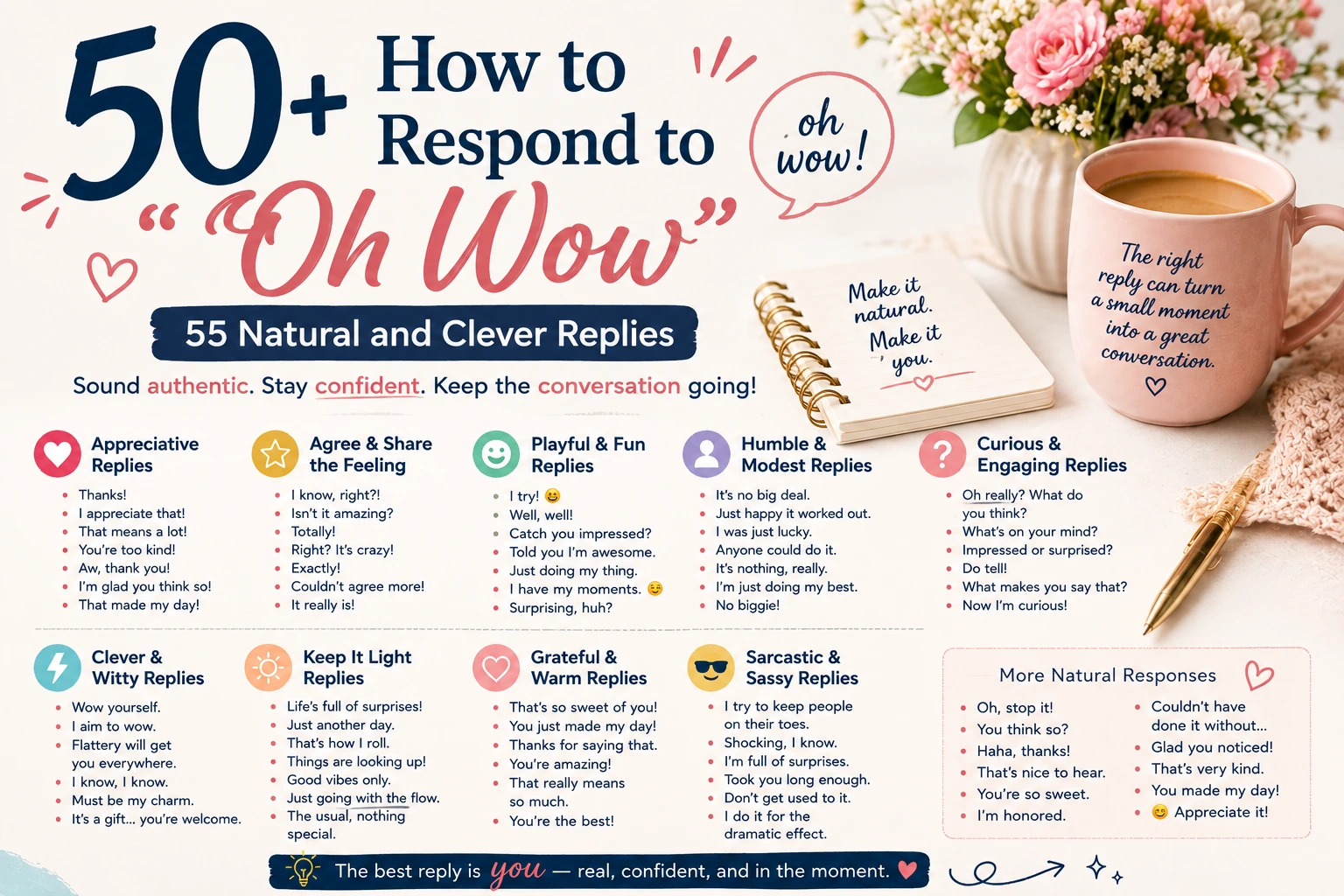
Someone says “Oh wow,” and suddenly you are wondering what to say next. Is it excitement? Surprise? Genuine admiration? Or are they simply caught off guard? The short phrase can carry very different meanings depending on the conversation and the person’s tone.
Knowing how to respond to “oh wow” can help you keep a conversation moving instead of replying with another awkward “yeah” or “haha.” A thoughtful response can make you sound confident, friendly, funny, professional, or genuinely interested.
The best response depends on what caused their reaction. If they are impressed, you can acknowledge it. If they are surprised, you can explain further. If they are joking, you can play along.
Below, you’ll find 55 creative responses, each with its meaning, tone, example, and practical use.
Section 1: What Does “Oh Wow” Mean?
“Oh wow” is an informal expression people use to show surprise, excitement, admiration, disbelief, or interest.
Its meaning depends heavily on context and tone.
For example:
“Oh wow, that’s amazing!”
Here, the speaker is clearly impressed.
But:
“Oh wow… I didn’t expect that.”
This may express genuine surprise or uncertainty.
Someone might also simply say:
“Oh wow.”
In that case, you may need to look at the surrounding conversation to understand what they mean.
Because “oh wow” is so flexible, your response should match the emotion behind it rather than relying on one standard reply.
Section 2: When to Use It
Responses to “oh wow” can work in many everyday situations, including texting, friendships, workplace conversations, social media comments, and casual discussions.
Casual Conversations
If a friend reacts to your story with “Oh wow,” you can keep things relaxed.
“I know, right? I couldn’t believe it either.”
Texting
When someone reacts to unexpected news, a short and natural response works well.
“Pretty unexpected, wasn’t it?”
Workplace Conversations
If a colleague says “Oh wow” after hearing an impressive update, keep your response professional.
“Yes, it was a great result for the team.”
Social Media
When someone comments “Oh wow” on your achievement or announcement, you can respond warmly.
“Thank you! It means a lot.”
When Someone Is Surprised
If your news genuinely caught them off guard, invite them to continue the conversation.
“What surprised you the most?”
The key is to read the situation before choosing your response.
Section 3: Is “Oh Wow” Polite or Professional?
“Yes,” “oh wow” can be polite, but it is generally informal and conversational.
It is perfectly normal among friends, classmates, family members, and casual acquaintances. However, it may not be the best choice in formal emails, business proposals, official presentations, or professional documents.
For example, instead of replying to a manager with:
“Oh wow, that’s crazy!”
you might say:
“That’s certainly impressive. Thank you for sharing the update.”
In professional settings, responses such as “That’s impressive,” “That’s certainly interesting,” “I appreciate the update,” or “That’s an excellent result” usually sound more polished.
In casual conversations, however, you have much more freedom to be humorous, playful, or expressive.
1. “I know, right?”
Meaning: You strongly agree with their reaction.
Tone: Casual, friendly
“I know, right? I wasn’t expecting it either.”
Short Explanation: Use this when you are equally surprised or impressed by what you just shared.
2. “Pretty impressive, huh?”
Meaning: You are inviting them to agree that something is impressive.
Tone: Confident, playful
“Pretty impressive, huh? The team really pulled it off.”
Short Explanation: Great when you want to acknowledge a positive reaction without sounding boastful.
3. “That was my reaction too.”
Meaning: You felt the same surprise or excitement.
Tone: Friendly, relatable
“That was my reaction too when I first heard the news.”
Short Explanation: This creates a sense of connection because you are sharing the same emotional response.
4. “I had a feeling you’d say that.”
Meaning: You expected them to react that way.
Tone: Playful, confident
“I had a feeling you’d say that after seeing the results.”
Short Explanation: Use it when their reaction was predictable in a fun way.
5. “Surprised?”
Meaning: You are teasingly asking whether they were caught off guard.
Tone: Playful, confident
“Surprised? You should have seen it coming.”
Short Explanation: A short response that works especially well in casual conversations.
6. “You should’ve seen my face.”
Meaning: You were even more surprised than they are.
Tone: Funny, conversational
“You should’ve seen my face when they announced it.”
Short Explanation: This adds personality and naturally encourages the other person to ask what happened.
7. “I know. It’s a lot to take in.”
Meaning: The information is surprising or overwhelming.
Tone: Understanding, mature
“I know. It’s a lot to take in after everything that happened.”
Short Explanation: Useful when the topic is serious or emotionally significant.
8. “Exactly what I was thinking.”
Meaning: Their reaction matches your own thoughts.
Tone: Casual, agreeable
“Exactly what I was thinking when I saw the final number.”
Short Explanation: This creates an easy feeling of agreement.
9. “And that’s not even the best part.”
Meaning: There is something even more interesting coming.
Tone: Excited, teasing
“And that’s not even the best part. Wait until you hear what happened next.”
Short Explanation: Perfect for storytelling when you have another surprising detail to share.
10. “Wait until you hear the rest.”
Meaning: The story is about to become even more interesting.
Tone: Playful, dramatic
“Wait until you hear the rest of the story.”
Short Explanation: Use this to build curiosity and keep the conversation going.
11. “Believe it or not, it gets better.”
Meaning: Something even more positive or surprising is coming.
Tone: Excited, optimistic
“Believe it or not, it gets better from here.”
Short Explanation: Great when you are sharing good news or an exciting story.
12. “I was just as shocked.”
Meaning: You were equally surprised.
Tone: Honest, casual
“I was just as shocked when I found out.”
Short Explanation: This is useful when the person’s “oh wow” reflects genuine surprise.
13. “Exactly.”
Meaning: You completely agree with their reaction.
Tone: Direct, confident
“Exactly. That’s what made the result so unexpected.”
Short Explanation: A simple option when you do not need a long explanation.
14. “It really was something.”
Meaning: The event was memorable or remarkable.
Tone: Reflective, mature
“It really was something. I don’t think I’ll forget it.”
Short Explanation: Works well when discussing a memorable experience.
15. “You’re telling me.”
Meaning: You strongly agree that something was surprising or difficult.
Tone: Casual, humorous
“You’re telling me. I was completely exhausted afterward.”
Short Explanation: A natural phrase for agreeing with someone’s reaction.
16. “Right? I couldn’t believe it.”
Meaning: You share their disbelief.
Tone: Friendly, expressive
“Right? I couldn’t believe it when I saw the announcement.”
Short Explanation: Use it when something genuinely caught you off guard.
17. “That’s exactly how I felt.”
Meaning: Their reaction matches your emotional response.
Tone: Warm, thoughtful
“That’s exactly how I felt when I first heard the news.”
Short Explanation: This is especially useful when the conversation is more personal.
18. “I knew you’d appreciate that.”
Meaning: You expected them to like or admire what you shared.
Tone: Friendly, confident
“I knew you’d appreciate that. You’ve always liked this kind of thing.”
Short Explanation: Good when you know the person’s interests well.
19. “Glad you think so.”
Meaning: You appreciate their positive reaction.
Tone: Polite, confident
“Glad you think so. I worked pretty hard on it.”
Short Explanation: A simple response to praise without sounding overly modest or boastful.
20. “Thank you, I appreciate that.”
Meaning: You are politely acknowledging their positive response.
Tone: Polite, professional
“Thank you, I appreciate that. It took quite a bit of work.”
Short Explanation: A reliable option for compliments, especially in professional situations.
21. “That means a lot.”
Meaning: Their reaction or admiration genuinely matters to you.
Tone: Warm, sincere
“That means a lot coming from you.”
Short Explanation: Use this when the other person’s opinion is especially meaningful.
22. “I’m glad you noticed.”
Meaning: You are pleased that they recognized something.
Tone: Confident, appreciative
“I’m glad you noticed the changes.”
Short Explanation: Works well when you intentionally put effort into something.
23. “It took some work.”
Meaning: You acknowledge the effort behind the result.
Tone: Humble, professional
“It took some work, but I’m happy with how it turned out.”
Short Explanation: A good workplace response when someone is impressed by your achievement.
24. “You like it?”
Meaning: You are asking whether they genuinely approve.
Tone: Curious, friendly
“You like it? I wasn’t sure what you’d think.”
Short Explanation: Useful when you want to turn their reaction into a conversation.
25. “What surprised you?”
Meaning: You want to understand their reaction.
Tone: Curious, thoughtful
“What surprised you the most?”
Short Explanation: This keeps the conversation focused on their perspective.
26. “What’s going through your mind?”
Meaning: You want them to explain their reaction.
Tone: Thoughtful, curious
“What’s going through your mind after hearing that?”
Short Explanation: Better suited to meaningful conversations than casual small talk.
27. “Tell me what you’re thinking.”
Meaning: You are inviting an honest response.
Tone: Open, conversational
“Tell me what you’re thinking. I’m curious.”
Short Explanation: Use this when you genuinely want their opinion.
28. “Didn’t see that coming?”
Meaning: You are playfully pointing out their surprise.
Tone: Teasing, casual
“Didn’t see that coming, did you?”
Short Explanation: Works well when the outcome was unexpected.
29. “Caught you off guard, huh?”
Meaning: You are acknowledging that they were surprised.
Tone: Playful
“Caught you off guard, huh? I knew it would.”
Short Explanation: Great for friendly teasing when the situation is lighthearted.
30. “Now you understand why I was excited.”
Meaning: You are explaining why you were enthusiastic.
Tone: Friendly, confident
“Now you understand why I was so excited about it.”
Short Explanation: Use it when someone finally understands your enthusiasm.
31. “I was waiting for that reaction.”
Meaning: You expected them to be impressed or surprised.
Tone: Playful, confident
“I was waiting for that reaction. I knew you’d love it.”
Short Explanation: Adds personality without becoming overly dramatic.
32. “Worth the surprise, right?”
Meaning: You are playfully asking whether the unexpected result was worthwhile.
Tone: Lighthearted
“Worth the surprise, right?”
Short Explanation: Works well after revealing a surprise or unexpected result.
33. “And you haven’t heard everything yet.”
Meaning: There is more surprising information to come.
Tone: Teasing, mysterious
“And you haven’t heard everything yet.”
Short Explanation: Use it when your story has another interesting twist.
34. “It gets even more interesting.”
Meaning: The situation is about to become more fascinating.
Tone: Excited, conversational
“It gets even more interesting once you know what happened next.”
Short Explanation: An effective way to keep someone engaged in your story.
35. “I’ll take that as a good reaction.”
Meaning: You interpret their “oh wow” positively.
Tone: Playful, confident
“I’ll take that as a good reaction.”
Short Explanation: Perfect when you are not completely sure what their “oh wow” means.
36. “I’m choosing to take that positively.”
Meaning: You are jokingly assuming they meant something good.
Tone: Witty, playful
“I’m choosing to take that positively.”
Short Explanation: A humorous response when their tone is ambiguous.
37. “Should I be worried?”
Meaning: You jokingly question their reaction.
Tone: Funny, teasing
“Should I be worried about that reaction?”
Short Explanation: Great when you are unsure whether their “oh wow” is positive or negative.
38. “That sounded suspiciously surprised.”
Meaning: Their reaction seemed unusually shocked.
Tone: Funny, teasing
“That sounded suspiciously surprised.”
Short Explanation: Use this with someone you know well and can comfortably tease.
39. “I’m sensing a lot of surprise here.”
Meaning: You are humorously pointing out their reaction.
Tone: Witty, casual
“I’m sensing a lot of surprise here.”
Short Explanation: Adds humor without being too sarcastic.
40. “Care to elaborate?”
Meaning: You are asking them to explain their reaction.
Tone: Curious, slightly formal
“Care to elaborate on that reaction?”
Short Explanation: Works well when you want more information while keeping the response concise.
41. “What does that ‘wow’ mean?”
Meaning: You want clarification.
Tone: Direct, curious
“Okay, what does that ‘wow’ mean?”
Short Explanation: Best when their reaction could have several different meanings.
42. “Good wow or bad wow?”
Meaning: You are asking whether they are impressed or concerned.
Tone: Playful
“Good wow or bad wow?”
Short Explanation: One of the easiest ways to clarify an ambiguous reaction.
43. “I’ll let you process that.”
Meaning: You are giving them time to react.
Tone: Confident, humorous
“I’ll let you process that for a minute.”
Short Explanation: Useful after sharing surprising information.
44. “Take your time.”
Meaning: You are jokingly acknowledging their surprise.
Tone: Playful
“Take your time. It’s a lot to process.”
Short Explanation: Best for light conversations where you are clearly joking.
45. “No words?”
Meaning: You are teasing them for being speechless.
Tone: Playful
“No words? I must have done something right.”
Short Explanation: Works particularly well when their reaction suggests genuine admiration.
46. “I’ll consider that a compliment.”
Meaning: You are interpreting their reaction positively.
Tone: Confident, witty
“I’ll consider that a compliment.”
Short Explanation: Great when someone reacts to something you have accomplished or created.
47. “Glad I could surprise you.”
Meaning: You are pleased that you managed to catch them off guard.
Tone: Confident, playful
“Glad I could surprise you for once.”
Short Explanation: Good for friendly conversations where surprises are part of the fun.
48. “Mission accomplished.”
Meaning: You successfully achieved the reaction you wanted.
Tone: Funny, confident
“Mission accomplished. That was exactly the reaction I wanted.”
Short Explanation: Use this after deliberately surprising someone.
49. “That reaction says everything.”
Meaning: Their response clearly communicates strong emotion.
Tone: Confident, humorous
“That reaction says everything. I don’t even need to explain.”
Short Explanation: Works when their facial expression or message already makes their feelings obvious.
50. “I’ll explain everything.”
Meaning: You recognize that your news needs context.
Tone: Helpful, reassuring
“I’ll explain everything. It sounds stranger than it actually is.”
Short Explanation: Use this when your information could easily be misunderstood.
51. “Let me put it into context.”
Meaning: You want to provide background information.
Tone: Professional, thoughtful
“Let me put it into context so it makes more sense.”
Short Explanation: Particularly useful in workplace or serious conversations.
52. “There’s a story behind that.”
Meaning: The information has an interesting background.
Tone: Intriguing, conversational
“There’s definitely a story behind that.”
Short Explanation: A natural way to encourage the other person to ask questions.
53. “Long story short…”
Meaning: You are about to summarize a longer explanation.
Tone: Casual, conversational
“Long story short, we somehow ended up winning.”
Short Explanation: Use it when there is a longer story but you want to get to the main point.
54. “That’s only half the story.”
Meaning: There is more information they do not know yet.
Tone: Mysterious, confident
“That’s only half the story.”
Short Explanation: A strong choice when the conversation involves an unexpected development.
55. “I knew this would get your attention.”
Meaning: You expected them to react strongly.
Tone: Playful, confident
“I knew this would get your attention.”
Short Explanation: Use it when you intentionally shared something interesting or surprising.
How to Choose the Best Response
The best response is not always the funniest or most sophisticated one. It should fit the situation.
If They Sound Impressed
Try:
“Glad you think so.”
It acknowledges their reaction without making the moment awkward.
If They Sound Surprised
Try:
“I was just as shocked.”
This creates common ground and keeps the conversation moving.
If They Sound Confused
Try:
“I’ll explain everything.”
This gives you an opportunity to provide context.
If They Are Joking
Try:
“Good wow or bad wow?”
It keeps the exchange playful.
If You Want Their Opinion
Try:
“What surprised you?”
This shifts the focus toward them and encourages a real conversation.
What Makes a Good Response?
A strong response to “oh wow” usually does one of three things:
- Acknowledges their reaction
- Adds useful context
- Keeps the conversation moving
For example, simply saying “yeah” may end the conversation.
But saying:
“I know, right? I wasn’t expecting it either.”
gives the other person something to respond to.
That small difference can completely change the flow of a conversation.
Conclusion
Knowing how to respond to “oh wow” is really about understanding the emotion behind those two words. They might express excitement, surprise, admiration, confusion, or simple curiosity.
Instead of automatically replying with “thanks” or “yeah,” consider the situation first. You can agree with their reaction, ask a thoughtful question, add humor, or provide more context.
The best responses feel natural because they match your personality and the relationship you have with the other person.
Do not search for the perfect response. Choose one that keeps the conversation feeling genuine.
Discover more
ways to ask someone if they are free to meet