
Getting fired can turn an ordinary day into an unexpected plot twist. While losing a job is usually stressful, sometimes humor can help you respond to the situation without making things worse. The key is knowing when a funny response will lighten the mood and when a serious answer is more appropriate.
Whether you are joking with a close friend, describing the situation on social media, or looking for a clever way to explain your sudden career change, the right words can make the moment feel less awkward. This guide brings together funny, witty, sarcastic, and lighthearted responses to being fired. These alternatives are designed for different personalities and situations, so you can choose something that feels natural rather than forced.
1. What Does “Funny Responses to Being Fired” Mean?
“Funny responses to being fired” refers to humorous or witty things someone can say after losing their job.
Instead of responding with anger or embarrassment, a person might use humor to make the situation feel lighter. For example, someone might say, “Apparently, my career needed a plot twist.”
These responses are generally meant for casual conversations with friends, family, or people who understand your sense of humor. They should be used carefully in professional situations, especially when communicating directly with a former employer.
2. When to Use Funny Responses to Being Fired
Funny responses work best in relaxed situations where humor is welcome.
You might use them when:
- A friend asks what happened at work.
- Someone makes a lighthearted comment about your job change.
- You want a funny social media caption.
- You are telling a story about your previous workplace.
- You want to make an awkward conversation less uncomfortable.
For example:
Friend: “Wait, you don’t work there anymore?”
You: “Let’s just say we mutually agreed that I should explore other buildings.”
The important thing is to read the room. Humor can make a difficult situation easier, but not everyone will appreciate jokes about employment.
3. Is It Polite or Professional?
Funny responses to being fired are generally casual rather than professional.
They can be perfectly appropriate among friends, siblings, or people who know you well. However, they are usually not suitable for formal emails, job interviews, reference discussions, or conversations with your former employer.
If you are explaining a termination during a job interview, keep your answer factual and professional. Humor may make the situation sound less serious than it actually was.
For casual conversations, however, a clever response can help you maintain confidence and keep the conversation positive.
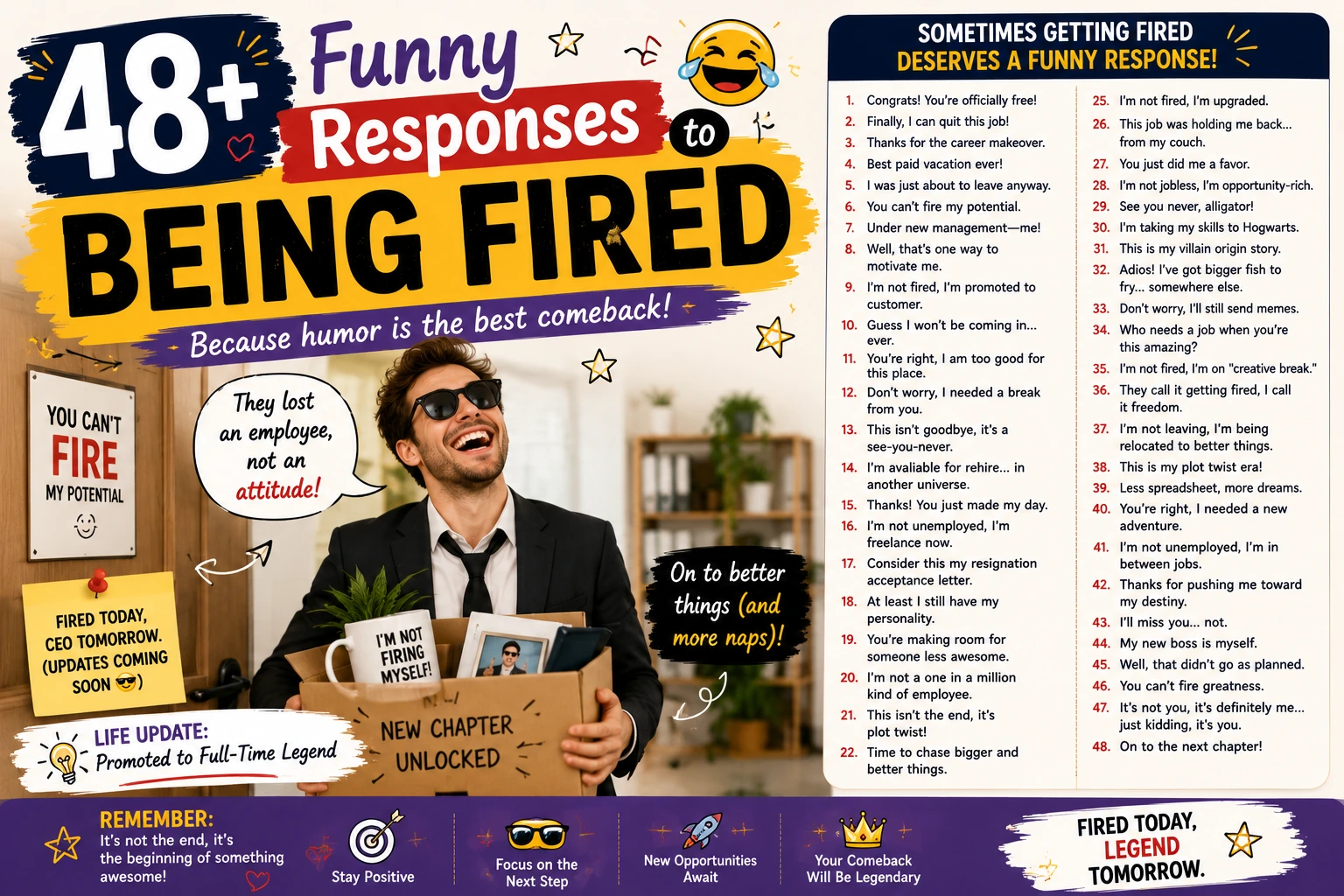
4. 48+ Funny Responses to Being Fired
Witty and Lighthearted
1. “Apparently, I was too talented for that place.”
Meaning: You jokingly suggest that your abilities were too impressive for the job.
Tone: Confident, humorous.
Example Sentence: “They let me go yesterday. Apparently, I was too talented for that place.”
Why use it: Great when joking with friends who understand that you are being sarcastic.
2. “I’ve been promoted to customer.”
Meaning: You humorously describe becoming a former employee.
Tone: Clever, playful.
Example Sentence: “I don’t work there anymore. I’ve been promoted to customer.”
Why use it: A short, clever response that works particularly well when talking about retail or service jobs.
3. “My employment subscription expired.”
Meaning: You compare your job to a subscription that has ended.
Tone: Modern, witty.
Example Sentence: “My employment subscription expired, and apparently there was no renewal option.”
Why use it: This works well in casual texting and social conversations.
4. “They decided to free me from my responsibilities.”
Meaning: You jokingly frame being fired as gaining freedom.
Tone: Sarcastic, upbeat.
Example Sentence: “Good news: they decided to free me from my responsibilities.”
Why use it: Useful when you want to turn an unpleasant event into a lighthearted story.
5. “My office era has officially ended.”
Meaning: Your time at the workplace is over.
Tone: Trendy, playful.
Example Sentence: “My office era has officially ended. Time for the next chapter.”
Why use it: A natural choice for social media captions or conversations with friends.
6. “I’ve been released back into the wild.”
Meaning: You are joking that you have been freed from your workplace.
Tone: Funny, casual.
Example Sentence: “Apparently, I’ve been released back into the wild.”
Why use it: Good for a humorous response when friends ask about your sudden availability.
7. “My boss and I decided to pursue separate dreams.”
Meaning: You humorously describe the end of your employment.
Tone: Dry, sarcastic.
Example Sentence: “My boss and I decided to pursue separate dreams.”
Why use it: This understated joke works well when you want humor without sounding bitter.
8. “I’m currently between paychecks.”
Meaning: You are unemployed but describe it in a softer, humorous way.
Tone: Light, understated.
Example Sentence: “I’m currently between paychecks and reconsidering my life choices.”
Why use it: A good casual phrase when you want to acknowledge the situation without dwelling on it.
9. “The company and I are taking some personal space.”
Meaning: You are no longer working there.
Tone: Dry, clever.
Example Sentence: “The company and I are taking some personal space for the foreseeable future.”
Why use it: Works well when you prefer subtle humor over an obvious joke.
10. “My career just took an unexpected intermission.”
Meaning: Your employment has temporarily paused.
Tone: Witty, optimistic.
Example Sentence: “My career just took an unexpected intermission, but the show isn’t over.”
Why use it: This response adds humor while keeping a positive outlook.
11. “I’ve unlocked a new level of free time.”
Meaning: You now have much more free time because you lost your job.
Tone: Playful, humorous.
Example Sentence: “I lost my job, but I’ve unlocked a new level of free time.”
Why use it: Perfect for casual conversations with friends.
12. “My alarm clock has been officially retired.”
Meaning: You no longer need to wake up for work.
Tone: Lighthearted.
Example Sentence: “My alarm clock has been officially retired until further notice.”
Why use it: A relatable joke for anyone who has recently left a job.
13. “I’ve been promoted to job hunter.”
Meaning: You are now looking for another job.
Tone: Positive, witty.
Example Sentence: “I’ve been promoted to full-time job hunter.”
Why use it: It keeps the situation upbeat while acknowledging reality.
14. “My desk and I have officially broken up.”
Meaning: You no longer have your workplace or desk.
Tone: Playful, humorous.
Example Sentence: “My desk and I have officially broken up. It was a difficult relationship.”
Why use it: Great for casual conversations when you want to make friends laugh.
15. “Apparently, I was working on my exit strategy.”
Meaning: You jokingly imply that getting fired was part of your plan.
Tone: Sarcastic, confident.
Example Sentence: “They fired me, but apparently I was just working on my exit strategy.”
Why use it: Best for close friends who understand your sense of humor.
16. “I’ve entered my unexpected sabbatical era.”
Meaning: You are jokingly describing unemployment as an unplanned break.
Tone: Trendy, witty.
Example Sentence: “I’ve entered my unexpected sabbatical era.”
Why use it: A playful way to reframe a difficult transition.
17. “My workplace chapter ended earlier than expected.”
Meaning: Your time at the company has ended.
Tone: Light, reflective.
Example Sentence: “My workplace chapter ended earlier than expected, but I’m already thinking about what’s next.”
Why use it: This balances humor with optimism.
18. “I’m taking an extended lunch break.”
Meaning: You are joking that your time away from work has become permanent.
Tone: Dry, sarcastic.
Example Sentence: “I’m taking an extended lunch break until I figure out my next move.”
Why use it: Short and clever for casual conversations.
19. “I’ve been transferred to the unemployment department.”
Meaning: You jokingly describe being unemployed as a new department.
Tone: Sarcastic, playful.
Example Sentence: “Apparently, I’ve been transferred to the unemployment department.”
Why use it: A funny response for friends who enjoy dry humor.
20. “My corporate adventure has reached the finale.”
Meaning: Your time in that workplace is finished.
Tone: Dramatic, humorous.
Example Sentence: “My corporate adventure has reached the finale, and honestly, the plot was wild.”
Why use it: Great when telling a funny story about your former job.
Sarcastic and Savage
21. “I finally got the promotion nobody wanted.”
Meaning: You jokingly describe unemployment as a promotion.
Tone: Sarcastic, bold.
Example Sentence: “Well, I finally got the promotion nobody wanted.”
Why use it: Use this with people who appreciate sarcastic humor.
22. “Turns out ‘team player’ was not enough.”
Meaning: You jokingly reference workplace expectations.
Tone: Dry, sarcastic.
Example Sentence: “Turns out being a team player was not enough to save the job.”
Why use it: Works when you’re comfortable making fun of workplace culture.
23. “I was promoted out of the building.”
Meaning: You jokingly imply that being fired was a promotion.
Tone: Witty, sarcastic.
Example Sentence: “I was promoted out of the building yesterday.”
Why use it: A clever one-liner that requires very little explanation.
24. “My boss finally got their wish: more meetings without me.”
Meaning: You humorously suggest that your absence benefits your former boss.
Tone: Sarcastic.
Example Sentence: “My boss finally got their wish: more meetings without me.”
Why use it: Best for private conversations with trusted friends.
25. “I’ve been professionally encouraged to explore new opportunities.”
Meaning: A polished, humorous way of saying you were fired.
Tone: Dry, clever.
Example Sentence: “I’ve been professionally encouraged to explore new opportunities.”
Why use it: This is a classic understated way to make a serious situation sound amusing.
26. “My resignation was accepted without me submitting one.”
Meaning: You joke about being fired unexpectedly.
Tone: Sarcastic.
Example Sentence: “My resignation was accepted without me actually submitting one.”
Why use it: A clever line for people who enjoy subtle workplace humor.
27. “They gave me a very permanent vacation.”
Meaning: You were removed from your job.
Tone: Sarcastic, light.
Example Sentence: “They gave me a very permanent vacation.”
Why use it: Useful when you want to keep the explanation short.
28. “I’ve been invited to pursue opportunities elsewhere.”
Meaning: You are joking about being dismissed.
Tone: Dry, professional-sounding humor.
Example Sentence: “I’ve been invited to pursue opportunities elsewhere, apparently.”
Why use it: Works because it sounds like corporate language while carrying a humorous meaning.
29. “My professional services are no longer required.”
Meaning: You no longer have the job.
Tone: Formal, sarcastic.
Example Sentence: “Apparently, my professional services are no longer required.”
Why use it: Ideal for dry humor and exaggerated formality.
30. “I’ve been strategically relocated to my couch.”
Meaning: You now spend your workdays at home.
Tone: Playful, sarcastic.
Example Sentence: “I’ve been strategically relocated to my couch while I figure out what’s next.”
Why use it: A fun option for friends and casual social posts.
31. “My company-sponsored character development has ended.”
Meaning: You jokingly suggest the job taught you lessons before ending.
Tone: Witty, reflective.
Example Sentence: “My company-sponsored character development has officially ended.”
Why use it: Works particularly well when the job was stressful but ultimately taught you something useful.
32. “I have been promoted to independent operations.”
Meaning: You are now working independently or looking for another job.
Tone: Clever, confident.
Example Sentence: “I’ve been promoted to independent operations.”
Why use it: A polished joke that avoids sounding overly negative.
33. “The corporate plot twist arrived early.”
Meaning: You were unexpectedly fired.
Tone: Modern, humorous.
Example Sentence: “The corporate plot twist arrived early, but I’m handling it.”
Why use it: Great for social media or conversations with friends.
34. “My career decided it needed a surprise episode.”
Meaning: Something unexpected happened in your career.
Tone: Playful.
Example Sentence: “My career decided it needed a surprise episode, so here we are.”
Why use it: A creative way to avoid making the conversation too serious.
35. “I’m taking a company-approved break that nobody approved.”
Meaning: You are joking about being unemployed.
Tone: Sarcastic.
Example Sentence: “I’m taking a company-approved break that nobody actually approved.”
Why use it: Best for friends who enjoy workplace sarcasm.
36. “Apparently, my attendance is no longer necessary.”
Meaning: You were let go from the workplace.
Tone: Dry, understated.
Example Sentence: “Apparently, my attendance is no longer necessary.”
Why use it: The understated delivery makes this especially funny.
37. “I’ve been removed from the corporate ecosystem.”
Meaning: You are no longer part of the company.
Tone: Dramatic, witty.
Example Sentence: “I’ve officially been removed from the corporate ecosystem.”
Why use it: Good for humorous storytelling.
38. “My access card and I are no longer on speaking terms.”
Meaning: Your employment has ended and you no longer have access to the workplace.
Tone: Playful, sarcastic.
Example Sentence: “My access card and I are no longer on speaking terms.”
Why use it: Particularly funny when your workplace used security cards or badges.
39. “The company has chosen a different protagonist.”
Meaning: You are joking that someone else has taken your role.
Tone: Dramatic, clever.
Example Sentence: “The company has chosen a different protagonist for the next season.”
Why use it: Great for people who enjoy storytelling-style humor.
40. “I’ve officially graduated from that workplace.”
Meaning: You have moved on from the company.
Tone: Positive, playful.
Example Sentence: “I’ve officially graduated from that workplace and I’m ready for what’s next.”
Why use it: This is humorous while still sounding optimistic.
Creative and Positive
41. “Every career needs a plot twist.”
Meaning: Unexpected changes can happen in professional life.
Tone: Positive, witty.
Example Sentence: “I got fired, but every career needs a plot twist.”
Why use it: This response keeps the focus on moving forward.
42. “Apparently, the universe has a new assignment for me.”
Meaning: You see the job loss as an opportunity for something different.
Tone: Optimistic, humorous.
Example Sentence: “Apparently, the universe has a new assignment for me.”
Why use it: Good when you want to turn an uncomfortable question into a hopeful conversation.
43. “I’m between chapters, not at the end of the book.”
Meaning: Losing one job does not mean your career is over.
Tone: Motivational, thoughtful.
Example Sentence: “I’m between chapters, not at the end of the book.”
Why use it: A more meaningful option when you want humor mixed with optimism.
44. “My next adventure just became mandatory.”
Meaning: You now need to find a new opportunity.
Tone: Positive, playful.
Example Sentence: “My next adventure just became mandatory, so I’m looking forward.”
Why use it: Helps shift the conversation away from embarrassment and toward future plans.
45. “I’ve been given the gift of an unexpected career reset.”
Meaning: You are treating the job loss as a fresh start.
Tone: Optimistic, clever.
Example Sentence: “I’ve been given the gift of an unexpected career reset.”
Why use it: Suitable when you want to sound calm and forward-looking.
46. “I’m officially available for better plotlines.”
Meaning: You are ready for new opportunities.
Tone: Confident, humorous.
Example Sentence: “That chapter ended, so I’m officially available for better plotlines.”
Why use it: A strong option for casual conversations and social posts.
47. “One door closed, and apparently it slammed.”
Meaning: Your job ended suddenly.
Tone: Funny, reflective.
Example Sentence: “One door closed, and apparently it slammed on the way out.”
Why use it: This combines humor with a familiar expression about new opportunities.
48. “I’m collecting life experience the expensive way.”
Meaning: You are humorously acknowledging that difficult experiences can teach valuable lessons.
Tone: Self-aware, witty.
Example Sentence: “I’m collecting life experience the expensive way, but I’ll figure it out.”
Why use it: Best when you want to acknowledge the difficulty without sounding defeated.
49. “My career just hit the refresh button.”
Meaning: You are starting a new professional chapter.
Tone: Modern, optimistic.
Example Sentence: “My career just hit the refresh button, so I’m seeing what comes next.”
Why use it: Simple and positive without making the situation sound overly dramatic.
50. “I’ve been unexpectedly upgraded to free agent status.”
Meaning: You are no longer tied to your former employer.
Tone: Confident, playful.
Example Sentence: “I’ve been unexpectedly upgraded to free agent status.”
Why use it: A fun way to describe being available for new opportunities.
5. Real-Life Situations: The Best Response
When a friend asks what happened
Keep it light if you feel comfortable.
Best response: “Apparently, I’ve been released back into the wild.”
It gives your friend an immediate answer without turning the conversation into a serious discussion.
When someone keeps asking about your old workplace
A dry response can end the conversation gracefully.
Best response: “My professional services are no longer required.”
It communicates the situation without sharing unnecessary details.
When you want to stay positive
Use humor that points toward the future.
Best response: “My career just hit the refresh button.”
This keeps attention on what you plan to do next.
When you want a social media caption
Choose something short and memorable.
Best response: “Every career needs a plot twist.”
It is simple, clever, and does not reveal unnecessary details.
When the situation is still sensitive
Skip the jokes and keep your response simple.
Best response: “My job ended unexpectedly, but I’m figuring out my next step.”
Sometimes honesty is more appropriate than humor.
6. What to Avoid
1. Avoid insulting your former employer
A joke can quickly become a public complaint if it becomes too personal.
2. Do not share confidential information
Keep private workplace details out of jokes, especially online.
3. Avoid blaming specific people
Funny responses are more effective when they focus on the situation rather than attacking an individual.
4. Know your audience
A joke that works with your best friend may not work with a former manager or professional contact.
5. Do not force humor
If you are genuinely upset, you do not have to make the situation funny. It is perfectly fine to respond honestly.
6. Avoid using humor during formal job discussions
When explaining your employment history to a potential employer, professionalism should come first.
7. Pro Tips for Using Humor After Being Fired
Keep the joke short. A quick one-liner often sounds more natural than an elaborate explanation.
Punch up the situation, not yourself. You can be funny without making yourself the target of harsh criticism.
End on a positive note. If possible, shift the conversation toward what you plan to do next. Humor works best when it shows confidence rather than bitterness.
8. Conclusion
Being fired is rarely the career moment anyone plans for, but a little humor can sometimes make an uncomfortable conversation easier. The best funny responses are clever without being cruel, confident without sounding bitter, and lighthearted without ignoring the reality of the situation. Whether you prefer dry sarcasm, workplace humor, or an optimistic one-liner, choose a response that matches your personality and audience. Most importantly, remember that one job ending does not define your entire career. Sometimes an unexpected ending simply creates room for a much better beginning.
Discover more