

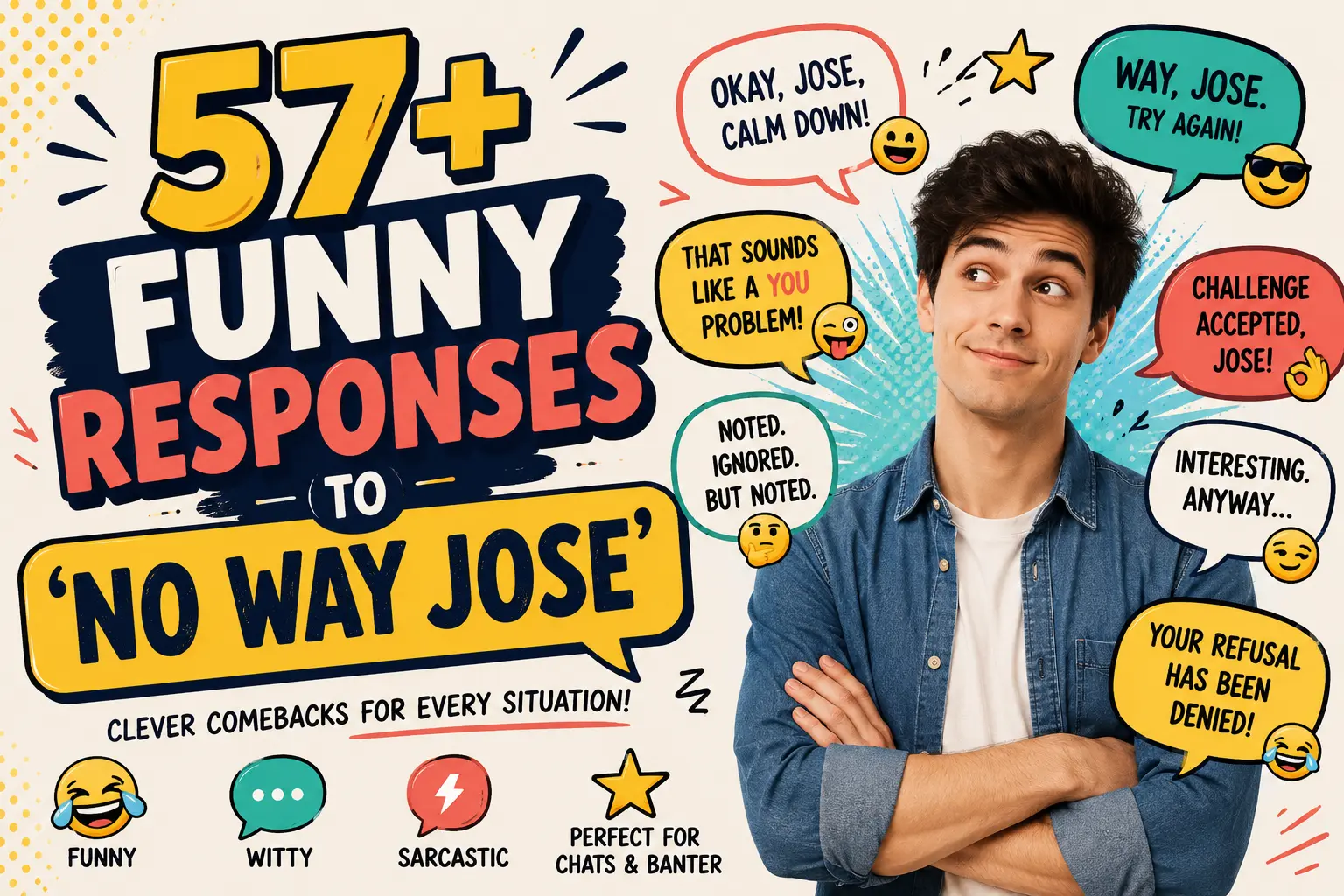
Someone says “No way, Jose!” and suddenly a simple conversation turns into a perfect opportunity for a clever comeback. Whether a friend is refusing your ridiculous idea, reacting dramatically to some unexpected news, or simply being playful, a funny response can keep the conversation going without making things awkward.
The phrase “No way, Jose” is already humorous because it adds a playful rhyme to a straightforward refusal. That makes it especially useful in casual conversations, texts, group chats, and friendly banter. Still, repeating the same response every time can get boring. Having a collection of witty alternatives gives you more ways to match the mood, from lighthearted and sarcastic to completely ridiculous. The best comeback is not necessarily the cleverest one. It is the one that fits the person, situation, and level of humor.
What Does “No Way, Jose” Mean?
“No way, Jose” is a playful way of saying “absolutely not,” “definitely not,” or “there is no chance.”
The phrase is informal and usually carries a humorous or exaggerated tone. Someone might say it when they strongly disagree with an idea, refuse a request, or react with disbelief.
For example:
“You want me to wake up at 5 a.m. for a hike?”
“No way, Jose.”
The expression is rarely meant to sound harsh. In most casual situations, it makes a refusal feel lighter and more entertaining.
Because it is playful, your response can be equally creative. Instead of simply saying “okay,” you can use humor to challenge the refusal, exaggerate the situation, or turn the conversation into friendly banter.
When to Use Funny Responses to “No Way, Jose”
Funny responses work best when the conversation is already casual and the other person understands your sense of humor.
With Friends
Friends are probably the easiest audience for sarcastic or ridiculous comebacks.
Example:
“Are you seriously making me watch that movie again?”
“No way, Jose.”
“Fine. I’ll file an official complaint.”
In Group Chats
A witty response can keep a group conversation entertaining.
Example:
“Who wants to present first?”
“No way, Jose.”
“Excellent. I volunteer you on behalf of everyone.”
During Friendly Arguments
A playful comeback can take the seriousness out of a harmless disagreement.
Example:
“You are absolutely wrong.”
“No way, Jose.”
“Interesting. I’ll allow you to believe that.”
While Texting
Short, unexpected replies often work particularly well over text.
Example:
“Can you send me your notes?”
“No way, Jose.”
“Understood. I respect your commitment to academic secrecy.”
When Someone Is Being Dramatic
If the other person is exaggerating their refusal, you can exaggerate your response too.
Example:
“I am never doing that again.”
“No way, Jose.”
“Noted. I’ll notify the history books.”
Is “No Way, Jose” Polite or Professional?
“No way, Jose” is casual and playful, rather than formal or professional.
It can work well with friends, siblings, classmates, and coworkers you know well. However, it is usually better to avoid it in formal emails, serious workplace discussions, interviews, academic writing, or conversations with someone you do not know well.
For professional situations, a simple response such as “I understand your concern,” “I see your point,” or “I’m afraid that won’t work” is more appropriate.
When using funny responses, context matters more than the actual words. A joke that makes your best friend laugh might sound disrespectful to a manager or unfamiliar colleague.
Playful and Lighthearted Responses
1. “Way, Jose.”
Meaning: A playful contradiction.
Tone: Lighthearted and cheeky.
“No way, Jose.”
“Way, Jose. I checked twice.”
Use this when you want to challenge their refusal without making the conversation serious.
2. “Okay, Jose, calm down.”
Meaning: Pretends their reaction is unnecessarily dramatic.
Tone: Playful.
“No way, Jose!”
“Okay, Jose, calm down. Nobody asked you to move countries.”
It works particularly well when someone dramatically rejects a harmless suggestion.
3. “That sounds like a personal problem, Jose.”
Meaning: Humorously refuses to take responsibility.
Tone: Sarcastic.
“No way, Jose. I’m not doing that.”
“That sounds like a personal problem, Jose.”
Use it when friendly teasing is already part of the conversation.
4. “Way too late, Jose.”
Meaning: Suggests the decision has already been made.
Tone: Mischievous.
“No way, Jose.”
“Way too late, Jose. The plan is already in motion.”
This is perfect when you are joking about having already committed someone to something.
5. “Noted, Jose. Ignored, but noted.”
Meaning: You heard their refusal but have no intention of respecting it.
Tone: Dry humor.
“No way, Jose.”
“Noted, Jose. Ignored, but noted.”
The contrast makes this comeback funnier.
6. “That’s adorable, Jose.”
Meaning: Playfully dismisses their refusal.
Tone: Teasing.
“No way, Jose.”
“That’s adorable, Jose. Anyway, here’s the plan.”
Use this with friends who enjoy exaggerated banter.
7. “You tried, Jose.”
Meaning: Suggests their refusal was unsuccessful.
Tone: Playful.
“No way, Jose.”
“You tried, Jose. I admire the confidence.”
It works when you want to pretend you have completely ignored their objection.
8. “Jose has spoken.”
Meaning: Turns their refusal into a dramatic official announcement.
Tone: Comedic.
“No way, Jose.”
“Jose has spoken. The meeting is adjourned.”
This works especially well in group chats.
9. “Objection overruled, Jose.”
Meaning: Pretends you are a judge rejecting their argument.
Tone: Witty.
“No way, Jose.”
“Objection overruled, Jose. Next question.”
Use it when someone is trying to win a silly argument.
10. “Your application for refusal has been denied.”
Meaning: Their rejection has supposedly been rejected.
Tone: Dry and absurd.
“No way, Jose.”
“Your application for refusal has been denied.”
The unnecessarily formal wording makes the response funny.
11. “Jose, I regret to inform you that I do not care.”
Meaning: A deliberately dramatic dismissal.
Tone: Sarcastic.
“No way, Jose.”
“Jose, I regret to inform you that I do not care.”
Use this with close friends who understand your humor.
12. “Counterargument: yes way.”
Meaning: A humorous way to disagree.
Tone: Clever.
“No way, Jose.”
“Counterargument: yes way.”
It is short enough to work perfectly in texting.
Sarcastic and Clever Responses
13. “That’s a bold statement for someone named Jose.”
Meaning: Turns their name into the joke.
Tone: Sarcastic.
“No way, Jose.”
“That’s a bold statement for someone named Jose.”
The randomness is what makes the response work.
14. “Wow. Strong feelings from Jose today.”
Meaning: Pretends their refusal is unusually dramatic.
Tone: Dry humor.
“No way, Jose.”
“Wow. Strong feelings from Jose today.”
It is useful when you want a low-effort but funny comeback.
15. “I’ll pretend I didn’t hear that.”
Meaning: Playfully ignores their refusal.
Tone: Cheeky.
“No way, Jose.”
“I’ll pretend I didn’t hear that.”
Keep this one for situations where the refusal is clearly part of friendly joking.
16. “Interesting. Anyway…”
Meaning: Pretends their opinion changed nothing.
Tone: Dry and sarcastic.
“No way, Jose.”
“Interesting. Anyway, here’s what we’re doing.”
The abrupt change of subject creates the joke.
17. “Your refusal has been beautifully documented.”
Meaning: Pretends their statement is an important official record.
Tone: Absurd.
“No way, Jose.”
“Your refusal has been beautifully documented for future generations.”
Use it when you want something more elaborate.
18. “I respect your confidence, not your decision.”
Meaning: Compliments their certainty while disagreeing with them.
Tone: Clever and teasing.
“No way, Jose.”
“I respect your confidence, not your decision.”
This works nicely during friendly disagreements.
19. “That sounds like something someone who is wrong would say.”
Meaning: Humorously claims their refusal proves they are incorrect.
Tone: Sarcastic.
“No way, Jose.”
“That sounds like something someone who is wrong would say.”
It is best used when both people are clearly joking.
20. “I hear you. I simply reject the concept.”
Meaning: A humorous refusal to accept their refusal.
Tone: Dry and witty.
“No way, Jose.”
“I hear you. I simply reject the concept.”
The overly formal language adds personality.
21. “Let’s agree that I’m right and move forward.”
Meaning: Pretends the argument is already settled.
Tone: Confident and playful.
“No way, Jose.”
“Let’s agree that I’m right and move forward.”
Use this when the disagreement is completely harmless.
22. “That opinion has been placed under review.”
Meaning: Pretends their statement is being evaluated officially.
Tone: Dry humor.
“No way, Jose.”
“That opinion has been placed under review.”
It is especially funny in work-related group chats when everyone knows you are joking.
23. “I’ll take that as a maybe.”
Meaning: Deliberately interprets a firm refusal as uncertainty.
Tone: Cheeky.
“No way, Jose.”
“I’ll take that as a maybe.”
This is great for playful teasing.
24. “Noted. Completely disregarded.”
Meaning: A humorous way to say their opinion will not change anything.
Tone: Sarcastic.
“No way, Jose.”
“Noted. Completely disregarded.”
Keep the tone light so it does not sound genuinely dismissive.
Ridiculous and Unexpected Responses
25. “Who invited Jose to the meeting?”
Meaning: Pretends Jose is an unexpected guest.
Tone: Absurd.
“No way, Jose.”
“Wait, who invited Jose to the meeting?”
The randomness makes this response work best among friends.
26. “Jose has entered the chat.”
Meaning: Dramatically announces their appearance.
Tone: Internet humor.
“No way, Jose.”
“Jose has entered the chat.”
Perfect for group messages.
27. “Tell Jose I said hello.”
Meaning: Pretends Jose is a completely separate person.
Tone: Silly.
“No way, Jose.”
“Tell Jose I said hello.”
The absurd misunderstanding creates the humor.
28. “Please leave your refusal after the beep.”
Meaning: Treats their rejection like a voicemail.
Tone: Witty.
“No way, Jose.”
“Please leave your refusal after the beep.”
It is a fun choice for texting.
29. “The Jose department is currently unavailable.”
Meaning: Pretends there is an official department handling Jose-related matters.
Tone: Absurd.
“No way, Jose.”
“The Jose department is currently unavailable.”
Use it when you want to make the conversation intentionally ridiculous.
30. “Jose, we need to talk about your attitude.”
Meaning: Pretends to discipline them over a silly refusal.
Tone: Dramatic.
“No way, Jose.”
“Jose, we need to talk about your attitude.”
It works particularly well when someone is being theatrically stubborn.
31. “Breaking news: Jose says no.”
Meaning: Turns their refusal into a major news event.
Tone: Comedic.
“No way, Jose.”
“Breaking news: Jose says no. More updates at nine.”
This is a great group-chat response.
32. “The council will discuss your decision.”
Meaning: Pretends their refusal requires official consideration.
Tone: Dramatic.
“No way, Jose.”
“The council will discuss your decision and get back to you never.”
The unnecessary seriousness makes the exchange funny.
33. “Jose, your contract has been terminated.”
Meaning: Pretends their refusal has resulted in an absurd consequence.
Tone: Dramatic and silly.
“No way, Jose.”
“Jose, your contract has been terminated.”
Use this only in clearly playful conversations.
34. “This is not the Jose we ordered.”
Meaning: Pretends their behavior is defective.
Tone: Absurd.
“No way, Jose.”
“This is not the Jose we ordered.”
It is particularly funny when the other person has been unusually stubborn.
35. “I expected better from you, Jose.”
Meaning: Pretends their refusal is a shocking betrayal.
Tone: Dramatic.
“No way, Jose.”
“I expected better from you, Jose.”
Deliver it dramatically for maximum effect.
36. “Jose, please read the room.”
Meaning: Pretends their refusal is socially inappropriate.
Tone: Sarcastic.
“No way, Jose.”
“Jose, please read the room.”
This works when everyone is already joking around.
37. “And yet, here we are.”
Meaning: Suggests their refusal has not stopped anything.
Tone: Dry and confident.
“No way, Jose.”
“And yet, here we are.”
Short, understated humor often lands better than an elaborate joke.
38. “A fascinating use of the word ‘no.’”
Meaning: Pretends to analyze their refusal academically.
Tone: Dry.
“No way, Jose.”
“A fascinating use of the word ‘no.’”
This works well when you enjoy deadpan humor.
Bold and Confident Comebacks
39. “Too late. I already made the executive decision.”
Meaning: Pretends you have authority over the situation.
Tone: Confident and playful.
“No way, Jose.”
“Too late. I already made the executive decision.”
Use it for harmless plans between friends.
40. “You underestimate my commitment to chaos.”
Meaning: Suggests you are willing to continue with the ridiculous idea.
Tone: Playful.
“No way, Jose.”
“You underestimate my commitment to chaos.”
This works especially well when the original idea is silly.
41. “That sounds like a challenge.”
Meaning: Treats their refusal as motivation.
Tone: Confident.
“No way, Jose.”
“That sounds like a challenge.”
It turns a simple “no” into playful competition.
42. “Challenge accepted, Jose.”
Meaning: Pretends their refusal has encouraged you.
Tone: Energetic.
“No way, Jose.”
“Challenge accepted, Jose.”
Use it when you want to keep the banter moving.
43. “I admire the resistance.”
Meaning: Playfully acknowledges their stubbornness.
Tone: Clever.
“No way, Jose.”
“I admire the resistance, honestly.”
This can sound witty without being overly sarcastic.
44. “Your confidence is impressive.”
Meaning: Compliments their certainty while teasing them.
Tone: Playful.
“No way, Jose.”
“Your confidence is impressive. Your logic, less so.”
This is better suited to close friends.
45. “We’ll revisit this when you change your mind.”
Meaning: Jokingly assumes their refusal is temporary.
Tone: Confident.
“No way, Jose.”
“We’ll revisit this when you change your mind.”
Use it when you are both clearly playing around.
46. “I respect the no. I just don’t like it.”
Meaning: Acknowledges the refusal while keeping the humor.
Tone: Lighthearted.
“No way, Jose.”
“I respect the no. I just don’t like it.”
This works when you want to keep the exchange friendly.
47. “Noted for absolutely no reason.”
Meaning: Pretends their refusal has been recorded despite being irrelevant.
Tone: Dry humor.
“No way, Jose.”
“Noted for absolutely no reason.”
It is short and works well over text.
48. “That’s unfortunate for you.”
Meaning: Jokingly suggests their refusal has somehow harmed them.
Tone: Sarcastic.
“No way, Jose.”
“That’s unfortunate for you.”
The absurd confidence is the punchline.
Short Responses for Texting
49. “Plot twist: yes.”
Meaning: Completely reverses their refusal.
Tone: Playful.
“No way, Jose.”
“Plot twist: yes.”
A quick option when you do not want a long comeback.
50. “Wrong answer.”
Meaning: Pretends their response is incorrect.
Tone: Cheeky.
“No way, Jose.”
“Wrong answer.”
Simple, confident, and easy to use.
51. “We’ll see about that.”
Meaning: Suggests their refusal may not be final.
Tone: Playful.
“No way, Jose.”
“We’ll see about that.”
It keeps the conversation open without being too aggressive.
52. “That’s cute.”
Meaning: Lightly dismisses their dramatic refusal.
Tone: Teasing.
“No way, Jose.”
“That’s cute.”
Keep this one for people who appreciate playful sarcasm.
53. “Sure, Jose.”
Meaning: Pretends to accept their statement while clearly teasing them.
Tone: Dry.
“No way, Jose.”
“Sure, Jose.”
The shorter the response, the more deadpan it can sound.
54. “Absolutely not accepted.”
Meaning: Rejects their rejection.
Tone: Playful.
“No way, Jose.”
“Absolutely not accepted.”
It works nicely in quick text exchanges.
55. “Denial noted.”
Meaning: Pretends their refusal is merely denial.
Tone: Dry and witty.
“No way, Jose.”
“Denial noted.”
This is ideal when you want something short and sarcastic.
56. “The audacity.”
Meaning: Pretends their refusal is outrageous.
Tone: Dramatic.
“No way, Jose.”
“The audacity.”
It works especially well when the refusal is completely harmless.
57. “Okay, I’ll add that to the list of things you’re wrong about.”
Meaning: Turns their refusal into another supposed mistake.
Tone: Sarcastic and playful.
“No way, Jose.”
“Okay, I’ll add that to the list of things you’re wrong about.”
Use this with someone who enjoys friendly arguments.
Best Responses in Real-Life Situations
When Your Friend Says It Dramatically
If your friend says “No way, Jose!” after you suggest something harmless, match their energy.
Best reply:
“Way, Jose. You’re being dramatic again.”
It keeps the conversation playful without making the disagreement serious.
When Someone Refuses Your Ridiculous Idea
Turn their refusal into another joke.
Best reply:
“That sounds like a challenge.”
It works particularly well when everyone knows the original idea was ridiculous.
When Someone Says It in a Group Chat
A short, unexpected response usually gets the most attention.
Best reply:
“Breaking news: Jose says no.”
It adds another layer of humor without requiring a long explanation.
When You Want a Sarcastic Comeback
Keep it dry rather than overly aggressive.
Best reply:
“Interesting. Your refusal has been placed under review.”
The formal wording makes the response intentionally ridiculous.
When You Do Not Want to Sound Mean
Choose a light response that does not attack the person.
Best reply:
“Okay, Jose, calm down.”
It acknowledges their reaction while keeping the mood friendly.
What to Avoid When Responding to “No Way, Jose”
1. Do Not Make Every Comeback Insulting
Sarcasm can be funny, but repeatedly insulting someone can quickly turn friendly banter into an argument.
2. Do Not Ignore the Context
A joke that works with your best friend may not work with a teacher, manager, client, or someone you barely know.
3. Avoid Overexplaining the Joke
A comeback usually works best when it is quick. If you need three paragraphs to explain why it was funny, the moment has probably passed.
4. Do Not Force Humor
If the other person is genuinely upset or uncomfortable, switch from comedy to a straightforward response.
5. Avoid Repeating the Same Line
Having several options makes your conversations feel more spontaneous.
6. Know When to Stop
Friendly teasing should remain enjoyable for everyone involved. If the other person stops engaging, let the joke go.
Pro Tips for Better Comebacks
Match Their Energy
If someone is being playful, you can be playful back. If they are serious, choose a calmer response.
Keep It Unexpected
The funniest replies often come from treating a tiny disagreement like a major official event.
For example:
“Your refusal has been forwarded to the appropriate department.”
The unnecessary seriousness creates the humor.
Use Timing to Your Advantage
A short comeback delivered immediately usually lands better than a clever response several minutes later. When texting, you have a little more freedom to think, but shorter is still often better.
Conclusion
A good response to “No way, Jose” does more than contradict a refusal. It can turn an ordinary exchange into a memorable moment of friendly banter. Whether you prefer dry sarcasm, absurd humor, dramatic statements, or quick one-liners, the best comeback depends on the situation and the person you are talking to.
You do not need the most complicated joke to be funny. Sometimes a simple “Way, Jose” is enough. Choose a response that feels natural, read the room, and let the humor stay light. After all, the best comeback is the one that makes everyone laugh rather than the one that simply gets the last word.
Discover more