

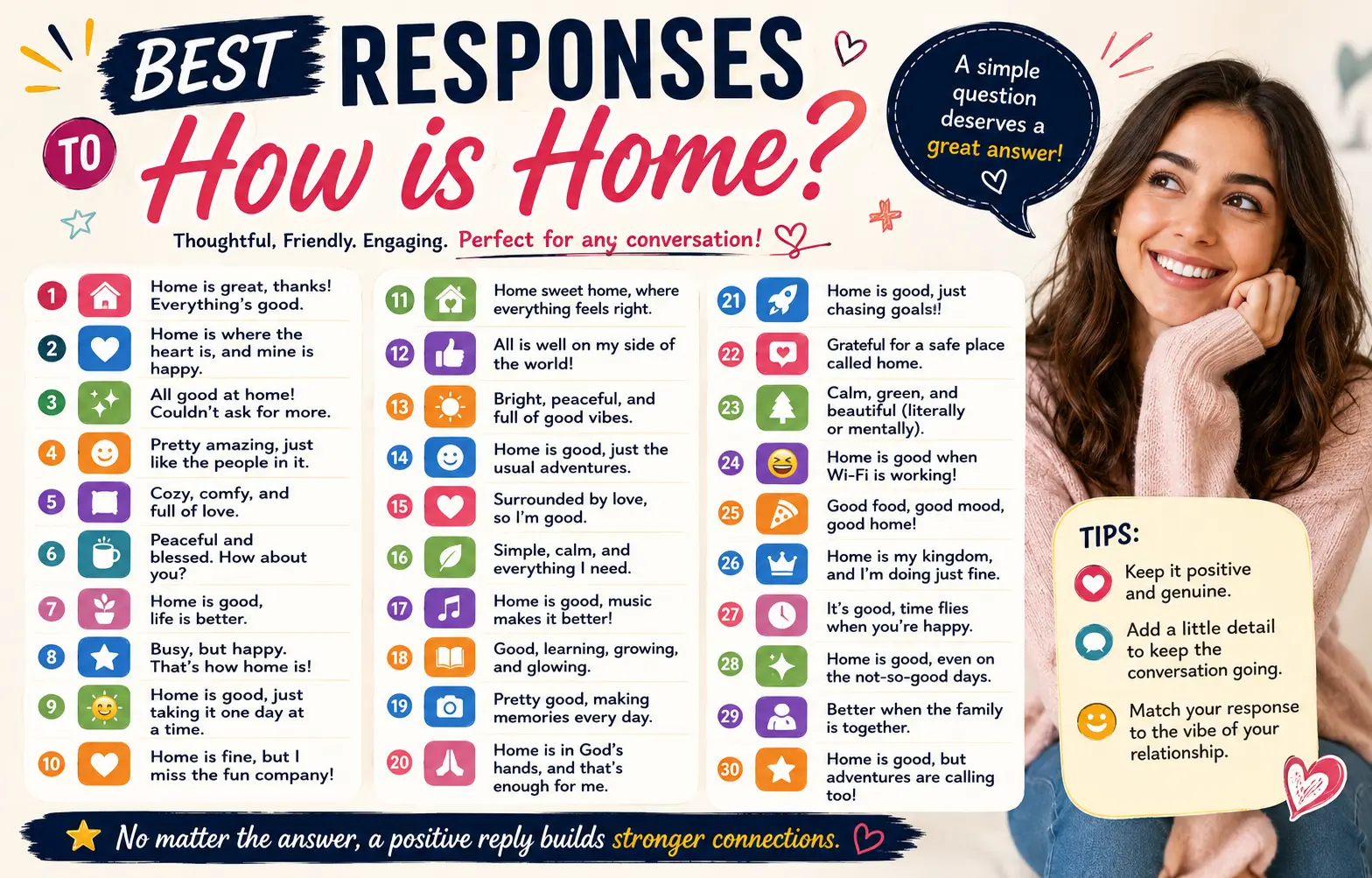
Sometimes a simple question like “How is home?” carries more meaning than it seems. It can be a casual way to ask about your family, your living situation, or how things are going at home. The best response depends on who is asking and how close you are to them.
A short answer works well with acquaintances, while a warmer response can make a conversation feel more personal. If you are texting a friend, talking to someone you like, or answering a family member, you can choose words that match the mood. Having a few natural responses ready also helps keep conversations from becoming repetitive.
In this guide, you will find 56+ responses to “How is home?” From polite and friendly replies to funny, confident, thoughtful, and playful options, there is something for almost every situation.
What Does “How Is Home?” Mean?
“How is home?” is a casual question about how things are going at your home.
Depending on the situation, the person may be asking about:
- Your family
- Your parents or siblings
- Your living situation
- The atmosphere at home
- Whether everything is going well
- How you are feeling about being at home
For example, if a friend asks, “How is home these days?”, they may simply want to know whether everything is okay with your family.
The question is usually friendly and conversational. However, the meaning can change depending on the relationship. Someone close to you may genuinely be checking on your well-being, while an acquaintance may simply be making conversation.
When to Use Responses to “How Is Home?”
You can respond to “How is home?” in many everyday situations.
With Friends
You can keep your answer relaxed and natural.
“Home is good. Everyone is doing well.”
With Family Members
A warmer response usually feels appropriate.
“Everything is good at home. Everyone sends their regards.”
With Someone You Are Getting to Know
You can give a little more information to keep the conversation moving.
“It’s been pretty peaceful lately. How about your home?”
In Text Conversations
Short responses often work best.
“All good here. Can’t complain.”
In More Formal Conversations
Keep the answer polite without sharing unnecessary personal details.
“Everything is well at home, thank you for asking.”
Is “How Is Home?” Polite or Professional?
Yes, “How is home?” can be polite, but it is generally casual rather than professional.
It works naturally between friends, relatives, classmates, neighbors, and people who already know each other.
In a professional setting, a slightly more neutral question may sound better, such as:
“How are things at home?”
or
“I hope everything is going well with your family.”
Your response should also match the relationship. You do not have to share personal information simply because someone asks. A brief answer such as “Everything is fine, thanks” is completely appropriate.
Polite and Appreciative Responses
1. Everything is good at home.
Meaning: Things are going well.
Tone: Polite and friendly.
Example: “Everything is good at home. Thanks for asking.”
Why to use it: This is a simple answer when you want to be warm without giving many details.
2. Home is doing well, thank you.
Meaning: Everything at home is fine.
Tone: Polite.
Example: “Home is doing well, thank you. How about yours?”
Why to use it: It works well when you want to return the question.
3. Everything is fine at home.
Meaning: There are no major problems.
Tone: Neutral and respectful.
Example: “Everything is fine at home. I appreciate you checking in.”
Why to use it: A good choice when you want to keep your answer straightforward.
4. All is well at home.
Meaning: Things are peaceful and okay.
Tone: Warm and slightly formal.
Example: “All is well at home, thankfully.”
Why to use it: This sounds polished without being overly formal.
5. Home is good, thanks for asking.
Meaning: Everything is fine and you appreciate their concern.
Tone: Friendly.
Example: “Home is good, thanks for asking. Everyone is doing fine.”
Why to use it: Perfect for everyday conversations.
6. Things are going well at home.
Meaning: Life at home is generally positive.
Tone: Polite and natural.
Example: “Things are going well at home. We have all been pretty busy lately.”
Why to use it: Useful when you want to give a slightly fuller answer.
7. Everyone is doing well, thankfully.
Meaning: Your family or household is okay.
Tone: Warm and appreciative.
Example: “Everyone is doing well, thankfully. It has been a busy week, though.”
Why to use it: Works especially well when the person is asking about your family.
8. Home is peaceful these days.
Meaning: Things feel calm at home.
Tone: Warm and relaxed.
Example: “Home is peaceful these days, which is honestly nice.”
Why to use it: Good when you want to share a little more personality.
9. Everything is settled at home.
Meaning: Things are stable and under control.
Tone: Mature and reassuring.
Example: “Everything is settled at home now, so I can focus on work.”
Why to use it: Helpful when someone knows you previously had something to deal with.
10. We are all doing well at home.
Meaning: You and your household are okay.
Tone: Friendly and sincere.
Example: “We are all doing well at home. How are things with you?”
Why to use it: A natural response when the question is clearly about your family.
Flirty and Playful Responses
11. Home is fine, but this conversation is more interesting.
Meaning: You are enjoying talking to the person.
Tone: Playful.
Example: “Home is fine, but this conversation is definitely more interesting.”
Why to use it: A subtle way to show interest without overdoing it.
12. Home is good. Why, are you planning a visit?
Meaning: You playfully suggest that they may want to come over.
Tone: Teasing.
Example: “Home is good. Why, are you planning a visit?”
Why to use it: Best for someone you already have a comfortable relationship with.
13. Home is great. Your timing is better, though.
Meaning: You are happy to hear from them.
Tone: Playful and warm.
Example: “Home is great. Your timing is better, though.”
Why to use it: Adds a little charm to an ordinary question.
14. Home is good. I was actually getting bored.
Meaning: Their message has made the conversation more interesting.
Tone: Playful.
Example: “Home is good. I was actually getting bored before you texted.”
Why to use it: Works naturally in casual texting.
15. Home is surviving. I am surviving too.
Meaning: You are joking about everyday life.
Tone: Lighthearted.
Example: “Home is surviving. I am surviving too. So, basically, everything is fine.”
Why to use it: Good when you want a humorous answer without being too personal.
16. Home is fine. What about the person asking?
Meaning: You turn the attention back to them.
Tone: Playful.
Example: “Home is fine. What about the person asking?”
Why to use it: Keeps the conversation moving in a fun way.
17. Home is good. Better now that you asked.
Meaning: Their question made you feel noticed.
Tone: Warm and playful.
Example: “Home is good. Better now that you asked.”
Why to use it: A gentle way to show appreciation.
18. Home is calm. My notifications are not.
Meaning: Your home is peaceful, but your phone is busy.
Tone: Funny and playful.
Example: “Home is calm. My notifications are not.”
Why to use it: Great for texting and casual conversations.
19. Home is good. Should I ask how yours is too?
Meaning: You jokingly pretend to forget to return the question.
Tone: Teasing.
Example: “Home is good. Should I ask how yours is too?”
Why to use it: Works best with someone who understands your humor.
20. Home is doing fine. I am the questionable one.
Meaning: You jokingly blame yourself for the chaos.
Tone: Self-deprecating and playful.
Example: “Home is doing fine. I am the questionable one today.”
Why to use it: Keeps the conversation light.
Confident and Self-Respecting Responses
21. Everything is good, and I am doing well too.
Meaning: You confidently confirm that things are okay.
Tone: Confident and positive.
Example: “Everything is good, and I am doing well too. Thanks for checking.”
Why to use it: A balanced response that does not overshare.
22. Home is fine. I have everything under control.
Meaning: You are managing things independently.
Tone: Confident.
Example: “Home is fine. I have everything under control.”
Why to use it: Good when someone seems concerned about you.
23. Things are good on my side.
Meaning: Your situation is stable.
Tone: Calm and confident.
Example: “Things are good on my side. I hope they are good on yours too.”
Why to use it: Works in both casual and semi-formal conversations.
24. No complaints from my side.
Meaning: Nothing major is wrong.
Tone: Relaxed and confident.
Example: “No complaints from my side. Everything is running smoothly.”
Why to use it: A natural alternative to “Everything is fine.”
25. Home is in a good place right now.
Meaning: Your home life feels stable.
Tone: Mature.
Example: “Home is in a good place right now, so I am feeling positive.”
Why to use it: Suitable when you want to sound thoughtful.
26. I am good, and things at home are good too.
Meaning: Both you and your household are doing well.
Tone: Confident and friendly.
Example: “I am good, and things at home are good too. Thanks for asking.”
Why to use it: A complete response that stays simple.
27. Everything is handled.
Meaning: Any issues at home have been managed.
Tone: Direct and confident.
Example: “Everything is handled now, so there is nothing to worry about.”
Why to use it: Useful when someone is asking because they know there was a problem.
28. Home is steady. I am focused on what is next.
Meaning: Your personal situation is stable and you are looking ahead.
Tone: Mature and confident.
Example: “Home is steady, and I am focused on what is next.”
Why to use it: Good for a thoughtful conversation.
29. Everything is going smoothly.
Meaning: Nothing is causing major trouble.
Tone: Calm and confident.
Example: “Everything is going smoothly at home these days.”
Why to use it: A clean answer when you do not want to explain further.
30. I appreciate you asking, but everything is under control.
Meaning: You value their concern while reassuring them.
Tone: Respectful and self-assured.
Example: “I appreciate you asking, but everything is under control.”
Why to use it: Especially useful when someone is being concerned about you.
Funny and Savage Responses
31. Home is good. The Wi-Fi is the real concern.
Meaning: You jokingly focus on internet problems instead of family matters.
Tone: Funny.
Example: “Home is good. The Wi-Fi is the real concern right now.”
Why to use it: Perfect for casual texting.
32. Home is peaceful until someone remembers I exist.
Meaning: You jokingly describe family interruptions.
Tone: Humorous.
Example: “Home is peaceful until someone remembers I exist.”
Why to use it: Works well with friends who understand your humor.
33. Home is fine. My snack supply is not.
Meaning: Everything is okay except your food situation.
Tone: Funny.
Example: “Home is fine. My snack supply is not looking promising.”
Why to use it: A harmless way to make the conversation more entertaining.
34. Home is functioning. That is enough for today.
Meaning: You jokingly suggest that things are barely organized.
Tone: Dry humor.
Example: “Home is functioning. That is enough for today.”
Why to use it: Great for a deadpan response.
35. Home is good. We have not started arguing yet.
Meaning: You jokingly describe a peaceful moment.
Tone: Playful.
Example: “Home is good. We have not started arguing yet, so that is progress.”
Why to use it: Best with close friends.
36. Home is fine. Nobody has asked me to do anything yet.
Meaning: You are joking about household responsibilities.
Tone: Funny.
Example: “Home is fine. Nobody has asked me to do anything yet.”
Why to use it: A relatable response for casual conversations.
37. Home is surviving the daily drama.
Meaning: There is some everyday chaos at home.
Tone: Humorous.
Example: “Home is surviving the daily drama. Nothing unusual.”
Why to use it: Good when your household is lively.
38. Home is good. I am currently on my best behavior.
Meaning: You jokingly imply that you are usually troublesome.
Tone: Playful.
Example: “Home is good. I am currently on my best behavior.”
Why to use it: A fun response for friends.
39. Home is great. My responsibilities disagree.
Meaning: You are joking about chores or duties.
Tone: Funny and relatable.
Example: “Home is great. My responsibilities disagree.”
Why to use it: Works well in casual chats.
40. Home is okay. The household committee is still meeting.
Meaning: You jokingly describe family discussions.
Tone: Witty.
Example: “Home is okay. The household committee is still meeting.”
Why to use it: A creative answer when you want something more original.
Curious, Thoughtful and Mature Responses
41. Home is doing well. How has your home been lately?
Meaning: You answer while showing genuine interest in them.
Tone: Thoughtful.
Example: “Home is doing well. How has your home been lately?”
Why to use it: Encourages a balanced conversation.
42. Things are okay at home. How are things with your family?
Meaning: You return the personal question.
Tone: Caring.
Example: “Things are okay at home. How are things with your family?”
Why to use it: Good when speaking with someone you know well.
43. Home has been pretty peaceful lately. How about yours?
Meaning: You share a small detail and invite them to respond.
Tone: Warm.
Example: “Home has been pretty peaceful lately. How about yours?”
Why to use it: Natural for a longer conversation.
44. Everyone is doing fine. It has been a busy week, though.
Meaning: Your family is okay despite a busy schedule.
Tone: Conversational.
Example: “Everyone is doing fine. It has been a busy week, though.”
Why to use it: Gives the other person something to ask about.
45. Home is good. We have just been keeping busy.
Meaning: Things are normal but everyone has been occupied.
Tone: Casual and mature.
Example: “Home is good. We have just been keeping busy lately.”
Why to use it: Useful when you want to avoid a long explanation.
46. Everything is okay at home. I hope things are good with you too.
Meaning: You answer while expressing concern for them.
Tone: Thoughtful.
Example: “Everything is okay at home. I hope things are good with you too.”
Why to use it: Works especially well when the conversation is sincere.
47. Home has been treating me well.
Meaning: You feel comfortable and positive about being at home.
Tone: Warm and reflective.
Example: “Home has been treating me well. I have enjoyed having some quiet time.”
Why to use it: A more interesting alternative to “home is good.”
48. It has been a calm week at home.
Meaning: Things have been peaceful recently.
Tone: Thoughtful.
Example: “It has been a calm week at home, which I really needed.”
Why to use it: Useful when you want to share your mood naturally.
49. Home feels good right now.
Meaning: You currently feel comfortable and content at home.
Tone: Personal and sincere.
Example: “Home feels good right now. I have finally had time to relax.”
Why to use it: Best for deeper conversations.
50. We are doing well and taking things one day at a time.
Meaning: Things are okay, even if life is not perfect.
Tone: Mature and thoughtful.
Example: “We are doing well and taking things one day at a time.”
Why to use it: A good response when life has been somewhat complicated.
51. Everything is stable at home, thankfully.
Meaning: Your home situation is secure and peaceful.
Tone: Mature.
Example: “Everything is stable at home, thankfully. I am grateful for that.”
Why to use it: Appropriate when someone is checking on your well-being.
52. Home is doing well, and I am grateful for the people there.
Meaning: You appreciate your family and home environment.
Tone: Sincere and reflective.
Example: “Home is doing well, and I am grateful for the people there.”
Why to use it: A thoughtful answer for a meaningful conversation.
53. Things are good at home. We are all finding our rhythm.
Meaning: Everyone is adjusting to their routines.
Tone: Mature and positive.
Example: “Things are good at home. We are all finding our rhythm again.”
Why to use it: Useful after a period of change.
54. Home has been a good place to recharge.
Meaning: Being at home has helped you rest and recover from a busy schedule.
Tone: Reflective.
Example: “Home has been a good place to recharge after a hectic week.”
Why to use it: A natural response when discussing stress or a busy routine.
55. Everything is fine, and I am enjoying some quiet time at home.
Meaning: You are doing well and appreciating some peace.
Tone: Calm and thoughtful.
Example: “Everything is fine, and I am enjoying some quiet time at home.”
Why to use it: Good when you want to sound relaxed and positive.
56. Home is good. I am just appreciating the little things lately.
Meaning: You are content with simple moments at home.
Tone: Reflective and warm.
Example: “Home is good. I am just appreciating the little things lately.”
Why to use it: This response works particularly well in a deeper conversation.
Real-Life Situations and the Best Responses
When a Friend Asks About Your Family
If your friend genuinely wants to know how everyone is doing, give them a warm answer.
Best response:
“Everyone is doing well, thankfully. How about your family?”
When Someone You Like Asks “How Is Home?”
You can keep the response natural while giving them something to continue the conversation with.
Best response:
“Home is good. Your timing is better, though.”
When an Acquaintance Asks
You do not need to share personal details.
Best response:
“Everything is good at home, thanks for asking.”
When You Are Having a Difficult Time at Home
You can be honest without explaining everything.
Best response:
“Things are a little complicated at home, but I am managing.”
When You Want to Keep the Conversation Going
Answer briefly, then return the question.
Best response:
“Home has been pretty peaceful lately. How about yours?”
What to Avoid When Responding to “How Is Home?”
1. Oversharing
You do not have to explain every personal detail. Give as much information as feels comfortable.
2. Sounding Too Formal
A response like “The domestic circumstances remain satisfactory” sounds unnatural in an everyday conversation.
3. Giving a One-Word Answer Every Time
“Fine” is technically an answer, but it can quickly end the conversation.
Try:
“Everything is fine. How about you?”
4. Ignoring the Context
A funny response may work with a close friend but feel inappropriate if someone is genuinely checking on your family.
5. Pretending Everything Is Perfect
If things are difficult, you can stay honest without revealing private information.
For example:
“Things are a little busy at home, but we are managing.”
6. Forgetting to Return the Question
If someone shows genuine interest in your home life, asking about theirs can make the conversation feel more balanced.
Pro Tips for Answering “How Is Home?”
1. Match Their Energy
If the person asks casually, keep your answer casual. If they sound concerned, respond more sincerely.
2. Give Them Something to Continue With
Instead of simply saying “good,” add a small detail.
“Home is good. Everyone has just been really busy lately.”
This gives the other person an easy opening for the next question.
3. Protect Your Privacy
A good response does not have to reveal everything. You can be friendly while still keeping personal matters private.
Conclusion
“How is home?” may be a simple question, but your response can shape the entire conversation. A polite answer can show appreciation, while a funny response can create an easygoing mood. A thoughtful answer can also turn a short question into a meaningful conversation.
The best response depends on the person, situation, and tone. You do not need complicated vocabulary to sound interesting. Sometimes, a simple and genuine answer works best. Choose words that feel natural to you, stay comfortable with what you share, and let the conversation develop from there.
Discover more