
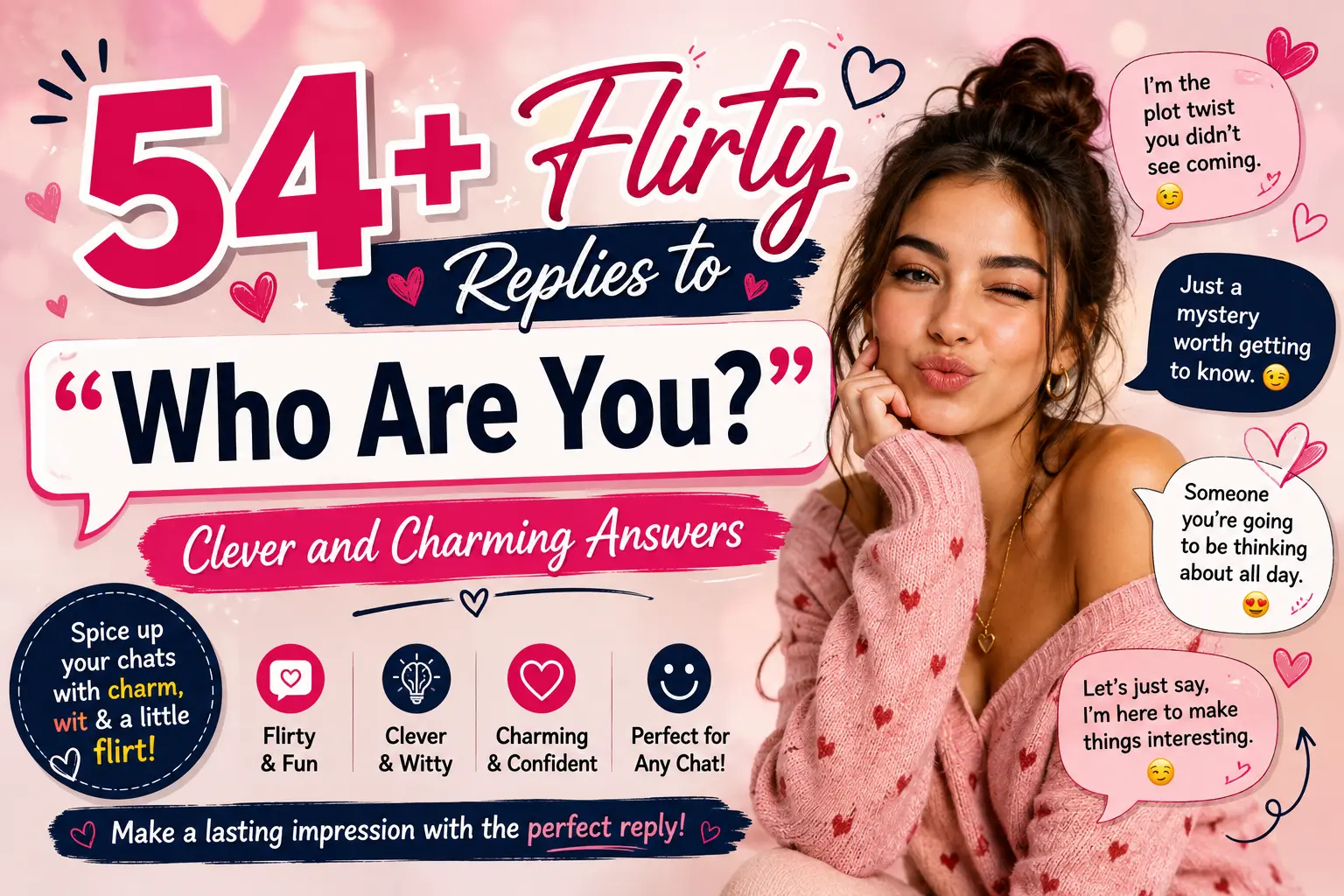
Sometimes a simple “Who are you?” is more than a request for your name. Depending on the situation, it can be an invitation to introduce yourself, start a conversation, or simply keep the interaction going. A clever response can make that moment feel much more natural and memorable.
If you are looking for flirty replies to “Who are you?”, the key is to keep your answer light, confident, and appropriate for the relationship. You do not always need a dramatic pickup line. Sometimes a little humor or mystery works better.
This guide brings together 54+ creative responses, ranging from playful and witty to confident and thoughtful. You will also find examples showing how each response can naturally fit into a conversation.
1. What Does “Who Are You?” Mean?
“Who are you?” is usually a straightforward question asking someone to identify themselves or share a little about who they are.
However, the meaning can change depending on context. Someone you have never met might genuinely want to know your name. A new online contact may be asking how they know you. A friend might ask it jokingly after you say something unexpected.
When there is a playful or friendly atmosphere, you can answer with humor instead of giving a completely ordinary introduction. The best response depends on how well you know the person and what kind of conversation you want to have.
2. When to Use Flirty or Playful Replies
These responses work best in casual situations, especially when the conversation already has a relaxed or humorous tone.
You might use them:
- When someone messages you unexpectedly
- When a new friend asks who you are
- When someone is joking around
- When you want to make an introduction memorable
- During casual texting
- When responding to a playful question
For example:
Them: “Who are you?”
You: “Someone you apparently need to get to know.”
The important thing is to read the situation first. A playful response may work beautifully with a friend but sound inappropriate in a formal conversation.
3. Is It Polite or Professional?
Flirty and playful replies are generally casual rather than professional.
They can work in friendly texting, social conversations, or informal online interactions. They are usually not appropriate for job interviews, professional emails, academic communication, or conversations with someone you barely know in a formal setting.
For professional situations, a straightforward introduction is better:
“Hi, I’m Marium. We connected through the student group.”
For casual conversations, you have much more freedom to add humor and personality.
Playful and Charming Replies
1. “Someone worth remembering.”
Meaning: You are presenting yourself as memorable.
Tone: Confident and playful.
Example: “Who are you?” “Someone worth remembering.”
Why use it: It adds a little mystery without going too far.
2. “Take a guess.”
Meaning: You are inviting the other person to figure you out.
Tone: Playful and mysterious.
Example: When someone asks who you are in a casual chat, you reply, “Take a guess.”
Why use it: Perfect when you want to keep the conversation going.
3. “Someone you just happened to meet at the right time.”
Meaning: You are making the introduction sound interesting.
Tone: Charming and confident.
Example: “Who are you?” “Someone you just happened to meet at the right time.”
Why use it: It gives an ordinary introduction a creative twist.
4. “That depends. Who’s asking?”
Meaning: You turn the question back on them.
Tone: Teasing and witty.
Example: A new acquaintance asks who you are, and you answer, “That depends. Who’s asking?”
Why use it: Great for playful conversations.
5. “The person behind this message.”
Meaning: You are jokingly pointing out the obvious.
Tone: Lighthearted.
Example: “Who are you?” “The person behind this message, obviously.”
Why use it: Works when you want humor without sounding overly bold.
6. “Someone you haven’t figured out yet.”
Meaning: You suggest there is more to discover about you.
Tone: Mysterious.
Example: “Who are you?” “Someone you haven’t figured out yet.”
Why use it: Good for keeping a conversation intriguing.
7. “Your newest conversation partner.”
Meaning: You introduce yourself through the current interaction.
Tone: Friendly and playful.
Example: “Who are you?” “Your newest conversation partner.”
Why use it: A safe option for a new casual conversation.
8. “A mystery with a perfectly good explanation.”
Meaning: You jokingly describe yourself as mysterious.
Tone: Clever and humorous.
Example: “Who are you?” “A mystery with a perfectly good explanation.”
Why use it: Adds personality without being too intense.
9. “Someone who clearly caught your attention.”
Meaning: You playfully suggest that their question shows interest.
Tone: Confident and teasing.
Example: “Who are you?” “Someone who clearly caught your attention.”
Why use it: Best when the conversation is already playful.
10. “The plot twist you didn’t expect.”
Meaning: You jokingly describe yourself as unexpected.
Tone: Witty and fun.
Example: “Who are you?” “The plot twist you didn’t expect.”
Why use it: Great for casual texting.
11. “Someone with an interesting story.”
Meaning: You suggest that there is more to you than a name.
Tone: Thoughtful and intriguing.
Example: “Who are you?” “Someone with an interesting story.”
Why use it: Encourages the other person to ask another question.
Confident and Clever Replies
12. “I’m the person you’re currently curious about.”
Meaning: You acknowledge their curiosity.
Tone: Confident.
Example: “Who are you?” “I’m the person you’re currently curious about.”
Why use it: Works well when you want to sound self-assured.
13. “Just someone making your day a little more interesting.”
Meaning: You suggest that the conversation is adding some fun.
Tone: Playful.
Example: “Who are you?” “Just someone making your day a little more interesting.”
Why use it: Friendly and easygoing.
14. “I could tell you, but where’s the fun in that?”
Meaning: You jokingly avoid giving a direct answer.
Tone: Teasing.
Example: Someone asks who you are, and you respond, “I could tell you, but where’s the fun in that?”
Why use it: Good for playful conversations.
15. “Someone you’ll probably remember.”
Meaning: You express confidence in being memorable.
Tone: Self-assured.
Example: “Who are you?” “Someone you’ll probably remember.”
Why use it: Short and confident.
16. “A surprisingly complicated answer.”
Meaning: You jokingly imply that your identity cannot be explained in one sentence.
Tone: Funny and mysterious.
Example: “Who are you?” “A surprisingly complicated answer.”
Why use it: Good when you want to invite follow-up questions.
17. “The person you decided to ask.”
Meaning: You point out that their curiosity brought the conversation here.
Tone: Clever.
Example: “Who are you?” “The person you decided to ask.”
Why use it: A subtle humorous answer.
18. “Someone with better answers than introductions.”
Meaning: You joke about not being good at introductions.
Tone: Funny and confident.
Example: “Who are you?” “Someone with better answers than introductions.”
Why use it: Perfect if you prefer humor over formal introductions.
19. “Give me a minute. I’m more interesting than my name suggests.”
Meaning: You suggest that your personality matters more than your introduction.
Tone: Confident and playful.
Example: “Who are you?” “Give me a minute. I’m more interesting than my name suggests.”
Why use it: Works when the conversation is already relaxed.
20. “A person you might enjoy getting to know.”
Meaning: You politely express confidence in your personality.
Tone: Warm and charming.
Example: “Who are you?” “A person you might enjoy getting to know.”
Why use it: A softer alternative to a bold pickup line.
Funny Replies
21. “That information is classified.”
Meaning: You pretend your identity is a secret.
Tone: Funny.
Example: “Who are you?” “That information is classified.”
Why use it: Great for joking with friends or casual contacts.
22. “Excellent question. I’ll get back to you.”
Meaning: You humorously avoid answering.
Tone: Sarcastic and light.
Example: “Who are you?” “Excellent question. I’ll get back to you.”
Why use it: Best when the conversation is already humorous.
23. “Currently accepting guesses.”
Meaning: You invite the person to guess your identity.
Tone: Playful.
Example: “Who are you?” “Currently accepting guesses.”
Why use it: Keeps the exchange interactive.
24. “A very curious person’s latest discovery.”
Meaning: You jokingly make their curiosity part of the answer.
Tone: Witty.
Example: “Who are you?” “A very curious person’s latest discovery.”
Why use it: Works well in lighthearted texting.
25. “Someone who forgot to prepare an introduction.”
Meaning: You admit you were not prepared for the question.
Tone: Self-deprecating and funny.
Example: “Who are you?” “Someone who forgot to prepare an introduction.”
Why use it: Makes the conversation feel relaxed.
26. “The main character of this particular conversation.”
Meaning: You jokingly give yourself an important role.
Tone: Funny and confident.
Example: “Who are you?” “The main character of this particular conversation.”
Why use it: Good for friends and casual online chats.
27. “A human with Wi-Fi and questionable jokes.”
Meaning: A deliberately silly introduction.
Tone: Humorous.
Example: “Who are you?” “A human with Wi-Fi and questionable jokes.”
Why use it: Great when you want to make someone laugh.
28. “That’s what I’m trying to figure out too.”
Meaning: You jokingly question your own identity.
Tone: Self-aware and funny.
Example: “Who are you?” “Honestly, that’s what I’m trying to figure out too.”
Why use it: Works especially well with close friends.
29. “A surprisingly normal person, most days.”
Meaning: You jokingly suggest you have your chaotic moments.
Tone: Casual and humorous.
Example: “Who are you?” “A surprisingly normal person, most days.”
Why use it: A relaxed answer that can lead to more conversation.
30. “Someone who should probably introduce themselves properly.”
Meaning: You turn the joke into a genuine introduction.
Tone: Friendly.
Example: “Who are you?” “Someone who should probably introduce themselves properly. I’m Alex.”
Why use it: Useful when you want humor followed by a real introduction.
Subtle and Thoughtful Replies
31. “I’m still discovering that myself.”
Meaning: You acknowledge that identity can develop over time.
Tone: Thoughtful.
Example: “Who are you?” “I’m still discovering that myself.”
Why use it: Better suited to a deeper conversation.
32. “More than a name, hopefully.”
Meaning: You suggest that people are more complex than labels.
Tone: Thoughtful and confident.
Example: “Who are you?” “More than a name, hopefully.”
Why use it: A meaningful alternative when the conversation feels sincere.
33. “Someone you can learn about one conversation at a time.”
Meaning: You emphasize gradually getting to know someone.
Tone: Warm and reflective.
Example: “Who are you?” “Someone you can learn about one conversation at a time.”
Why use it: Good for a thoughtful conversation.
34. “Someone with a story still being written.”
Meaning: You describe yourself as a work in progress.
Tone: Reflective.
Example: “Who are you?” “Someone with a story still being written.”
Why use it: Works well when discussing goals or personal experiences.
35. “A mix of ambition, curiosity, and unfinished plans.”
Meaning: You give a more personal description without listing facts.
Tone: Thoughtful and confident.
Example: “Who are you?” “A mix of ambition, curiosity, and unfinished plans.”
Why use it: Great for a meaningful introduction.
36. “Someone who values good conversations.”
Meaning: You explain what you appreciate socially.
Tone: Warm and mature.
Example: “Who are you?” “Someone who values good conversations.”
Why use it: Appropriate when you want to move beyond small talk.
37. “Someone you’ll have to ask better questions to discover.”
Meaning: You encourage deeper questions.
Tone: Playful and thoughtful.
Example: “Who are you?” “You’ll have to ask better questions to discover.”
Why use it: Keeps the conversation moving naturally.
38. “A person who prefers actions over labels.”
Meaning: You suggest that your behavior says more than an introduction.
Tone: Mature and confident.
Example: “Who are you?” “A person who prefers actions over labels.”
Why use it: Works when the conversation is more serious.
Short and Witty Replies
39. “Your latest mystery.”
Meaning: You jokingly make yourself mysterious.
Tone: Playful.
Example: “Who are you?” “Your latest mystery.”
Why use it: Short and easy to text.
40. “Someone you should probably know.”
Meaning: A confident introduction.
Tone: Bold.
Example: “Who are you?” “Someone you should probably know.”
Why use it: Best for casual situations where confidence fits.
41. “A good question deserves a good answer.”
Meaning: You signal that you are about to introduce yourself.
Tone: Clever.
Example: “Who are you?” “A good question deserves a good answer. I’m Alex.”
Why use it: Adds personality before a straightforward introduction.
42. “Someone passing through your notifications.”
Meaning: You jokingly reference messaging.
Tone: Casual and funny.
Example: “Who are you?” “Someone passing through your notifications.”
Why use it: Particularly suitable for texting.
43. “A stranger, for now.”
Meaning: You acknowledge that you are not familiar yet.
Tone: Subtle and intriguing.
Example: “Who are you?” “A stranger, for now.”
Why use it: Lets the conversation develop naturally.
44. “The person you just asked about.”
Meaning: A deliberately obvious answer.
Tone: Dry humor.
Example: “Who are you?” “The person you just asked about.”
Why use it: Works when the other person appreciates sarcasm.
45. “Someone with a name, a story, and excellent timing.”
Meaning: You combine humor with a confident introduction.
Tone: Charming and witty.
Example: “Who are you?” “Someone with a name, a story, and excellent timing.”
Why use it: A polished option for casual conversation.
46. “The answer to your very direct question.”
Meaning: You playfully point out how straightforward they were.
Tone: Dry and humorous.
Example: “Who are you?” “The answer to your very direct question.”
Why use it: Great for witty exchanges.
47. “Someone who was hoping you’d ask.”
Meaning: You show enthusiasm for continuing the conversation.
Tone: Playful and confident.
Example: “Who are you?” “Someone who was hoping you’d ask.”
Why use it: Best when the conversation is already friendly.
48. “A name you’ll know soon enough.”
Meaning: You add a little mystery.
Tone: Playful.
Example: “Who are you?” “A name you’ll know soon enough.”
Why use it: Keeps things light without being overly dramatic.
49. “Someone who believes introductions should be interesting.”
Meaning: You explain your unusual response.
Tone: Clever and confident.
Example: “Who are you?” “Someone who believes introductions should be interesting.”
Why use it: Good for people who enjoy wordplay.
50. “Just another person trying to make a memorable first impression.”
Meaning: You acknowledge that you are introducing yourself.
Tone: Friendly and self-aware.
Example: “Who are you?” “Just another person trying to make a memorable first impression.”
Why use it: A balanced option when you want charm without exaggeration.
51. “Someone who thinks you deserve a better introduction than ‘hi.’”
Meaning: You suggest putting more thought into the conversation.
Tone: Playful.
Example: “Who are you?” “Someone who thinks you deserve a better introduction than ‘hi.’”
Why use it: Works nicely for casual texting.
52. “A person you might find more interesting after five minutes of conversation.”
Meaning: You let your personality speak for itself.
Tone: Confident and mature.
Example: “Who are you?” “A person you might find more interesting after five minutes of conversation.”
Why use it: A grounded alternative to a dramatic pickup line.
53. “Someone who would rather show you than explain.”
Meaning: You believe personality is better demonstrated than described.
Tone: Confident and thoughtful.
Example: “Who are you?” “Someone who would rather show you than explain.”
Why use it: Best when the conversation has a more sincere tone.
54. “Start with my name; the rest can come later.”
Meaning: You combine a genuine introduction with a little mystery.
Tone: Warm and playful.
Example: “Who are you?” “Start with my name; the rest can come later.”
Why use it: A natural way to keep the conversation open without oversharing.
Conclusion
A question as simple as “Who are you?” does not always need an ordinary answer. The right response can make a conversation more memorable, show your personality, and encourage the other person to keep talking. Whether you prefer something witty, mysterious, funny, or thoughtful, choose a response that actually sounds like you.
The strongest replies are not necessarily the boldest ones. They are the ones that fit the situation naturally. Keep your confidence genuine, read the other person’s tone, and let the conversation develop at its own pace.
Discover more
formal replies to hope you are doing well