
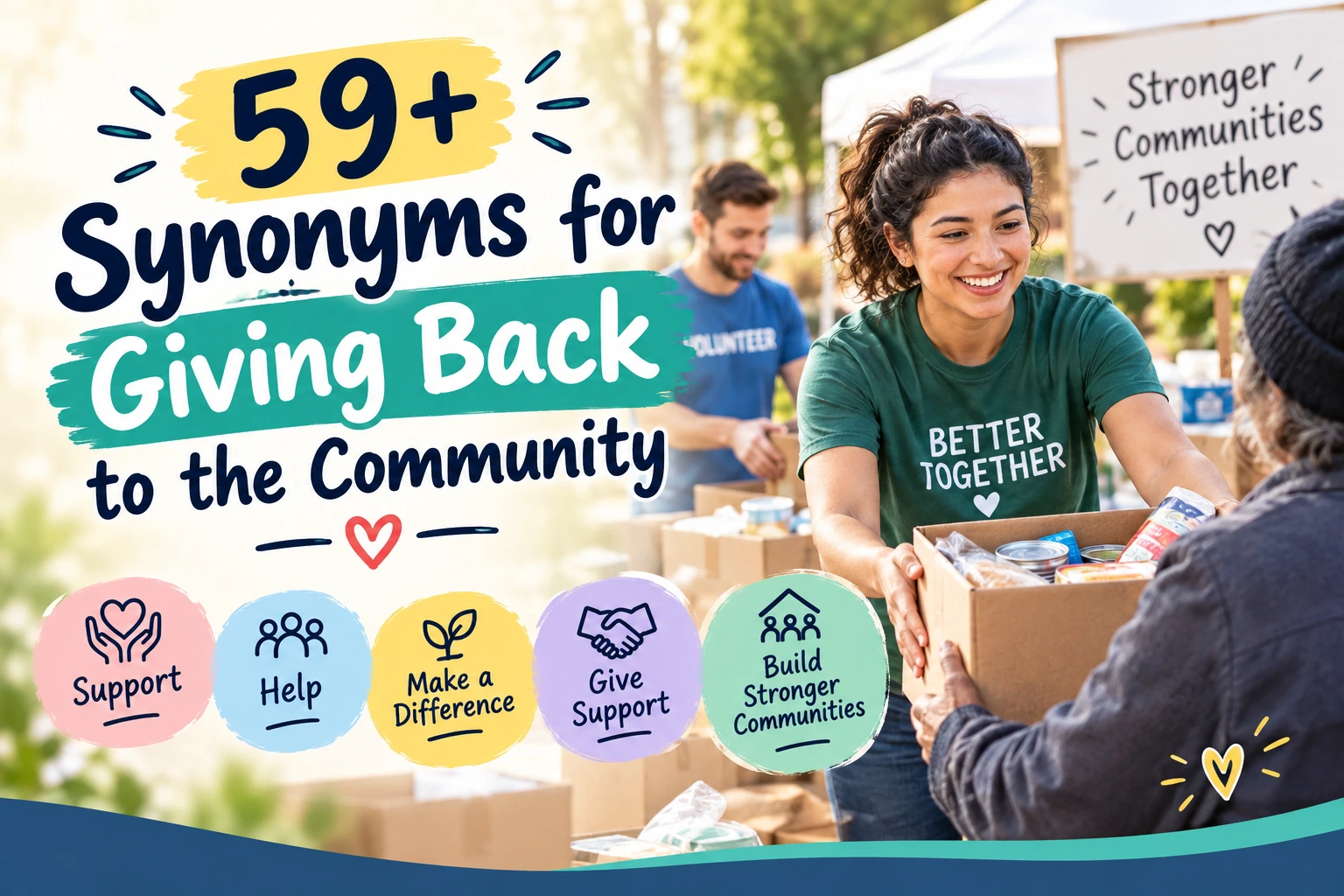
Giving back to the community is more than a phrase—it describes the many ways people use their time, skills, resources, and energy to make life better for others. Whether you are volunteering at a local organization, mentoring young people, supporting a neighborhood project, donating resources, or helping someone develop new skills, there are countless ways to express this meaningful idea.
The phrase “giving back to the community” is warm and widely understood, but using different expressions can make your writing more precise and engaging. This is especially useful when writing a résumé, cover letter, scholarship application, company profile, speech, social media post, or personal statement.
In this guide, you will find 59+ synonyms for giving back to the community, ranging from professional and formal expressions to warm, inspirational, and conversational alternatives.
What Does “Giving Back to the Community” Mean?
“Giving back to the community” means contributing time, effort, knowledge, money, skills, or resources to help other people or improve the community you are part of.
It can include many activities, such as:
- Volunteering for a nonprofit organization
- Supporting local charities
- Mentoring students
- Organizing community events
- Donating useful resources
- Helping vulnerable groups
- Sharing professional knowledge
- Supporting neighborhood projects
- Participating in environmental initiatives
- Creating opportunities for others
The expression usually has a positive, generous, and socially responsible tone. It suggests that someone wants to contribute to something larger than themselves.
For example:
“Our employees enjoy giving back to the community through volunteer projects.”
Depending on the context, you might replace the phrase with something more formal, such as “serving the community,” or something more personal, such as “supporting those around us.”
When to Use It
There are many situations where synonyms for “giving back to the community” can make your communication more specific and polished.
In a résumé or CV
Instead of:
“I enjoy giving back to the community.”
You could write:
“I am committed to community service and volunteer engagement.”
In a scholarship application
“My experience serving local students has strengthened my commitment to community development.”
In a company profile
“Our organization is committed to supporting local communities through education and outreach.”
In a speech
“We have a responsibility to contribute to the communities that have supported us.”
In an email
“We are proud to support local initiatives and create meaningful opportunities for residents.”
In casual conversation
“I enjoy helping out in my neighborhood whenever I can.”
Choosing the right alternative depends on your audience, purpose, and the specific kind of contribution you are describing.
Is It Polite or Professional?
“Giving back to the community” is both polite and professional. It has a positive, generous tone and is commonly used in nonprofit, educational, corporate, and social settings.
However, the phrase can sometimes sound broad. If you are writing a professional document, a more specific expression may communicate your contribution more effectively.
For example:
“I give back to the community.”
is positive but general.
A stronger professional version could be:
“I volunteer as a mentor for local students.”
The second sentence tells the reader exactly how you contribute.
For formal writing, expressions such as “community service,” “civic engagement,” “community development,” and “supporting local initiatives” can sound polished. For personal writing, “helping others,” “supporting my community,” and “making a difference locally” may feel warmer and more natural.
59+ Synonyms for “Giving Back to the Community”
1. Serving the Community
Meaning: Helping and contributing to the people and organizations around you.
Tone: Professional, respectful.
Example: “She has dedicated several years to serving the community through educational programs.”
Short Explanation: This is one of the most natural alternatives for formal writing.
Purpose and Personalization: Use it when your contribution involves ongoing service rather than a single event.
2. Supporting the Community
Meaning: Providing assistance, resources, or encouragement to local people and organizations.
Tone: Warm, professional.
Example: “Our company remains committed to supporting the community through local initiatives.”
Short Explanation: This expression is broad enough to cover donations, volunteering, mentorship, and other forms of assistance.
Purpose and Personalization: Add the specific type of support to make it more meaningful.
3. Contributing to the Community
Meaning: Offering something valuable to improve or strengthen the community.
Tone: Professional, positive.
Example: “I am passionate about contributing to the community through education and mentorship.”
Short Explanation: A polished alternative that works particularly well in applications and professional profiles.
Purpose and Personalization: Mention your skills or resources to explain what you contribute.
4. Serving Others
Meaning: Using your time, abilities, or resources to help other people.
Tone: Compassionate, inspirational.
Example: “Her career has been shaped by a strong desire to serve others.”
Short Explanation: This focuses more on people than on a particular geographic community.
Purpose and Personalization: Ideal for personal statements, speeches, and reflective writing.
5. Helping the Community
Meaning: Taking practical action to assist people around you.
Tone: Friendly, straightforward.
Example: “We organize monthly activities focused on helping the community.”
Short Explanation: Simple and conversational, making it easy to understand.
Purpose and Personalization: Best when writing for a broad audience.
6. Making a Difference
Meaning: Taking action that creates a positive impact.
Tone: Inspirational, motivational.
Example: “Even small acts of kindness can make a difference in the community.”
Short Explanation: This emphasizes the impact rather than the specific activity.
Purpose and Personalization: Pair it with a concrete example for greater credibility.
7. Making a Positive Impact
Meaning: Creating beneficial change for individuals or the community.
Tone: Professional, motivational.
Example: “Our volunteers work together to make a positive impact in underserved neighborhoods.”
Short Explanation: A strong choice for professional and organizational communication.
Purpose and Personalization: Specify the area of impact, such as education, health, or the environment.
8. Contributing to Society
Meaning: Doing something beneficial for society as a whole.
Tone: Formal, thoughtful.
Example: “She hopes to use her skills to contribute to society.”
Short Explanation: This expands the idea beyond a local community.
Purpose and Personalization: Particularly suitable for academic essays and personal statements.
9. Community Service
Meaning: Voluntary work performed to benefit other people or the community.
Tone: Formal, professional.
Example: “His community service includes tutoring students and organizing food drives.”
Short Explanation: This is a widely recognized term in educational and professional settings.
Purpose and Personalization: Use it when discussing structured volunteer activities.
10. Volunteering in the Community
Meaning: Giving your time and effort without expecting payment.
Tone: Friendly, professional.
Example: “Volunteering in the community has taught me valuable leadership skills.”
Short Explanation: More specific than “giving back” because it clearly identifies volunteer work.
Purpose and Personalization: Mention the organization or activity to make the statement stronger.
11. Engaging in Community Service
Meaning: Actively participating in activities that benefit the community.
Tone: Formal, academic.
Example: “Students are encouraged to engage in community service throughout the academic year.”
Short Explanation: This sounds polished and works well in institutional writing.
Purpose and Personalization: Suitable for scholarship essays, applications, and school profiles.
12. Participating in Civic Engagement
Meaning: Taking part in activities that contribute to civic and community life.
Tone: Formal, sophisticated.
Example: “Young people can develop leadership skills through civic engagement.”
Short Explanation: This is broader and more formal than ordinary volunteer work.
Purpose and Personalization: Use it when your activities involve community participation, advocacy, or civic initiatives.
13. Strengthening the Community
Meaning: Taking action that makes a community more connected, capable, or resilient.
Tone: Motivational, professional.
Example: “The initiative focuses on strengthening the community through education.”
Short Explanation: This emphasizes long-term improvement rather than one-time assistance.
Purpose and Personalization: Ideal for nonprofit projects and community development programs.
14. Building Stronger Communities
Meaning: Helping create healthier, more connected, and supportive communities.
Tone: Inspirational, professional.
Example: “We believe that education plays a vital role in building stronger communities.”
Short Explanation: This expression works especially well when discussing long-term social impact.
Purpose and Personalization: Use it for organizational missions and speeches.
15. Supporting Local Initiatives
Meaning: Helping projects and programs designed to benefit a local area.
Tone: Professional, polished.
Example: “The business supports local initiatives focused on youth development.”
Short Explanation: This is useful when your contribution specifically involves local projects.
Purpose and Personalization: Name the initiative or cause for greater specificity.
16. Investing in the Community
Meaning: Putting time, money, knowledge, or resources into community improvement.
Tone: Professional, strategic.
Example: “The organization is investing in the community through scholarships and training programs.”
Short Explanation: This conveys a sense of long-term commitment.
Purpose and Personalization: Particularly effective in corporate social responsibility writing.
17. Giving Back Locally
Meaning: Contributing to people and causes in your local area.
Tone: Warm, conversational.
Example: “Our team enjoys giving back locally during the holiday season.”
Short Explanation: A natural variation that feels personal and approachable.
Purpose and Personalization: Good for social media posts, newsletters, and casual writing.
18. Supporting Those in Need
Meaning: Providing help to people experiencing difficulties or lacking resources.
Tone: Compassionate, caring.
Example: “The organization is dedicated to supporting those in need.”
Short Explanation: This focuses on the people receiving assistance.
Purpose and Personalization: Use it when your work directly benefits vulnerable groups.
19. Helping Those Around Us
Meaning: Offering assistance to people in your immediate community.
Tone: Warm, personal.
Example: “We believe in helping those around us whenever we have the opportunity.”
Short Explanation: This sounds natural and sincere in personal communication.
Purpose and Personalization: Great for speeches, captions, and community messages.
20. Lifting Others Up
Meaning: Helping people become stronger, more confident, or more successful.
Tone: Inspirational, warm.
Example: “Mentorship is one of the most meaningful ways to lift others up.”
Short Explanation: This focuses on empowerment rather than simply providing material assistance.
Purpose and Personalization: Excellent for mentoring, education, and leadership contexts.
21. Empowering Others
Meaning: Giving people knowledge, opportunities, resources, or confidence to improve their lives.
Tone: Motivational, professional.
Example: “Our program focuses on empowering others through practical education.”
Short Explanation: This is especially appropriate when your work helps people become more independent.
Purpose and Personalization: Specify the skills or opportunities you provide.
22. Creating Opportunities
Meaning: Providing pathways for people to learn, work, grow, or succeed.
Tone: Professional, motivational.
Example: “The foundation focuses on creating opportunities for talented young people.”
Short Explanation: This emphasizes sustainable support rather than temporary assistance.
Purpose and Personalization: Ideal for education, employment, and youth-development initiatives.
23. Paying It Forward
Meaning: Passing kindness or assistance on to others after receiving help yourself.
Tone: Friendly, inspirational.
Example: “After receiving a scholarship, she wanted to pay it forward by mentoring other students.”
Short Explanation: This emphasizes a continuing cycle of generosity.
Purpose and Personalization: Particularly effective for personal stories and speeches.
24. Sharing Your Skills
Meaning: Using your knowledge or abilities to help others.
Tone: Friendly, practical.
Example: “Professionals can give back by sharing their skills with younger learners.”
Short Explanation: This reminds readers that contributions do not have to involve money.
Purpose and Personalization: Mention your specific skill to make the phrase more powerful.
25. Sharing Your Expertise
Meaning: Offering specialized knowledge to help others or improve a community.
Tone: Professional, sophisticated.
Example: “She enjoys sharing her expertise with students interested in technology.”
Short Explanation: An excellent alternative for professional profiles and corporate volunteering.
Purpose and Personalization: Mention your field of expertise for clarity.
26. Mentoring Others
Meaning: Guiding and supporting people as they learn and develop.
Tone: Professional, supportive.
Example: “He gives back by mentoring students who are beginning their careers.”
Short Explanation: This describes a specific and meaningful form of community contribution.
Purpose and Personalization: Best when your involvement includes regular guidance.
27. Nurturing Future Generations
Meaning: Helping younger people develop the skills and confidence they need for the future.
Tone: Inspirational, thoughtful.
Example: “Our education program is focused on nurturing future generations.”
Short Explanation: This has a warm, long-term perspective.
Purpose and Personalization: Particularly suitable for education and youth programs.
28. Fostering Community Growth
Meaning: Encouraging positive development within a community.
Tone: Formal, professional.
Example: “The initiative is dedicated to fostering community growth through entrepreneurship.”
Short Explanation: This emphasizes development and progress.
Purpose and Personalization: A strong choice for organizational reports and proposals.
29. Promoting Community Development
Meaning: Supporting projects that improve the social or economic well-being of a community.
Tone: Formal, professional.
Example: “The nonprofit works to promote community development through vocational training.”
Short Explanation: This is particularly useful in formal and nonprofit contexts.
Purpose and Personalization: Mention the specific development area for a stronger statement.
30. Advancing the Community
Meaning: Helping a community progress and improve.
Tone: Formal, ambitious.
Example: “The program aims to advance the community by expanding access to education.”
Short Explanation: This expression communicates progress and forward movement.
Purpose and Personalization: Works well in mission statements and professional writing.
31. Improving Lives
Meaning: Taking action that makes people’s circumstances better.
Tone: Compassionate, inspirational.
Example: “Our volunteers are committed to improving lives through education and support.”
Short Explanation: This focuses directly on the human outcome of community involvement.
Purpose and Personalization: Add the specific way lives are being improved.
32. Making a Meaningful Contribution
Meaning: Providing valuable help that has genuine significance.
Tone: Professional, thoughtful.
Example: “I hope to make a meaningful contribution to the community through my work.”
Short Explanation: This sounds polished without being overly formal.
Purpose and Personalization: Excellent for personal statements and interviews.
33. Making a Lasting Impact
Meaning: Creating positive effects that continue over time.
Tone: Inspirational, professional.
Example: “The organization strives to make a lasting impact on local education.”
Short Explanation: This emphasizes sustainability and long-term results.
Purpose and Personalization: Use it when discussing projects designed to create lasting change.
34. Creating Positive Change
Meaning: Taking action that improves an existing situation.
Tone: Motivational, modern.
Example: “Young volunteers can play an important role in creating positive change.”
Short Explanation: A versatile phrase for speeches, campaigns, and social initiatives.
Purpose and Personalization: Explain what change you hope to create.
35. Building a Better Community
Meaning: Working toward improved conditions and stronger relationships within a community.
Tone: Warm, inspirational.
Example: “Every volunteer plays a role in building a better community.”
Short Explanation: Simple, optimistic, and easy for a broad audience to understand.
Purpose and Personalization: Particularly useful for public-facing communication.
36. Strengthening Local Connections
Meaning: Helping people develop stronger relationships and networks within their area.
Tone: Warm, community-focused.
Example: “The event aims to strengthen local connections among residents.”
Short Explanation: This focuses on relationships rather than material support.
Purpose and Personalization: Ideal for neighborhood events and community-building activities.
37. Building Community Connections
Meaning: Creating relationships between people, groups, and organizations.
Tone: Friendly, professional.
Example: “Volunteering is a valuable way to build community connections.”
Short Explanation: This works well when your contribution involves bringing people together.
Purpose and Personalization: Mention the groups or people being connected.
38. Encouraging Social Responsibility
Meaning: Promoting the idea that people and organizations should contribute positively to society.
Tone: Formal, professional.
Example: “The program encourages social responsibility among young professionals.”
Short Explanation: This expression is particularly suitable for corporate and educational contexts.
Purpose and Personalization: Use it when discussing values, leadership, or organizational culture.
39. Practicing Civic Responsibility
Meaning: Taking responsible action as a member of society.
Tone: Formal, civic-minded.
Example: “Volunteering is one way of practicing civic responsibility.”
Short Explanation: This gives community involvement a more formal civic dimension.
Purpose and Personalization: Suitable for academic essays and speeches.
40. Contributing Your Time
Meaning: Volunteering your time to support a cause or community.
Tone: Simple, professional.
Example: “You can contribute your time by helping at a local learning center.”
Short Explanation: This makes the contribution specific and emphasizes that time itself has value.
Purpose and Personalization: Useful when discussing volunteer opportunities.
41. Donating Your Time and Skills
Meaning: Volunteering both time and abilities for a useful purpose.
Tone: Professional, generous.
Example: “Employees are encouraged to donate their time and skills to local organizations.”
Short Explanation: This clearly communicates that volunteering involves more than financial donations.
Purpose and Personalization: Great for workplace volunteer programs.
42. Volunteering Your Expertise
Meaning: Offering professional knowledge without expecting payment.
Tone: Professional, generous.
Example: “She volunteers her expertise to help nonprofit organizations improve their websites.”
Short Explanation: This is a precise alternative when professional skills are central to the contribution.
Purpose and Personalization: Name the skill or field for maximum clarity.
43. Giving Your Time to a Good Cause
Meaning: Volunteering time to support something beneficial.
Tone: Warm, conversational.
Example: “He enjoys giving his time to a good cause whenever his schedule allows.”
Short Explanation: This sounds natural in everyday communication.
Purpose and Personalization: Use it when you want a sincere but uncomplicated expression.
44. Supporting a Worthwhile Cause
Meaning: Helping an initiative or issue that you believe is valuable.
Tone: Positive, professional.
Example: “The team regularly supports worthwhile causes related to education.”
Short Explanation: This works when the focus is on the cause rather than the community itself.
Purpose and Personalization: Identify the cause to make the statement more concrete.
45. Championing Local Causes
Meaning: Actively supporting causes that benefit the local community.
Tone: Strong, motivational.
Example: “The organization has spent years championing local causes.”
Short Explanation: “Championing” suggests active and enthusiastic support.
Purpose and Personalization: Best when you play an active role rather than simply making a donation.
46. Advocating for the Community
Meaning: Speaking or acting in support of community interests and needs.
Tone: Professional, purposeful.
Example: “She is passionate about advocating for the community and expanding educational access.”
Short Explanation: This is more specific when your contribution involves representation or awareness.
Purpose and Personalization: Identify the issue you advocate for.
47. Standing Up for Others
Meaning: Supporting people when they need help, protection, or representation.
Tone: Courageous, compassionate.
Example: “Community leadership often means standing up for others.”
Short Explanation: This focuses on personal responsibility and solidarity.
Purpose and Personalization: Particularly effective in speeches and inspirational writing.
48. Supporting Local Families
Meaning: Providing assistance to families within a local area.
Tone: Compassionate, personal.
Example: “The volunteers spend weekends supporting local families through food and educational programs.”
Short Explanation: This is more specific than the general phrase “giving back.”
Purpose and Personalization: Use it when families are the direct beneficiaries of your work.
49. Investing in Local People
Meaning: Providing resources, opportunities, education, or support to people in the community.
Tone: Professional, empowering.
Example: “The program invests in local people by providing career training.”
Short Explanation: This emphasizes people as the foundation of community development.
Purpose and Personalization: Especially effective for workforce and education initiatives.
50. Helping Others Thrive
Meaning: Supporting people so they can grow, succeed, and become more independent.
Tone: Inspirational, compassionate.
Example: “Our mission is centered on helping others thrive through education.”
Short Explanation: This conveys a deeper goal than simply providing temporary assistance.
Purpose and Personalization: Ideal for mentoring, education, and empowerment-focused projects.
51. Creating Opportunities for Others
Meaning: Opening doors that allow other people to learn, work, or succeed.
Tone: Motivational, professional.
Example: “Our initiative is focused on creating opportunities for others to develop new skills.”
Short Explanation: This highlights empowerment and long-term impact.
Purpose and Personalization: Specify the opportunities you create, such as training, scholarships, or internships.
52. Sharing Resources
Meaning: Providing useful materials, money, knowledge, or other resources to others.
Tone: Practical, generous.
Example: “The organization believes in sharing resources with schools that need additional support.”
Short Explanation: This is a clear and practical expression for charitable contributions.
Purpose and Personalization: Mention the resource being shared for specificity.
53. Extending a Helping Hand
Meaning: Offering assistance to someone who needs it.
Tone: Warm, compassionate.
Example: “Community members came together to extend a helping hand to families affected by the crisis.”
Short Explanation: This has an empathetic and human quality.
Purpose and Personalization: Best for heartfelt writing, speeches, and community messages.
54. Lending a Hand
Meaning: Helping someone with a task or problem.
Tone: Friendly, casual.
Example: “We are always happy to lend a hand when our neighborhood needs support.”
Short Explanation: This is natural and conversational.
Purpose and Personalization: Great for informal communication and social media.
55. Doing Your Part
Meaning: Contributing your fair share toward a positive goal.
Tone: Casual, motivational.
Example: “Everyone can do their part to make the neighborhood a better place.”
Short Explanation: This makes community involvement feel accessible rather than overwhelming.
Purpose and Personalization: Use it when encouraging collective participation.
56. Being There for Others
Meaning: Providing support, presence, or assistance when people need it.
Tone: Warm, personal.
Example: “Sometimes giving back simply means being there for others when they need you.”
Short Explanation: This highlights emotional and practical support.
Purpose and Personalization: Particularly effective for personal reflections.
57. Giving of Yourself
Meaning: Offering your time, energy, skills, or care for the benefit of others.
Tone: Heartfelt, inspirational.
Example: “True service often begins with a willingness to give of yourself.”
Short Explanation: This expression emphasizes personal commitment and generosity.
Purpose and Personalization: Works beautifully in speeches and reflective writing.
58. Cultivating a Culture of Service
Meaning: Encouraging an environment where helping others becomes a shared value.
Tone: Formal, organizational.
Example: “The company is cultivating a culture of service among its employees.”
Short Explanation: This is particularly useful when discussing organizational values or corporate responsibility.
Purpose and Personalization: Use it for schools, companies, nonprofits, and institutions.
59. Fostering a Spirit of Giving
Meaning: Encouraging generosity and willingness to help others.
Tone: Inspirational, warm.
Example: “The campaign aims to foster a spirit of giving throughout the community.”
Short Explanation: This focuses on creating a broader culture of generosity.
Purpose and Personalization: A strong choice for campaigns, events, and community initiatives.
60. Building a Culture of Care
Meaning: Creating an environment where people actively support and care for one another.
Tone: Compassionate, professional.
Example: “The school is committed to building a culture of care and community support.”
Short Explanation: This emphasizes empathy and collective responsibility.
Purpose and Personalization: Particularly suitable for schools, workplaces, and community organizations.
61. Investing in Social Good
Meaning: Using resources or effort to create positive benefits for society.
Tone: Professional, sophisticated.
Example: “The foundation is investing in social good through education and environmental programs.”
Short Explanation: This is a polished expression for corporate, nonprofit, and philanthropic contexts.
Purpose and Personalization: Best when discussing organized or strategic community impact.
Conclusion
There are countless ways to express the idea of giving back to the community, and the best choice depends on your audience, purpose, and the kind of contribution you are describing. Expressions such as “serving the community,” “making a positive impact,” “empowering others,” and “supporting local initiatives” can make professional writing more precise, while phrases like “lending a hand” and “helping those around us” feel more personal and conversational. Experiment with these alternatives naturally rather than forcing them into your writing. The right expression can make your message sound more sincere, specific, and meaningful.
Discover more