
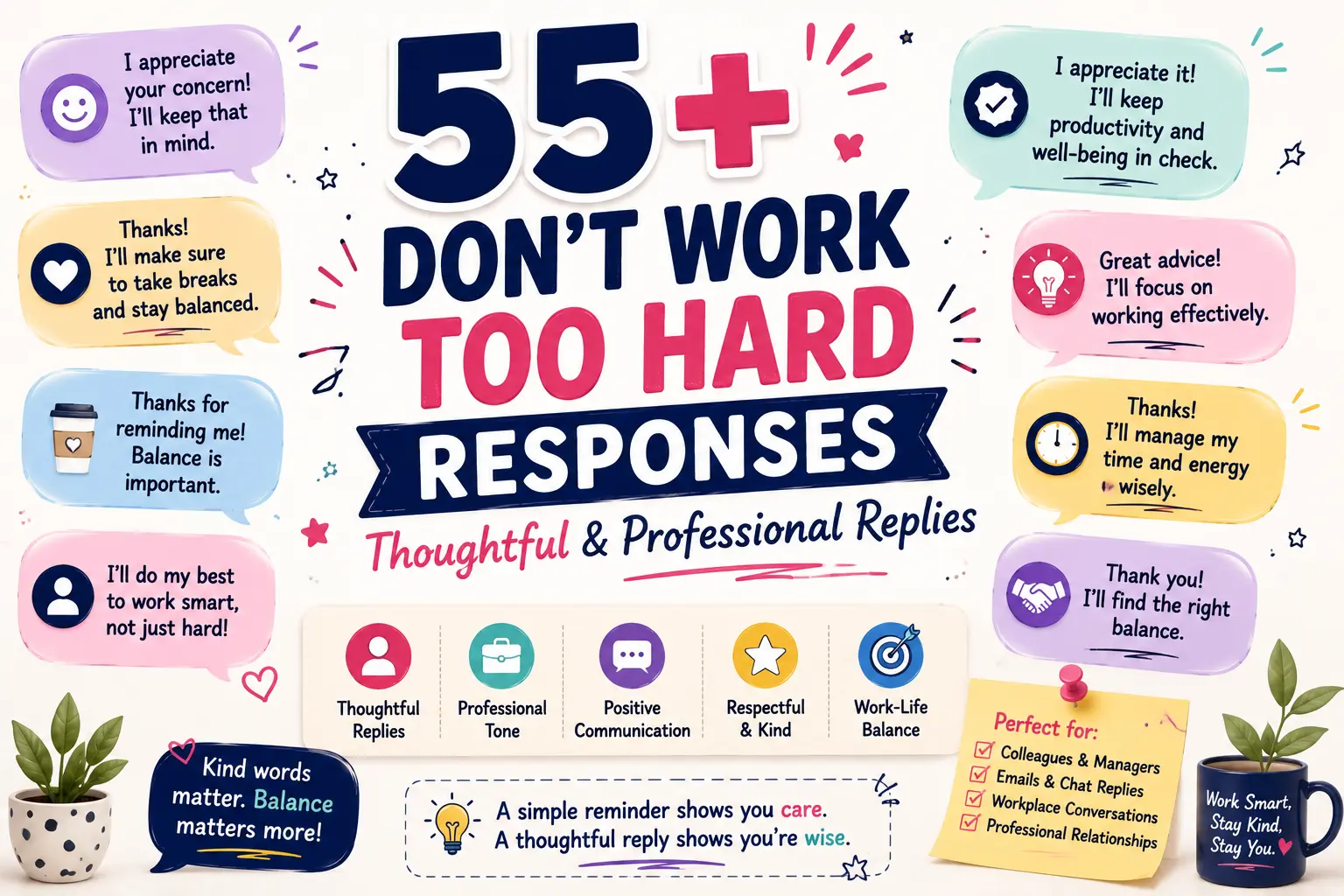
Sometimes, a simple “Don’t work too hard” can say more than it seems. It may be a friendly reminder to take a break, a caring way to show concern, or a lighthearted comment from a colleague, friend, or family member. But knowing how to respond can make the conversation more engaging and personal.
Instead of replying with the same old “You too,” you can choose an answer that matches the situation and your relationship with the other person. Whether you want to sound professional, warm, funny, appreciative, or motivational, the right response can keep the conversation flowing naturally.
In this guide, you’ll find 55+ don’t work too hard responses and thoughtful alternatives that work in everyday conversations, workplace chats, emails, and casual messages.
What Does “Don’t Work Too Hard” Mean?
“Don’t work too hard” is a friendly expression used to encourage someone not to overwork themselves. It usually communicates concern, goodwill, or a reminder to maintain a healthy balance between responsibilities and rest.
The phrase can be completely sincere, but it can also be playful or humorous depending on the context. A coworker might say it before leaving the office, while a friend might use it jokingly when they see you busy.
For example:
“I’m heading home now. Don’t work too hard!”
The emotional tone is generally friendly, caring, and supportive, although the meaning can change depending on how it is delivered.
When to Use “Don’t Work Too Hard”
“Don’t work too hard” is versatile enough for many everyday situations. However, the best response depends on who said it and where the conversation is taking place.
1. With Coworkers
You can use it when ending a conversation with a colleague.
Example:
“Thanks! You have a good evening too.”
2. With Friends
It can be used casually when a friend knows you’re busy.
Example:
“I’ll try! I definitely need a break later.”
3. In Workplace Chats
A short, polite response works well in professional messaging.
Example:
“Thanks, I appreciate that. Have a great evening!”
4. In Emails
A slightly more polished version is better for professional correspondence.
Example:
“Thank you for the kind reminder. I’ll be sure to take some time to recharge.”
5. In Casual Texts
You can be playful, humorous, or affectionate without sounding overly formal.
Example:
“I’ll do my best, but this deadline has other plans!”
6. In Speeches or Public Settings
For speeches, presentations, or formal remarks, use a more thoughtful expression.
Example:
“Thank you for the reminder to maintain a healthy balance between commitment and rest.”
Is “Don’t Work Too Hard” Polite or Professional?
Yes, “Don’t work too hard” is generally polite, but it is more conversational than formal.
It works particularly well among coworkers who have a friendly relationship. However, in highly formal business communication, a phrase such as “Please remember to take some time to rest” may sound more appropriate.
The phrase can also occasionally sound sarcastic, especially when someone says it jokingly to a person who is clearly doing very little. Context and tone matter.
Best settings for “Don’t Work Too Hard”
- Casual conversations
- Friendly workplace chats
- Text messages
- Conversations with coworkers
- Social media messages
- Conversations with friends and family
Better alternatives for formal situations
- “Please remember to take adequate breaks.”
- “I hope you’re able to maintain a healthy work-life balance.”
- “Take some time to recharge when you can.”
- “Please take care of yourself while managing your workload.”
Here are thoughtful, creative, professional, funny, and caring ways to respond to “Don’t work too hard.”
1. Thanks, I’ll Try to Keep a Balance
Meaning: You appreciate their concern and acknowledge the importance of balancing work and rest.
Tone: Friendly, mature, balanced
“Thanks, I’ll try to keep a balance and not let work take over.”
Why use it: This is a natural response when you want to sound responsible without being overly formal.
Purpose and Personalization: Great for coworkers, classmates, or friends who genuinely care about your workload.
2. Thanks for Looking Out for Me
Meaning: You are thanking someone for showing concern.
Tone: Warm, appreciative
“Thanks for looking out for me. I really appreciate it.”
Why use it: Choose this when you want your response to feel more personal.
Purpose and Personalization: Especially suitable when the person regularly checks in on you.
3. I’ll Make Sure to Take a Break
Meaning: You promise to give yourself some time to rest.
Tone: Responsible, friendly
“I’ll make sure to take a break once I finish this part.”
Why use it: Perfect when someone is concerned that you’re working continuously.
Purpose and Personalization: It shows that you value both productivity and your well-being.
4. I’ll Keep That in Mind
Meaning: You acknowledge the advice without making a big commitment.
Tone: Polite, professional
“Thanks, I’ll keep that in mind while I finish this project.”
Why use it: A safe option for workplace conversations.
Purpose and Personalization: It works particularly well when you want a concise but respectful response.
5. Don’t Worry, I Know When to Rest
Meaning: You reassure the other person that you understand your own limits.
Tone: Reassuring, confident
“Don’t worry, I know when to rest. I appreciate you checking in.”
Why use it: Use this when you want to reassure someone without sounding dismissive.
Purpose and Personalization: Works nicely with friends, relatives, and close coworkers.
6. Thanks! I’ll Pace Myself
Meaning: You intend to manage your energy instead of rushing constantly.
Tone: Practical, friendly
“Thanks! I’ll pace myself and get through it steadily.”
Why use it: Ideal when you have a demanding task ahead.
Purpose and Personalization: This response communicates maturity and self-awareness.
7. I’ll Try Not to Overdo It
Meaning: You agree that working excessively isn’t ideal.
Tone: Casual, thoughtful
“I’ll try not to overdo it. Thanks for the reminder!”
Why use it: A natural response for everyday conversations.
Purpose and Personalization: It sounds relaxed without minimizing the person’s concern.
8. Thanks, I Needed That Reminder
Meaning: You recognize that you genuinely needed encouragement to slow down.
Tone: Appreciative, sincere
“Thanks, I needed that reminder. I’ve been focused on this all afternoon.”
Why use it: Perfect when you’ve been immersed in work for a long time.
Purpose and Personalization: Makes the conversation feel genuine rather than scripted.
9. I’ll Do My Best to Take It Easy
Meaning: You will try to avoid unnecessary stress.
Tone: Warm, casual
“I’ll do my best to take it easy once I’m done here.”
Why use it: Good for friendly conversations.
Purpose and Personalization: It works especially well when you want to sound relaxed.
10. Thanks, I Appreciate the Concern
Meaning: You acknowledge someone’s thoughtful concern.
Tone: Professional, respectful
“Thanks, I appreciate the concern. I’ll make sure to take some time away from the screen.”
Why use it: Suitable for workplace communication.
Purpose and Personalization: A polished choice when you want warmth without being overly casual.
11. I’ll Remember to Recharge
Meaning: You recognize the importance of resting and restoring your energy.
Tone: Positive, modern
“I’ll remember to recharge after I wrap this up.”
Why use it: Great for casual or professional conversations.
Purpose and Personalization: “Recharge” gives the response a fresh and positive feel.
12. You’re Right—I Should Take a Break
Meaning: You agree that resting is necessary.
Tone: Honest, friendly
“You’re right—I should take a break before starting the next task.”
Why use it: Use this when you genuinely realize you’ve been working for too long.
Purpose and Personalization: It feels especially natural in conversations with people who know you well.
13. I’ll Keep the Workload in Check
Meaning: You intend to prevent your workload from becoming overwhelming.
Tone: Professional, composed
“Thanks. I’ll keep the workload in check and prioritize what matters.”
Why use it: Excellent for professional settings.
Purpose and Personalization: It demonstrates organization and responsibility.
14. Thanks! I’ll Work Smarter, Not Longer
Meaning: You plan to focus on efficiency instead of simply spending more time working.
Tone: Motivational, confident
“Thanks! I’ll work smarter, not longer.”
Why use it: A strong response when discussing productivity.
Purpose and Personalization: It adds a thoughtful productivity angle to the conversation.
15. I’ll Make Time to Unwind
Meaning: You intend to relax after working.
Tone: Warm, polished
“I’ll make time to unwind once I’m finished with this assignment.”
Why use it: Good for conversations where someone is encouraging you to relax.
Purpose and Personalization: “Unwind” sounds natural and sophisticated without being stiff.
16. Thanks! I’ll Take It One Step at a Time
Meaning: You plan to handle your responsibilities gradually.
Tone: Calm, motivational
“Thanks! I’ll take it one step at a time instead of stressing over everything.”
Why use it: Useful when you have many responsibilities.
Purpose and Personalization: It communicates patience and emotional balance.
17. I’ll Be Sure to Look After Myself
Meaning: You promise to prioritize your well-being.
Tone: Caring, mature
“Thanks for saying that. I’ll be sure to look after myself.”
Why use it: Best when the speaker’s concern is sincere.
Purpose and Personalization: It turns a simple exchange into a warmer interaction.
18. Thanks! I’ll Know When to Step Away
Meaning: You recognize the value of taking breaks.
Tone: Thoughtful, confident
“Thanks! I’ll know when to step away and come back refreshed.”
Why use it: A polished alternative for coworkers or classmates.
Purpose and Personalization: Shows that you understand sustainable productivity.
19. I’ll Try to Keep Things Reasonable
Meaning: You intend not to push yourself unnecessarily.
Tone: Casual, understated
“I’ll try to keep things reasonable and finish what I can today.”
Why use it: Good when you want to sound calm and practical.
Purpose and Personalization: Particularly useful for everyday workplace conversations.
20. Thanks, I’ll Save Some Energy for Tomorrow
Meaning: You plan to avoid exhausting yourself today.
Tone: Friendly, thoughtful
“Thanks, I’ll save some energy for tomorrow too!”
Why use it: Works nicely at the end of a workday.
Purpose and Personalization: It gives the response a light, positive feel.
21. I’ll Try to Maintain a Healthy Balance
Meaning: You recognize the importance of balancing responsibilities with personal time.
Tone: Professional, mature
“I’ll try to maintain a healthy balance while we finish this project.”
Why use it: Excellent for workplace or academic settings.
Purpose and Personalization: A more polished alternative to “I won’t work too hard.”
22. Thanks—I’ll Give Myself Some Breathing Room
Meaning: You intend to allow yourself enough time and space to rest.
Tone: Warm, conversational
“Thanks—I’ll give myself some breathing room after this deadline.”
Why use it: Ideal when someone is concerned about your schedule.
Purpose and Personalization: Sounds empathetic and natural.
23. I’ll Make Sure I Don’t Burn Myself Out
Meaning: You intend to avoid excessive pressure and exhaustion.
Tone: Honest, modern
“I’ll make sure I don’t burn myself out trying to finish everything tonight.”
Why use it: Good for informal conversations.
Purpose and Personalization: It directly acknowledges the concern behind the original phrase.
24. Thanks! I’ll Take Some Time to Reset
Meaning: You plan to pause and mentally refresh.
Tone: Modern, thoughtful
“Thanks! I’ll take some time to reset after I finish this.”
Why use it: Great for friends, classmates, and coworkers.
Purpose and Personalization: “Reset” sounds contemporary and relaxed.
25. I’ll Keep My Priorities Straight
Meaning: You will focus on important tasks rather than trying to do everything at once.
Tone: Professional, confident
“I’ll keep my priorities straight and avoid taking on unnecessary tasks.”
Why use it: Particularly useful in professional environments.
Purpose and Personalization: Shows organization rather than simply promising to work less.
26. Thanks! I’ll Take Your Advice
Meaning: You appreciate the advice and intend to follow it.
Tone: Polite, sincere
“Thanks! I’ll take your advice and step away for a while.”
Why use it: A simple response that works in almost any situation.
Purpose and Personalization: Ideal when you want to acknowledge someone’s kindness directly.
27. I’ll Try to Keep My Evenings Work-Free
Meaning: You plan to protect your personal time.
Tone: Professional, balanced
“I’ll try to keep my evenings work-free once this deadline passes.”
Why use it: Useful in conversations about work-life balance.
Purpose and Personalization: Best when discussing long-term habits.
28. I’ll Leave Some Room for Fun
Meaning: You plan to balance work with enjoyable activities.
Tone: Playful, upbeat
“Don’t worry—I’ll leave some room for fun too!”
Why use it: Perfect for friends and casual chats.
Purpose and Personalization: Adds humor and positivity to the response.
29. I’ll Work at a Sensible Pace
Meaning: You plan to work steadily without rushing.
Tone: Professional, composed
“Thanks. I’ll work at a sensible pace and focus on quality.”
Why use it: Suitable for workplace conversations.
Purpose and Personalization: It communicates productivity without glorifying overwork.
30. Thanks! I’ll Give Myself Permission to Pause
Meaning: You recognize that breaks are worthwhile.
Tone: Reflective, supportive
“Thanks! I’ll give myself permission to pause when I need to.”
Why use it: A thoughtful response to someone expressing genuine concern.
Purpose and Personalization: Particularly effective when discussing busy periods.
Funny and Playful Don’t Work Too Hard Responses
Sometimes the best answer is one that makes the other person laugh.
31. Too Late, I’m Already in Too Deep!
Meaning: You’re joking that you’ve already become heavily involved in your work.
Tone: Funny, playful
“Too late, I’m already in too deep!”
Why use it: Great for friends or close coworkers.
Purpose and Personalization: Keeps the conversation light without taking the comment too seriously.
32. I’ll Try, but My Deadline Has Other Plans
Meaning: Your deadline is forcing you to stay focused.
Tone: Humorous, relatable
“I’ll try, but my deadline has other plans.”
Why use it: Perfect for workplace or student conversations.
Purpose and Personalization: A relatable way to joke about being busy.
33. Define “Too Hard.”
Meaning: You’re jokingly challenging the idea of what counts as working too much.
Tone: Dry, witty
“Define ‘too hard.’ I’m still negotiating with my workload.”
Why use it: Best with people who understand your sense of humor.
Purpose and Personalization: Works particularly well in playful conversations.
34. I’ll Add “Relax” to My To-Do List
Meaning: You’re humorously treating relaxation like another task.
Tone: Clever, funny
“I’ll add ‘relax’ to my to-do list.”
Why use it: Great for texting friends or coworkers.
Purpose and Personalization: A witty response for people who joke about productivity.
35. I’m Working on It—Literally
Meaning: You playfully point out that you’re currently working.
Tone: Funny, casual
“I’m working on it—literally.”
Why use it: Ideal for a quick humorous reply.
Purpose and Personalization: Short, clever, and easy to use in texts.
36. Don’t Worry, I’m Only Slightly Overachieving
Meaning: You’re joking about being unusually hardworking.
Tone: Playful, sarcastic
“Don’t worry, I’m only slightly overachieving today.”
Why use it: Use this with friends or colleagues who appreciate sarcasm.
Purpose and Personalization: Adds personality without making the conversation too serious.
37. I’ll Try to Keep My Inner Workaholic Under Control
Meaning: You’re joking about your tendency to keep working.
Tone: Humorous, self-aware
“I’ll try to keep my inner workaholic under control.”
Why use it: Good for informal conversations.
Purpose and Personalization: Shows self-awareness while keeping things light.
38. My Laptop and I Are in This Together
Meaning: You’re joking that you and your computer are committed to the task.
Tone: Funny, casual
“My laptop and I are in this together.”
Why use it: Perfect for students, freelancers, and office workers.
Purpose and Personalization: A fun response for digital-work situations.
39. I’ll Stop Before the Coffee Stops Working
Meaning: You’re joking about relying on coffee to keep going.
Tone: Playful
“I’ll stop before the coffee stops working.”
Why use it: Works best in casual conversations.
Purpose and Personalization: A humorous way to acknowledge that you need limits.
40. I’ll Pretend I Know How to Relax
Meaning: You’re joking about finding it difficult to stop working.
Tone: Witty, casual
“I’ll pretend I know how to relax!”
Why use it: Best for friends and close colleagues.
Purpose and Personalization: Makes the conversation more playful.
Professional Responses to “Don’t Work Too Hard”
41. Thank You for the Reminder to Maintain Balance
Meaning: You appreciate the reminder to balance productivity and personal time.
Tone: Formal, professional
“Thank you for the reminder to maintain balance while managing the project.”
Why use it: Appropriate for workplace communication.
Purpose and Personalization: A polished alternative for professional environments.
42. I Appreciate That. I’ll Be Mindful of My Workload
Meaning: You will pay attention to how much work you’re taking on.
Tone: Professional, respectful
“I appreciate that. I’ll be mindful of my workload this week.”
Why use it: Excellent for managers, colleagues, or mentors.
Purpose and Personalization: Communicates maturity and accountability.
43. Thank You. I’ll Make Sure to Take Appropriate Breaks
Meaning: You acknowledge the importance of taking breaks.
Tone: Formal, responsible
“Thank you. I’ll make sure to take appropriate breaks throughout the day.”
Why use it: Suitable for formal professional settings.
Purpose and Personalization: Clear, respectful, and workplace-friendly.
44. I Appreciate the Thought. I’ll Keep Things Sustainable
Meaning: You plan to work in a way that can be maintained over time.
Tone: Professional, sophisticated
“I appreciate the thought. I’ll keep things sustainable as we move forward.”
Why use it: Great for discussions about long-term projects.
Purpose and Personalization: “Sustainable” emphasizes consistent productivity rather than short bursts of overwork.
45. Thank You. I’ll Prioritize What Matters Most
Meaning: You intend to focus on essential tasks rather than doing everything at once.
Tone: Professional, confident
“Thank you. I’ll prioritize what matters most and avoid unnecessary pressure.”
Why use it: Ideal for workplace conversations.
Purpose and Personalization: Demonstrates strategic thinking.
46. I’ll Keep an Eye on My Work-Life Balance
Meaning: You intend to protect time outside work.
Tone: Professional, thoughtful
“Thanks. I’ll keep an eye on my work-life balance during this busy period.”
Why use it: Appropriate for professional or academic contexts.
Purpose and Personalization: Particularly useful during demanding projects.
47. Thank You. I’ll Pace the Work Accordingly
Meaning: You will manage your workload at an appropriate speed.
Tone: Formal, composed
“Thank you. I’ll pace the work accordingly and focus on maintaining quality.”
Why use it: Suitable for formal workplace discussions.
Purpose and Personalization: Sounds measured and professional.
48. I Appreciate Your Concern. I’ll Take Time to Recharge
Meaning: You recognize the person’s concern and intend to rest.
Tone: Warm, professional
“I appreciate your concern. I’ll take some time to recharge after the project milestone.”
Why use it: Useful when speaking with someone senior or professional.
Purpose and Personalization: Combines courtesy with a healthy-work message.
Caring and Thoughtful Responses
49. That’s Kind of You to Say
Meaning: You appreciate their thoughtful words.
Tone: Warm, sincere
“That’s kind of you to say. I’ll make sure to take care of myself.”
Why use it: Perfect when someone is genuinely looking out for you.
Purpose and Personalization: Makes your response feel personal and appreciative.
50. I Really Appreciate You Checking In
Meaning: You are grateful that someone took the time to ask about you.
Tone: Caring, sincere
“I really appreciate you checking in. I’ve been quite busy lately.”
Why use it: Best when the person is showing genuine concern.
Purpose and Personalization: Helps strengthen supportive relationships.
51. That Means a Lot—Thank You
Meaning: Their concern genuinely matters to you.
Tone: Heartfelt, warm
“That means a lot—thank you for reminding me to slow down.”
Why use it: Suitable when the person’s words have emotional significance.
Purpose and Personalization: Adds warmth to an otherwise ordinary exchange.
52. I’ll Take Good Care of Myself
Meaning: You reassure them that you won’t ignore your own needs.
Tone: Reassuring, caring
“Don’t worry, I’ll take good care of myself.”
Why use it: A natural response when someone is concerned about you.
Purpose and Personalization: Works with family, friends, and close colleagues.
53. Thanks for Caring
Meaning: You directly acknowledge the person’s concern.
Tone: Warm, simple
“Thanks for caring. I’ll make sure I get some downtime.”
Why use it: Great when you want to keep your response short but meaningful.
Purpose and Personalization: Particularly effective with close friends and family.
54. I’ll Try to Be Kinder to Myself
Meaning: You recognize that you should not put unnecessary pressure on yourself.
Tone: Reflective, thoughtful
“Thanks. I’ll try to be kinder to myself during this busy week.”
Why use it: A meaningful response to someone who genuinely cares about your well-being.
Purpose and Personalization: Gives the conversation a more reflective and personal tone.
55. I’ll Remember That Rest Is Part of the Process
Meaning: You recognize that rest can support sustainable productivity.
Tone: Motivational, thoughtful
“I’ll remember that rest is part of the process, not a distraction from it.”
Why use it: Excellent for meaningful conversations about work or study.
Purpose and Personalization: This response sounds mature and encouraging.
Quick Responses to “Don’t Work Too Hard”
If you need something short for a text or chat, try:
- “Thanks, I’ll try!”
- “I’ll keep that in mind!”
- “You too—take care!”
- “I’ll pace myself!”
- “Thanks for looking out!”
- “I’ll make time to relax!”
- “I’ll try not to overdo it!”
- “Thanks, I appreciate it!”
- “I’ll take a break soon!”
- “Don’t worry, I’ve got it!”
- “I’ll keep things balanced!”
- “Thanks! I’ll recharge later.”
- “I’ll do my best!”
- “Noted—I’ll take it easy.”
- “I’ll save some energy for tomorrow!”
How to Choose the Best Response
The ideal response depends less on the exact words and more on your relationship with the person and the situation.
For a coworker:
“Thanks, I’ll pace myself.”
For your manager:
“I appreciate that. I’ll be mindful of my workload.”
For a close friend:
“Thanks for looking out for me!”
For a funny conversation:
“I’ll add ‘relax’ to my to-do list.”
For someone genuinely concerned:
“That’s kind of you to say. I’ll make sure to take care of myself.”
For a formal email:
“Thank you for the reminder. I’ll make sure to maintain a healthy balance.”
For a motivational conversation:
“I’ll work smarter, not longer.”
Choosing an appropriate response makes your communication sound more natural and intentional.
Conclusion
Knowing different don’t work too hard responses gives you more ways to communicate appreciation, humor, professionalism, and warmth. Instead of automatically saying “You too,” you can choose a response that reflects the situation and your relationship with the other person.
Whether you’re replying to a coworker, friend, manager, classmate, or family member, small changes in wording can make everyday conversations feel more genuine. Try experimenting with different expressions and choose the one that naturally matches your personality. The best response isn’t necessarily the most complicated—it’s the one that feels authentic and fits the moment.
Discover more
funny ways to say shit hit the fan