
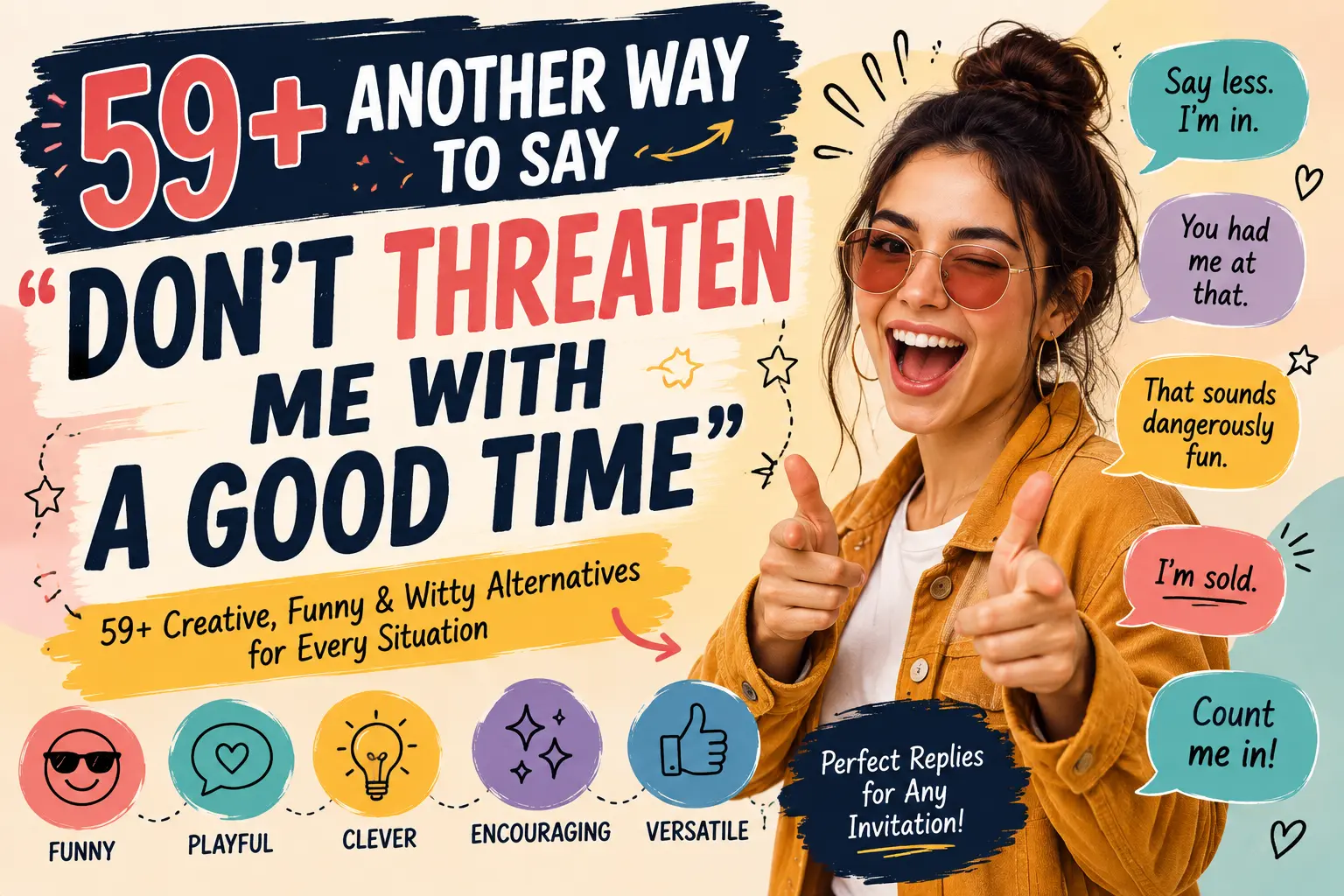
Sometimes, a familiar phrase says exactly what you mean, but it can still feel a little overused. “Don’t threaten me with a good time” is a playful expression people use when they are enthusiastically accepting an appealing idea, invitation, or opportunity. Its humor comes from pretending that something enjoyable is actually a “threat.” Because the phrase is casual and witty, it works especially well in texts, social conversations, captions, and friendly banter. However, you may want a different expression when you are trying to sound more natural, clever, enthusiastic, or professional. The right alternative can make your response feel more personal and better suited to the situation. In this guide, you will find 59+ creative alternatives, along with meanings, tones, examples, and practical tips for choosing the right expression.
What Does “Don’t Threaten Me With a Good Time” Mean?
“Don’t threaten me with a good time” is a humorous way of saying, “That sounds great, and I would definitely enjoy it.”
The speaker is not actually feeling threatened. Instead, the phrase uses playful exaggeration to show excitement about an enjoyable plan or opportunity.
For example, if a friend says, “We are getting pizza and watching movies tonight,” you might reply, “Don’t threaten me with a good time.”
The expression is usually informal, lighthearted, and enthusiastic. It can also suggest that the speaker is very easily persuaded when something fun is involved.
When to Use It
The original phrase is best suited to casual situations. You can use it when chatting with friends, responding to an invitation, commenting on social media, or joking with someone you know well.
Casual conversation
“We are ordering food and playing games tonight.”
Response: “Don’t threaten me with a good time.”
Text messages
“Want to spend Saturday exploring the new café district?”
Response: “You know I can’t say no to that.”
Social media
“Beach day, good food, and no responsibilities.”
Response: “That sounds dangerously good.”
Friendly invitations
“Come over. We have snacks and movies.”
Response: “Say less. I’m in.”
For formal emails, workplace conversations, or professional presentations, however, a simpler expression such as “That sounds like a great opportunity” is usually more appropriate.
Is “Don’t Threaten Me With a Good Time” Polite or Professional?
The phrase is polite in the right social setting, but it is not particularly formal or professional.
It has a humorous, conversational quality. Therefore, it works best with friends, classmates, relatives, familiar coworkers, and people who understand your sense of humor.
In a professional email, you could instead write:
“That sounds like an excellent opportunity.”
Or:
“I would be happy to take part.”
The key is to match the expression with the relationship and setting. A playful phrase can make casual communication warmer, while a straightforward response can make professional communication clearer.
1. “Say less. I’m in.”
Meaning: You have already heard enough to agree.
Tone: Casual, confident, enthusiastic.
Example: “There’s food, music, and a movie marathon.” “Say less. I’m in.”
Why use it: This is perfect for texting when you want to show immediate enthusiasm without overexplaining.
Purpose and personalization: It feels modern and confident, especially in conversations with close friends.
2. “That sounds like my kind of plan.”
Meaning: The proposed activity suits your interests.
Tone: Friendly and relaxed.
Example: “We’re getting dinner and checking out the new bookstore.” “That sounds like my kind of plan.”
Why use it: Choose this when you genuinely like the idea and want to sound natural.
Purpose and personalization: Add a specific detail to make it more personal, such as “That sounds exactly like my kind of Saturday.”
3. “You had me at that.”
Meaning: The idea was enough to convince you immediately.
Tone: Playful and enthusiastic.
Example: “We’re ordering pizza and watching old movies.” “You had me at pizza.”
Why use it: It works especially well when one part of the plan is particularly appealing.
Purpose and personalization: Replace “that” with the thing you are most excited about.
4. “I’m definitely not saying no to that.”
Meaning: You are interested and probably willing to participate.
Tone: Playful and casual.
Example: “Want to try that new restaurant tonight?” “I’m definitely not saying no to that.”
Why use it: This gives you a humorous way to show interest without sounding overly excited.
Purpose and personalization: It is useful when you want to keep your response relaxed.
5. “That sounds dangerously fun.”
Meaning: The idea sounds extremely enjoyable.
Tone: Witty and playful.
Example: “A whole day of games and snacks?” “That sounds dangerously fun.”
Why use it: This keeps the exaggerated humor of the original phrase.
Purpose and personalization: It works particularly well in texts and casual conversations.
6. “Well, now I’m interested.”
Meaning: The suggestion has caught your attention.
Tone: Casual and confident.
Example: “There’s a new café with unlimited desserts.” “Well, now I’m interested.”
Why use it: Use this when someone has introduced an idea that genuinely appeals to you.
Purpose and personalization: It sounds natural without being overly enthusiastic.
7. “You’re making this very hard to resist.”
Meaning: The opportunity sounds too appealing to decline.
Tone: Playful and expressive.
Example: “We’re going for burgers and then bowling.” “You’re making this very hard to resist.”
Why use it: It adds personality while clearly showing interest.
Purpose and personalization: Keep it friendly by using it for plans rather than making the conversation overly dramatic.
8. “I could be convinced.”
Meaning: You are becoming interested in the suggestion.
Tone: Light and slightly teasing.
Example: “How about coffee and a walk after class?” “I could be convinced.”
Why use it: This is useful when you want to sound interested but not immediately committed.
Purpose and personalization: It gives the other person room to continue persuading you.
9. “That’s an offer I can get behind.”
Meaning: You support or approve of the idea.
Tone: Friendly and confident.
Example: “Let’s skip the boring plans and get ice cream.” “That’s an offer I can get behind.”
Why use it: This phrase works well when you want to sound enthusiastic without using slang.
Purpose and personalization: It can work in both casual conversation and relaxed workplace settings.
10. “I’m listening.”
Meaning: You are interested in hearing more.
Tone: Simple and conversational.
Example: “I have an idea for what we could do this weekend.” “I’m listening.”
Why use it: It creates curiosity and encourages the person to explain their idea.
Purpose and personalization: This is especially useful when you are not ready to commit yet.
11. “Now that’s tempting.”
Meaning: The suggestion is very appealing.
Tone: Playful and casual.
Example: “There’s a dessert place open late tonight.” “Now that’s tempting.”
Why use it: It shows interest without making a firm commitment.
Purpose and personalization: It works particularly well when someone presents you with an unexpectedly good idea.
12. “I’m sold.”
Meaning: You are completely convinced.
Tone: Confident and casual.
Example: “We can get food and watch your favorite movie.” “I’m sold.”
Why use it: This is short, clear, and easy to use.
Purpose and personalization: It works especially well in text messages because it gets your point across quickly.
13. “Count me in.”
Meaning: You want to participate.
Tone: Friendly and enthusiastic.
Example: “We’re going hiking Saturday morning.” “Count me in.”
Why use it: This is one of the most versatile alternatives.
Purpose and personalization: Use it whenever you want to clearly accept an invitation.
14. “I’m absolutely down for that.”
Meaning: You are completely willing to participate.
Tone: Casual and enthusiastic.
Example: “Want to grab some food after class?” “I’m absolutely down for that.”
Why use it: It feels natural in everyday conversations.
Purpose and personalization: This is particularly effective in casual texting.
15. “That sounds way too good to pass up.”
Meaning: The idea is so appealing that declining would be difficult.
Tone: Playful and enthusiastic.
Example: “Free concert tickets and dinner afterward?” “That sounds way too good to pass up.”
Why use it: Use this when the offer genuinely sounds exceptional.
Purpose and personalization: It communicates excitement without relying on slang.
16. “I’m not exactly going to complain.”
Meaning: You are pleased with the situation.
Tone: Dry, humorous, relaxed.
Example: “We finished early, so we can leave.” “I’m not exactly going to complain.”
Why use it: This is excellent when you prefer understated humor.
Purpose and personalization: The understatement makes the response funnier.
17. “You make a compelling case.”
Meaning: The suggestion is convincing.
Tone: Clever and polished.
Example: “We could spend the afternoon at the arcade.” “You make a compelling case.”
Why use it: Choose this when you want a more sophisticated alternative.
Purpose and personalization: It works well with friends and in relaxed professional conversations.
18. “I like where this is going.”
Meaning: You approve of the direction of the conversation or plan.
Tone: Playful and confident.
Example: “First dinner, then dessert, then a movie.” “I like where this is going.”
Why use it: This works when a plan becomes increasingly appealing.
Purpose and personalization: It adds humor without being too exaggerated.
19. “This is exactly what I needed.”
Meaning: The suggestion is particularly welcome.
Tone: Warm and appreciative.
Example: “Forget studying tonight. Let’s take a break and get dinner.” “This is exactly what I needed.”
Why use it: Use this when the idea arrives at a perfect moment.
Purpose and personalization: It can express genuine appreciation as well as excitement.
20. “You know me too well.”
Meaning: Someone has suggested something they know you will enjoy.
Tone: Warm and playful.
Example: “I picked up your favorite snacks.” “You know me too well.”
Why use it: This is ideal when someone remembers your preferences.
Purpose and personalization: It makes your response feel more personal and appreciative.
21. “Well, I’m certainly not objecting.”
Meaning: You approve of the suggestion.
Tone: Witty and understated.
Example: “We’re ordering pizza instead of cooking.” “Well, I’m certainly not objecting.”
Why use it: This is a polished alternative with a subtle humorous edge.
Purpose and personalization: It works particularly well when you want dry humor.
22. “That’s hard to argue with.”
Meaning: The suggestion is difficult to reject.
Tone: Casual and clever.
Example: “Why cook when we can order our favorite food?” “That’s hard to argue with.”
Why use it: It works well when someone makes a convincing suggestion.
Purpose and personalization: Use it when you want to acknowledge that the idea makes sense.
23. “You’ve got my attention.”
Meaning: The idea has become interesting to you.
Tone: Confident and conversational.
Example: “There’s a new place with live music tonight.” “You’ve got my attention.”
Why use it: This is a good response when you want to hear more before deciding.
Purpose and personalization: It adds a little mystery to your reply.
24. “That sounds like a win.”
Meaning: The suggestion seems beneficial or enjoyable.
Tone: Positive and casual.
Example: “We can finish the project early and grab lunch.” “That sounds like a win.”
Why use it: It works for both social plans and everyday situations.
Purpose and personalization: It is especially useful when several benefits come together.
25. “I’m not about to turn that down.”
Meaning: You are very willing to accept.
Tone: Casual and confident.
Example: “There’s extra pizza in the kitchen.” “I’m not about to turn that down.”
Why use it: This gives your response a relaxed, humorous quality.
Purpose and personalization: It works best when the situation is clearly positive.
26. “That’s my kind of trouble.”
Meaning: The situation sounds like fun.
Tone: Playful and humorous.
Example: “Late-night snacks and board games?” “That’s my kind of trouble.”
Why use it: It keeps the exaggerated humor of the original phrase.
Purpose and personalization: Use it for harmless, enjoyable situations.
27. “I see absolutely no downside.”
Meaning: You cannot find a reason to reject the idea.
Tone: Dry and humorous.
Example: “Movie, snacks, and no early morning plans.” “I see absolutely no downside.”
Why use it: This is great for understated humor.
Purpose and personalization: The serious wording makes the joke work.
28. “You’re speaking my language.”
Meaning: You have suggested something I really like.
Tone: Friendly and playful.
Example: “Pizza, movies, and dessert?” “You’re speaking my language.”
Why use it: This is an expressive way to show shared interests.
Purpose and personalization: It works especially well when someone understands your preferences.
29. “That’s a very persuasive proposal.”
Meaning: The suggestion is convincing.
Tone: Witty and polished.
Example: “We could take a break and get coffee.” “That’s a very persuasive proposal.”
Why use it: It adds a slightly formal twist to a casual situation.
Purpose and personalization: The contrast between formal wording and a fun situation creates humor.
30. “I’m already considering it.”
Meaning: You are seriously thinking about accepting.
Tone: Casual and thoughtful.
Example: “Want to join us for dinner?” “I’m already considering it.”
Why use it: Choose this when you want to express interest without immediately agreeing.
Purpose and personalization: It leaves the conversation open.
31. “You really know how to sell an idea.”
Meaning: Someone has presented an attractive proposal.
Tone: Playful and appreciative.
Example: “Free food and a movie afterward?” “You really know how to sell an idea.”
Why use it: It compliments the person while showing your interest.
Purpose and personalization: It is especially useful when someone has successfully persuaded you.
32. “I’m listening very carefully now.”
Meaning: The suggestion has become especially interesting.
Tone: Humorous and conversational.
Example: “There might be dessert after dinner.” “I’m listening very carefully now.”
Why use it: This creates a funny shift in attention.
Purpose and personalization: It works best when one detail suddenly makes a plan more appealing.
33. “That sounds suspiciously enjoyable.”
Meaning: The idea sounds unusually fun.
Tone: Witty and playful.
Example: “We’re spending the afternoon playing games.” “That sounds suspiciously enjoyable.”
Why use it: It uses playful exaggeration without being overly dramatic.
Purpose and personalization: It is a strong choice for humorous texting.
34. “I can work with that.”
Meaning: You approve of the proposal.
Tone: Casual and confident.
Example: “How about coffee instead of lunch?” “I can work with that.”
Why use it: This is useful when you are agreeing to a practical plan.
Purpose and personalization: It sounds natural and relaxed.
35. “That’s not exactly a difficult sell.”
Meaning: The idea is very easy to accept.
Tone: Dry and humorous.
Example: “We’re getting your favorite food tonight.” “That’s not exactly a difficult sell.”
Why use it: This is ideal for people who enjoy understated humor.
Purpose and personalization: It sounds clever without becoming overly dramatic.
36. “You had me at the first sentence.”
Meaning: You were convinced almost immediately.
Tone: Playful and enthusiastic.
Example: “There’s food, music, and a late start tomorrow.” “You had me at the first sentence.”
Why use it: This works when someone presents an especially appealing idea.
Purpose and personalization: It adds personality to an otherwise simple acceptance.
37. “I’m already looking forward to it.”
Meaning: You are genuinely excited about the plan.
Tone: Warm and sincere.
Example: “We’re finally meeting up this weekend.” “I’m already looking forward to it.”
Why use it: Use this when you want to sound sincere rather than humorous.
Purpose and personalization: It is one of the safest choices when you want warmth and enthusiasm.
38. “That sounds like a solid plan.”
Meaning: You think the proposed plan is good.
Tone: Friendly and straightforward.
Example: “Let’s finish our work and grab dinner afterward.” “That sounds like a solid plan.”
Why use it: This is useful when you want to sound positive without being overly playful.
Purpose and personalization: It works in both casual and semi-professional conversations.
39. “I’m very easily persuaded by that.”
Meaning: The suggestion is highly appealing.
Tone: Humorous and self-aware.
Example: “There are fresh cookies in the kitchen.” “I’m very easily persuaded by that.”
Why use it: It adds personality while remaining friendly.
Purpose and personalization: Use it when the attraction of the idea is obvious.
40. “Well, that changes everything.”
Meaning: New information has made the situation much more appealing.
Tone: Dramatic and playful.
Example: “Actually, there’s free dessert too.” “Well, that changes everything.”
Why use it: This works particularly well as a humorous reaction to unexpected good news.
Purpose and personalization: It creates a little dramatic effect without sounding serious.
41. “You’re making a strong argument here.”
Meaning: The suggestion is becoming difficult to reject.
Tone: Clever and conversational.
Example: “We can finish the work tomorrow and relax tonight.” “You’re making a strong argument here.”
Why use it: It is useful when someone is gradually convincing you.
Purpose and personalization: It sounds more polished than ordinary slang.
42. “I’m intrigued.”
Meaning: You are interested and want to know more.
Tone: Polished and curious.
Example: “I have an unusual idea for the weekend.” “I’m intrigued.”
Why use it: Choose this when you want to show interest without immediately agreeing.
Purpose and personalization: It is concise and works in many settings.
43. “That’s quite the invitation.”
Meaning: The invitation sounds particularly appealing.
Tone: Playful and slightly formal.
Example: “Dinner, dessert, and a movie afterward.” “That’s quite the invitation.”
Why use it: The slightly formal wording gives the response a humorous edge.
Purpose and personalization: It is ideal when you want to sound amused and impressed.
44. “You’re not making it easy to say no.”
Meaning: The offer is very appealing.
Tone: Friendly and playful.
Example: “We’re ordering your favorite food tonight.” “You’re not making it easy to say no.”
Why use it: This communicates enthusiasm while keeping the tone relaxed.
Purpose and personalization: It works well when someone knows exactly what you like.
45. “That’s exactly the kind of invitation I like.”
Meaning: You strongly approve of the invitation.
Tone: Warm and enthusiastic.
Example: “Come over for snacks and a movie.” “That’s exactly the kind of invitation I like.”
Why use it: It makes your approval very clear.
Purpose and personalization: This works particularly well for friendly invitations.
46. “I’m going to have a hard time resisting that.”
Meaning: The suggestion is extremely appealing.
Tone: Playful and conversational.
Example: “There’s a new dessert place downtown.” “I’m going to have a hard time resisting that.”
Why use it: It maintains the playful spirit of the original phrase.
Purpose and personalization: It is especially natural in text conversations.
47. “That’s dangerously close to my perfect plan.”
Meaning: The suggestion closely matches what you would enjoy.
Tone: Humorous and expressive.
Example: “Coffee, books, and a quiet afternoon.” “That’s dangerously close to my perfect plan.”
Why use it: Use this when the plan matches your interests unusually well.
Purpose and personalization: Mention a specific activity to make it feel authentic.
48. “You had me convinced before you finished.”
Meaning: You agreed very quickly.
Tone: Warm and playful.
Example: “We can get food and stop by the bookstore.” “You had me convinced before you finished.”
Why use it: It shows genuine enthusiasm.
Purpose and personalization: This works especially well when someone knows your interests.
49. “I’m not seeing a reason to decline.”
Meaning: You see no good reason to reject the offer.
Tone: Calm and witty.
Example: “Dinner is covered, and we can leave early.” “I’m not seeing a reason to decline.”
Why use it: This gives a straightforward response a subtle humorous twist.
Purpose and personalization: It is a good option when you prefer understated humor.
50. “That sounds exceptionally tempting.”
Meaning: The proposal is very appealing.
Tone: Polished and playful.
Example: “There’s a new café with an incredible dessert menu.” “That sounds exceptionally tempting.”
Why use it: Choose this when you want something more refined than casual slang.
Purpose and personalization: It works well in written conversations.
51. “I’m having trouble finding a reason to say no.”
Meaning: You are strongly considering accepting.
Tone: Thoughtful and playful.
Example: “We could finish this tomorrow and take tonight off.” “I’m having trouble finding a reason to say no.”
Why use it: This is a natural way to express reluctant agreement.
Purpose and personalization: It works well when you want your response to sound conversational.
52. “Well, you certainly know how to make an offer.”
Meaning: The proposal is attractive and convincing.
Tone: Witty and appreciative.
Example: “Dinner is on me, and I picked your favorite place.” “Well, you certainly know how to make an offer.”
Why use it: This responds positively while complimenting the person.
Purpose and personalization: It adds a touch of personality without being overly casual.
53. “I’d be very hard-pressed to refuse.”
Meaning: It would be difficult for you to reject the opportunity.
Tone: Polished and slightly humorous.
Example: “We have tickets to the event and an extra seat.” “I’d be very hard-pressed to refuse.”
Why use it: This is a more sophisticated alternative.
Purpose and personalization: It works well when you want clever wording without slang.
54. “That’s an opportunity I’d happily take.”
Meaning: You would gladly accept the opportunity.
Tone: Positive and professional.
Example: “Would you like to join the team for the event?” “That’s an opportunity I’d happily take.”
Why use it: This is one of the better options for professional or semi-formal situations.
Purpose and personalization: It keeps enthusiasm while sounding polished.
55. “I’d call that a pretty good offer.”
Meaning: You think the proposal is appealing.
Tone: Casual and understated.
Example: “Dinner and a movie after work?” “I’d call that a pretty good offer.”
Why use it: This is useful when you want to sound interested without exaggerating.
Purpose and personalization: Its understated style makes it easy to use naturally.
56. “That sounds like a plan worth making.”
Meaning: The idea is good enough to turn into an actual plan.
Tone: Friendly and thoughtful.
Example: “We should spend Saturday exploring the city.” “That sounds like a plan worth making.”
Why use it: This is a warm way to accept an idea.
Purpose and personalization: It works especially well when discussing future plans.
57. “I’m all for it.”
Meaning: You fully support the idea.
Tone: Friendly and confident.
Example: “Should we take a break and grab some food?” “I’m all for it.”
Why use it: It is short, natural, and highly versatile.
Purpose and personalization: Use it when you want a clear and enthusiastic response.
58. “That’s a yes from me.”
Meaning: You agree with the proposal.
Tone: Casual and decisive.
Example: “Want to try the new café tomorrow?” “That’s a yes from me.”
Why use it: It makes your answer unmistakably clear.
Purpose and personalization: It works particularly well in group conversations.
59. “I’d be happy to join.”
Meaning: You would gladly participate.
Tone: Polite, warm, and professional.
Example: “Would you like to join us for the event?” “I’d be happy to join.”
Why use it: This is one of the best alternatives when the situation requires a respectful tone.
Purpose and personalization: It can be used in professional emails, invitations, and everyday conversations.
How to Choose the Right Alternative
The best alternative depends on your relationship with the person, the situation, and the level of enthusiasm you want to show.
For casual texting, options such as “Say less. I’m in,” “I’m sold,” and “You’re speaking my language” feel natural.
For understated humor, try “I see absolutely no downside,” “That’s hard to argue with,” or “I’m not exactly going to complain.”
For a more polished conversation, use “You make a compelling case,” “I’m intrigued,” or “That’s an opportunity I’d happily take.”
Most importantly, do not force an expression simply because it sounds clever. A natural response will always sound better than a phrase that does not match your personality.
Conclusion
“Don’t threaten me with a good time” is memorable because it turns simple enthusiasm into playful humor. Still, you do not have to rely on the same expression every time. Alternatives such as “I’m sold,” “Count me in,” “That sounds dangerously fun,” and “You make a compelling case” can help you communicate the same idea in different ways. Whether you want to sound funny, confident, warm, understated, or polished, there is an expression that can fit the moment. Choose your wording based on the situation, keep your response natural, and let your personality do the rest.
Discover more
you should study harder is it okay to say that